

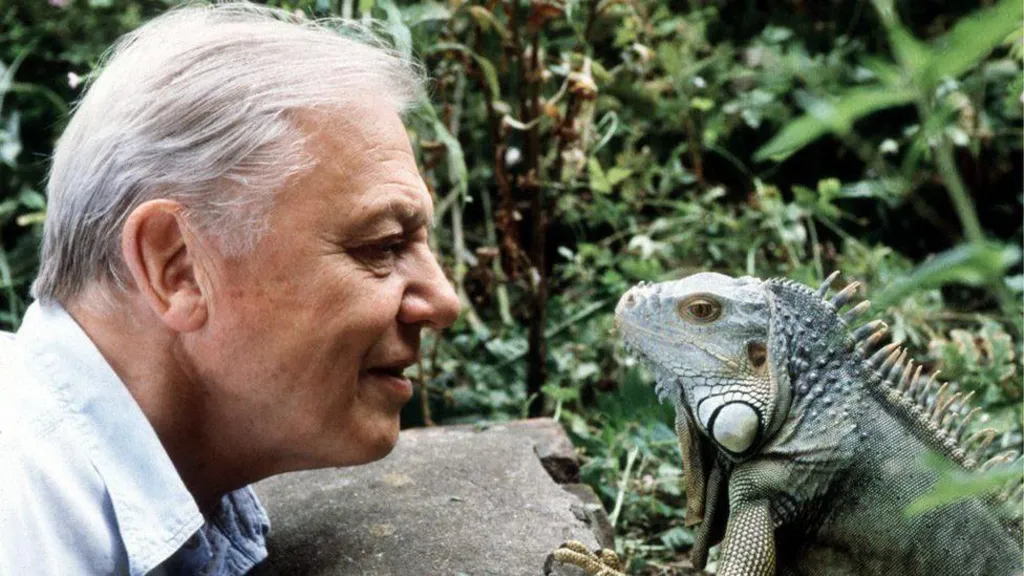

Sir David Attenborough was a British Broadcaster; he also works on natural historian, a great writer. The most popular work of Sir David Attenborough is narrating major nature documentaries such as Life on Earth , The Blue Planet , Planet Earth , Frozen Planet , and Ocean with David Attenborough . His voice and narrating style was so unique that attract all ordnances. He was born on May 8 , 1926 . In 1950s he joined BBC and started giving his magical voice on nature documentaries. He served more than 70 years helping viewers understand wildlife, Ocean Environmental exclusiveness, Climate, and the living systems that are continuously support life on Earth and our atmosphere along with our environment.
The view of his Life and Work:
- The narrating legendary Sir David Attenborough was born on May 8, 1926, in London, England.
- He joined the BBC in 1952 as a natural documentary narrator and became one of the most trusted voices in natural-history television. His magical deep voice attracts listeners .
- His major works include Zoo Quest, Life on Earth, The Blue Planet, Planet Earth, Blue Planet II, style is calm, clear, and careful. Frozen Planet, A Life on Our Planet, and Ocean with David Attenborough.
- His narration It gives the footage room to speak.
- His later work focuses strongly on climate change, biodiversity loss, ocean protection, habitat damage, and plastic pollution.
- In 2026, he turned 100, with BBC specials, a Royal Albert Hall event, tree planting, nature walks, and public tributes marking the milestone.
Sir David Attenborough: The magical Deep Voice Changed Nature Television
Few broadcasters are tied to follow Sir David Attenborough narrating style so that they could become popular and attract ordinance . For many viewers, his voice is the sound of wildlife television itself. It is calm, measured, and direct. He can describe a bird, whale, forest, desert, coral reef, or frozen plain in a way that makes the scene feel close, even when it was filmed far from ordinary human life.
Sir David Frederick Attenborough was born on May 8, 1926. He became a broadcaster, writer, natural historian, and conservation advocate whose work helped turn wildlife documentaries into serious public television. Britannica identifies him as one of the leading figures in educational natural-history broadcasting, with major works across the long-running Life series and later environmental documentaries.
Education and Early Life
David Attenborough grew up with a strong interest in fossils, animals, and natural history. As a child, he collected natural specimens and paid close attention to the living world around him. That habit stayed with him. Long before he became a famous broadcaster, he was already learning through close observation.
He studied at Clare College, Cambridge, where he received a degree in natural sciences. After that, he served in the Royal Navy and later worked in educational publishing. Britannica’s student biography notes that he worked at an educational publishing house before joining the BBC in 1952.
That background shaped his voice on television. He did not speak as a performer trying to fill silence. He spoke as someone who understood the subject and knew how to explain it in plain language.
How Sir David Attenborough Started at the BBC
Attenborough joined the BBC in 1952 as a television producer after completing a training program. In 1954, he and Jack Lester, curator of reptiles at London Zoo, created Zoo Quest. The program filmed animals both in the wild and in zoos, which helped move British wildlife television beyond studio-based displays.
That early work was important. Wildlife programs before this often treated animals as curiosities. Zoo Quest helped build a field-based style. It brought viewers closer to animals, landscapes, travel, and the people studying wildlife.
Attenborough also shaped British television from inside the BBC. He later worked as a senior television executive, including as controller of BBC Two. That part of his career matters because he was not only the face and voice of nature programming. He also helped create space for ambitious factual television.
The Documentaries That Made Sir David Attenborough Famous
Sir David Attenborough’s career includes a long list of major documentary series. Some explain evolution. Some explore oceans. Some focus on animal behavior. Others show the damage humans have caused to climate, habitats, and wildlife.
Zoo Quest
Zoo Quest helped introduce Attenborough to British viewers in the 1950s. The series followed journeys to film and study animals in different places. By today’s standards, some early wildlife television feels dated, but Zoo Quest helped build the travel-based natural-history style that later became central to Attenborough’s work.
Life on Earth
Life on Earth, released in 1979, became one of Attenborough’s defining works. The series explored evolution and the variety of life across the planet. It helped viewers understand living things as part of a long biological story, not just as separate animals on screen.
This series remains central to his reputation because it mixed science, travel, film, and narration on a scale television had rarely attempted before.
The Living Planet and The Trials of Life
The Living Planet focused on habitats and how living things adapt to different conditions. The Trials of Life looked closely at animal behavior, including feeding, mating, parenting, and survival.
These programs helped to present wildlife attractively storytelling becomes charming ,attracting and realistic and more detailed. Animals were shown responding to pressure, risk, opportunity, hunger, and competition.
The Blue Planet
The Blue Planet brought ocean life to a wider audience. For many viewers, it changed the way they saw the sea. The ocean was no longer empty blue space. It was full of movement, sound, danger, and hidden life.
This ocean storytelling also prepared viewers for later conversations about plastic pollution, overfishing, warming seas, and marine protection.
Planet Earth
Planet Earth became one of the best-known nature documentary brands. Its scale, filming quality, global locations, and Attenborough narration made it a modern entry point for millions of viewers.
For many American audiences, Planet Earth was their first strong connection with Attenborough’s work. It reached homes, classrooms, streaming platforms, and science lessons across the United States.
Blue Planet II
In 2017 Blue Planet released where he took special attention to focus How people pollute ocean life and dame its beauty . People all over the world subconsciously or unconsciously throw human made waste into the vast ocean . The series showed a clear massage and give clear visual link between daily consumption and ocean harm.
Frozen Planet
Frozen Planet focused on polar regions, including the Arctic and Antarctic. It showed animals living in extreme cold and brought attention to places most people never visit.
The polar setting also made climate change easier to see. Ice, weather, animal survival, and warming conditions were visible through penguins, polar bears, seals, and other species.
A Life on Our Planet
A Life on Our Planet took a more personal tone. Attenborough used his own lifetime as a frame for environmental change. The film connected his career to biodiversity loss, climate change, and the need to protect and restore nature.
This work marked a later stage of his public role. He was no longer only showing viewers what nature is. He was also warning them about what is being lost.
Latest Work: Ocean with David Attenborough
His latest documentary, Ocean with David Attenborough, turns his attention to marine life, ocean health, and the future of the seas.
The film played in theaters globally starting May 8, 2025, on Attenborough’s 99th birthday. It premiered on National Geographic Channel on June 7, 2025, and began streaming on Disney+ and Hulu on June 8, 2025, World Ocean Day. National Geographic describes it as Attenborough’s first collaboration with National Geographic.
The documentary focuses on the ocean’s importance, the damage facing marine systems, and the chance for recovery when people protect underwater habitats. Disney+ describes the film as a look at Earth’s underwater habitats, the ocean’s major challenges, and the chance for marine life recovery at a large scale.
This film matters because it brings Attenborough’s conservation message back to one of his strongest subjects: the sea. It connects ocean beauty with overfishing, marine protection, coral stress, habitat damage, and the urgent need to protect blue spaces before more life is lost.
Sir David Attenborough Career Timeline
| Year | Event |
| 1926 | Born on May 8 |
| 1952 | Joined the BBC as a television producer |
| 1954 | Helped create Zoo Quest |
| 1979 | Life on Earth aired |
| 1985 | Knighted for service to broadcasting |
| 2001 | The Blue Planet aired |
| 2006 | Planet Earth aired |
| 2017 | Blue Planet II aired |
| 2020 | A Life on Our Planet released |
| 2025 | Ocean with David Attenborough released |
| 2026 | Turned 100 |
Why His Voice Became So Recognizable
Sir David Attenborough’s voice is famous because it serves the scene. It does not compete with the footage. His delivery is slow enough to let the viewer absorb the image, but never so slow that the moment feels empty.
He uses plain language, careful pacing, and emotional restraint. That matters in wildlife film. A dramatic voice can make nature feel staged. A cold voice can make it feel distant. Attenborough sits between those extremes. He sounds interested, informed, and respectful.
His narration gives animals room to remain the focus. When a bird feeds its chick, when a whale moves through deep water, or when a predator waits in grass, the voice helps the viewer notice what matters. Then it steps back.
Sir David Attenborough’s Storytelling Style
Attenborough’s storytelling works because it treats viewers as capable people. He explains science clearly, but he does not talk down to the audience. He uses concrete details, visible behavior, and simple cause and effect.
A strong Attenborough scene often includes four things:
- A real place
- A living animal, plant, or habitat
- A problem tied to survival
- A wider meaning connected to life, change, or risk
That structure feels natural because it follows life itself. An animal needs food. A plant needs light. A chick needs protection. A whale needs depth and distance. From there, the viewer begins to understand ecology without needing a heavy science lecture.
His work also avoids cheap emotion. Nature can be beautiful, but it can also be harsh. Animals struggle, fail, adapt, and die. Attenborough’s programs let those facts stand without turning them into melodrama.
His Role in Conservation and Climate Awareness
Over time, Attenborough’s public role changed. His early programs focused more on showing wildlife and explaining natural history. His later work speaks more directly about climate change, habitat loss, extinction, overfishing, plastic pollution, and biodiversity decline.
That shift reflects the planet he spent his life documenting. The more his programs showed nature in detail, the harder it became to ignore human pressure on land, oceans, climate, and species. Reuters describes him as an active voice in environmental awareness, with influence around climate change and plastic pollution.
This is one reason his legacy reaches beyond television. He helped bring conservation into ordinary homes. Families watched his programs in living rooms. Teachers used clips in classrooms. Viewers who had never seen a rainforest, coral reef, desert, or polar ice sheet came away with a clearer sense that those places mattered.
Sir David Attenborough Books
Sir David Attenborough is known mostly for television, but books have also been part of his public work. They give readers a slower way to follow the ideas behind his documentaries.
Important titles include:
- Life on Earth
- The Living Planet
- The Trials of Life
- A Life on Our Planet
- Ocean: Earth’s Last Wilderness
These books help expand the same themes seen in his screen work: evolution, animal behavior, environmental change, ocean health, and the link between human choices and the rest of nature.
Awards, Honors, and Public Recognition
Sir David Attenborough has received wide public and professional recognition for broadcasting, science communication, and conservation. He was knighted in 1985 and later received further royal honors for his service to broadcasting and nature. Reuters reported during his 100th birthday coverage that he has been admired across generations and by public figures, including Queen Elizabeth II and Barack Obama.
Awards alone do not explain his standing. Many people trust him because he built his public identity through careful work over decades. He did not become known for noise or scandal. He became known for observation, patience, and a steady concern for nature.
That consistency matters. In a media culture that often rewards speed, Attenborough’s authority comes from the opposite. He looks closely, speaks clearly, and keeps returning attention to the natural world.
Sir David Attenborough at 100
Sir David Attenborough turned 100 on May 8, 2026. Reuters reported that he said he was “completely overwhelmed” by birthday wishes as tributes came in from around the globe. The centenary included BBC specials, a Royal Albert Hall concert, tree planting, nature walks, and public celebrations.
The Royal Albert Hall hosted David Attenborough’s 100 Years on Planet Earth on May 8, 2026, as a live BBC celebration of his career. The event honored his work in wildlife storytelling and brought public attention back to the natural-history programs that shaped generations of viewers.
Reaching 100 made his career feel even more remarkable. His television life began when the medium itself was young. He worked through black-and-white broadcasting, color television, global natural-history expeditions, high-definition wildlife filming, streaming platforms, and modern conservation campaigns.
That span is rare. It means his career does not belong to one generation. Grandparents, parents, teenagers, teachers, scientists, filmmakers, and nature lovers have all met nature through his programs in different ways.
Why American Audiences Still Connect With Sir David Attenborough
Although Attenborough is British, American audiences have long connected with his work. His documentaries fit a strong U.S. interest in wildlife, oceans, national parks, science education, climate, and family-friendly nature programming.
Many U.S. viewers know him through PBS, Discovery, BBC America, Netflix, Disney+, Hulu, National Geographic, classroom clips, and streaming libraries. His work reaches people who come for different reasons. Some watch for the animals. Some watch for the photography. Some watch for science. Others watch because his voice creates a rare quiet space in noisy media.
His style travels well because it does not depend on slang, political argument, or celebrity performance. A snow leopard, coral reef, desert fox, rainforest canopy, or blue whale needs context, not gimmicks. Attenborough gives that context in language most people can follow.
The Legacy of Sir David Attenborough
Sir David Attenborough’s legacy rests on more than a famous voice. He changed how people saw nature on screen. He helped make wildlife television serious, beautiful, and widely trusted.
His work gave viewers a wider sense of life on Earth. It showed that animals are not background decoration. Forests, oceans, ice sheets, insects, plants, predators, and microscopic life all belong to systems that support life in ways people often miss.
His documentaries also shaped later filmmakers. Modern nature programs still use patterns that Attenborough helped popularize: the patient close-up, the global journey, the quiet explanation, the animal behavior sequence, and the closing reminder that nature is under pressure.
The deepest part of his legacy is attention. He taught viewers to look longer. In many cases, that is the first step toward care.
Best Sir David Attenborough Documentaries to Watch First
Life on Earth
Start here for the broad story of evolution and the diversity of life. It remains one of the most important works in his career.
The Living Planet
This is a strong choice for viewers interested in habitats and how life adapts to different places.
The Trials of Life
Watch this for animal behavior, survival, mating, parenting, and the daily pressures that shape life.
The Blue Planet
This series suits anyone interested in oceans, marine life, and the hidden richness of life below the surface.
Planet Earth
This is one of the easiest entry points for modern viewers. It combines powerful footage, global settings, and clear narration.
Blue Planet II
Watch this for ocean life and a stronger conservation message around plastic pollution and marine damage.
Frozen Planet
Choose this for polar wildlife, ice, cold-climate survival, and the connection between animals and warming conditions.
Our Planet
This series gives viewers a mix of wildlife footage and direct conservation themes.
A Life on Our Planet
This is one of his most personal works. It connects his lifetime of observation with a direct warning about biodiversity loss and climate change.
Ocean with David Attenborough
This 2025 film is a strong current pick for viewers interested in ocean recovery, marine protection, and the future of life underwater. It also gives American viewers a clear streaming path through National Geographic, Disney+, and Hulu.
Common Misconceptions About Sir David Attenborough
He Is Not Only a Narrator
Many people know Attenborough mainly as a voice, but his career includes work as a producer, presenter, writer, broadcaster, and BBC executive. He helped shape programs, not just narrate them.
His Work Is Not Just About Beautiful Animals
His documentaries include beauty, but they also deal with survival, competition, extinction, climate, habitat loss, overfishing, and human pressure on natural systems.
His Career Did Not Start With Planet Earth
Planet Earth made him familiar to many modern viewers, but his television work began decades earlier. His BBC career started in 1952, and Zoo Quest began in 1954.
His Conservation Message Is Not Separate From His Documentary Work
His environmental message grew from decades of filming nature. The more he showed viewers about life on Earth, the clearer the damage became. His later warnings about climate, ocean health, and biodiversity are part of the same career, not a separate public role.
Final Thoughts
Sir David Attenborough matters because he changed the way people watch nature. He made wildlife television serious without making it dry. He made science understandable without making it shallow. He gave viewers beauty, but he also asked them to notice damage, loss, and responsibility.
His voice became famous, but the larger achievement is what that voice carried. Across more than 70 years, Attenborough helped millions of people see the natural world with more patience and care. For many viewers, he made distant places feel close enough to protect.
FAQs About Sir David Attenborough
Who is Sir David Attenborough?
Sir David Attenborough is a British broadcaster, natural historian, writer, and conservation advocate known for presenting and narrating major nature documentaries.
How old is Sir David Attenborough?
Sir David Attenborough was born on May 8, 1926. He turned 100 on May 8, 2026.
What is Sir David Attenborough famous for?
He is famous for nature documentaries such as Life on Earth, The Blue Planet, Planet Earth, Frozen Planet, Blue Planet II, A Life on Our Planet, and Ocean with David Attenborough.
What was Sir David Attenborough’s first major TV show?
One of his earliest major programs was Zoo Quest, which began in 1954 and helped establish his career in natural-history television.
What is Sir David Attenborough’s latest documentary?
His major recent documentary is Ocean with David Attenborough. It played in theaters globally from May 8, 2025, premiered on National Geographic Channel on June 7, 2025, and streamed on Disney+ and Hulu from June 8, 2025.
What is Sir David Attenborough’s most famous documentary?
Many viewers name Planet Earth as his most famous modern documentary series. Life on Earth is also central to his legacy because it helped define his long-form natural-history style.
Why is Sir David Attenborough’s voice so famous?
His voice is calm, clear, and measured. It gives viewers enough information to understand the scene while keeping the focus on the animal, plant, or habitat on screen.
What has Sir David Attenborough said about climate change?
In his later work, he has spoken directly about climate change, biodiversity loss, habitat destruction, ocean damage, and the need to protect natural systems. His documentaries helped bring those concerns into mainstream public discussion.
Reference:
https://www.bbc.com/
https://www.nationalgeographic.com/