

Biodegradable means a material can be broken down by living microorganisms — bacteria, fungi, or algae — into natural substances like water, carbon dioxide, and organic matter. But that label alone doesn’t tell you how fast it breaks down, where it needs to go, or whether it’s safe for your compost bin.
You’ve probably seen and heard the term “biodegradable” on all sorts of things – trash bags, coffee cups, packaging, clothing. It sounds like a green and healthy seal of approval. But it isn’t – at least not automatically. Whether some product that’s labelled as biodegradable is really going to be good for the environment depends entirely on what it’s made of, how it gets disposed of, and what kind of conditions it ends up in.
This guide is here to cut through all the confusion: what biodegradable really means, how it works, how it’s different from compostable and bio-based, what to look out for on labels, and what actually happens to these materials that get thrown in landfills, put in the compost, or end up in the ocean.
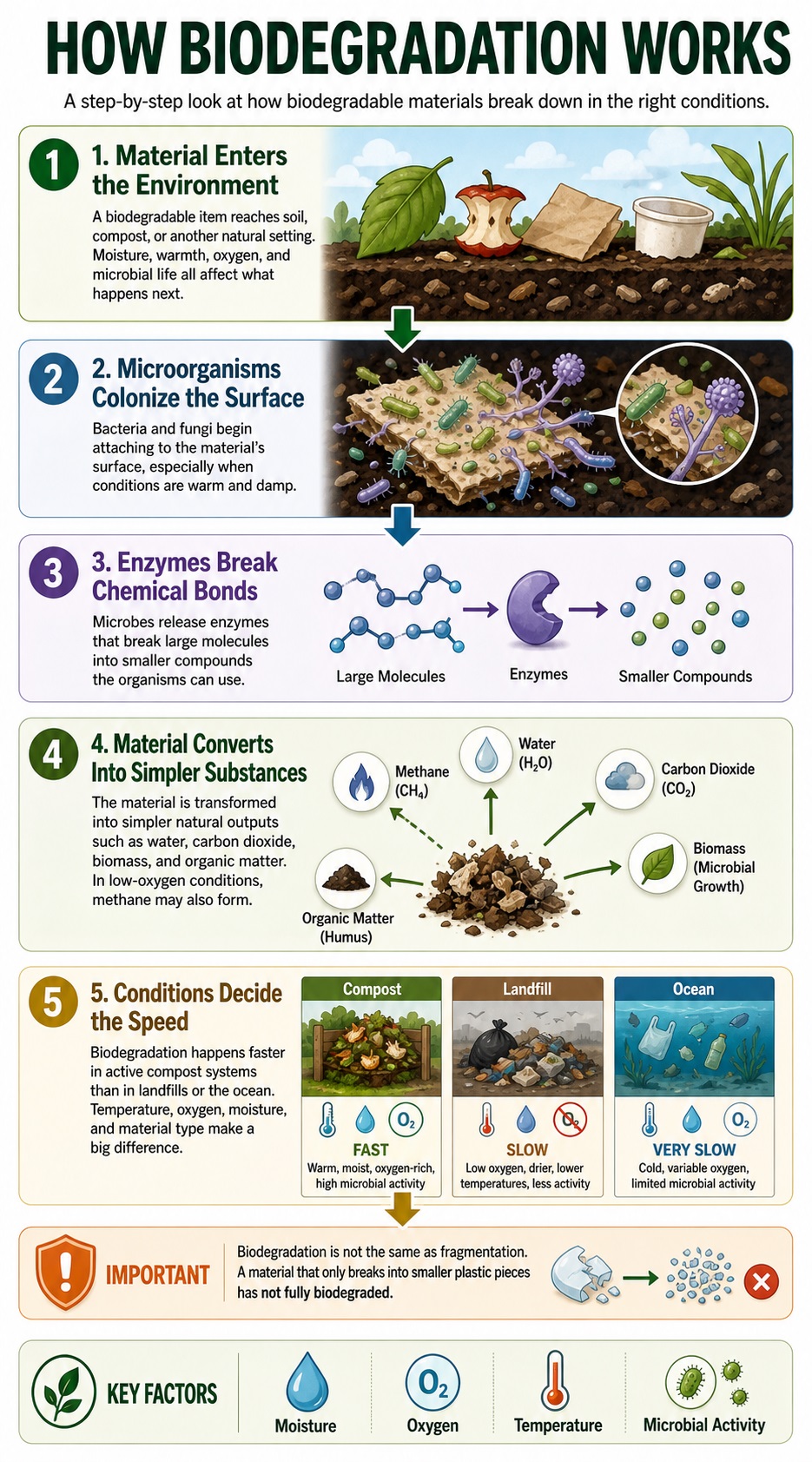
How Biodegradation Actually Works
Biodegradation is a living, breathing process that involves real living things – not just some random crumbling or breaking into pieces. It happens in three broad stages, and here’s a look at what happens in each one.
Stage 1: The Microbes Move In
Bacteria, fungi and other tiny living organisms start breaking down a material when the conditions are just right: a bit of moisture, some air, a bit of heat, and a load of active microbial life in the surrounding environment. Food scraps and leaves are always pretty easy targets. But most conventional plastics are designed to resist all this kind of attack – that’s what makes them so strong and so long-lasting.
Stage 2: Enzymes Do Their Thing
The microbes start breaking down the big molecules into smaller bits, using enzymes to help them along. What they’re working with is important – natural materials like plant fibres, starch and protein are all pretty easy for microbes to deal with. But synthetic plastics are more like a foreign language to them, so they just don’t break down even if they do get a bit crumbly.
Stage 3: The Material Transforms
As time goes on, and the microbes keep working, the material just keeps getting simpler and simpler. What it turns into depends on if there’s oxygen around or not.
Why Oxygen Is Such A Big Deal
If there is oxygen around, then you get aerobic biodegradation. This is what happens in healthy compost piles, in the soil, and in proper industrial composting systems. The end result is useful stuff like carbon dioxide, water and heat, along with some nice earthy soil. This is why composting is so valuable.
But if there is no oxygen, then it’s anaerobic biodegradation. This is what happens when trash gets buried in a landfill and just sits there. Even so, the organic parts of the waste still break down – but much, much more slowly, and they produce methane, which is about 80 times worse for the environment than carbon dioxide over a 20-year period. The EPA has identified food waste that gets buried in landfills as a major driver of methane emissions from municipal waste sites, which is a big reason why getting that kind of waste out of landfills and into composting is so important for the climate.
Sending biodegradable materials to landfill doesn’t make them disappear cleanly — it can make the problem worse by producing methane.
How Fast Does Something Need to Break Down
There’s no single rule book – what it takes for something to break down is all over the place. The speed of breakdown largely depends on what the stuff is made of, how hot or cold it gets, whether it’s wet or dry, if there’s oxygen around and which microorganisms are hanging out. A banana peel in a warm compost heap, for instance, can be turned into compost in a few short weeks. But a cotton shirt buried in the ground could take months to disintegrate. And then there’s plastic bottles – they can just keep on going for centuries, slowly shedding tiny bits of plastic as they go.
Some people have created standards that set rough guidelines for breakdown times, but these only work under very specific circumstances:
- The EU’s EN 13432 compostability standard says that at least 90% of certified packaging has to be gone within six months – but only if it’s composted in a very specific way in an industrial setting. And don’t get it twisted – this standard doesn’t say what happens to packaging that ends up in a landfill, the ocean, or just thrown in the bin.
- The US FTC Green Guides also have something to say about biodegradable claims – it says that if a product is described as “degradable”, you need to prove that the whole thing will break down completely within a year of being thrown away. But you can forget about products that are destined for the landfill or the incinerator or recycling facilities – they just can’t meet that standard.
Biodegradable doesn’t mean it’s gonna disappear in an instant – it just means it can break down at all – and that’s only if you put it in the right conditions.
Biodegradable vs. Compostable vs. Bio-Based vs. Degradable
These terms are often used interchangeably but they have meaningfully different definitions. Confusing them leads to wrong disposal choices and greenwashing.
| Term | What It Means | What to Watch For |
| Biodegradable | Can be broken down by microorganisms over time | Doesn’t guarantee speed, safety, or proper conditions |
| Compostable | Breaks down into compost within a set timeframe without toxic residue | Often requires industrial composting — not your backyard bin |
| Bio-based | Made partly or fully from renewable biological materials | Not automatically biodegradable or compostable |
| Degradable | Can break apart due to sunlight, heat, or chemical action | May only fragment into smaller pieces — not fully biodegrade |
| Oxo-degradable | Plastic with additives that promote fragmentation | Widely criticized for contributing to microplastic pollution; banned under EU single-use plastic rules |
The key distinction most people miss: all compostable materials are biodegradable, but not all biodegradable materials are compostable. Food scraps and dry leaves are both. Many biodegradable plastics are not compostable in a home bin — and some require specialized industrial equipment even to begin breaking down.
Bio-based is a separate category again. Bio-PET, for example, is partly derived from plant sources, but at end of life it behaves exactly like conventional PET plastic. The origin of a material and its end-of-life behavior are two different questions.
What Makes Something Biodegradable?
A material will break down on its own at some point in time – that is, if it’s biodegradable. Its ability to do so is influenced by a variety of factors that all play a role in the process:
Chemical Structure
Certain natural materials are just built to be broken down by microbes. Think of things like the cellulose in paper and cotton, or starch in food – we’ve been feeding microbes this stuff for ages. Then you’ve got conventional plastics, which are essentially the opposite – long chain polymers designed specifically to resist microbial attack.
Surface Area
The smaller pieces of something are going to break down faster because there’s more surface area for the microbes to get to work on. Shredded leaves are going to compost faster than whole branches – but with plastics, breaking them down into tiny pieces isn’t quite the same thing. A plastic item can break into teeny tiny pieces and still be chemically the same, creating all those pesky microplastics instead of compost.
Temperature, Moisture, and Oxygen
Microbes are the ones actually breaking down the material, and they work a lot faster in warm, damp, oxygen rich environments. That’s why industrial composting facilities which control for all three can get rid of all sorts of stuff, while the same stuff might just sit in a cold, dry landfill or your backyard heap.
Additives, Coatings, and Treatments
You can have a product that looks totally natural but still contains additives that prevent breakdown altogether. Some common culprits include:
- The plastic lining inside a paper coffee cup
- That shiny or laminated stuff on glossy paper
- Synthetic dyes and adhesives
- Grease resistant coatings (including some nasty PFAS-based treatments)
- Multi-layer packaging that uses mixed materials
That’s why a paper food container or coffee cup isn’t automatically compostable, just because it looks like paper. It’s the details in there that matter.
Types of Biodegradable Products
Biodegradable Plastics
Biodegradable plastics are made from natural feedstocks rather than petroleum, and they’re actually designed to break down under the right biological conditions. Here are two of the most common types:
- Polylactic Acid (PLA) — used in food packaging, cups, and cutlery. PLA is made from fermented plant starch (usually corn or sugarcane) and has a compostability certification, but it usually needs an industrial composting facility to break down properly – and even then, its got to be above 58°C. It won’t break down much in your home compost heap or a landfill.
- Polyhydroxyalkanoates (PHA) — this stuff is produced by bacteria, and is used in medical products and packaging. Some variants of PHA can actually be composted at home, but usually it depends on what type you have and the local conditions.
Important note: Biodegradable plastics are only as useful as the system in place to collect and process them. Without industrial composting facilities to actually handle the stuff, they don’t really offer much advantage over conventional plastics.
Biodegradable Paper Products
Paper bags, cardboard boxes, and newspapers – the staples of everyday waste – are actually pretty biodegradable – as long as they haven’t got a plastic coating, or been splattered with ink or laminated in some way. And yes you can even compost these at home. But add in any plastic linings, tape or a glossy finish and you can say goodbye to compostability.
Biodegradable Fabrics
Natural fibres like cotton, linen, hemp & wool break down way more easily than the synthetic ones. So organic cotton, bamboo fabric,jute & wool are naturally biodegradable textiles. On the other hand blended fabrics with a mix of natural and synthetic fibres can be a bit hit or miss – the synthetic bits might still be around long after the natural stuff has gone to compost. And lets not forget the impact of dyes & chemical treatments on how cleanly a fabric breaks down.
Biodegradable Food Packaging
Restaurants & food companies are switching to biodegradable packaging in droves these days – driven by consumer demand, tighter regulations (especially in EU, Canada & bits of the US) & the fact that it’s getting cheaper to produce biodegradable packaging than the old plastic stuff. And the good news is that with the right certification, the right disposal & a bit of proper care the environmental benefits really do add up. But without all that in place that “biodegradable” fast food box is going to end up in a landfill doing very little more than the one it replaced.
Examples of Biodegradable and Non-Biodegradable Materials
| Product or Material | Biodegradable? | What to Know |
| Apple core | Yes | Best composted — landfill produces methane |
| Banana peel | Yes | Breaks down much faster in compost than landfill |
| Dry leaves | Yes | Useful for compost and mulch |
| Grass clippings | Yes | Compost quickly when layered properly |
| Untreated paper | Usually | Coatings and heavy inks can interfere |
| Cardboard box | Usually | Remove tape and plastic labels before composting |
| Cotton T-shirt | Usually | Pure cotton biodegrades more readily than blends |
| Wool sweater | Usually | Dyes and treatments affect how cleanly it breaks down |
| Untreated wood | Yes | Breaks down slowly; chipping speeds the process |
| Glass bottle | No | Recyclable, but not biodegradable |
| Aluminum can | No | Recyclable, but not biodegradable |
| Plastic grocery bag | No (in practical conditions) | Fragments into microplastics; persists for centuries |
| PLA cup | Sometimes | Usually requires industrial composting |
| Compostable takeout container | Yes, if certified and accepted | Check local composting program rules |
| Glossy laminated paper | Usually not | Plastic layers block biological breakdown |
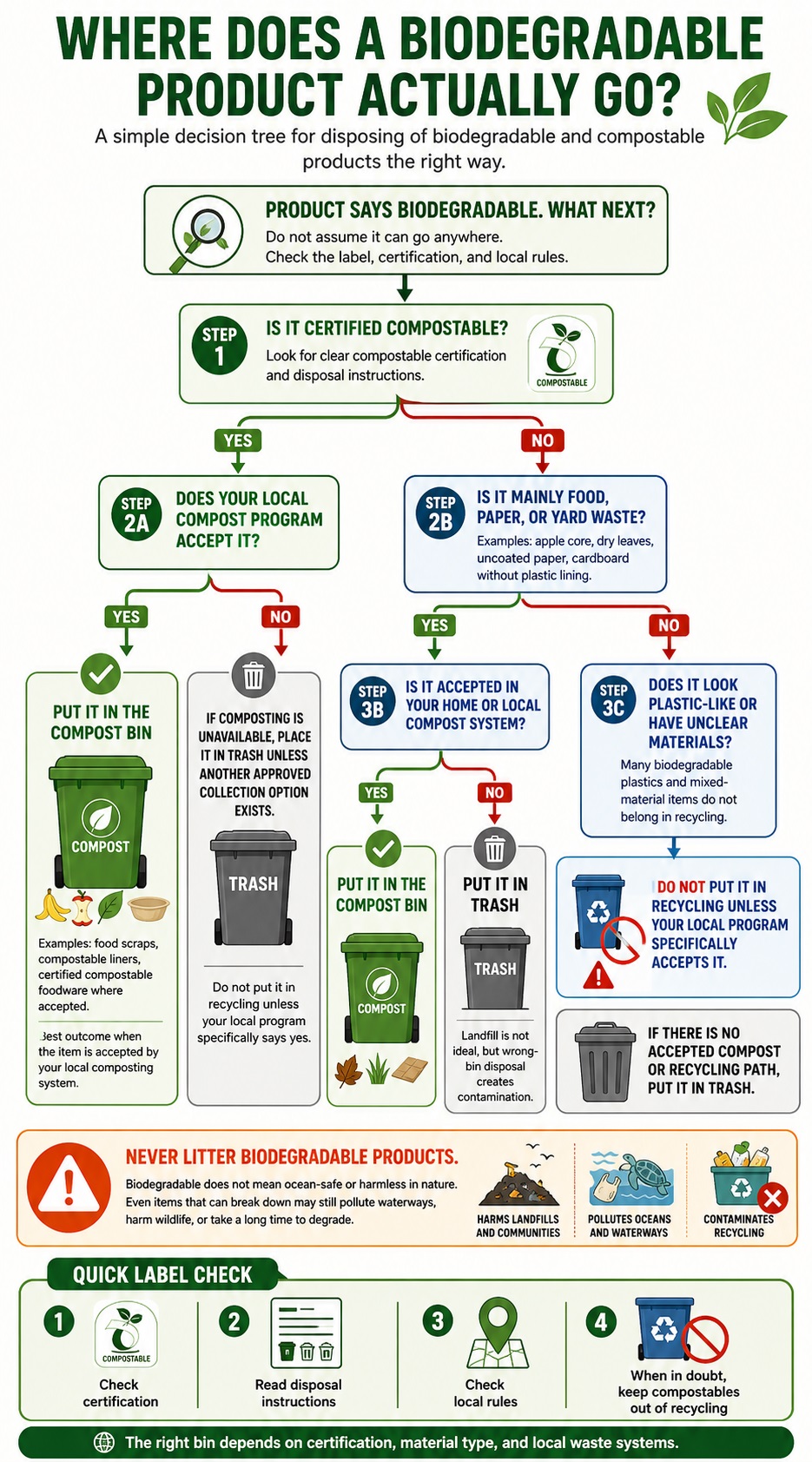
What Happens in Compost, Landfills, Recycling, and Oceans?
The same biodegradable item can behave very differently depending on where it ends up — which is why disposal method matters as much as the material itself.
| Disposal Environment | What Usually Happens |
| Home compost | Food scraps, leaves, plain paper, and yard waste break down well. Most compostable plastics do not meet the temperature requirements and should not go here unless specifically certified as home compostable. |
| Industrial composting | Certified compostable packaging can break down under managed heat, moisture, and aeration. This is the intended destination for most PLA and similar products. |
| Landfill | Low oxygen and compaction dramatically slow all decomposition. Organic waste still breaks down anaerobically and produces methane. Biodegradable products offer little advantage here. |
| Recycling bin | Compostable plastics can contaminate conventional plastic recycling streams. When in doubt, follow local disposal instructions rather than assuming it’s fine. |
| Ocean or roadside | Cold water, low microbial activity, and different chemistry mean that even labeled biodegradable items break down slowly here. They can still harm wildlife, fragment into microplastics, and travel vast distances before decomposing. |
Biodegradable does not mean ocean-safe or litter-safe. No label should ever be read as permission to dispose of something irresponsibly. The best outcome is always proper disposal, reducing use, and keeping materials out of waterways.
How to spot a trustworthy biodegradable claim
Packaging claims can be totally misleading . A genuine claim will be specific, tied to a named testing standard and backed up by third-party certification – that way you can actually check it out.
Certifications that are worth trusting
- ASTM D6400 – this is the one to look for in the US for compostable plastics.
- ASTM D6868 – this is what you want if the product has a coating or additive that you want to break down.
- EN 13432 – this is the European version – the one to look for if you’re in Europe
- BPI Compostable – this is the North American certification for compostable products
- TÜV OK Compost Industrial – this one is for industrial composting – a pretty high bar to clear
- TÜV OK Compost Home – a bit trickier – this one requires composting at home – so you’ll need a good garden to get this certification
Vague claims that you should treat with a healthy dose of skepticism
The FTC Green Guides are pretty clear – they warn against making broad claims – and by that they mean claims that are just too vague. Be wary of labels that say:
- “Green” or “eco-friendly” – these are just buzz words
- “Earth-safe” or “planet-safe” – sounds nice but what does it really mean?
- “Natural plastic” or “made from plants” – this is a bit of a red flag
- “Degradable” – unless they can tell you how it will break down and where
- “Environmentally friendly” – if they’re not specific then its just empty words
Good clear trustworthy claims look like “Certified industrially compostable — ASTM D6400” or “Home compostable — TÜV OK Compost Home”. If the label can’t give you the specifics – – who certified it and where is it supposed to break down – then treat the claim as completely unverified.
Some US states are getting tough on this stuff. Minnesota, for instance, now requires that any product that says its “compostable”- even trash bags, packaging and food-service items – have third party certification if they want to be sold or distributed in the state.
A Practical Checklist to spot biodegradable claims that are actually worth trusting
- Do I really need this? The most sustainable option is often the one you don’t buy. Before you get too excited about biodegradable packaging think about whether you could use a reusable cloth instead
- Is it certified – and by whom? Look for named standards like ASTM or EN and third-party certification logos. “Biodegradable” alone means nothing to me. “Certified industrially compostable” or “certified home compostable” is the kind of information I need to trust the claim
- Where does it actually go after it’s been used? A product that’s biodegradable will only deliver its environmental benefits if its in the right disposal system. Make sure your local council or waste hauler can take it before you buy
- Will it contaminate the recycling? If a compostable plastic looks like regular plastic it might confuse the recycling systems. Follow the instructions to the letter
- What’s the full story? Even certified products made from corn starch or sugarcane have costs – from land use to water to transport. Products made from agricultural byproducts are usually better than those made from purpose-grown crops.
What Businesses Need to Know About Biodegradable Claims
Making biodegradable or compostable claims on your business can land you in a whole heap of trouble if they’re not accurate and specific. That’s why the US FTC Green Guides and the EU’s packaging regulations are pushing for businesses to be more accountable when it comes to environmental marketing.
Before you even think about using biodegradable packaging, you should do some digging to verify: what’s the material composition and certification status – is it legit? Which testing standards actually apply? What are the specific labeling requirements in your state and local area? Will your customers actually have access to industrial composting? Is the product contaminated with food (which will affect how it can be recycled)? And the big one – is there a more sustainable option available, like reusing or recycling something instead?
Clearer claims are a win-win. Here are some examples of language that is specific and actually defensible:
- “Compostable where accepted — ASTM D6400”, by the way
- “Certified home compostable — TÜV OK Compost Home”, we’re talking official here
- “Take that label off before recycling”
- “Only accepted in food waste programs that actually participate”
Faq
Does biodegradable mean the same thing as compostable?
No way. Biodegradable just means that microorganisms can break it down over time. Compostable is a whole different ball game – it requires the material to break down within a defined timeframe, under composting conditions, and without leaving any nasty residues behind. So all compostable materials are biodegradable, but not the other way around.
What actually happens to biodegradable plastics in the ocean?
The truth is, most biodegradable plastics are tested in warm industrial composting conditions – which is a pretty different world to what you find in cold seawater. In the ocean, even labeled biodegradable materials are not going to magically break down right away. And even if they do, they can still harm wildlife, break down into microplastics, and travel long distances.
Are biodegradable products always better for the environment?
Not always. We need to look at the full picture – from getting the materials to making the product to using and disposing of it. A durable, reusable product that gets used hundreds of times is going to have a much lower footprint than some disposable biodegradable thing that breaks down cleanly – even if the latter is biodegradable.
Can I just chuck all my biodegradable items in the home compost?
No way. Generally, just food scraps, yard trimmings, plain paper and untreated natural fibres are safe to chuck in the home compost. Biodegradable plastics and certified compostable packaging usually need industrial composting, unless they’ve been specifically certified for home composting.
Does bio-based mean it’s automatically biodegradable?
Nope. Bio-based describes where the material comes from – renewable biological sources – but it doesn’t tell us anything about how it behaves when it’s at the end of its life. So even if something is bio-PET, which uses plant-derived inputs, it still behaves like conventional PET plastic when it comes to disposal.
What is the most common mistake people make when it comes to biodegradable products?
Assuming that just because it’s biodegradable, it can go anywhere. Newsflash – a biodegradable product still needs to go to the right place to break down properly. If it ends up in a landfill, the ocean or the wrong recycling bin, it’s unlikely to deliver the environmental benefits that the label promises.
Bottom line
“Biodegradable” can be a useful word. But it only helps when the label is clear.
A product should say how it breaks down. It should also have a trusted certificate. And it must go to the right place after use.
For example, some items break down well in a compost plant. But they do not help much if they go to a landfill. In a landfill, trash has little air and space to break down.
Some products also sound natural. But they may have dyes, coatings, or plastic parts. These can stop the item from breaking down.
The best choice is simple. Use less first. Reuse what you can. If you need a single-use item, pick one that is certified. Then make sure you can dispose of it the right way.
Biodegradable products can help. But they are only one part of a better choice.