

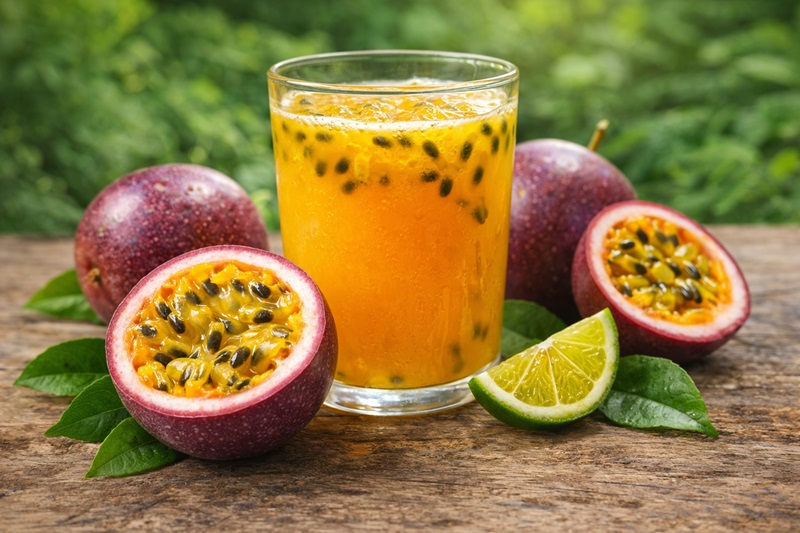

People tend to have strong feelings about passion fruit – there are few foods that people don’t have a strong opinion about. Some people are immediately drawn to its sweet-tart tropical intensity, while others try it once and give up on it, finding it too sharp, too floral, or just plain not what they expected.
And that’s actually what makes passion fruit so interesting – it’s just not your typical crowd-pleaser like a banana or a melon. It’s bright and aromatic, and it packs a punch. Despite its small size, passion fruit is a fruit that can be either really exciting or overwhelmingly intense – depending on its ripeness, the variety, the texture and really, just personal taste.
Quick Answer: What Does Passion Fruit Taste Like
Passion fruit has a complex mix of sweet, tart, tangy and highly aromatic flavours. Many people describe it as a bit like a combination of pineapple, mango, citrus, kiwi and guava – although the floral aroma and sharper finish are really what set it apart. The pulp is nice and juicy, and slightly gelatinous, and the black seeds add a nice bit of crunch. When they’re ripe, the fruits are sweeter and rounder – while unripe ones are more sour.
What Is Passion Fruit and Where Does It Come From
Passion fruit is a tropical fruit that grows on vines – actually, the Passiflora vine, which is known for its impressive flowers and fragrant fruit. It’s thought to have originated in South America – specifically in parts of Brazil, Paraguay and northern Argentina – before spreading to other warm regions around the world. These days, it’s widely grown in tropical and subtropical climates and is often used in juices, desserts, sauces, smoothies and other fruit-based snacks. The two most common types are purple and yellow passion fruit, and while the purple ones tend to be a bit sweeter the yellow ones tend to be a bit more tart.
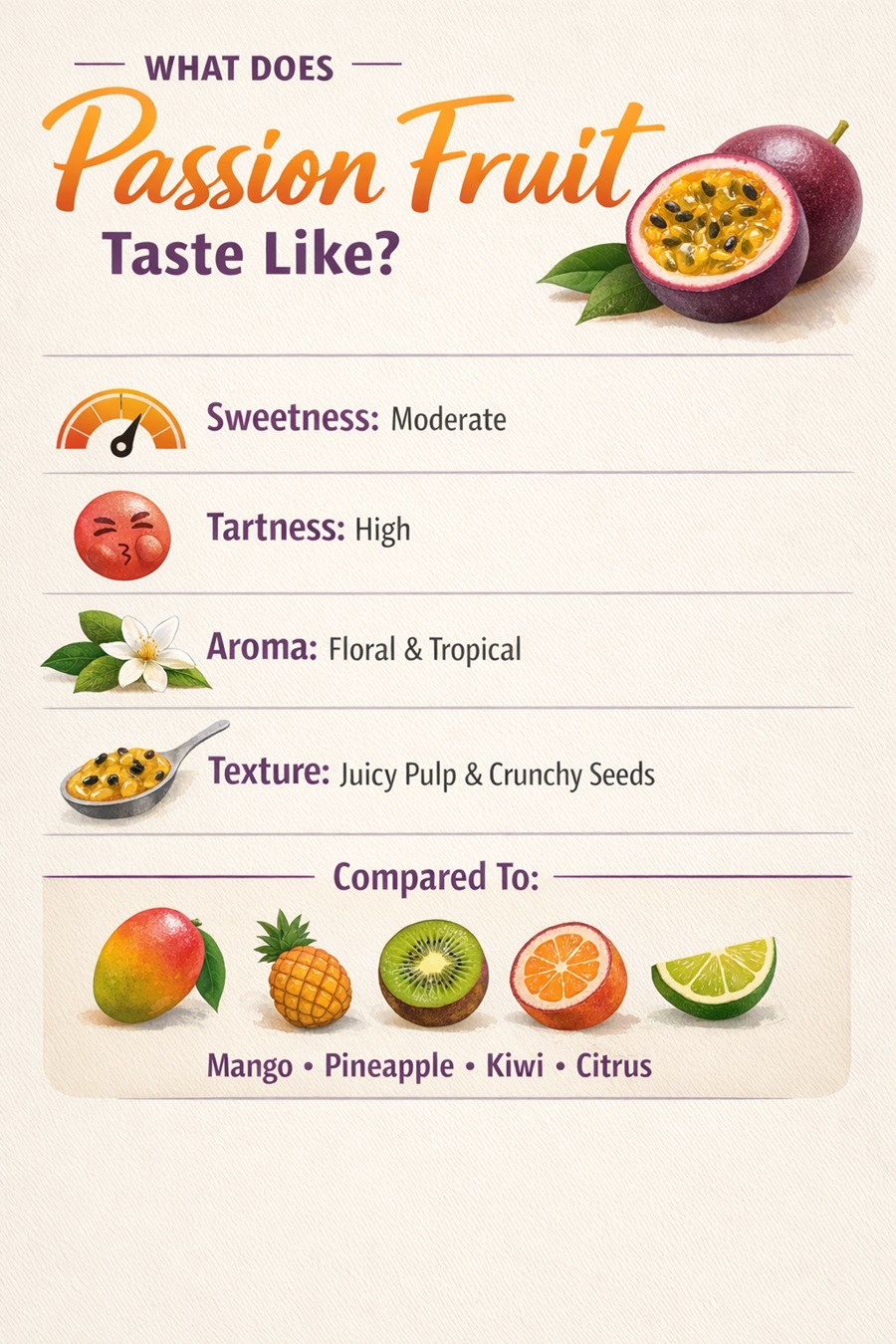
Flavor Profile of Passion Fruit
Passion fruit has a layered flavour profile – the tartness hits you first, then the sweetness follows, with a lingering tropical and floral aroma that leaves you wanting more.
It’s tricky to compare passion fruit to just one other fruit, as it has some of the acidity of citrus, some of the tropical sweetness of mango or pineapple, and a fragrant quality that can feel sort of perfumed.
People often describe passion fruit as:
- a bit sweet-tart
- utterly tropical
- and a bit citrusy
- and floral
- and juicy
- and slightly puckering (in a good way)
- bright and refreshing
It’s also a lot more concentrated than people often expect. A small spoonful can deliver a surprisingly big punch of flavour.
Why Some People Just Can’t Get Enough of Passion Fruit
The Sweet and Sour Combination is a Game Changer
People who love a good balance of sweet and sour in their fruit tend to go wild for passion fruit. It’s the perfect pick-me-up on a hot day, whether you’re sipping it in a smoothie, on top of yogurt, or in a chilled dessert.
The Aroma is Like a Vacation in a Fruit
Much of the charm of passion fruit comes down to its incredible scent. It smells like a tropical paradise, all rich and fruity and floral. And that smell is just so distinctive – it’s one of those scents that really sticks with you.
It’s a Chameleon of Fruits – Pairs Well with Just About Anything
Passion fruit is one of those magical fruits that can elevate pretty much any dish it’s added to. A small amount and it adds a burst of freshness, some depth, and just a bit of zing – that’s why you see it turning up in so many recipes.
Why Some People Can’t Stand Passion Fruit
It’s Too Sour For Some People’s Tastes
Some folks out there expect tropical fruit to be sweet, mellow and super tasty. And then they try passion fruit…and discover it just isn’t. Even when it’s ripe, it still has that nice tangy zip that some people just can’t get along with.
The Aroma Can Be Too Much
There’s a fine line between ‘lovely and fragrant’ and ‘way too overpowering’. For some people, the floral scent of passion fruit crosses that line in a hurry.
The Seeds – Love ’em or Hate ’em
Some people love getting a bit of crunch in their fruit – but not everyone feels the same. Some people love the contrast between the seeds and the soft pulp. Others find it a bit… off-putting
One Bad Experience Can Put You Off for Life
Let’s face it, if the first passion fruit you ever try is a stinker – underripe, sour and just plain unpleasant – that’s probably the last time you’ll try it. That’s a shame, because a good passion fruit is actually pretty hard to beat.
Passion Fruit Texture
Inside a passion fruit, you’ve got sweet golden pulp, tiny edible black seeds, and a jelly-like coating. Oh – and that white pith in the middle? Bit of a bitter one, so you can probably forget about that as well.
The texture is silky smooth and super juicy…right up until you bite down on a crunchy seed. Some people love that surprise – others not so much. Which just goes to show you – passion fruit can be a bit of a polarizing fruit.
Does the Ripeness Really Make a Difference?
Yes – it makes a world of difference
A ripe passion fruit tastes sweeter, richer and more balanced. A less ripe one tastes sour, a bit sharp and not so pleasant.
In a nutshell:-
- Ripe passion fruit: sweet, soft and a right treat for the nose
- Less ripe passion fruit: sour, a bit of a handful and generally not as pleasant
For what it’s worth, a ripe passion fruit tends to have a bit of wrinkled skin and feels a bit heavy for its size. Loads of people assume wrinkled means old – but with passion fruit, it just means the flavour is really coming on.
Does Purple Passion Fruit Taste Any Different From Yellow Passion Fruit?
Yep – it most certainly does
- Purple passion fruit: sweeter and richer and just more generally pleasant
- Yellow passion fruit: a bit more tart and a bit more of a handful
Both have their fans – but you might not always be blown away by the first one you try.
How Passion Fruit Compares to Some Other Fruits
| Fruit | Sweetness | Tartness | Main Difference |
| Mango | Higher | Lower | Passion fruit tastes less creamy and more tangy than mango. |
| Pineapple | Similar to slightly higher | Similar | Passion fruit is usually more floral, while pineapple tastes cleaner and more direct. |
| Kiwi | Similar | Similar to slightly higher | Passion fruit is often more aromatic and more intensely tropical. |
| Guava | Higher | Lower | Passion fruit usually tastes sharper and brighter than guava. |
| Citrus | Similar to slightly lower | Higher | Passion fruit has citrus-like acidity but a sweeter, more fragrant tropical profile. |
Is Passion Fruit Supposed To Be Sour ?
Yup, some sourness is totally normal. Passions aren’t usually that mild or sweet – even when they’re at their ripest, they still have a tangy edge going on. That tartness is actually part of what makes them so appealing.
Now, theres a difference between something that’s just tart and something that’s straight up sour. If it tastes super sharp with hardly any sweetness to it, chances are its just not fully ripe.
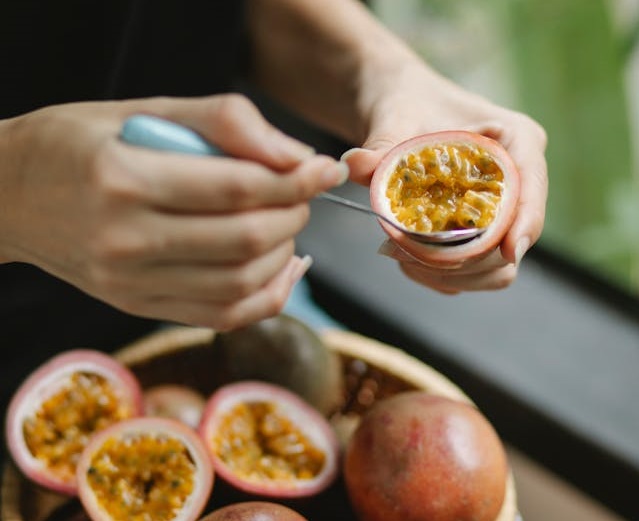
Is Passion Fruit an Acquired Taste ?
Yeah, for some people, yes it is.
If you’re used to eating softer, sweeter fruits, then passion fruit can be a bit too intense at first. The smell is stronger, the tartness is more noticeable and those seeds can be a bit off-putting. But give it a go when its ripe or mixed in with some sweeter ingredients and people often find it a lot more palatable.
Passion Fruit in Juice, Desserts, and Raw Form
When you have passion fruit raw, you get the whole experience – its tart, its sweet, its got a floral taste to it and it’s just really intense.
But when its in juice form – especially if its commercial or has been all sweetened up – it tends to be a bit more diluted and tastes a lot softer and easier to like. When you use it in desserts or cooked recipes, the acidity gets a bit less sharp and the tropical sweetness really comes to the forefront. That’s why a lot of people enjoy it more in curds, sorbets, mousses, or sauces rather than just eating it straight.
Best Ways to Eat Passion Fruit if You’re Not Sure You’ll Like It
If you want to get in on the passion fruit action but arent entirely sure, these are the easiest ways to get started:
- mix it in with some yogurt
- blend it in with some smoothies
- pair it with some sweeter fruits like banana or mango
- use it in some desserts
- get started with a ripe fruit rather than one thats still a bit firm and underripe
Nutrition Snapshot: Passion Fruit Offers More Than Just Taste
Passion fruit isnt just a taste sensation – it’s also got a bit of nutritional value going on. Its got fibre, vitamin C and some beneficial plant compounds. You might not be eating it in huge amounts, but it still brings a bit more to the table than just flavour.
Who Will Probably Like Passion Fruit Most ?
Passion fruit is probably most likely to appeal to the people who enjoy the stronger stuff – the tart fruits, tropical flavours, fragrant foods and bold textures.
It might not be so appealing to the people who dislike sourness, prefer milder flavours or dont enjoy crunchy seeds.
Final Verdict: Why Passion Fruit Really Puts People to the Test
Passion fruit really divides opinion – but it’s not because its a bad thing. Its actually because its just so intense.
Its sweet, its tart, its floral, its juicy and its crunchy all at the same time. For the right person, that makes it exciting and refreshing. For someone who prefers milder flavours, it can just be too much.
That’s why some people love passion fruit and others just dont get it. The same qualities that make it memorable are the ones that make it so polarizing.
FAQs About Passion Fruit Taste
What does passion fruit taste like for the first time?
Usually sweet, tart, tropical, and more aromatic than expected.
Is passion fruit sweet or sour?
It is usually both, though less ripe fruit tastes more sour.
Can you eat the seeds in passion fruit?
Yes. The seeds are edible and commonly eaten with the pulp.
Why does passion fruit taste so strong?
Its aroma is naturally intense, which makes the flavor seem bigger and brighter.
Does passion fruit taste better when wrinkled?
Often yes. Slight wrinkling can be a sign that the fruit is ripe and sweeter inside.