

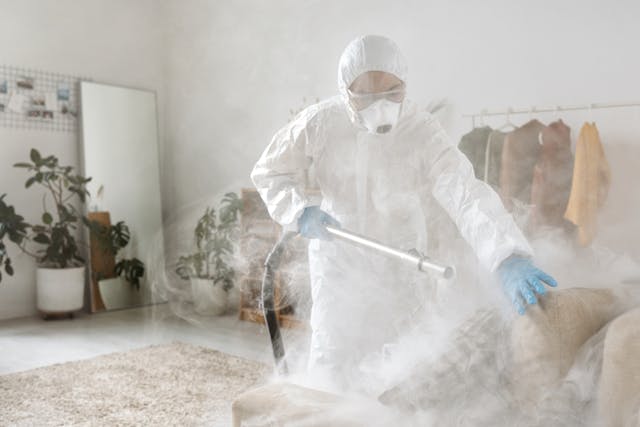

Biocides are products used to control harmful life forms.
They can kill or slow germs, mould, fungi, algae, bugs, rats, and biofilm. Some are made from chemicals. Some come from natural sources. Some use tiny living things.
You can find biocides in many products. These include sprays, wipes, pool chemicals, treated wood, pest control, mould-proof paint, and water system products.
Biocides can help keep people, homes, water, and tools safe. But they must be used with care. They are made to kill or control living things. So they can also harm people, pets, wildlife, and soil if used the wrong way.
Key Points
- Biocides help control harmful germs, pests, mould, algae, and fungi.
- They are used in cleaners, paints, pools, wood, water systems, pest control, and health care.
- In the EU, biocides are split into four main groups and 22 product types.
- Biocides are useful, but they can also be risky.
- Use them only as the label says.
- Safe use means the right dose, enough contact time, fresh air, gloves when needed, and safe disposal.
- Rules in the EU and U.S. help make sure these products work and have clear labels.
What Is a Biocide?
A biocide is a product or active part used to control a harmful organism.
It can kill, stop, scare away, or slow down harmful life forms. These life forms include germs, mould, fungi, insects, rats, algae, and biofilm.
A biocide can be:
- A chemical
- A natural active part
- A tiny living thing
- A product with one or more active parts
- A treatment added to a material or finished product
Here is a simple example. Household bleach often uses sodium hypochlorite as its active part. The bleach may also have other parts. These help it stay stable, clean better, foam, smell better, or work well on a surface.
Biocides are not the same as medicines.
Medicines are made to work in or on the body. They follow medical rules. Biocides are usually made for surfaces, water, tools, buildings, materials, or pests.
That is why you should never use an industrial biocide as a home cure or body-care product.
Biocides vs. Antimicrobials, Antibiotics, Antibacterials, and Pesticides
These words can overlap. But they do not mean the same thing.
Antimicrobials kill or slow tiny germs. These germs include bacteria, fungi, and some viruses. Some antimicrobials are medicines. Others are biocides.
Antibiotics are medicines. They treat bacterial infections in people or animals. An amoxicillin tablet is an antibiotic. It is not a home biocide.
Antibacterials target bacteria. For example, a surface spray may say it kills bacteria. Based on its use, it may count as a biocide or pesticide.
Pesticides are a wider group in many laws. Some pest-control biocides are also pesticides. But many crop products are kept in a separate group. These include many weed killers and farm fungicides.
Use matters most.
A hospital surface spray is not the same as an oral antibiotic. A mould-proof paint additive is not the same as a crop weed killer. A cooling-tower biocide also has a different use.
The label, purpose, and setting decide how the product is controlled.
Biocides vs. Cleaning Products
Cleaning products and biocides are not the same.
A cleaner removes dirt, grease, dust, food bits, and grime.
A biocide kills or controls harmful life forms. These may include germs, mould, fungi, algae, insects, or rats.
In real use, cleaning often comes first. Dirt and grime can stop a biocide from working well.
For example, you may first wipe a kitchen counter with soap or detergent. This removes visible dirt. Then you may use a disinfectant if you need to reduce germs.
Not every surface needs a biocide each day. Often, simple steps work well. Clean the area. Keep it dry. Let fresh air in. Fix leaks and damp spots.
These steps can lower the need for strong chemical products.
Main Types of Biocides
In the EU, biocides are split into four main groups. They are also split into 22 product types.
These groups help officials check active parts and products.
| Main Group | Examples |
| Disinfectants | Hand hygiene products, surface sprays, vet hygiene products, drinking water disinfectants |
| Preservatives | Can preservatives, film preservatives, wood preservatives, building material preservatives, working-fluid preservatives |
| Pest control | Rat poisons, insect killers, repellents, attractants, and other pest-control products |
| Other biocidal products | Antifouling products, embalming fluids, and taxidermy fluids |
Common active parts include chlorine compounds, sodium hypochlorite, hydrogen peroxide, alcohols, quats, glutaraldehyde, isothiazolinones, copper compounds, and other special actives.
The allowed use is not the same for every product. It depends on the product type, country, strength, exposure route, and approval status.
How Biocides Work
Biocides work in different ways.
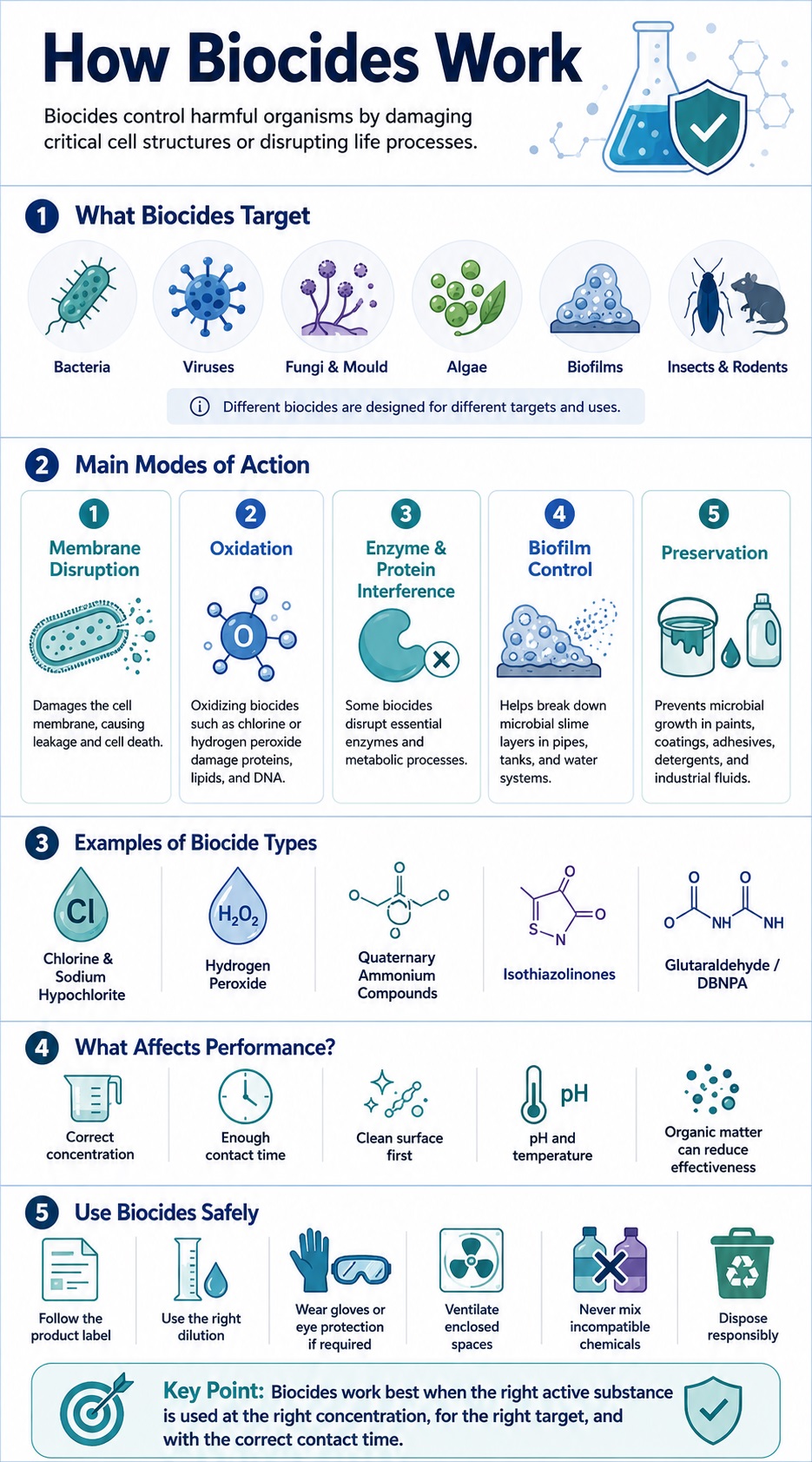
Some harm the outer layer of a germ cell. This layer is called the cell membrane. When it breaks, the cell can leak and die.
Some biocides use oxidation. This means they react with parts of a germ. They can damage proteins, fats, and genetic material.
Some biocides block enzymes. Enzymes help living cells work. When key enzymes stop, the germ cannot grow or survive.
Some biocides help preserve products. They slow mould, bacteria, and fungi in stored goods or treated materials.
Some biocides help with pest control. They can kill, repel, attract, or control target pests.
Common ways biocides work include:
- Cell damage: breaks the outer layer of germ cells
- Oxidation: damages key parts inside germs
- Enzyme blocking: stops basic cell work
- Preservation: slows germ growth in products or materials
- Pest control: kills, repels, attracts, or controls pests
Natural biocides still need safety checks.
“Natural” does not always mean safe. Plant oils, plant-based actives, and tiny living actives can still cause harm. They can irritate skin, harm water life, trigger allergies, or raise safety concerns.
How Biocides Are Made
Biocides are made in careful steps. Some are made by chemical reactions. Some come from living microbes. Others are made by mixing an active substance with helper ingredients.
A biocide is not just one chemical in a bottle. Most products have one main active substance. They also have other ingredients that help the product work well. These ingredients help it mix with water, spread on a surface, stay stable, or last in storage.
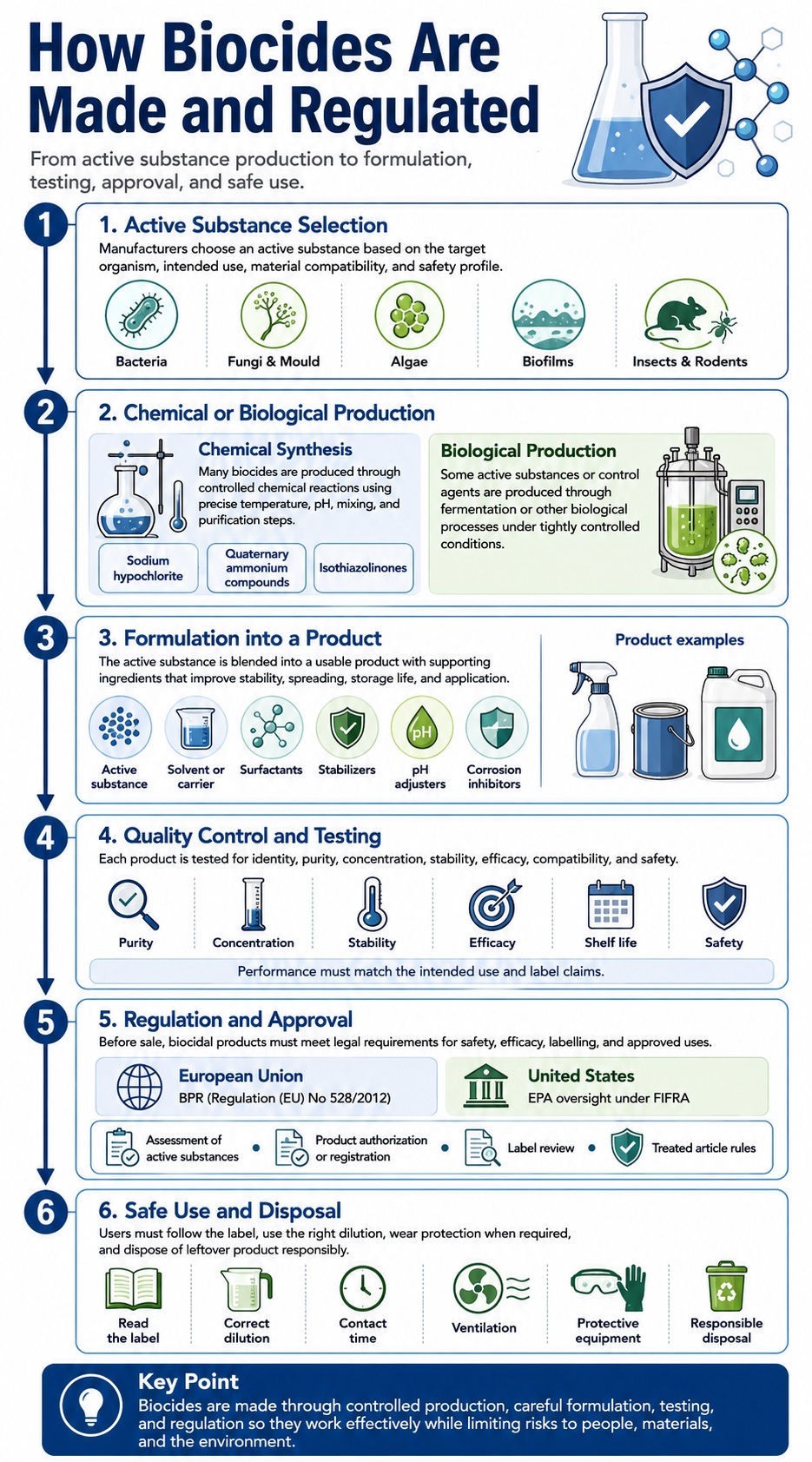
The first step is to choose the active substance. This choice depends on the target. The target can be bacteria, fungi, algae, insects, rats, mice, or slime-forming microbes.
The active substance must also fit the job. A hard-surface cleaner uses different chemistry than a paint preservative. A water-treatment product also needs a different formula.
Chemical Ways to Make Biocides
Many biocides are made through chemical reactions. In this process, raw materials react in a controlled tank or system. Makers control heat, pressure, pH, and mixing. This helps them make the right compound.
Some biocides use chlorine chemistry. Sodium hypochlorite is one example. It is the main active substance in many bleach products. It is often made by reacting chlorine with sodium hydroxide in a high-pH mix.
Other products use different oxidizing chemicals. These include chlorine dioxide and peracetic acid. They need their own reaction steps. They also need special care because they can break down or react if stored the wrong way.
Some biocides do not work by oxidation. They are made through other chemical routes.
Quats are one example. The full name is quaternary ammonium compounds. They are often used in cleaners and surface disinfectants. Makers form them by reacting amines with other chemicals. This gives the molecules a positive charge. That charge helps them attach to microbe surfaces.
Some preservatives use isothiazolinones. Common examples include MIT, CMIT, and BIT. These are used in paints, glues, soaps, and many water-based products. They help stop microbes from growing in the product.
These preservatives work at low levels. That is useful, but it also means care matters. Too much can raise the risk of skin allergy. This is why rules often set limits for their use.
Biological and Fermentation-Based Production
Not all biocides are made by synthetic chemistry. Some are made with living microbes or natural processes.
In this method, selected microbes grow in clean, controlled tanks. These microbes can make useful substances. In other cases, the microbes themselves become the active part of the product.
Some pest-control products use bacteria, fungi, viruses, or natural by-products. These can target certain pests. Makers must choose the right strain and control how it grows. They also test purity, strength, safety, and shelf life.
Bio-based biocides can be useful. They can reduce the need for some older chemicals. But “bio-based” does not always mean safe. These products still need testing for people, animals, crops, storage, and the environment.
Formulation: Turning the Active Substance Into a Product
After makers produce the active substance, they turn it into a product people can use. This step is called formulation.
Formulation matters. The same active substance can act in different ways when mixed with different ingredients.
A finished biocidal product can include:
- Active substance: controls the harmful organism
- Solvent or carrier: helps carry or dissolve the active substance
- Surfactant: helps the product spread or wet a surface
- Stabilizer: helps slow breakdown in storage
- pH adjuster: keeps the product in the right range
- Corrosion blocker: helps protect metal parts
- Fragrance or dye: adds smell or color in some products
- Thickener or foam agent: helps the product stay on a surface
- Preservative: protects the product from spoilage
This is why the label matters. The label tells users where and how to use the product. It also gives the right dose, contact time, surface type, and safety steps.
Do not guess the dose. Do not mix biocides with other chemicals unless the label says it is safe. The wrong mix can make the product weaker or more harmful.
Quality Control and Testing
Before a biocide reaches the market, makers test it. They check that each batch is clean, stable, and strong enough to work.
Tests can check:
- Active substance level
- pH
- Thickness
- Storage life
- Germ-killing power
- Corrosion risk
- Packaging fit
- Unwanted by-products
- Shelf life
- Safety and exposure data
For disinfectants, tests show whether the product kills the germs named on the label. For preservatives, tests show whether the product stops spoilage. For treated materials, tests show whether the treatment keeps working during normal use.
Why Manufacturing Controls Matter
Biocide makers need strict controls. Small changes can affect safety and performance.
Too little active substance can make the product weak. Too much can raise the risk of skin, eye, or breathing irritation. It can also raise the risk of corrosion, residue, or harm to water and soil.
Impurities also matter. Some reactions can make unwanted by-products. Makers must control raw materials, reaction steps, cleaning, storage, packaging, and transport.
Good controls help each batch match the approved formula. They also help the product work the same way each time.
In the European Union and the United States, companies must keep records for approval, labels, and safe-use claims. These records show what is in the product, how it works, and how people should use it safely.
Common Uses of Biocides
Biocides are used in homes, hospitals, public places, factories, and water systems.
Common uses include:
- Health care: surface sprays, tool cleaning, hygiene products, and infection control
- Water treatment: drinking water, wastewater, pools, spas, and cooling towers
- Food sites: cleaning surfaces, tools, storage rooms, and work areas
- Building work: mould-proof paint, treated wood, sealants, glues, plastics, and other materials
- Factories: metal fluids, paper mills, hydraulic fluids, textiles, coatings, and water systems
- Pest control: rats, insects, repellents, attractants, and pest control linked to hygiene
- Marine use: coatings that slow growth on ships, docks, and underwater parts
Biocides are useful because germs can cause real problems. They can damage materials, spoil products, spread disease, lower machine performance, and create hygiene risks.
Biocides in Water Treatment and Industrial Systems
Water systems can grow germs fast.
Warmth, food, still water, and long pipes can all support growth. Over time, germs can form biofilms. A biofilm is a sticky layer of tiny life forms on a surface. It gets harder to remove as it grows.
Biocides are used in:
- Drinking water
- Wastewater treatment
- Cooling towers
- Process water
- Oilfield fluids
- Refining systems
- Paper mills
- Pools and spas
- Closed-loop factory water systems
Some water biocides are oxidizing biocides. These include chlorine, sodium hypochlorite, bromine products, hydrogen peroxide, and chlorine dioxide.
Others are non-oxidizing biocides. These include glutaraldehyde and DBNPA. Workers choose them when rust risk, material fit, or a certain germ problem matters.
In factories, poor germ control can cause biofouling, rust, bad smells, blocked pipes, weak heat transfer, and machine failure.
But too much biocide can also cause harm. Poor disposal can raise risk for water, soil, and wildlife.
Biocides in Paints, Coatings, and Building Materials
Many paints and coatings today are water-based. This can make them easier to use. But it can also let germs grow while the product sits in storage.
Biocides are used in coatings in two main ways.
In-can preservatives protect paint while it is still in the can. They help stop spoilage, bad smells, gas, and germ growth before use.
Film preservatives protect the dry paint after it is applied. They help reduce mould, algae, fungi, and other growth on the finished surface.
In the EU system:
| Product Type | What It Covers |
| PT 6 | In-can preservatives |
| PT 7 | Film preservatives |
| PT 10 | Building material preservatives |
| PT 21 | Antifouling products |
Common coating preservatives include MIT, CMIT, and BIT. These are part of a group called isothiazolinones.
They work well at low levels. But they can also cause allergy concerns. Skin allergy is the main concern.
Some coating ingredients have faced rule changes in different markets. One example is zinc pyrithione in some uses.
Paint makers must check the current rules before using any active substance. This applies to coatings, treated products, and antimicrobial additives.
What Are Treated Articles?
A treated article is a product that has been treated with a biocide. It can also be a product that has a biocide added on purpose.
Examples include:
- Antimicrobial textiles
- Mould-resistant wall paint
- Treated wood
- Odour-control plastic
- Antimicrobial cutting boards
- Preserved leather
- Treated filters
- Biocide-protected sealants or glues
The EU biocide rules cover treated articles too. This matters because a finished product can still fall under these rules.
That can happen if the product contains a biocide. It can also happen if the product makes a biocide claim.
Marketing words matter.
Claims like these can trigger rule checks:
- “Kills germs”
- “Antibacterial”
- “Antimicrobial”
- “Mould resistant”
- “Odour control”
- “Self-sanitizing”
- “Kills 99.9% of bacteria”
Health Risks and Exposure Routes
Biocides are useful because they control harmful life forms. But that same feature can create risk.
Risk rises when exposure is too high, too often, or poorly controlled.
Exposure can happen through:
- Breathing vapour, mist, spray, or dust
- Skin contact with liquids, wipes, sprays, or treated goods
- Eye contact during splashing or spraying
- Accidental swallowing
- Poor storage in unmarked bottles
- Leftover residues on surfaces, fabric, tools, or equipment
Possible health effects include:
- Skin irritation
- Eye irritation or injury
- Allergic skin rash
- Breathing irritation
- Asthma symptoms in sensitive users
- Chemical burns from strong concentrates
- Poisoning after accidental swallowing
- Higher workplace risks for some workers
Isothiazolinones are a good example. They help preserve products. But they are also known to cause allergic skin reactions in some people.
Some people face higher risk. These include workers who handle strong concentrates, cleaners in rooms with poor airflow, children, pets, people with asthma, people with allergies, older adults, and pregnant people.
Environmental Risks of Biocides
Biocides can get into nature in many ways.
They can leave homes, sites, and plants through wastewater, rain runoff, spills, and waste. They can also leak from treated wood, paint, coatings, and other surfaces.
Key risks include:
- Harm to fish and other water life
- Dirty soil and mud
- Harm to plants or animals not meant to be treated
- Build-up in living things for some chemicals
- Long life in the environment
- Change into other chemicals
- Harm to helpful tiny life forms
- More chemical load in wastewater systems
Antifouling paint gives a clear warning from the past. Tributyltin was used in marine coatings from the 1970s to the 1990s. It caused serious harm to sea life. It was later phased out under global rules.
Do not pour old biocides into drains, soil, streams, or storm drains. This includes strong leftovers, old cans, and expired products.
Use local hazardous-waste sites or approved collection routes.
Regulation of Biocides in the European Union
The main EU law is Regulation (EU) No 528/2012. It is also called the Biocidal Products Regulation, or BPR.
The BPR has applied since 1 September 2013. It replaced the older Biocidal Products Directive.
The BPR covers:
- Active substances
- Biocidal products
- Product approval
- Treated articles
- Labels
- Data needs
- Risk checks
- Proof that the product works
- Market checks
EU rules use two main steps.
First, the active substance is checked and approved at EU level. Then the final product must be approved before sale.
Products must work as claimed. They must also be safe for people, animals, and the environment when used as directed.
Product approval can be:
- National
- Accepted across some Member States
- EU-wide for some product groups
For companies, compliance is not just about one chemical.
It also depends on product type, use, strength, exposure, label words, claims, treated-article status, and country rules.
Authorisation, Labelling, and Safe-Use Instructions
Biocide labels are not casual tips. They are part of the safety and legal rules.
Labels may show:
- Active substance name
- Active substance strength
- Hazard symbols
- Warning words
- Use steps
- Dilution rate
- Contact time
- Surface or material limits
- Target germs or pests
- Airflow needs
- Gloves, goggles, or other gear
- Storage rules
- Disposal steps
Contact time matters.
A product that needs five minutes will not work the same way after ten seconds. A strong concentrate can be unsafe if you do not dilute it.
A product made for trained workers may not be safe for home use.
Correct use helps the product work. It also helps keep people safe.
Biocide Regulation in the United States
In the United States, many disinfectants and sanitizers are controlled by the EPA.
The EPA treats many of these products as antimicrobial pesticides under FIFRA. FIFRA stands for the Federal Insecticide, Fungicide, and Rodenticide Act.
These products need data to support label claims. For example, a product must prove it can kill the germs named on the label.
This matters for claims such as:
- “Kills 99.9% of bacteria”
- “Disinfects”
- “Sanitizes”
- “Kills viruses”
- “Controls mould”
- “Antimicrobial protection”
A product cannot make public health claims without proper review. It also needs approved label words.
Biocides and Antimicrobial Resistance
Antimicrobial resistance is often called AMR.
AMR means germs survive a product meant to kill or control them. People often talk about AMR with antibiotics. But experts also study disinfectants and other biocides.
The main concern is repeated low-level exposure.
This can happen when a product is too weak. It can also happen when it is wiped away too soon.
Some germs may survive. Over time, they may adapt.
This is why the right dose matters. Contact time also matters. So does following the label.
A 2025 review raised concern about lower bacterial response to some biocides. It also said this area is hard to study. One reason is that tests and terms are not yet standard.
This does not mean each use of disinfectant causes AMR.
It means biocides should be used with care. In low-risk cases, cleaning, drying, or better airflow may be enough.
When Not to Use Biocides
Biocides are not always the best first step.
For many home or building problems, try simpler fixes first:
- Clean visible dirt
- Fix leaks
- Lower dampness
- Improve airflow
- Dry wet materials fast
- Remove food that attracts pests
- Seal pest entry points
- Use screens or barriers
- Store waste well
- Maintain tools and equipment
For example, do not keep spraying mould without fixing dampness. The mould will come back.
Do not use antibacterial products on every surface without need. This can add exposure without clear benefit.
In many daily cases, soap, water, drying, and good hygiene are enough.
Safe Use of Biocidal Products
Safe use starts with the label.
Follow these rules:
- Use the product only for its stated purpose.
- Read the label before use.
- Use the right dilution rate.
- Follow the contact time.
- Let fresh air into closed rooms.
- Wear gloves or eye gear when the label says so.
- Do not mix products.
- Never mix bleach with ammonia, acids, toilet cleaners, or other chemicals.
- Keep products in their first container.
- Store them away from food, heat, children, and pets.
- Do not put biocides in drink bottles or blank containers.
- Dispose of leftovers by local waste rules.
Workplace and plant-use biocides need extra care.
Workers may need training, risk checks, airflow controls, spill plans, and safety gear.
Latest Developments in Biocide Regulation and Science
Biocide rules are changing.
Officials are reviewing safety, new products, market checks, and environmental risks.
The European Commission is now reviewing the BPR. The review will check if the law still works well. The Commission expects to finish it around mid-2027.
The Commission also opened talks on the BPR review in late 2025 and early 2026.
This matters for makers, importers, shops, formulators, and treated-product sellers. Future changes may affect approval times, data needs, substance limits, and market checks.
Scientists are also studying biocide tolerance, biofilms, and possible links with antibiotic resistance.
The practical message is simple. Do not avoid all biocides. Use them only when needed. Use the approved strength and contact time.
Future Trends in Biocide Development
Future biocides are moving toward safer and more targeted use.
Key trends include:
- Lower-risk active substances
- Better exposure models
- Safer preservatives for water-based products
- Slow-release coatings
- Digital biofilm checks
- Better wastewater controls
- Replacements for high-concern substances
- Integrated pest control
- Less routine use when cleaning or design changes work
- Stronger checks on treated articles
Companies will need more than strong chemicals.
They will need records, current approvals, true claims, safer formulas, and clear user instructions.
Conclusion
Biocides play an important role in health, water safety, buildings, factories, pest control, and product care.
They help control bacteria, viruses, fungi, algae, mould, rats, insects, and other harmful life forms.
But they come with trade-offs.
Biocides can irritate skin, affect breathing, harm water life, and pollute soil or water. Misuse can also add to resistance concerns.
That is why rules, labels, training, and safe disposal matter.
The safest approach is simple. Use biocides only when needed. Choose the right product. Follow the label. Fix root causes like dampness, dirt, poor airflow, and pest entry points.
Frequently Asked Questions About Biocides
Are biocides and pesticides the same thing?
Not exactly. The words overlap, but they are not the same.
In the EU, biocides often mean non-farm products. These include disinfectants, preservatives, pest-control products, antifouling products, and treated materials.
Many crop products follow separate plant-protection rules.
Are disinfectants biocides?
Yes. Many disinfectants are biocides.
They are made to kill or control germs on surfaces, skin, tools, water, or materials.
Can I use industrial biocides at home?
No. Industrial biocides can be too strong for home use.
They may contain stronger amounts, different solvents, and worker-only instructions.
How can I tell if a paint contains biocides?
Check the label or safety data sheet.
Look for words such as preservative, fungicide, algicide, antimicrobial, mould resistant, MIT, CMIT, BIT, zinc pyrithione, or listed active substances.
Are natural biocides safer?
Not always.
Natural substances can still irritate skin, harm water life, trigger allergies, or cause other risks.
Natural origin does not remove the need for tests, labels, and safe use.
Do biocides cause antimicrobial resistance?
Wrong use or repeated weak exposure can add selection pressure in some settings.
Using the approved strength and contact time lowers this risk.
Avoid routine use where cleaning is enough.
What should I do with expired biocidal products?
Keep them in their first labelled containers.
Follow local hazardous-waste or chemical-disposal rules.
Do not pour strong leftovers into drains, soil, streams, or storm drains.