

The textile industry is a major contributor to global carbon emissions – a staggering 10% – outstripping the totals for international flights and maritime shipping. As consumers begin to grasp the scale of this issue, organic linen has emerged as one of the few sustainable alternatives in home goods. Unlike conventional cotton, which demands copious amounts of irrigation and chemical inputs, flax – the humble plant from which linen is made – actually thrives in poor soil with minimal water and virtually zero pesticides.
But its credentials go way beyond being environmentally friendly. Organic linen sheets also deliver some tangible benefits when it comes to sleep quality, skin health and long-term durability – that’s a pretty compelling combination. So what sets them apart, and how can you choose a set that delivers on both comfort and eco-responsibility? Lets take a closer look.
What really makes organic linen special?
Not all linen is created equal – and that is not a surprise. To qualify as ‘organic’, the flax used has to be cultivated without synthetic pesticides, herbicides or genetically modified seeds. But the most rigorous benchmark is the Global Organic Textile Standard (GOTS), which is effectively a quality mark that audits every stage of production – from the farm to the finished product – for environmental and labor best practices.
If you want to choose a set of organic linen sheets that meets all these criteria, here’s what to look out for:
- Flax grown using crop rotation and natural pest management – no artificial chemicals needed
- Processing that avoids chlorine bleaching and nasty dyes
- Fair labour conditions throughout the entire production chain
- And of course, traceability from field to fabric
The reason this all matters is that “natural” and “eco-friendly” are pretty meaningless marketing terms on their own. GOTS, on the other hand, is an independent third-party verification that genuinely ensures a product meets measurable standards.
The case for linen bedding
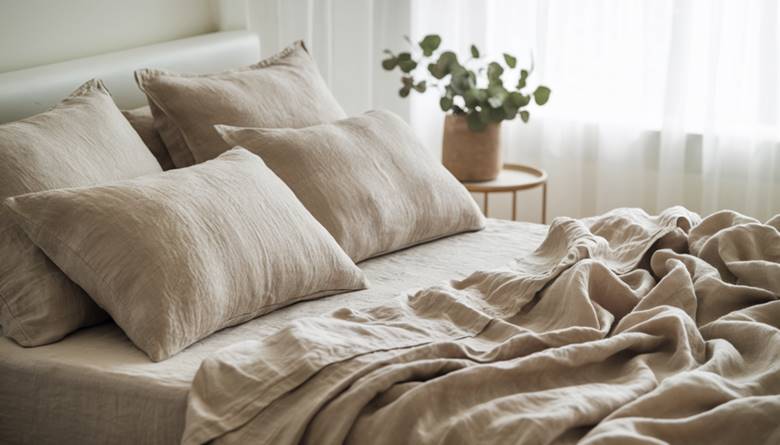
Organic linen is not just good for the planet – it’s also really, really good for you. The fabric’s structure – long, hollow fibres – creates a natural temperature regulation and moisture management that synthetic materials just can’t match.
Here’s the lowdown on the many benefits:
- Environmental advantages: Flax uses a fraction of the water of cotton and grows without irrigation in most climates. The good news is that you get to use the entire plant – minimal waste. And at the end of its life, organic linen breaks down completely – which is a far cry from polyester blends that shed microplastics everywhere
- Health and comfort benefits: The fabric is totally hypoallergenic and antimicrobial, making it perfect for sensitive skin and allergy sufferers. Plus its high breathability keeps your body temperature in check – linen sheets will feel cool in the summer and really warm in the winter. And the best part? The material just gets softer with each wash, while still holding its shape like a dream.
How to choose your organic linen sheets
Thread count – the usual benchmark for determining cotton quality – doesn’t really apply to linen. This is because its thicker fibres mean quality linen typically tops out at around 80-150 threads per inch. So when you’re shopping for a set, consider these factors instead:
- Certification – whether you are looking at SIJO’s organic linen collection or any other brand, look for standards such as GOTS or OEKO-TEX Standard 100, which provide a more reliable benchmark than marketing language alone.
- Weave – do you want the crisp, textured look of a plain weave, or the instant softness of stonewashed linen?
- Weight – heavier linen (180-220gsm) is great for year-round use, lighter weights (150-180gsm) are best suited to warm climates
- Construction – if possible, look for European flax from countries like Belgium and France – they’re renowned for producing some of the longest, highest-quality fibres around
Color also signals production methods. Undyed linen in natural beige or gray tones requires no chemical processing. If you prefer dyed sheets, verify that the manufacturer uses low-impact or plant-based dyes.
Taking Care of Your Linen Sheets
Proper care really does make a big difference in how long linen sheets last. The fabric is pretty tough – vintage linen has been know to last for decades – but it does need a bit of TLC to keep it in good nick.
- Washing: Use cold or warm water, not that hot stuff. A pH-neutral detergent is best, and steer clear of bleach and fabric softener, as they’ll weaken or coat the fibers and reduce the absorbency.
- Drying: Line drying is always the best option, but if you’re stuck using a machine, take the sheets out while they’re still slightly damp and give them a low heat tumble to sort out any wrinkles.
- Storage: Keep the sheets in a breathable bag or on an open shelf – not stuffed in some plastic container that’s going to trap moisture and encourage mildew.
- Ironing: Ironing’s not strictly necessary, but if you do want to iron, do it while they’re still damp and use a hot setting. Some people love the look of ironed linen, while others prefer the natural texture.
Expect your linen sheets to get softer after the first few washes. The fabric will start to mellow out and develop a lovely, smooth drape that’s still strong.
The Big Picture of Textile Choices
The fashion and home goods industries are getting a lot of heat over their environmental impact and the mountains of useless rubbish they’re generating. Fast fashion alone is responsible for 92 MILLION TONS of textile waste every year, and a lot of that’s non-biodegradable synthetic rubbish.
But there’s a better way to do things – and that’s with organic linen production.
- Carbon sequestration: Flax plants are actually quite good at absorbing CO2 as they grow, and organic farming practices build up the soil rather than sucking it dry.
- Reduced chemical runoff: Conventional cotton farming uses a whopping 16% of the world’s insecticides, whereas organic flax needs practically no chemicals at all.
- Circular potential: The good news is that organic linen doesn’t contain any synthetic fibres or nasty chemicals, so it can be composted when its time is up.
This is good news for ecosystems AND for farming communities – organic certification often includes labour standards that conventional farming tends to ignore.
Why Organic Linen is Worth Splashing Out On
Quality organic linen sheets cost a pretty penny upfront – we’re talking $200 to $400 for a queen set – but they’re actually good value in the long run.
Think about it – synthetic sheets may need replacing every couple of years because they’re pilling and falling apart. But a set of well-maintained linen sheets can last 10 to 20 years and just keep getting comfier with time. The per-year cost often ends up lower than those cheap alternatives.
And then there’s the small matter of how nice it is to sleep on a nice, comfortable set of sheets. Linen’s got a way of keeping you at the right temperature, and it’s hypoallergenic too – so you can say goodbye to skin irritation and hello to a better night’s sleep. And let’s not forget the lovely texture – there’s just something about a nice bit of linen that you won’t get with a polyester blend.