



Salt & Stone body wash sits in the premium body-care aisle. It has sleek packaging, high-end scents, and ingredients that sound closer to facial skin care than basic soap.
That is why many shoppers ask a fair question: is Salt and Stone body wash non toxic, or is it mostly clean beauty marketing?
The honest answer is not a simple yes or no.
For most healthy adults, Salt & Stone body wash does not look like an unusually risky product when used as directed. It contains common body-wash ingredients, including cleansing agents, humectants, preservatives, fragrance, aloe, niacinamide, hyaluronic acid, amino acids, and botanical extracts.
The bigger issue is the phrase “non toxic.” In personal care, that term is broad and easy to stretch. It does not tell you whether a product suits sensitive skin, eczema-prone skin, fragrance allergies, or reactive skin.
A better question is: does Salt & Stone body wash fit your skin, and do its clean-beauty claims match the ingredient list?
Quick Answer: Is Salt and Stone Body Wash Non Toxic?
Salt & Stone body wash is not best described as toxic, but calling it fully “non toxic” gives shoppers a false sense of certainty. Its formulas include common cleansing agents, fragrance, preservatives, and skin-care-style ingredients such as glycerin, hyaluronic acid, niacinamide, aloe, amino acids, and botanical extracts.
For most adults with normal skin, it is reasonable to use as directed. The main concern is not obvious whole-body toxicity. It is fragrance, irritation, and allergy risk, especially for people with eczema-prone, itchy, dry, or sensitive skin.
Key Takeaways
- “Non toxic” is not a clear cosmetic category for body wash.
- Salt & Stone body wash is better described as a premium fragranced cleanser with clean-beauty positioning.
- The formula includes useful skin-feel ingredients such as glycerin, hyaluronic acid, niacinamide, aloe, amino acids, sodium PCA, and sodium lactate.
- The biggest concern is fragrance sensitivity, not obvious systemic toxicity.
- Rinse-off body wash stays on the skin for a short time, but sensitive users can still react.
- People with eczema, fragrance allergies, frequent itching, or reactive skin should patch test first or choose a fragrance-free cleanser.
- U.S. cosmetics still do not need FDA approval before sale, except for color additives, but companies are responsible for product safety and labeling. MoCRA has also added stronger cosmetic oversight rules.
What Does “Non Toxic” Mean in Body Wash?
“Non toxic” sounds simple. In cosmetics, it often works more like a marketing phrase than a precise safety label.
A body wash is not safe or unsafe just because an ingredient sounds natural, synthetic, clean, plant-based, or chemical. Every cosmetic ingredient is a chemical, including water, aloe, glycerin, salt, coconut-derived cleansers, and essential oils.
Real safety depends on practical details:
- Ingredient concentration
- How often you use the product
- How long it stays on your skin
- Whether it is rinse-off or leave-on
- Your skin barrier health
- Your allergy history
- Your tolerance for fragrance
- The full formula, not one ingredient alone
That last point matters. A body wash is a rinse-off product. It touches the skin for a short time before it goes down the drain. That lowers contact time compared with lotion, deodorant, perfume, body oil, sunscreen, or serum.
Still, rinse-off does not mean risk-free. Many people with sensitive skin react quickly to fragrance, strong cleansers, certain preservatives, or botanical extracts.
The FDA says cosmetic products and ingredients generally do not need premarket approval, except for color additives. Cosmetic companies remain responsible for making sure products are safe and properly labeled.
So, when someone asks, “is Salt and Stone body wash non toxic?”, the more useful answer is this:
Salt & Stone body wash does not look like an obvious high-risk body wash for most adults, but “non toxic” is too loose to be the final judgment.
Better questions include:
- Does it contain fragrance?
- Does it make my skin feel dry, tight, or itchy?
- Does my skin react to scented products?
- Are the ingredients clear enough for my allergy history?
- Is it suitable for sensitive or eczema-prone skin?
- Am I paying for scent, skin benefits, branding, or all three?
U.S. Cosmetic Safety Rules Have Changed Under MoCRA
Cosmetics in the U.S. still do not go through the same FDA premarket approval process as drugs. But cosmetic oversight has changed.
The Modernization of Cosmetics Regulation Act of 2022, known as MoCRA, expanded FDA authority over cosmetics. It added requirements tied to serious adverse event reporting, facility registration, product listing, safety substantiation, and good manufacturing practice rules for cosmetic facilities.
That matters because older clean-beauty content often says, “cosmetics are barely regulated.” That statement is too broad now.
MoCRA does not make “non toxic” a regulated body-wash category. It also does not mean every cosmetic product is FDA-approved before sale. It does mean cosmetic companies now carry stronger compliance duties than they did before 2022.
For shoppers, the practical takeaway is simple: do not rely on “non toxic” as your main safety standard. Read the ingredient list, check fragrance, think about your skin history, and use the product as directed.
Salt & Stone Body Wash at a Glance
Salt & Stone positions its body wash as an aromatic gel cleanser with a premium scent profile and skin-care-style ingredients. The brand describes the product as a body wash infused with seaweed extracts and hyaluronic acid for a rich lather and soft skin feel.
That formula style fits the current premium body-care trend. Many shoppers want body wash that feels less basic and more like skin care. Salt & Stone clearly speaks to that demand.
The trade-off is clear. You get a more elevated scent and a richer shower feel, but fragrance becomes part of the safety conversation. For normal skin, that works for many people. For reactive skin, it is the first thing to check.
| Category | Salt & Stone Body Wash Review |
| Product type | Premium fragranced body wash |
| Main appeal | Scent, packaging, luxury shower feel, skin-care-style ingredients |
| Formula style | Cleansing gel with humectants, fragrance, botanicals, amino acids, and antioxidants |
| Best for | Normal skin, scent lovers, premium body-care shoppers |
| Use caution if | You have eczema, fragrance sensitivity, allergies, or very reactive skin |
| Main concern | Fragrance and irritation risk |
| Better description | Clean-beauty-positioned fragranced body wash |
Ingredient Review: What Is Inside Salt & Stone Body Wash?
Salt & Stone body wash formulas vary by scent, so check the exact ingredient list before buying. Most formulas follow the same basic pattern. They include cleansers, moisturizers, preservatives, fragrance, botanicals, and skin-care-style ingredients.
That mix matters. Salt & Stone is not just soap with perfume added. It contains ingredients that support a softer skin feel. At the same time, it remains a fragranced rinse-off product, so sensitive-skin users should read the label carefully.
Salt & Stone’s body wash ingredient lists include ingredients such as Sodium C14-16 Olefin Sulfonate, Cocamidopropyl Betaine, Glycerin, Cocamide MIPA, Fragrance or Parfum, Benzyl Alcohol, Coco-Glucoside, Sodium Benzoate, Citric Acid, Sodium PCA, Sodium Lactate, Aloe Barbadensis Leaf Juice, Hyaluronic Acid, Niacinamide, amino acids, botanical extracts, and fragrance allergens in some formulas such as Limonene, Linalool, Citral, Geraniol, Eugenol, and Benzyl Benzoate.
Ingredient Safety Snapshot
| Ingredient or Group | Why It Is Used | Main Consumer Consideration |
| Glycerin | Helps skin hold water | Generally well tolerated |
| Sodium PCA and Sodium Lactate | Bind moisture | Help improve skin feel |
| Hyaluronic Acid | Attracts water | Useful for hydration feel, but rinse-off contact limits benefits |
| Niacinamide | Skin-conditioning ingredient | More useful in leave-on products than rinse-off body wash |
| Aloe | Skin-conditioning ingredient | Often soothing, but not a guarantee against irritation |
| Amino Acids | Support a softer skin feel | Usually low concern for most users |
| Sodium C14-16 Olefin Sulfonate | Foaming cleanser | Can feel strong or drying on some skin |
| Cocamidopropyl Betaine | Foam booster and co-cleanser | Common in cleansers, but some allergy-prone users react |
| Fragrance or Parfum | Creates scent | Main concern for sensitive, eczema-prone, or fragrance-reactive skin |
| Benzyl Alcohol, Sodium Benzoate, Dehydroacetic Acid | Help preserve the formula | Necessary in water-based formulas, but possible triggers for some users |
| Botanical Extracts | Add skin-care appeal and scent story | Natural does not always mean gentle |
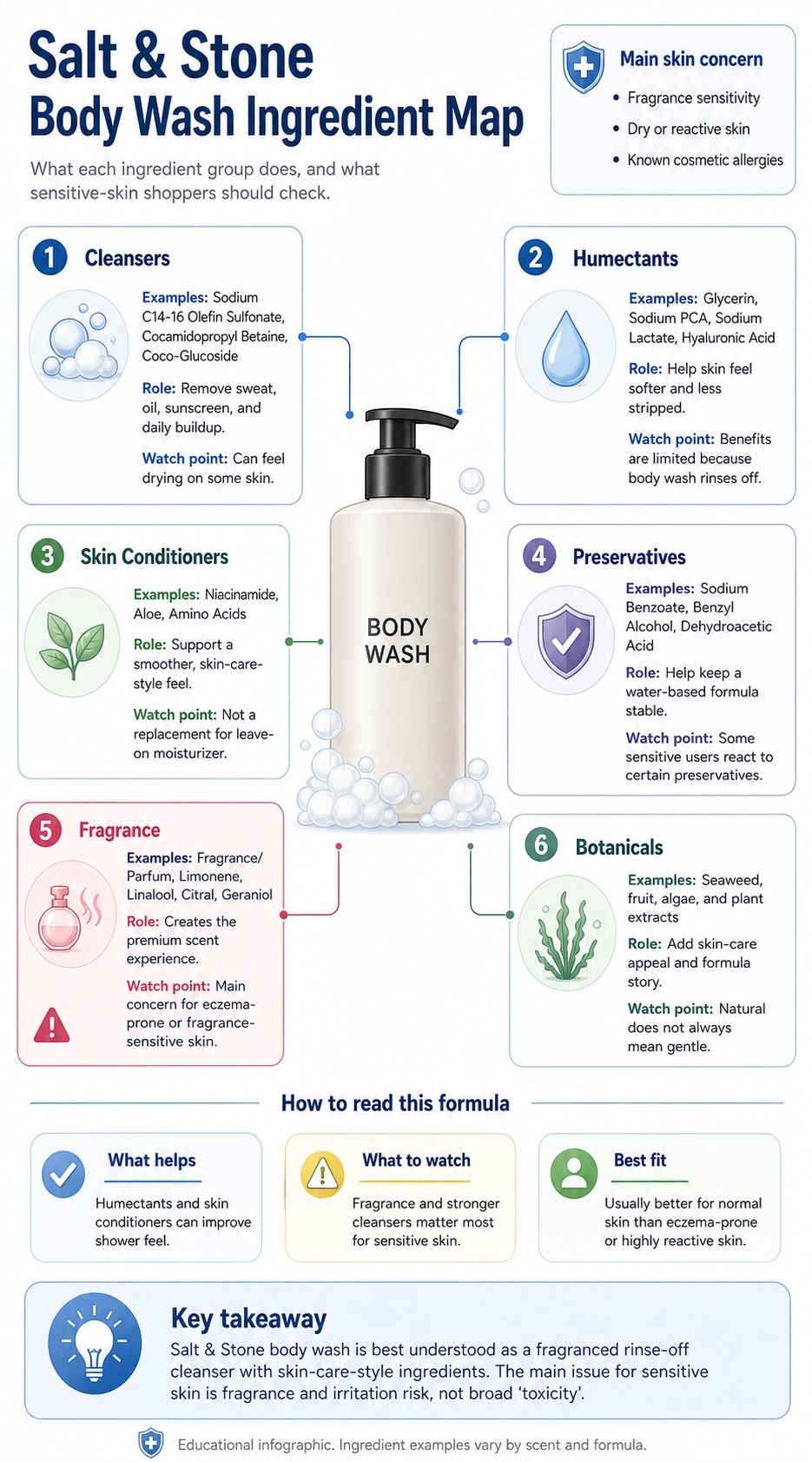
Cleansing Agents and Surfactants
Salt & Stone body wash uses cleansing ingredients such as:
- Sodium C14-16 Olefin Sulfonate
- Cocamidopropyl Betaine
- Coco-Glucoside
- Cocamide MIPA
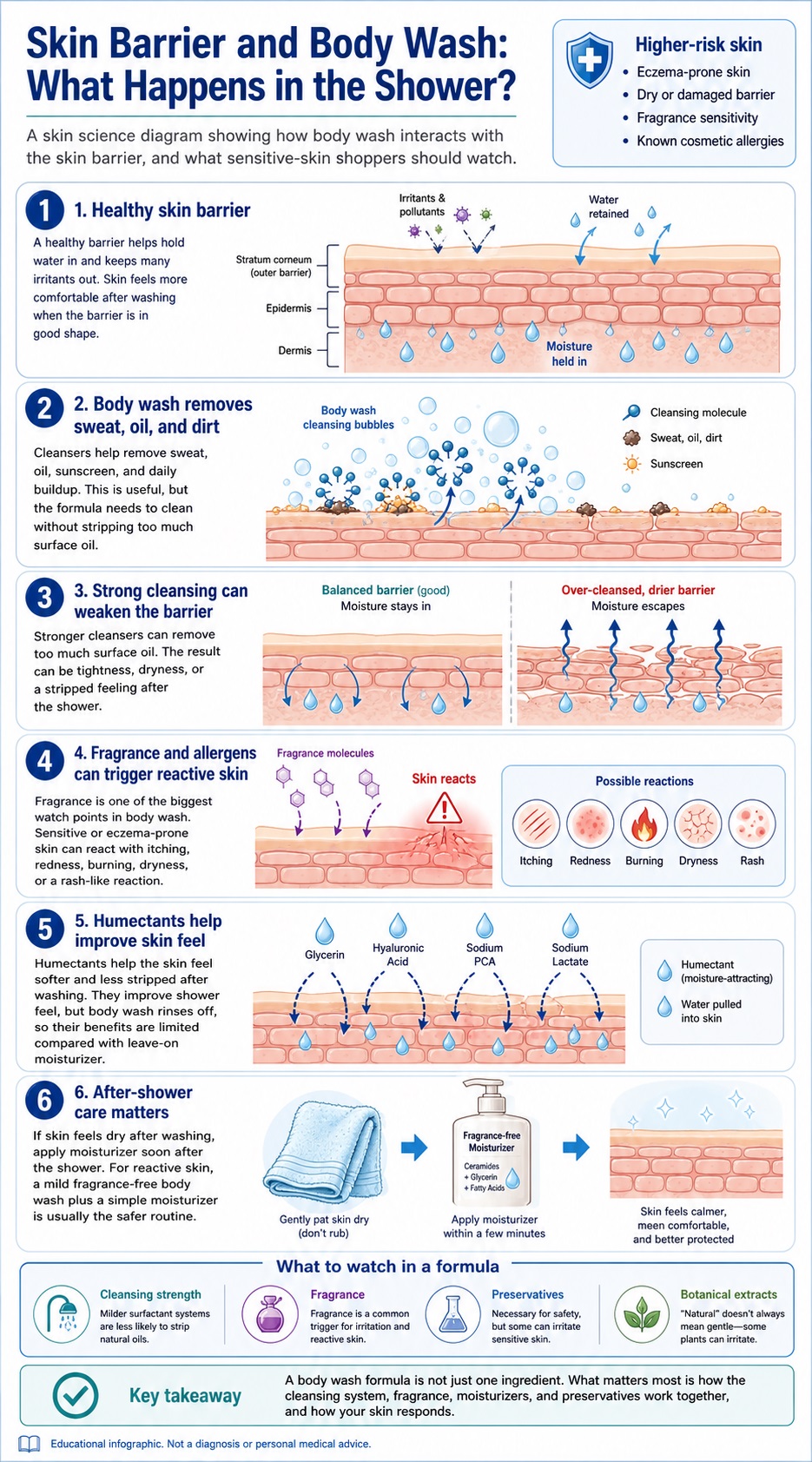
These ingredients help remove sweat, oil, sunscreen, deodorant residue, and daily dirt. They also create foam and help the wash rinse away cleanly.
The real question is not whether surfactants are “toxic.” They serve a clear purpose in body wash. The better question is whether they feel gentle enough on your skin.
Some people handle foaming body washes without any problem. Others notice tightness, dryness, itching, or a stripped feeling after showering. That reaction is more common in people with dry skin, eczema-prone skin, a weakened skin barrier, or a history of cleanser irritation.
You may like: Are Bath and Body Works Candles Toxic or Safe?
Moisturizing and Skin-Supporting Ingredients
Salt & Stone body wash also includes ingredients often found in moisturizing and skin-care products.
Common examples include:
- Glycerin
- Sodium PCA
- Sodium Lactate
- Hyaluronic Acid
- Aloe Barbadensis Leaf Juice
- Niacinamide
- Amino acids
- Seaweed, algae, fruit, and botanical extracts
These ingredients improve the feel of the formula. Glycerin, sodium PCA, sodium lactate, and hyaluronic acid are humectants, which means they help attract or hold water at the skin’s surface.
Niacinamide is widely used in skin care for barrier support and skin conditioning. In a rinse-off body wash, its effect is more limited than in a leave-on lotion or serum.
Aloe, amino acids, and botanical extracts can add a softer, more conditioned feel during washing. Still, botanical extracts are not automatically safer. Some people react to plant-derived ingredients, especially when the skin barrier is already irritated.
This is where Salt & Stone has a more skin-care-inspired ingredient profile than many basic scented cleansers. The ingredient list is not only foam and fragrance. It includes hydration-focused and skin-conditioning ingredients that can make the wash feel less drying for many users.
The limit is clear: body wash rinses off. These ingredients can improve the shower experience, but they do not replace a leave-on moisturizer.
Preservatives and Formula Stability
Salt & Stone body wash is water-based, so it needs preservatives. Without a proper preservative system, bacteria, yeast, and mold can grow in the bottle over time.
Common preservation-related ingredients in Salt & Stone body wash formulas include:
- Sodium Benzoate
- Benzyl Alcohol
- Dehydroacetic Acid
- Citric Acid
- Leuconostoc/Radish Root Ferment Filtrate in some formulas
Preservatives often get unfair treatment in clean-beauty content. A water-based body wash needs them. A “preservative-free” water-based body wash is not automatically safer if the formula can spoil or become contaminated.
The useful question is whether the preservative system fits the formula and whether your skin tolerates it. Most people use preserved rinse-off products without trouble. People with sensitive or allergy-prone skin still need to compare the ingredient list with past reactions.
If you already know you react to benzyl alcohol, benzoates, or other preservative systems, check the exact formula before buying.
Fragrance Is the Biggest Safety Question
Fragrance is the most important part of this ingredient review.
Salt & Stone body wash is built around scent. Its appeal comes partly from fragrance profiles such as Santal & Vetiver, Bergamot & Hinoki, Black Rose & Oud, and other luxury-style blends.
That does not make the product unsafe. It does mean Salt & Stone is not the most conservative choice for very sensitive skin.
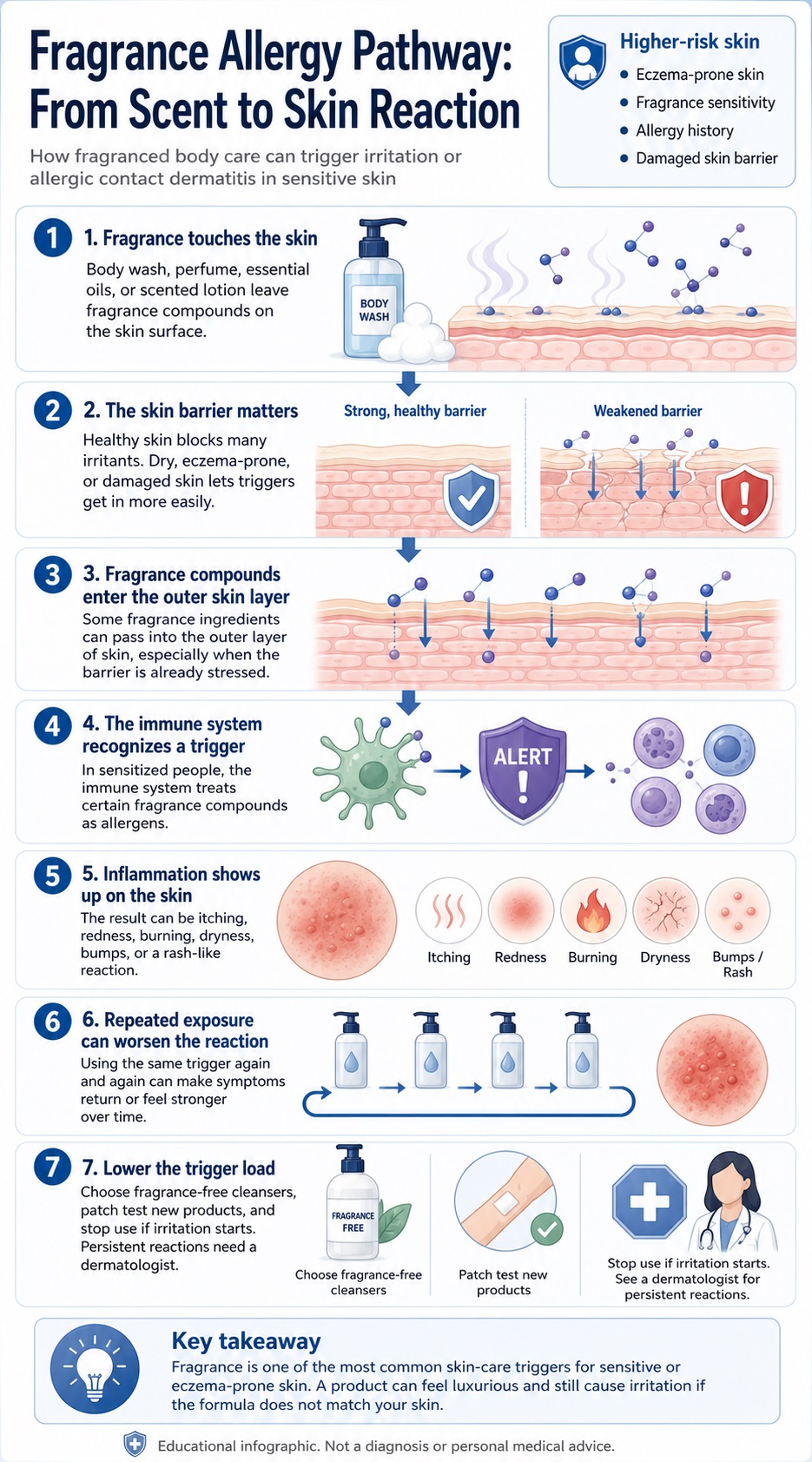
Fragrance can be natural, synthetic, or a blend of both. Many people assume natural fragrance is gentler, but that is not always true. Essential oils and plant-based scent compounds can also irritate skin or trigger allergic contact dermatitis in some users.
The FDA says fragrance ingredients in cosmetics must meet the same safety requirement as other cosmetic ingredients, but they do not need FDA approval before they go on the market. Cosmetic companies remain responsible for safety and labeling.
U.S. cosmetic labeling rules also allow brands to list “fragrance” or “parfum” without naming every scent compound on the main ingredient list. The FDA explains that fragrance formulas can be treated as trade secrets.
For shoppers with fragrance allergies, that creates a real gap. If your skin reacts, you often cannot tell which exact scent ingredient caused the problem.
For normal skin, fragrance is often fine. For eczema-prone, allergy-prone, or reactive skin, fragrance is the main reason to patch test first or choose a fragrance-free cleanser.
Fragrance-Free vs Unscented
Sensitive-skin shoppers should look for fragrance-free, not just unscented.
These terms do not always mean the same thing.
A fragrance-free product is usually the better choice because fragrance is not added for scent. An unscented product can still contain masking fragrance ingredients used to hide the natural smell of the formula.
That distinction matters when the goal is to avoid fragrance exposure. A product can smell neutral and still contain fragrance-related ingredients.
Salt & Stone body wash is not positioned as fragrance-free. Scent is central to the product experience. That makes it better suited to people who enjoy fragrance and already know their skin tolerates it.
Is Salt and Stone Body Wash Safe for Sensitive Skin?
Salt & Stone body wash can work for some people with normal, balanced, or mildly dry skin. It is not the safest default choice for very sensitive skin because it contains fragrance.
Sensitive-skin shoppers should focus less on luxury branding and more on skin response.
| Skin Type | Salt & Stone Body Wash Suitability |
| Normal skin | Likely suitable for many users |
| Dry skin | Can feel comfortable for some users because of humectants |
| Oily or sweaty skin | Likely useful as a cleansing body wash |
| Sensitive skin | Patch test first |
| Eczema-prone skin | Fragrance-free cleanser is usually safer |
| Fragrance-sensitive users | Use caution or avoid |
| Allergy-prone skin | Review the full ingredient list carefully |
The American Academy of Dermatology advises people managing atopic dermatitis to use cleanser only when needed and to choose a mild, fragrance-free cleanser. The AAAAI also recommends non-soap fragrance-free cleansers for people with eczema.
So, if your skin rarely reacts to scented products, Salt & Stone body wash can be a reasonable premium option. If you often feel itchy, dry, bumpy, or irritated after using fragranced body care, it is not the safest first choice.
Is Salt and Stone Body Wash Actually “Clean”?
Salt & Stone body wash fits the clean-beauty look. It has simple packaging, refined scents, plant-derived language, and ingredients often seen in skin-care products.
But “clean” is not a single scientific standard.
Each brand defines clean beauty in its own way. One brand focuses on avoiding certain ingredients. Another focuses on plant-based sourcing. Another connects clean beauty with packaging, vegan claims, cruelty-free claims, or lifestyle branding.
That is why “clean” does not mean fragrance-free, non-irritating, eczema-safe, dermatologist recommended, or safe for every skin type.
A clean-beauty product can still contain fragrance allergens. A basic drugstore cleanser can be gentle. A natural extract can irritate skin. A synthetic ingredient can be safe and useful.
The better way to judge Salt & Stone body wash is to look past the clean-beauty label and read the formula.
Clean Beauty Claims to Treat Carefully
Be cautious when any body wash uses claims such as:
- Non toxic
- Chemical-free
- Natural
- Clean
- Safe for all skin types
- Free from harsh chemicals
- Hypoallergenic
- Dermatologist approved
Some of these claims help when the brand explains them clearly. Others are too vague to mean much on their own.
“Chemical-free” is the worst offender. Every cosmetic ingredient is a chemical, including water, aloe, salt, glycerin, fragrance, preservatives, and plant extracts. The word chemical does not automatically mean harmful.
Salt & Stone body wash should not be judged by clean-beauty language alone. Judge it by its ingredient list, scent profile, cleansing strength, preservative system, and how your skin reacts after use.
What Salt & Stone Gets Right
Salt & Stone body wash has several real strengths.
The formula includes more than basic cleansing agents. Ingredients such as glycerin, hyaluronic acid, niacinamide, aloe, sodium PCA, sodium lactate, amino acids, and botanical extracts give it a more skin-care-inspired profile than many standard scented body washes.
It is also a rinse-off product. That does not remove irritation risk, but it lowers contact time compared with perfume, lotion, deodorant, or body oil. In practice, many people tolerate fragrance better in a wash than in a leave-on product.
The brand also makes fragrance a clear part of the product experience. This is not hidden. Many shoppers buy Salt & Stone body wash because they want a richer scent than a basic cleanser.
Based on the publicly listed product positioning and ingredient style, Salt & Stone body wash looks like a conventional premium fragranced cleanser, not an unusually high-risk cosmetic product for the average adult user.
The issue is not that Salt & Stone body wash is clearly bad. The issue is that “non toxic” is too broad and marketing-heavy to be the main standard.
What Consumers Should Be Cautious About
Fragrance Transparency
Fragrance is the biggest concern for shoppers who want full ingredient clarity.
A body wash can list “fragrance” or “parfum” without naming every scent compound on the main ingredient list. That is common in beauty products, but it creates a problem for people with allergies.
If you already react to fragrance, essential oils, perfume, scented detergent, or scented lotion, Salt & Stone body wash is not the safest first choice.
Sensitive Skin Compatibility
Premium does not always mean gentle.
A luxury body wash can still irritate reactive skin. A polished scent can still cause itching. A formula with niacinamide and hyaluronic acid can still feel drying if the cleansing system does not agree with your skin.
If your skin barrier is already stressed, choose function over scent. Fragrance-free body wash is usually the better starting point.
“Non Toxic” Is Too Broad
Salt & Stone body wash is acceptable for many users, but “non toxic” is not the best label.
A more accurate description is:
Salt & Stone body wash is a premium fragranced cleanser with several skin-supporting ingredients, but it is not a fragrance-free sensitive-skin product.
That wording gives shoppers a clearer answer than a simple toxic or non toxic label.
Price vs Function
Salt & Stone is priced as premium body care. Before buying, ask what you are paying for:
- Scent
- Brand style
- Packaging
- Skin-care-style ingredients
- Shower feel
- Clean-beauty positioning
For some shoppers, that mix is worth the price. For others, a fragrance-free drugstore cleanser offers better value and a safer choice for sensitive skin.
Salt & Stone Body Wash vs Fragrance-Free Sensitive-Skin Body Wash
Salt & Stone body wash and a sensitive-skin body wash serve different shoppers.
| Feature | Salt & Stone Body Wash | Fragrance-Free Sensitive-Skin Body Wash |
| Main appeal | Scent, premium feel, skin-care-style ingredients | Lower irritation risk |
| Fragrance | Yes, fragrance is central to the product | Usually no |
| Best for | Normal skin and scent lovers | Eczema-prone, dry, itchy, allergy-prone, or reactive skin |
| Typical ingredients | Humectants, botanicals, fragrance, surfactants, amino acids | Mild cleansers, glycerin, ceramides, colloidal oatmeal, or simple moisturizers |
| Main concern | Fragrance sensitivity or cleanser-related dryness | Less scent and less luxury feel |
| Clean-beauty appeal | Strong | Varies by brand |
| Dermatology-first positioning | Not primarily | Often yes |
| Better choice for reactive skin | Not usually | Usually yes |
| Better choice for luxury scent | Yes | Usually no |
Salt & Stone works best for people who want a scented, premium shower product and already know their skin handles fragrance well.
A fragrance-free sensitive-skin body wash works better for people who need fewer triggers, less scent, and a simpler formula. That choice is less exciting, but it often makes more sense for skin that gets dry, itchy, red, or irritated after showering.
Who Should Consider Salt & Stone Body Wash?
Salt & Stone body wash makes the most sense for people who want a scented, premium shower product and already know their skin handles fragrance well.
It can be a good fit for:
- People with normal or non-reactive skin
- Shoppers who enjoy scented body wash
- Adults who tolerate fragranced skin care
- People who want a body wash with humectants and skin-care-style ingredients
- Shoppers who care about scent, packaging, and bathroom style
- Users who want a more polished shower feel than basic soap
- Adults without eczema, fragrance allergies, or frequent skin irritation
For this group, Salt & Stone body wash is not really medical skin care. It is a more elevated daily shower product built around scent, texture, and skin-conditioning ingredients.
Who Should Avoid It or Patch Test First?
Be more cautious if you:
- Have eczema-prone skin
- React to fragrance
- Prefer fragrance-free personal care
- Feel itchy after showering
- Get rashes from scented lotions, perfumes, or detergents
- Have known fragrance allergies
- Have very dry or damaged skin
- Are buying for a child or someone with highly reactive skin
- Have headaches or scent sensitivity triggered by fragranced products
A patch test helps reduce guesswork. To patch test a rinse-off body wash, use a small amount on a limited area such as the inner arm. Rinse it off as directed. Watch the area for 24 to 48 hours.
Stop using the product if you notice itching, burning, redness, bumps, rash-like irritation, or unusual dryness.
How to Read the Label Before Buying
Read the label like a skin-care shopper, not just a clean-beauty shopper.
Check these first:
- Does the formula list fragrance or parfum?
- Have you reacted to scented products before?
- Does your skin tolerate foaming body washes?
- Are there botanical extracts you already know you react to?
- Does the brand disclose enough for your comfort level?
- Are you buying for scent or sensitive-skin safety?
- Is your skin already dry, irritated, or eczema-prone?
- Do you need fragrance-free, not naturally fragranced or unscented?
A natural scent is still a scent. Essential oils and botanical fragrance compounds can irritate some users, just like synthetic fragrance ingredients.
Skin Reactions to Watch For
Stop using the product if you notice:
- Itching
- Burning
- Redness
- Tightness
- Dry patches
- Bumps
- Rash-like irritation
- Skin that feels worse after showering
A body wash should leave your skin clean and comfortable. If your skin feels stripped, hot, itchy, or unusually dry, the formula is not a good match.
What About Environmental Toxicity?
This review focuses on normal consumer use and skin tolerance, not a full environmental toxicity or biodegradability review.
That distinction matters. A body wash can be acceptable for normal skin use while still raising separate environmental questions about fragrance compounds, surfactants, packaging, wastewater, ingredient sourcing, biodegradability, or aquatic impact.
So, “non toxic” means different things in different conversations. For skin safety, the biggest practical issue with Salt & Stone body wash is fragrance sensitivity and irritation risk. For environmental safety, shoppers need a separate review of biodegradability, packaging, ingredient sourcing, and wastewater impact.
Dermatologist-Style Verdict: Non Toxic or Clean Beauty Marketing?
Salt & Stone body wash is not best described as toxic. For most healthy adults with normal skin, it is reasonable to use as directed.
But calling it fully “non toxic” says too much. The phrase can make a product sound safer, cleaner, or more medically reassuring than the ingredient list can prove.
The most accurate verdict is this:
Salt & Stone body wash is a premium, fragrance-forward body wash with several skin-supporting ingredients and strong clean-beauty appeal. It is not an obvious concern for most users, but it is not the most conservative choice for sensitive, eczema-prone, allergy-prone, or fragrance-reactive skin.
If you want a luxury scented body wash and your skin handles fragrance well, Salt & Stone can make sense. If you want the lowest-risk cleanser for reactive skin, choose a mild fragrance-free body wash instead.
FAQs
Is Salt and Stone body wash non toxic?
Salt & Stone body wash does not look unusually concerning for most healthy adults when used as directed. Still, “non toxic” is a broad beauty-marketing term, not a clear cosmetic safety category. The formula contains fragrance, cleansing agents, preservatives, and botanical extracts, which can irritate some users.
Is Salt and Stone body wash safe for sensitive skin?
It can work for some people with mildly sensitive skin, but it is not the safest default choice because it contains fragrance. People with reactive, allergy-prone, or eczema-prone skin should patch test first or choose a fragrance-free cleanser.
Does Salt and Stone body wash contain fragrance?
Yes. Salt & Stone body washes are fragrance-forward products. Scent is part of the brand’s main appeal.
Is Salt and Stone body wash chemical-free?
No. No body wash is chemical-free. Water, glycerin, aloe, fragrance, preservatives, and plant extracts are all chemicals. The better question is whether the formula suits your skin.
Is Salt and Stone body wash good for eczema?
Salt & Stone body wash is not the best first choice for eczema-prone skin because it contains fragrance. The AAD and AAAAI both recommend fragrance-free cleanser guidance for people managing eczema or atopic dermatitis.
Can Salt and Stone body wash cause irritation?
Yes. It can irritate people who are sensitive to fragrance, foaming cleansers, preservatives, or botanical extracts. Any body wash can cause irritation when the formula does not match the user’s skin.
Is fragrance-free better than unscented?
For sensitive skin, fragrance-free is usually the better label to look for. Unscented products can still contain masking scent ingredients, while fragrance-free products are made without added scent.
Is Salt and Stone body wash better than drugstore body wash?
It depends on what you need. Salt & Stone offers premium fragrance, packaging, and skin-care-style ingredients. A drugstore fragrance-free body wash is often cheaper and better for sensitive skin.
Is Salt and Stone body wash worth it?
It is worth considering if you value scent, a premium shower feel, and skin-care-style ingredients. It is less useful if your main goal is fragrance avoidance, sensitive-skin safety, or low-cost daily cleansing.
Final Answer
Salt & Stone body wash is not simply “toxic,” but shoppers should not treat it as automatically “non toxic” either. It is best understood as a premium fragranced body wash with clean-beauty marketing and some genuinely useful skin-care-style ingredients.
For normal skin, it is likely fine for many adults. For sensitive, eczema-prone, allergy-prone, or fragrance-reactive skin, a mild fragrance-free cleanser is the safer choice.