

Most people talk about sustainability in terms of packaging, transport, materials and energy – and those things are super important but they’re not the whole picture. Businesses are also creating waste with how they create content. When images are tossed out too quickly, or every new campaign has to start from scratch, or assets are treated like throwaways, teams are creating waste that they just don’t need to be.
It’s pretty consistent with the way we think about waste, actually – we’re supposed to make sure we reduce and reuse as much as possible, before we even think about recycling.
What is creative waste in digital marketing?
Creative waste is basically the value that’s getting lost from your visual assets that you could be using. So that’s things like unnecessary reshoots, duplicated work on designs, images that are still good but just got thrown away, and content that’s only used once then gets binned – what’s the plan there? A lower-waste workflow is all about getting the most out of what you already have before you even create new stuff.
You Can Be a Sustainable Business in More Ways Than One
When we talk about sustainable marketing, most of the time it starts with the physical stuff – print, and paper and plastic. That makes sense because brochures and signs and all that take up real physical space.
But waste in marketing isn’t just about paper and plastic. You’ve also got repeated production cycles, avoidable reshoots, duplicated work and just poor organisation of your assets. You’ve got a product team who send a bunch of samples off to shoot again because you don’t have a photo that fits the new layout anymore. You’ve got a content team who recreate graphics just because they can’t find the original files. You’ve got e-commerce brands replacing dozens of images just because they think they need new photos – a little bit of editing would have done the trick.
This Really Matters
These things might seem small on their own but they add up. And they shape how your business uses its time, its tools, its energy and its creative resources. The UNEP looks at sustainable consumption and production in a really holistic way – from how you make things right through to how you throw them away, and every step in between. That means your workflow choices are actually part of the sustainability conversation, not separate from it.
What Creative Waste Looks Like in Real Business Workflows
Creative waste is rarely labeled that way inside a company. More often, it hides inside routine habits.
Replacing usable images too quickly
Sometimes an image is abandoned because the background is distracting, the dimensions are wrong, or the composition no longer matches a campaign template. But those issues do not always require a full reshoot.
Creating one-time-use assets
Teams often build visuals for a single campaign or channel with no plan to reuse them later. That can increase output, but it does not always increase long-term value.
Recreating work because assets are hard to find
A disorganized content library often leads businesses to recreate work they already paid for. In many cases, the problem is not a lack of assets. It is a lack of structure.
Why Reusing Visual Content Can Be a More Sustainable Approach
Reuse is already a familiar sustainability principle in other areas of business. Companies try to extend the life of equipment, reduce single-use materials, and get more value from the resources they already have. The same logic applies to visual content.
A strong image does not lose all value after one campaign. A product photo used on a category page may also work in an email, a blog post, a seasonal promotion, or a comparison guide. A team image can be reused across a recruitment page, company profile, or report. A graphic may only need updated text or a new format, not a full redesign.
This kind of reuse does not eliminate the footprint of content production. But it can reduce unnecessary repetition. It can also help teams treat visual assets as long-term resources instead of disposable outputs.
Where Digital Editing Fits Into a Lower-Waste Workflow
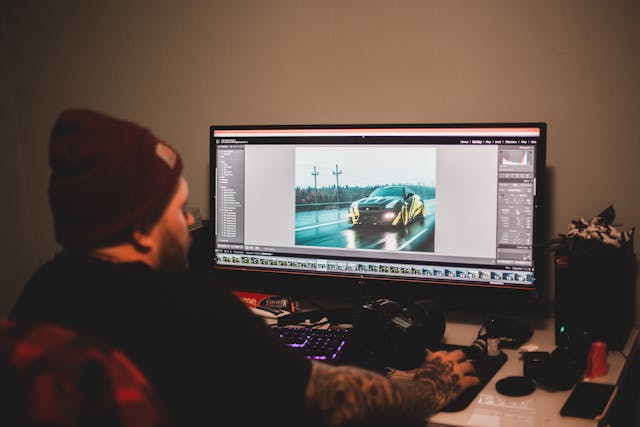
Not every image needs a full redesign to become useful again. In many cases, small edits can make an older asset fit for a new purpose.
That might mean resizing for another platform, cleaning up visual clutter, improving consistency across a product catalog, or isolating a subject from a distracting background so the image can work in a different layout. In that context, tools such as AI background remover tools can be part of a practical cleanup workflow when an image does not need to be replaced outright.
A useful support tool, not the main strategy
The strongest sustainability case is not about any one tool. It is about whether a business is making better use of assets it already has. Digital editing can support that goal when it helps teams reuse, adapt, and extend the life of existing visuals instead of restarting the process every time.
There should still be limits. Faster editing is not automatically more sustainable if it simply leads to more low-value content. The better standard is thoughtful reuse.
Making Visual Workflows More Sustainable for E-commerce & Content Teams
When it comes to creating new visuals for products that get pushed out on multiple channels all the time, it’s no surprise that waste is a major issue in e-commerce. But a well-run library of images can help reduce that pressure to come up with brand new visuals every time you need a new listing, refresh a previous campaign, or are coming up with new content.
Content teams in editorial roles can benefit just as much as e-commerce. Think about it – that illustration you created for a single explainer could easily work for a related guide, and a process graphic might only need new labels slapped on it before it’s good to go again. Even a banner can often be reworked into multiple different placements without needing to be completely re-designed from scratch.
What Good Reuse Really Looks Like
Now, I know what you’re thinking – ‘good reuse’ must just be a fancy way of saying ‘lazy content recycling’. Not quite. Good reuse means keeping all your content tidy, upholding quality standards and adapting it in a way that still resonates with your audience.
How Businesses Can Cut Down on Creative Waste
When it comes to getting a lower-waste workflow going, it all starts with that simple little question: ‘do we actually have something we can use here?’
Before you even think about reshooting or re-designing something you probably don’t need to – take a moment to see if just a little bit of editing or tidying up an old asset can solve your problem. And don’t forget that little pause can save a whole heap of work down the line.
Another useful strategy is to build a ‘reuse-first’ process. That means you need to be keeping all your files tidy, your assets well-labelled and your old visuals easy to find. A lot of businesses end up re-creating content not because they really need to, but because their systems are set up to make reuse more of a hassle than it needs to be.
Digital teams can also benefit from looking at sustainability a bit more broadly. The W3C’s Web Sustainability Guidelines have a great take on this – basically saying that sustainability is all about making informed decisions about digital products and services. And that includes taking into account the workflow choices that’ll help you produce better, more sustainable content without slowing yourself down.
Some Final Thoughts
It’s a common myth that you have to choose between good quality and good sustainability when it comes to your visual content production. But the truth is, in a lot of cases, what’s more practical is also what’s more responsible: refine what you’ve already got, reuse what’s still got value, and only knock up a brand new asset when it really is necessary.
Creative waste is a sneaky one – you might not even notice it’s there most of the time, because it just looks like normal workflow friction. But over time, those little habits will really start to add up, and before you know it you’re using up a lot more effort and energy than you need to be keeping your content flowing. A bit more thought in your visual process will definitely help you cut down on avoidable waste – even if it doesn’t solve all your sustainability challenges overnight.