


If you buy firewood, you will hear many names. Sellers use words like cord, face cord, rick, truckload, and loose load. These words can be hard to compare.
A full cord has a set size. Most other terms do not. That is why buyers need to ask clear questions before they pay.
This guide explains each firewood size in simple words. It also shows how to check the stack before the wood lands in your yard.
Quick Answer: What Are Cords of Wood?
A full cord is the main firewood size in the United States.
It is a stacked pile that is:
- 4 feet high
- 4 feet deep
- 8 feet long
That equals 128 cubic feet.
This size includes the wood, bark, and air gaps.
Terms like face cord, rick, rack, rank, truckload, and loose load are not as clear. Their size can change by seller and area.
Firewood Size Quick Guide
| Term | Common Size | Volume | Buyer Note |
| Full cord | 4 ft × 4 ft × 8 ft | 128 cubic feet | This is the standard cord size. |
| Half cord | 4 ft × 2 ft × 8 ft | 64 cubic feet | Good for medium winter use. |
| Quarter cord | 4 ft × 1 ft × 8 ft | 32 cubic feet | Good for light home use. |
| Face cord / Rick | 4 ft × 8 ft × log length | About 32–64 cubic feet | Always ask for the log length. |
| Stove cord | 4 ft × 8 ft × 12 in | About 32 cubic feet | Often cut short for wood stoves. |
| Bush cord | 4 ft × 4 ft × 8 ft | 128 cubic feet | Another name for a full cord. |
| Truckload / Loose load | Changes by truck | Unknown until stacked | Do not pay full cord price without exact size. |
What Is a Full Cord of Wood?
A full cord is the best size to use when you compare firewood prices. It is a neat stack of wood that is 4 feet high, 4 feet deep, and 8 feet long. The total space is 128 cubic feet. That does not mean 128 cubic feet of solid wood. The stack also has bark and air gaps between the logs.
A full cord must be stacked well. The logs should sit in rows. They should not be dumped in a loose pile.
What Counts in a Full Cord?
A full cord includes:
- The wood
- The bark
- The air gaps between the logs
This is why two cords can feel a bit different. Round logs leave more open space. Split logs fit tighter.
So, a cord of split wood often gives you more burnable wood.
Is a Full Cord Right for You?
A full cord is a lot of wood. It can fill a full-size pickup bed two or three times. It can also fill a 4×8 ft trailer in a deep stack.
Buy a full cord if you:
- Heat your home with wood most of the winter
- Have dry covered space for a 4 ft × 8 ft × 4 ft stack
- Trust the seller
- Want the best price per cubic foot
- Plan to dry or split the wood yourself
Buy a face cord or half cord if you:
- Use your fireplace only sometimes
- Have little storage space
- Want to test a new seller
- Will use the wood in one season
What Is a Face Cord of Wood?
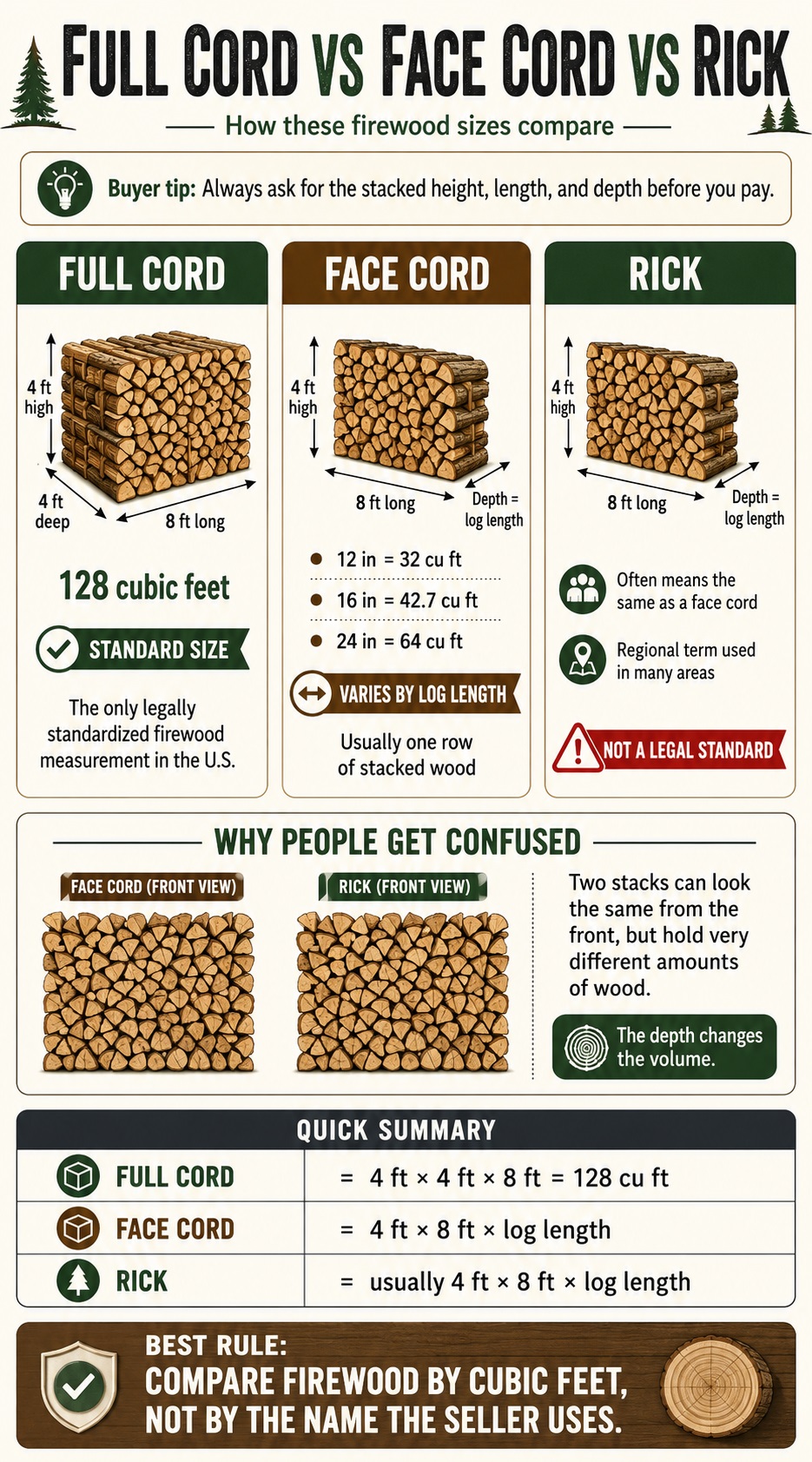
A face cord is one row of stacked wood. It is often 4 feet high and 8 feet long. The depth depends on the log length. Many logs are 12, 16, 18, or 24 inches long. This is where buyers can lose money.
Two stacks can look the same from the front. But one stack can hold much more wood than the other.
How a Face Cord Compares to a Full Cord
A full cord is 48 inches deep. A face cord is only one row deep. So the depth is the length of the logs.
Here is a simple guide:
| Log Length | Face Cord Volume | Share of Full Cord |
| 12 inches | About 32 cubic feet | One-fourth |
| 16 inches | About 42.7 cubic feet | One-third |
| 18 inches | About 48 cubic feet | About 38% |
| 24 inches | About 64 cubic feet | One-half |
Example: 16-Inch Face Cord
A face cord with 16-inch logs is:
- 4 ft high
- 8 ft long
- 1.33 ft deep
That gives about 42.7 cubic feet.
That is one-third of a full cord.
So price matters.
If a seller asks $150 for a face cord and $300 for a full cord, the full cord is the better deal. You get three times the wood for only twice the price.
What Is a Rick of Firewood?
A rick of firewood is a local term. People use it most in the Midwest and South. In many places, a rick means the same thing as a face cord.
It is often one row of stacked wood that is:
- 4 feet high
- 8 feet long
- As deep as the log length
But here is the key point.
A rick is not a legal firewood size in the United States. That means one seller may use “rick” one way. Another seller may use it in a different way. So, always ask for the full size before you buy.
Ask:
- How high is the stack?
- How long is the stack?
- How deep are the logs?
The Rick Problem
A rick can be hard to judge by sight. A rick of 16-inch logs and a rick of 24-inch logs can both look like the same 4×8 ft wall from the front.
But they do not hold the same amount of wood. A 24-inch rick has 50% more wood than a 16-inch rick. So, if both cost the same, the 24-inch rick is the better deal. But you only know that if you ask for the log length.
Other Names for a Rick
Some sellers use other names, such as:
- Rank
- Rack
- Pile
- Tier
These words are not standard. If a seller uses one of these terms, ask for the stack size in feet and inches before you pay.
What Is a Stove Cord?
A stove cord is a short stack of firewood. It is often cut into 12-inch logs. This size fits many wood stoves.
A common stove cord stack is:
- 4 feet high
- 8 feet long
- 12 inches deep
That gives about 32 cubic feet.
So, a 12-inch stove cord is about one-fourth of a full cord.
What Is a Bush Cord?
A bush cord is another name for a full cord. People use this term in Canada and parts of the northern United States.
A bush cord is:
- 4 feet high
- 4 feet deep
- 8 feet long
That equals 128 cubic feet. So, a bush cord and a full cord are the same size.
How to Measure Firewood Before You Pay
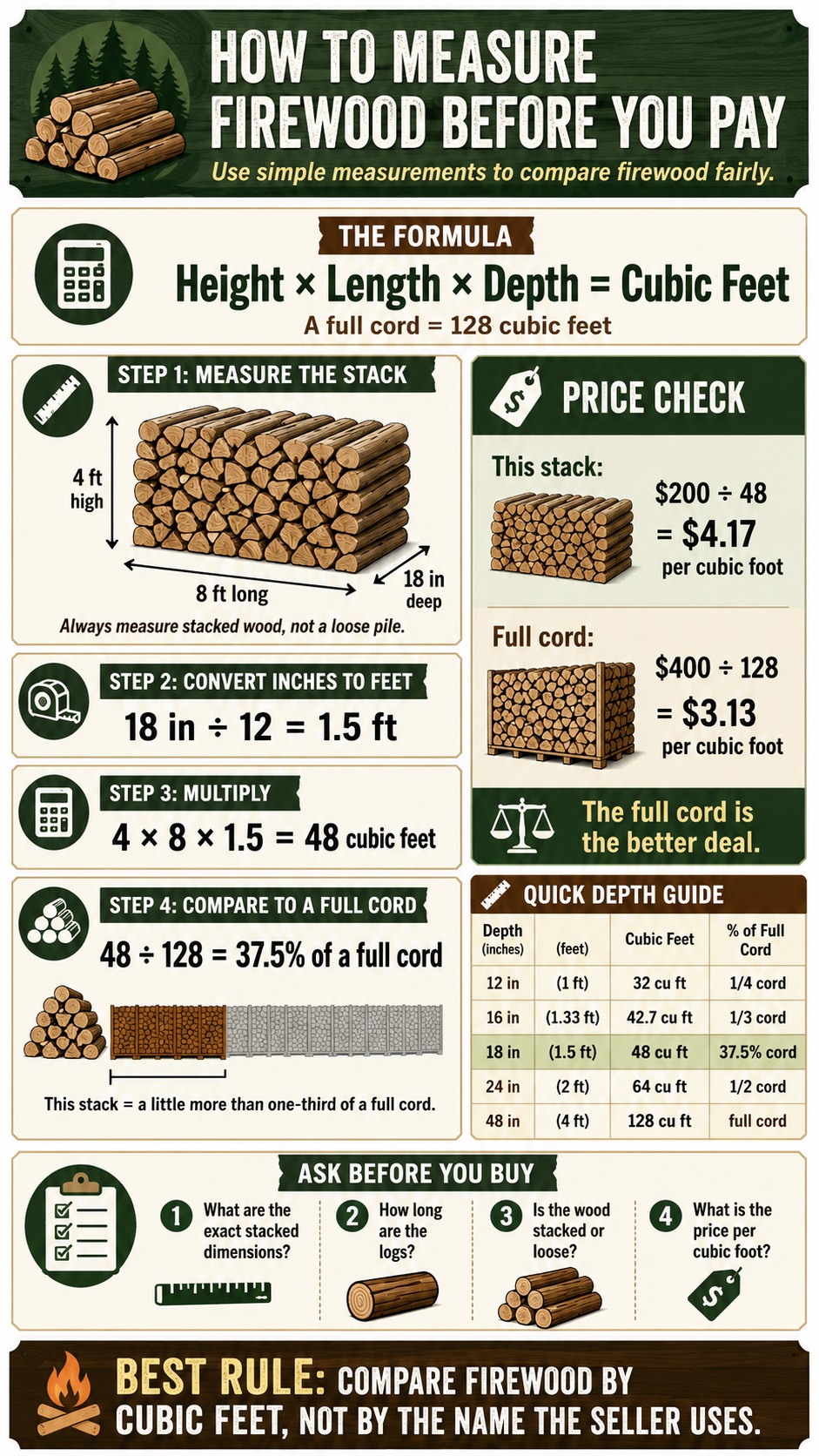
Use this simple formula:
Height × Length × Depth = Cubic feet
A full cord is 128 cubic feet.
A rick or face cord is usually smaller.
Simple Example
You see a stacked pile of wood.
It is:
- 4 feet high
- 8 feet long
- 18 inches deep
First, turn inches into feet.
18 inches ÷ 12 = 1.5 feet
Now multiply:
4 × 8 × 1.5 = 48 cubic feet
Now compare it to a full cord:
48 ÷ 128 = 37.5% of a full cord
So, this stack is a little more than one-third of a full cord.
Price Example
Say the seller charges $200 for that 48-cubic-foot stack.
The price per cubic foot is:
$200 ÷ 48 = $4.17 per cubic foot
Now say another seller charges $400 for a full cord.
The price per cubic foot is:
$400 ÷ 128 = $3.13 per cubic foot
In this case, the full cord is the better deal.
Cord Calculator
| Stack Height | Stack Length | Log Depth | Total Volume | Share of Full Cord |
| 4 ft | 8 ft | 12 in / 1 ft | 32 cu ft | 0.25 / quarter cord |
| 4 ft | 8 ft | 16 in / 1.33 ft | 42.7 cu ft | 0.33 / one-third cord |
| 4 ft | 8 ft | 18 in / 1.5 ft | 48 cu ft | 0.375 |
| 4 ft | 8 ft | 24 in / 2 ft | 64 cu ft | 0.5 / half cord |
| 4 ft | 8 ft | 48 in / 4 ft | 128 cu ft | 1 full cord |
How Much Does a Cord of Firewood Weigh?
Firewood weight changes a lot.
It depends on:
- Wood type
- Log size
- Water inside the wood
- Whether the wood is green or dry
Green wood is fresh-cut wood. It holds more water.
Seasoned wood has dried for months. It weighs less and burns better.
Firewood Weight Guide
| Wood Type | Green Full Cord | Seasoned Full Cord |
| Oak | About 5,000 lbs | About 3,500 lbs |
| Hickory | About 5,400 lbs | About 4,200 lbs |
| Hard maple | About 4,700 lbs | About 3,100 lbs |
| Ash | About 4,400 lbs | About 3,000 lbs |
| White pine | About 3,000 lbs | About 2,000 lbs |
| Cedar | About 2,600 lbs | About 1,800 lbs |
Can a Pickup Truck Carry a Full Cord?
Most half-ton pickup trucks can carry about 1,000 to 1,200 lbs in the bed. A full cord of green hardwood can weigh 4,000 to 5,400 lbs. That means one full cord can take four or five truckloads. This matters when you compare delivery prices. A seller who says “one truckload” is not the same as a seller who says “one full cord.” Always ask for the stacked size.
How Long Does a Cord of Wood Last?
A cord of wood does not last the same for every home.
It depends on:
- How often you burn wood
- How cold your area gets
- What kind of stove or fireplace you use
- Whether the wood is hardwood or softwood
A full cord lasts longer when you burn it in an efficient wood stove.
It burns faster in an open fireplace because much of the heat escapes through the chimney.
How Long One Full Cord Usually Lasts
| Use Type | How Long One Full Cord Lasts |
| Wood stove as main heat in a cold area | 6–10 weeks |
| Wood stove as extra heat | 3–4 months |
| Open fireplace, light use | 3–6 months |
| Fireplace insert, weekend use | 4–8 months |
| Outdoor fire pit, fun use | One season or longer |
Hardwood lasts longer than softwood. Hardwood is denser. That means each log gives off more heat. For example, a cord of white oak gives much more heat than a cord of pine. So, if you heat your home often, hardwood is usually the better buy.
How Many Pieces of Wood Are in a Cord?
There is no exact number.
The count changes based on:
- Log length
- Split size
- Wood type
- How neatly the wood is stacked
For common 16-inch split logs, use these rough counts:
| Firewood Amount | Common Piece Count |
| Full cord | About 550–650 pieces |
| Face cord / rick | About 180–220 pieces |
| Half cord | About 275–325 pieces |
These numbers help you plan daily use. They are not the best way to check a seller. A seller can split wood into small pieces and make the count look high. So, always measure firewood by stacked volume, not by piece count.
Are Firewood Sizes Set by Law?
Yes, but only the cord has a clear legal size in the United States. A legal full cord is 128 cubic feet when the wood is stacked well. That means the wood should be placed in neat rows. It should not be dumped in a loose pile.
Terms like rick, truckload, pile, and loose load are not clear legal sizes. Their meaning can change by seller or place.
What This Means for Buyers
Ask the seller for the real stacked size.
Ask:
- How high is the stack?
- How long is the stack?
- How deep is the stack?
- What part of a full cord is it?
A good seller can answer these questions.
If a seller will not give clear sizes, choose another seller.
What Is a Loose Cord or Thrown Cord?
A loose cord is wood that is tossed into a truck bed, trailer, or pile. It is also called a thrown cord or tossed cord. Loose wood takes up more space than stacked wood. That happens because there are larger air gaps between the logs. So, a loose pile can look big but hold less wood.
Loose Wood vs. Stacked Wood
A loose pile often has 25% to 30% less usable wood than the same space filled with stacked wood. This matters a lot when you pay by the load. A seller may say they delivered a “full cord” loose. But after you stack it, it may only measure 85 to 95 cubic feet. That is far less than a true full cord of 128 cubic feet.
How to Avoid Paying Too Much
Always ask for the stacked volume, not the truck volume. Do not judge the amount by the size of the truck bed. If the seller brings loose wood, stack it before you decide if the amount is right. A good seller will tell you the stacked size and stand behind the amount.
Seasoned, Green, and Kiln-Dried Firewood: What Is the Difference?
Firewood size tells you how much wood you get. Moisture tells you how well that wood burns. Dry wood burns hotter and cleaner. Wet wood is harder to light. It also makes more smoke.
The EPA recommends burning wood with less than 20% moisture. That helps the fire burn cleaner and better.
What Is Seasoned Firewood?
Seasoned firewood has been cut, split, and dried in open air.
It usually dries for 6 to 12 months.
Good seasoned wood has clear signs.
It often has:
- Cracks on the cut ends
- A lighter feel than fresh wood
- A hollow sound when two logs hit each other
- Less moisture inside
Most seasoned firewood has about 15% to 25% moisture.
Best Use for Seasoned Wood
Seasoned wood works well for most homes. It gives a good mix of price and burn quality. It is often cheaper than kiln-dried wood. It also burns much better than green wood.
What Is Green Firewood?
Green firewood is fresh-cut wood. It still holds a lot of water. Green wood often has 40% to 60% moisture. That makes it hard to burn.
Green wood can:
- Be hard to light
- Make too much smoke
- Burn cooler
- Leave more creosote in the chimney
- Make your stove or fireplace work poorly
Creosote is a sticky black buildup inside a chimney. Too much creosote can raise fire risk.
Should You Buy Green Wood?
Buy green wood only if you have time to dry it. You also need a dry, covered place to store it. Most green wood needs 6 to 12 months to season before use. It is not a good choice if you need firewood right away.
What Is Kiln-Dried Firewood?
Kiln-dried firewood is dried in a heated room. This removes moisture fast. Most kiln-dried wood has about 10% to 20% moisture. It is ready to burn right away.
Kiln-dried wood:
- Lights fast
- Burns hot
- Makes less smoke
- Leaves less creosote
- Works well for indoor fires
The main downside is price. Kiln-dried wood often costs 30% to 60% more than seasoned wood.
Best Use for Kiln-Dried Wood
Kiln-dried wood is best if you want wood now. It is also good if you do not have space to dry wood at home. It costs more, but it saves time and storage work.
How to Check Firewood Moisture
A wood moisture meter gives a quick reading. Most cost about $15 to $40.
To test wood the right way:
- Split one piece of wood.
- Test the fresh inside face.
- Do not test only the outside surface.
- Look for a reading under 20%.
If the inside is under 20%, the wood is ready to burn well.
Firewood Heat by Wood Type
Not all firewood gives the same heat.
Hardwood is denser than softwood. That means hardwood gives more heat from each cord. Softwood burns faster. It is still useful for kindling and fire starting.
Firewood Species Comparison
| Wood Type | Heat per Cord | Burn Time | Best Use |
| Osage orange | 32.9 million BTU | Longest | Main home heat |
| White oak | 29.1 million BTU | Very long | Main home heat |
| Hickory | 27.7 million BTU | Very long | Main home heat |
| Hard maple | 25.5 million BTU | Long | Heat and cooking |
| Red oak | 24.6 million BTU | Long | Main home heat |
| Ash | 23.6 million BTU | Long | General use |
| Douglas fir | 20.7 million BTU | Medium | Extra heat |
| Black cherry | 20.4 million BTU | Medium | Heat and nice fires |
| White pine | 14.3 million BTU | Short | Kindling |
| Cedar | 13.0 million BTU | Short | Fire starting |
Hardwood vs. Softwood
Hardwood is best for steady heat.
Good hardwoods include:
- Oak
- Hickory
- Maple
- Ash
These woods burn longer.They work well in wood stoves and fireplace inserts.
Softwood burns fast.
Good softwoods include:
- Pine
- Cedar
- Fir
These woods are not best for long heat. But they light fast and help start a fire.
How Much Does a Cord of Firewood Cost?
Firewood prices change by area, season, wood type, and service. Delivery and stacking can also change the final price.
Here are common U.S. price ranges for a full cord.
| Firewood Type | Common Price per Full Cord |
| Green hardwood | $150–$250 |
| Seasoned hardwood | $250–$400 |
| Premium hardwood | $350–$500 |
| Kiln-dried hardwood | $400–$600+ |
| Seasoned softwood | $100–$200 |
What Raises Firewood Prices?
Firewood costs more when:
- You live in a city or suburb
- You buy during peak season
- The seller delivers the wood
- The seller stacks the wood
- The logs are cut short and even
- The wood is heat-treated for transport
Peak season often runs from October to January.
Prices rise because more people buy firewood then.
What Lowers Firewood Prices?
You can often pay less if you:
- Buy in summer
- Pick up the wood yourself
- Buy green wood and dry it yourself
- Buy two or more cords at once
- Use a local seller with lower delivery costs
Summer buying can save about 15% to 25% in many areas.
Always Ask What the Price Includes
Before you order, ask clear questions.
Ask if the price includes:
- Delivery
- Stacking
- Tax
- Short log cuts
- Kiln drying
- Heat treatment
Delivery and stacking can add $50 to $150 or more. So, a low firewood price can become much higher at checkout. Always confirm the full cost before the wood arrives.
How to Store a Cord of Firewood the Right Way
Good storage keeps firewood dry. It also helps protect the money you spent. Wet wood burns poorly. It makes more smoke and less heat.
Firewood Storage Basics
Follow these simple steps:
- Stack wood off the ground.
- Use pallets, a firewood rack, or 2×4 boards.
- Cover only the top of the stack.
- Leave the sides open for air.
- Store wood in a sunny, breezy spot.
- Keep it at least 5 feet from your house.
- Split large logs before stacking.
- Face the cut ends outward.
Airflow matters. If you cover the whole stack with a tarp, moisture can get trapped inside. That slows drying and can cause rot.
How Much Space Does a Cord Need?
A full cord of firewood takes up a lot of space.
A stacked full cord is about:
- 4 feet high
- 4 feet deep
- 8 feet long
So, plan your storage area before you order. Do not wait until the truck arrives.
Why You Should Buy Local Firewood
Buy firewood near where you plan to burn it. Moving firewood too far can spread pests and tree diseases. A good rule is to buy wood within 50 miles of where it was cut. Firewood can carry insects inside the bark or wood. These pests can spread to new forests.
Common pests include:
- Emerald ash borer
- Spotted lanternfly
- Spongy moth
Many states also limit the movement of untreated firewood. If you go camping, buy firewood near the campsite. Do not bring firewood from home.
What Not to Burn Indoors
Not all wood is safe for a fireplace or wood stove.
Do not burn:
- Painted wood
- Stained wood
- Varnished wood
- Pressure-treated lumber
- Plywood
- Particle board
- OSB
- Ocean driftwood
- Moldy wood
- Rotten wood
- Trash
- Plastic
- Rubber
- Wet or green wood
These materials can make harmful smoke. Some can also damage your stove, chimney, or flue. Wet wood is also a problem. It burns poorly and can cause creosote buildup. Creosote is a sticky chimney buildup that raises fire risk.
Questions to Ask Before Buying Firewood
Ask these questions before you pay:
- Is this a full cord, face cord, rick, or another size?
- What are the exact stacked sizes?
- How high is the stack?
- How long is the stack?
- How deep is the stack?
- How long are the logs?
- What type of wood is it?
- Is it green, seasoned, or kiln-dried?
- How long has it been drying?
- Will it arrive stacked or loose?
- Is delivery included?
- Is stacking included?
- Is the firewood local?
- Can I get a receipt with the cord amount listed?
A good seller can answer these questions clearly.
If the seller avoids the size question, choose another seller.
Common Firewood Buying Mistakes
Avoid these mistakes:
- Buying by “truckload” without exact size
- Thinking a face cord is a full cord
- Paying full cord prices for a rick
- Judging the pile by eye
- Trusting loose piles that look bigger than they are
- Skipping the moisture check
- Forgetting to ask about delivery fees
- Forgetting to ask about stacking fees
Two truckloads can hold very different amounts of wood.
That is why stacked size matters more than truck size.
Frequently Asked Questions
What are cords of wood?
Cords of wood are a way to measure firewood in bulk.
A full cord equals 128 cubic feet.
It is stacked in a neat pile that is:
- 4 feet high
- 4 feet deep
- 8 feet long
How big is a cord of wood?
A full cord is a large stack.
It measures 4 ft × 4 ft × 8 ft.
Many buyers are surprised by how much space it takes.
Is a face cord the same as a cord of wood?
No.
A face cord is one row of wood.
It is usually:
- 4 feet high
- 8 feet long
- As deep as the log length
If the logs are 16 inches long, the face cord is about one-third of a full cord.
Always ask for the log depth.
What is the difference between a cord and a rick?
A cord has a fixed size.
A rick does not.
In many areas, a rick means the same thing as a face cord.
It is often one row of stacked wood.
But the depth depends on the log length.
Ask for the full stacked size before you buy.
What is the difference between a cord and a truckload?
A cord has a fixed volume of 128 cubic feet when stacked.
A truckload has no fixed size.
It depends on:
- Truck size
- Bed height
- Log length
- How loosely the wood is loaded
A full-size pickup bed often holds about one-third to one-half of a stacked cord.
How many cubic feet are in a cord of wood?
A full cord has 128 cubic feet.
That number applies when the wood is stacked neatly.
A face cord or rick is usually smaller.
It often has 32 to 64 cubic feet, based on log length.
How long does a cord of wood last?
It depends on how much you burn.
A full cord may last:
- 6–10 weeks as main heat in a cold area
- 3–4 months as extra heat
- 4–8 months for weekend fireplace use
- One season or more for outdoor fire pits
Why should I buy local firewood?
Local firewood helps stop the spread of pests.
Bugs and tree diseases can hide inside logs.
When firewood moves far, pests move with it.
Buying local protects nearby trees and forests.
Summary
A full cord of wood is the only standard firewood size.
It equals 128 cubic feet.
A full cord is stacked:
- 4 feet high
- 4 feet deep
- 8 feet long
A face cord and a rick are not the same as a full cord.
They are usually one row of wood.
The amount you get depends on the log length.
Before you buy, ask for the stack size in writing.
Check:
- Height
- Length
- Depth
- Wood type
- Moisture level
- Delivery cost
- Stacking cost
Then compare prices by cubic foot.
This takes only a few minutes.
It can help you avoid overpaying by 30% to 60% on your next firewood order.