

Quick answer: Can Dogs Eat Cashews?
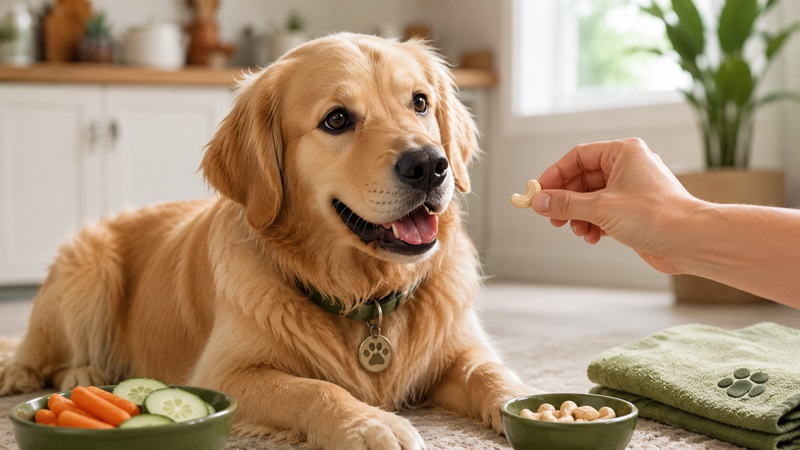
Yes, dogs can eat plain cashews in tiny amounts.
But cashews are not a great dog treat. They have a lot of fat and calories. Too many can upset your dog’s stomach. In some dogs, fatty food can also lead to worse health problems.
Only give cashews once in a while. One small piece is very different from a handful.
Are Cashews Safe for Dogs?
Cashews are not toxic to dogs.
This makes them different from macadamia nuts. Macadamia nuts are unsafe for dogs and should never be fed to them.
Cashews are safe only in strict limits. They should not be a daily snack.
Safe cashews for dogs should be:
- Plain
- Unsalted
- Free from sugar or spice
- Raw or dry roasted
- Out of the shell
- Cut into small pieces
Never give your dog salted cashews. Also skip honey-roasted, spicy, chocolate-covered, or sweetened cashews. These can add salt, sugar, fat, or other unsafe items.
Cashew shells are not safe. They can contain a harsh oil found in poison ivy. Keep shells away from your dog.
Cashew Nutrition: What Is in One Nut?
One average cashew weighs about 1.5 grams. It has about:
| Nutrient | Amount per cashew |
| Calories | 9 |
| Total fat | 0.7 g |
| Saturated fat | 0.1 g |
| Protein | 0.3 g |
| Carbs | 0.5 g |
| Sodium, if plain | 0 mg |
| Magnesium | 7 mg |
| Zinc | 0.2 mg |
| Copper | 0.1 mg |
These numbers look small. But they add up fast for a small dog.
For a 10-pound dog, one cashew is already a rich snack. A handful is too much.
Cashews do have protein and minerals. But your dog does not need them from nuts. A complete dog food already gives your dog the right nutrients in the right amounts.
So, cashews offer little real benefit. They are best kept as a rare bite, not a normal treat.
How Many Cashews Can Dogs Eat? Safe Amounts by Size
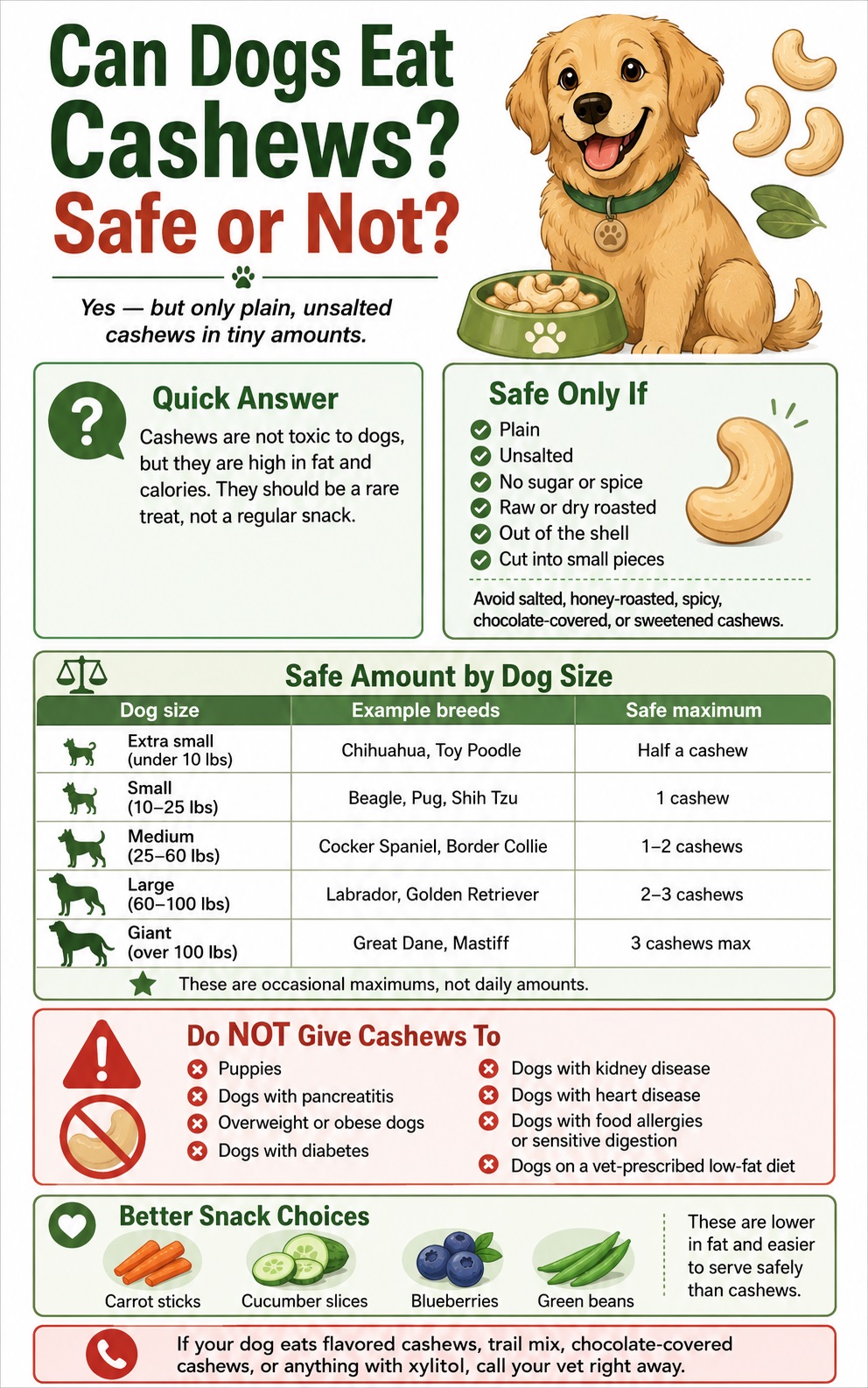
Cashews should be a rare treat.
The amounts below are the most a dog should have once in a while. They are not daily amounts.
| Dog size | Example breeds | Safe maximum |
| Extra small, under 10 lbs | Chihuahua, Toy Poodle | Half a cashew |
| Small, 10 to 25 lbs | Beagle, Pug, Shih Tzu | 1 cashew |
| Medium, 25 to 60 lbs | Cocker Spaniel, Border Collie | 1 to 2 cashews |
| Large, 60 to 100 lbs | Labrador, Golden Retriever | 2 to 3 cashews |
| Giant, over 100 lbs | Great Dane, Mastiff | 3 cashews at most |
These are general limits only.
Do not give cashews to a dog with health problems listed below. This rule applies no matter the dog’s size.
Ask your vet before you add any new food to your dog’s diet.
Why Cashews Can Be Bad for Dogs
They Have a Lot of Fat
Fat is the main problem with cashews. Nuts are rich in oils and fats. In some dogs, this can cause vomiting, loose stool, and pancreas trouble. Dogs with a past pancreas issue need a strict low-fat diet. A fatty snack can cause a flare-up. For these dogs, even one cashew can be a bad idea.
They Can Add Extra Weight
Cashews have many calories for their size. A few cashews each week can add up, mainly for a small dog. Over time, this can lead to weight gain. Extra weight puts stress on a dog’s joints, heart, and body.
They Can Upset the Stomach
Some dogs do not handle fatty foods well.
After eating cashews, a dog may have:
- Vomiting
- Loose stool
- Gas
- Drooling
- Less hunger than usual
This does not always mean the cashew was toxic. It often means your dog’s stomach did not handle the fat well.
They Can Be a Choking Risk
Whole cashews can get stuck in a dog’s throat. This risk is higher for small dogs. Break cashews into tiny pieces before you share one.
Salt and Flavorings Can Be Unsafe
Most cashews made for people are salted. Too much salt is bad for dogs. It is more risky for dogs with heart, kidney, or blood pressure problems. Flavored cashews are also unsafe. Garlic, onion, chili, barbecue spice, and sweet coatings can harm dogs. Garlic and onion are toxic to dogs. They can damage red blood cells.
Cashew Products: Safe or Not Safe?
Salted Cashews: Not Safe
Salted cashews have too much sodium for dogs. Dogs do not need extra salt. Too much can cause thirst, more pee, and salt poisoning in large amounts.
Honey-Roasted Cashews: Not Safe
Honey-roasted cashews have sugar and often salt. These are not good for dogs. Too much sugar can lead to weight gain and tooth problems.
Spiced or Flavored Cashews: Not Safe
Do not give dogs chili, garlic, onion, barbecue, or other flavored cashews. Garlic and onion are toxic, even in small amounts. Spicy food can also upset the gut.
Chocolate-Covered Cashews: Not Safe
Chocolate is toxic to dogs. It can cause vomiting, loose stool, a fast heart rate, seizures, and worse signs. Dogs should not eat any chocolate.
Trail Mix: Not Safe
Trail mix is a dangerous snack for dogs. It often has raisins, macadamia nuts, chocolate chips, and salt. Raisins can harm a dog’s kidneys. Macadamia nuts and chocolate are also toxic to dogs.
Never share trail mix with your dog.
Cashew Butter: Use Great Care
Plain cashew butter can be used only in a tiny amount. Think one small lick, not a spoonful.
Check the label first. Many nut butters have xylitol. Xylitol is very toxic to dogs.
It can cause vomiting, weakness, trouble walking, collapse, seizures, liver failure, and bleeding problems.
If the label lists xylitol, do not give it to your dog.
Cashew Milk: Not a Good Choice
Cashew milk does not help dogs. It often has sugar, salt, or other added items. Dogs only need water to drink.
Cashew Ice Cream: Not Safe
Cashew ice cream has too much sugar and fat. It can also contain sweeteners or flavors that are not safe for dogs.
Complete Nut Safety Guide for Dogs
Some nuts are safer than others. But most nuts are not good treats for dogs.
Use this guide before you share any nut with your dog.
| Nut | Safe for dogs? | Notes |
| Cashews | Tiny amounts only | Plain only. High in fat. No salt or flavor. |
| Peanuts | Small amounts only | Plain only. No salt. Peanut butter must have no xylitol. |
| Almonds | No | Not a good choice. Hard to digest. Salted ones are risky. |
| Walnuts | No | Can upset the stomach. Black walnuts are toxic. |
| Macadamia nuts | Never | Toxic to dogs. They can cause weakness, shakes, and vomiting. |
| Pecans | No | Can upset the stomach. They can also affect the nerves. |
| Pistachios | No | Not a good choice. High in fat. Mold can also be a risk. |
| Brazil nuts | No | Not a good choice. Very high in fat. |
| Hazelnuts | No | Not a good choice. They can choke dogs and are high in fat. |
| Pine nuts | No | Not a good choice. Very high in fat and can upset the stomach. |
Dogs That Should Never Eat Cashews
Some dogs should not eat cashews at all.
For these dogs, the risk is too high. The small taste is not worth it.
Do not give cashews to:
- Dogs with past pancreas trouble
- Overweight dogs
- Dogs with diabetes
- Dogs with food allergies
- Dogs with a weak stomach
- Dogs with kidney disease
- Dogs with heart disease
- Dogs that need less salt
- Dogs on a low-fat diet from a vet
- Puppies
- Older dogs with weak organs
- Pregnant dogs
- Nursing dogs
Puppies are still growing. Their stomachs do not handle rich food well.
Older dogs can also have a harder time with fatty snacks.
Can Dogs Be Allergic to Cashews?
Yes. Some dogs can be allergic to cashews.
Watch for these signs:
- Itchy skin
- Hives
- Swelling of the face or mouth
- Vomiting
- Loose stool
- Trouble breathing
Try only one tiny piece the first time.
Then watch your dog for 30 to 60 minutes. Do not give more during that time.
Call your vet if you see any signs of an allergy.
What to Do If Your Dog Eats Cashews
If your dog ate one or two plain cashews, stay calm.
A healthy medium or large dog will often be fine. Still, watch your dog for 12 to 24 hours.
Look for:
- Vomiting
- Loose stool
- Gas
- Low energy
- Belly pain
- Not wanting food
Call your vet or an animal ER right away if:
- Your dog ate many cashews
- The cashews had salt
- The cashews had spice
- The cashews had chocolate
- The cashews came from trail mix
- The snack had raisins
- The snack had xylitol
- The snack had garlic or onion
- The snack had macadamia nuts
- Your dog is very small
- Your dog is old
- Your dog is pregnant
- Your dog has a health problem
Emergency Signs
Get vet help right away if your dog has:
- Vomiting that will not stop
- Loose stool that will not stop
- Weakness
- Shaking
- Trouble walking
- Collapse
- A hard or swollen belly
- Strong belly pain
- Seizures
If your dog ate xylitol, chocolate, raisins, or macadamia nuts, act fast.
Call your vet, an animal ER, or the ASPCA Animal Poison Control Center at 888-426-4435.
Do not wait for signs to start.
Healthier Snack Alternatives to Cashews
Cashews are not the best snack for dogs.
These foods are easier to serve. They are also lower in fat than cashews.
| Snack | Benefit | How to serve |
| Carrot sticks | Low in calories. Good crunch. | Serve raw or cooked. Cut into small pieces. |
| Cucumber slices | Very low in calories. Adds water. | Remove seeds for dogs with weak stomachs. |
| Blueberries | Sweet and rich in plant nutrients. | Serve whole, or cut in half for small dogs. |
| Apple slices | Has fiber and vitamins. | Remove the core and seeds first. |
| Plain cooked pumpkin | Gentle on the stomach. Good for gut health. | Use plain pumpkin only. Do not use pie filling. |
| Green beans | Low in calories. Good for weight control. | Serve plain. No salt or spice. |
| Plain cooked chicken | High-value protein treat. | No skin, bones, salt, or spice. |
| Watermelon | Adds water. Low in calories. | Remove the rind and all seeds. |
These snacks give dogs more real value than cashews.
They are also easier to portion in a safe way.
Frequently Asked Questions
Can dogs eat cashews every day?
No. Dogs should not eat cashews every day.
Cashews have too much fat and too many calories for daily use. For daily rewards, use a low-calorie dog treat made for your dog’s size.
Are cashews toxic to dogs?
No. Cashews are not toxic like macadamia nuts, chocolate, or raisins.
The main risks are fat, stomach upset, and added salt or flavor.
Can dogs eat salted cashews?
No. Dogs should not eat salted cashews.
Salted cashews have too much sodium. This is more risky for dogs with heart or kidney disease.
Only plain, unsalted cashews are safe in tiny amounts.
Can cashews cause pancreatitis in dogs?
Yes. Cashews can trigger pancreatitis in some dogs.
They are high in fat. Fatty foods can cause a flare-up in dogs that had this issue before.
Dogs with past pancreatitis should never eat cashews.
What happens if my dog eats one cashew?
A healthy medium or large dog will often be fine after one plain cashew.
Watch for vomiting, loose stool, gas, or low energy.
Call your vet if the cashew was salted, flavored, or mixed with raisins, chocolate, xylitol, or macadamia nuts.
Can puppies eat cashews?
No. Puppies should not eat cashews.
Puppies need puppy food and vet-approved treats. Their stomachs are still growing, and fatty foods can upset them.
Can dogs eat cashew butter?
Only plain cashew butter is safe, and only in a tiny amount.
Check the label first. It must have:
- No xylitol
- No added sugar
- No salt
- No flavoring
Even then, give only a small lick as a rare treat.
In practice, it is safer to skip cashew butter.
Is cashew butter safer than peanut butter for dogs?
No. Cashew butter is not safer than peanut butter.
Both must be free from xylitol and added ingredients.
Plain peanut butter is easier to find. It also has a longer history of use as a dog treat.
Are cashews better than dog treats?
No. Cashews are not better than dog treats.
Dog treats are made for dogs. They are easier to portion and fit better into a dog’s diet.
Cashews are human food. They do not give dogs a special benefit.
The Bottom Line
Dogs can eat one or two plain, unsalted cashews once in a while.
But cashews are not a good regular treat. They have too much fat and too many calories.
They are also risky for dogs with:
- Pancreatitis
- Obesity
- Diabetes
- Weak stomachs
- Kidney disease
- Heart disease
- Food allergies
Most store-bought cashews are not safe for dogs. They often have salt, spice, sugar, chocolate, or other unsafe items.
For crunchy snacks, choose carrot sticks, cucumber slices, green beans, or plain rice cakes instead.
Save cashews for yourself. Give your dog a treat made for dogs.
Vet Safety Note
This article is for general information only. It is not vet care. Talk to your vet before giving a new food to a dog with any health problem.
This includes pancreatitis, diabetes, kidney disease, heart disease, food allergies, or obesity. In an emergency, call your vet, an animal ER, or the ASPCA Animal Poison Control Center at 888-426-4435.