
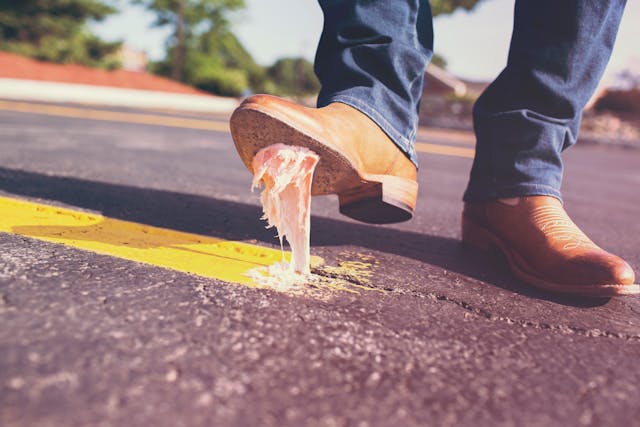

Is gum biodegradable? It’s a question more people are asking — and the short answer is no. Most conventional chewing gum is not biodegradable. The bit that stays in your mouth long after the flavour wears off – that chewy gum base – is made from synthetic polymers that refuse to break down in the natural environment. Once you spit it out on the ground, it doesn’t just rot away like food waste. No, it just sticks there, gets flattened by people walking past and persists – often for decades.
Gum is the second most common form of rubbish you see lying around. Behind cigarette butts, of course. The industry churns out an estimated 1.74 trillion pieces a year worldwide, adding up to a pretty staggering 2.436 million tonnes in total – a mind-boggling 730,000 tonnes of which is synthetic gum base. That’s a bit of a litter problem, to put it mildly.
This article is going to cover what gum is actually made of, why it won’t break down, the latest research on microplastics, how to pick a gum that’s better for the planet and one simple behaviour change that will make most of the problem go away.
What Is Chewing Gum Actually Made Out Of?
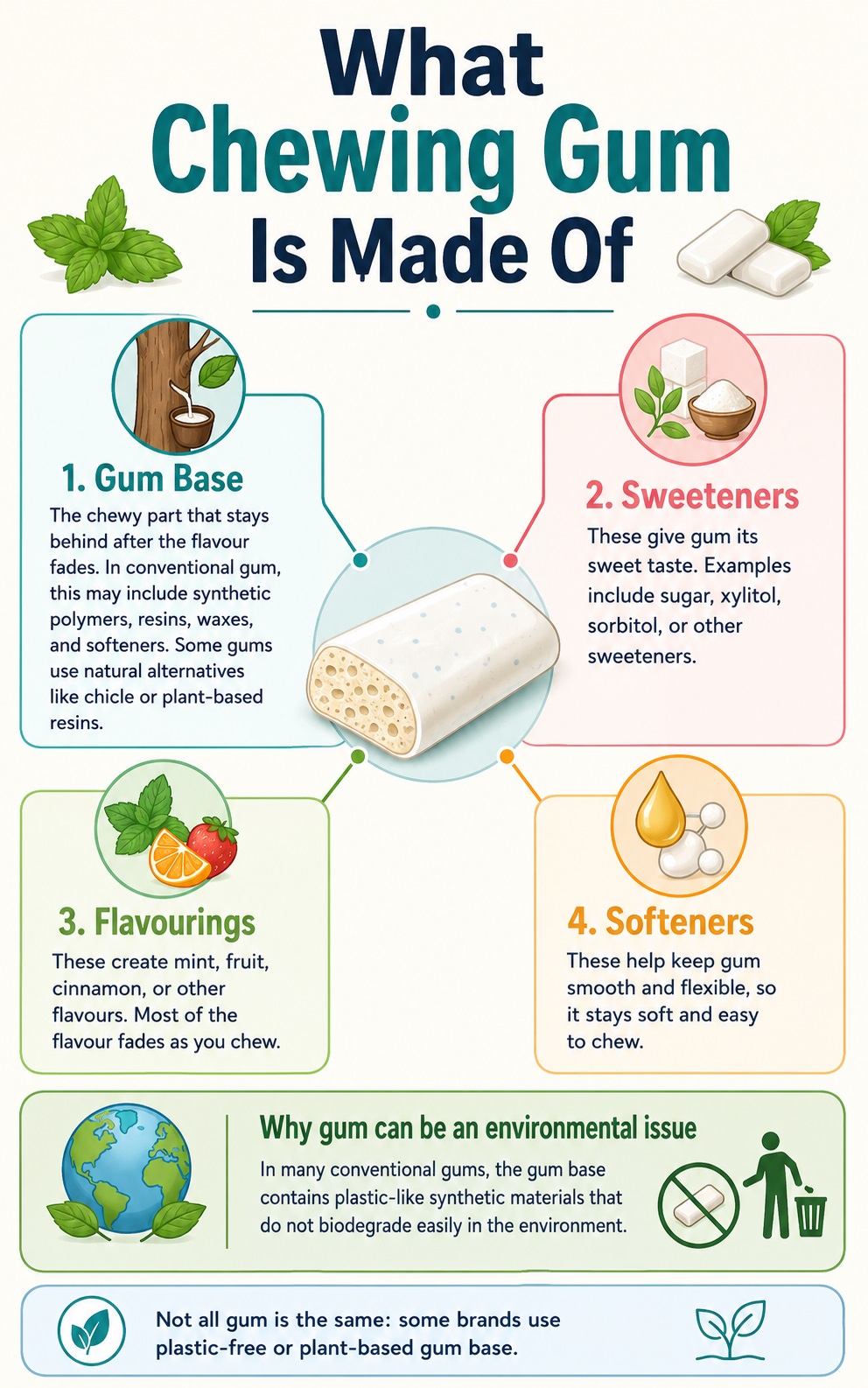
Chewing gum is made up of four main ingredients: gum base, sweeteners, flavourings, and softeners.
The sweeteners and flavourings melt away as you chew. But the gum base stays behind – a sort of rubbery, stretchy mass that’s designed to hold its shape even when you’re chomping away on it under your tongue.
Under US law, approved gum base ingredients include polyethylene, polyisobutylene, polyvinyl acetate, butadiene-styrene rubber, petroleum wax, and loads of other resins and softeners. In other words, the same sort of synthetic materials that go into regular plastic products. That’s why some people are now describing regular chewing gum not as litter so much as a form of plastic pollution.
Not every gum has to be made this way though. Some manufacturers use chicle (a natural latex sap from trees), plant-based resins or other natural latex products instead. Even so, these alternatives need to get disposed of properly – which I’ll go into below.
Is Chewing Gum Biodegradable, Then?
No – most mainstream chewing gum is not biodegradable.
Now, the key word there is readily. Some materials will break down over time, given enough heat, moisture, and microbial activity. But if you squish a piece of gum into concrete it ain’t gonna behave like a leaf in the garden or a scrap of food in a compost heap. The microorganisms that live in the wild just can’t break down synthetic rubber structures easily. It just sticks there, gets flattened by people walking past, collects dirt and often stays visible until someone actually comes along and lifts it up.
What On Earth Is “Gum Base” And Why Do Labels Keep It Under Wraps?
“Gum base” is probably the most mysterious part of any food label
You may see a gum wrapper clearly listing the sweeteners, flavours, colours and softeners they’ve used, then just slap on the phrase ‘gum base’ to indicate the chewy bit – without saying what that base is actually made of. Are they using synthetic polymers, natural resins or a mix of both? Sorry, no one’s really saying – because under US regulations ‘chewing gum base’ is just a fancy way of saying a non-nutritive substance made from approved ingredients – but the actual recipe is just a trade secret.
For the average shopper who wants to make an informed choice, its a real problem. Just because a product has a short ingredient list, it doesn’t necessarily mean its simple or plastic-free. And the gum base is often the most environmentally significant part of the product – but guess what, no one’s explaining it to you.
Here are some more transparent labels to look out for – although it still needs to get chucked in the bin eventually
- “Plastic-free gum”
- Chicle gum (let’s hope thats true!)
- “Natural gum base”
- “Plant-based gum base”
- No synthetic gum base – still gonna end up in the trash, though
Is Chewing Gum Just Plastic in Disguise?
A lot of conventional gums contain plastic-like synthetic polymers – but saying all gum is plastic is just a bit too simple.
Itd be more accurate to say a lot of mainstream gums contain these synthetic polymer materials in the gum base that make them behave more like litter than food waste. Theres a difference between a bit of gum and a plastic bottle – but once that gum hits the ground, it creates the same kind of lasting environmental mark.
Around 95% of commercial chewing gum is estimated to contain some form of synthetic polymer. Every year, roughly 250,000 tonnes of gum waste are chucked out – most of which ends up in the wrong place.
What Happens When You Spit Gum On the Pavement?
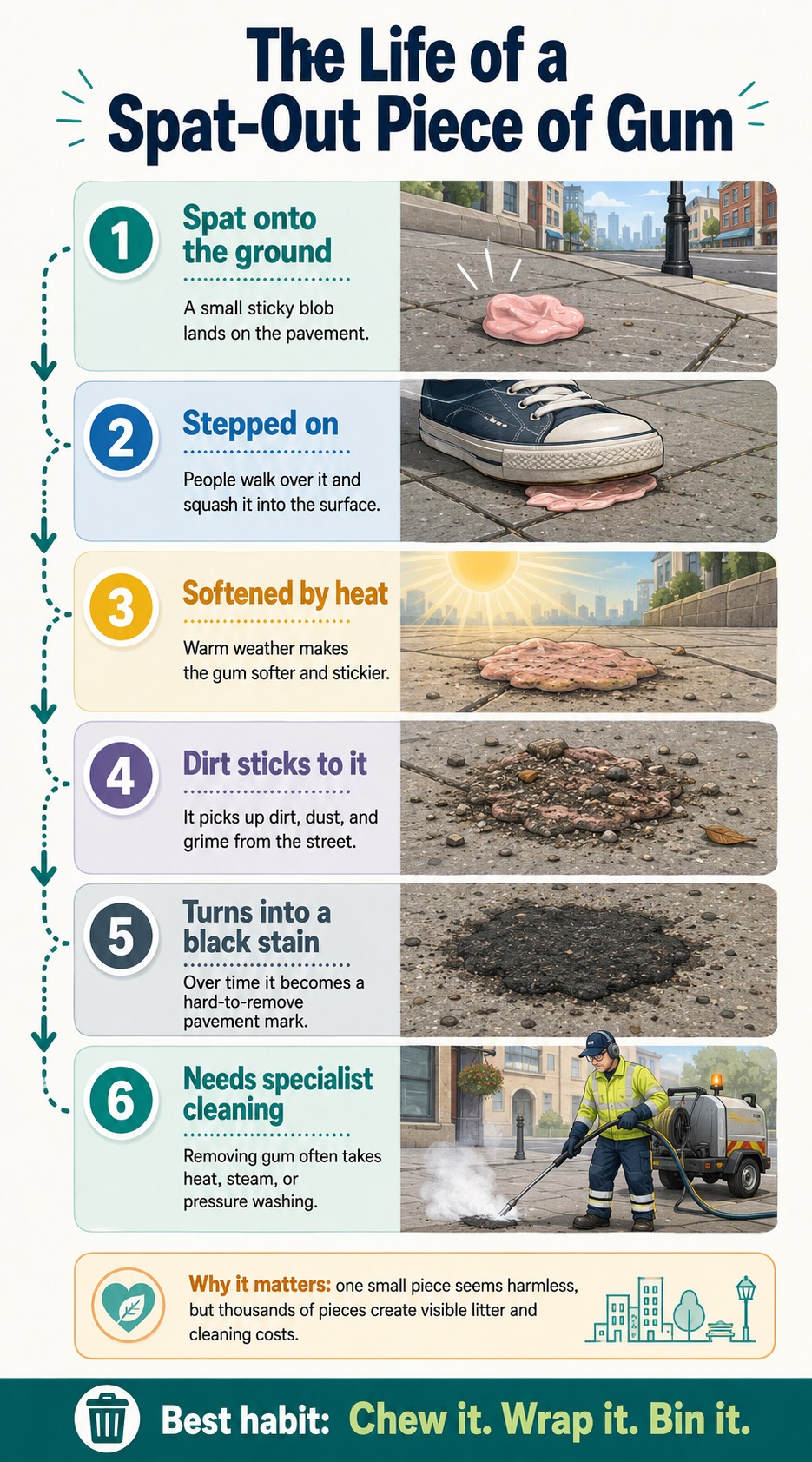
First its just a small, sticky blob. Then some careless sod walks on it. Heat comes along and softens it up, its then latched onto by dirt and dust. And before you know it, its just a flat grey or black mark embedded into the surface – perfectly indistinguishable from hundreds of others all over the place.
Thats why busy public spaces look such a state over time. One bit on its own is insignificant but thousands of bits all getting spat and trampled over months and years just creates a big, stained mess that’s a pain to clean.
Why Gum Litter is such a Pain to Clean Up
Gum has a nasty habit of sticking to rough surfaces – concrete, tarmac, brick, stone – and just about any other surface that’s a bit bumpy. This is because it fills up the tiny gaps and has a snappy strong hold. Don’t expect the rain to shift it off – and good luck with using an ordinary broom to get rid of it – you’ll just end up spreading it around. If you want it gone, you need to break out the big guns: heat, steam, pressure washing or some serious chemical treatment.
They reckon it costs about €1.50 to get the gum off one bit of pavement in Scotland. One report way back in 2021 estimated that the UK was chucking a staggering £7 million a year at clearing gum off the streets.
In June 2025, the UK government chipped in with £1.2 million to support more than 50 councils in their gum-clearing efforts. This was all part of the Chewing Gum Task Force – run in partnership with Keep Britain Tidy and the gum manufacturers (who include the likes of Mars Wrigley and Perfetti Van Melle) who are actually coughing up up to £10 million over five years for this lot. By January 2026 the task force was into its fifth year and had already cleared a pretty impressive 4.15 million square metres of pavement – and had managed to reduce gum litter by up to 86% in those areas. If you’re a council, you can apply for a grant of up to £27,500 – and if you need some snazzy equipment, you’ll get even more support than that.
The thing is, all this money spent on gum-clearing is money that could be going towards other much-needed local services.
What the 2025 Microplastics Research Found – and How it’s Rattling the Chewing Gum Industry
In March 2025, researchers from UCLA dropped a bombshell at the American Chemical Society (ACS) Spring meeting in San Diego that opened up a whole new can of worms on the gum debate.
The study – “Chewing Gums: Unintended Sources of Ingested Microplastics in Humans“ – took a look at ten different brands of chewing gum – five of them synthetic and five that used natural materials. The key findings were pretty scary:
- Gum releases an average of 100 microplastic particles per gram – and some samples were releasing up to 637 particles per gram.
- A whopping 94% of all the microplastics were released within the first 8 minutes of chewing.
- Most of the release happened within the first two minutes – and that was all down to the physical act of chewing itself, rather than any special magic of the gum.
- Just as a surprise, natural and synthetic gums released similar quantities of microplastics – which was a bit of a blow for those who thought switching to chicle or plant-based gum would be a safer option.
That last one was a real eye-opener. It means all that fuss over choosing the ‘right’ type of gum may be a bit of a waste of time – at least, if the researchers are right. They’re still doing some digging on natural gums to see where all these microplastics are coming from.
The study boss, Sanjay Mohanty at UCLA, made a point to say that they’re not out to cause a panic – it’s just more research needed before anyone can say whether these microplastics are any kind of risk to humans. For now, the takeaway is pretty clear: gum is just another everyday product that’s chipping in to your microplastic intake – so maybe think twice about how often you chew and where you dispose of your gum.
Is Gum Biodegradable or Just Slow to Break Down?
Many people assume gum eventually breaks down — just slowly. That assumption is worth correcting. True biodegradation means microorganisms can digest a material and return it to nature. Most conventional gum base contains synthetic polymers that microorganisms simply cannot break down, regardless of how much time passes. Slow decomposition and non-biodegradability are not the same thing — and for conventional gum, the honest answer is the latter.
How Long Does Chewing Gum Take to Break Down ?
A lot of articles out there say gum will break down in 5, 20, or 50 years. Those exact numbers get kicked around a lot but the truth is – they don’t really have any solid basis in fact
The honest truth is conventional gum is basically a piece of junk that lasts forever, it doesn’t break down on a timescale that comes anywhere near food waste. The actual timeline is going to depend on the type of gum you’re dealing with, the temperature, how much sunlight it gets, the moisture levels, what kind of surface its on, and how many feet walk by it. A piece of gum on a hot city street is going to age in a totally different way to a piece of gum in a shaded spot of soil
For all practical purposes, the exact number doesn’t really matter that much – the key point is that standard gum doesn’t break down very quickly and it doesn’t belong on the ground
Can Chewing Gum Be Recycled or Composted ?
Recycling: Conventional chewing gum is not accepted in your standard recycling for paper, plastic, glass, or metal – it gets stuck everywhere, gets contaminated after being used, and just cant be sorted or processed like that
However there are some specialist programs kicking around. TerraCycle has been running pilot gum recycling projects in the States, Europe, and Mexico – they collect up used gum, clean it, mix it with other materials and then use it to make things like doorstops and playground equipment. Gum Drop is a UK-based company that partners with gum brands like Wrigley to collect discarded gum and turn it into plastic pellets and rubberised stuff like shoe soles and wellies – these programs arent available everywhere yet, but they are out there and growing
Composting: Most standard gum base is not going to break down at all in your home compost or food waste bin – its nothing like peeling a piece of fruit, or throwing some veg scraps or coffee grounds into the bin. Even if its plastic-free or based on chicle, dont go putting it in your compost unless you’ve got specific guidance from the brand that its alright to do so, and also unless your local composting facility is allowed to handle it
Drains and toilets: whatever you do – dont try to put gum in the drains or toilets. Its a complete nightmare.
The general advice still stands: just wrap up your used gum and chuck it in the bin
Biodegradable Gum vs Plastic-Free Gum – Whats the Difference ?
These two claims are kinda-related but not exactly the same thing
Plastic-free gum means that the base of the gum isn’t made from synthetic plastic – its made from natural stuff like chicle, or plant-based resins.
Biodegradable gum means the material is supposed to break down if you put it in the right conditions
These claims can overlap but actually conditions really do matter a lot. A material that is described as biodegradable may still require some pretty specific conditions to actually break down – like industrial composting temperatures, or very specific moisture levels – and a city sidewalk just wont give you that.
The 2025 research from UCLA/ACS even adds a bit of a wrinkle – even gum that is based on natural materials appears to release microplastics when you chew it – possibly because they introduce them during manufacturing. Choosing a natural gum base may be a bit better for the environment in the long run, but it wont completely eliminate exposure to microplastics when you chew it.
The safest take: going for a plastic-free or chicle-based gum is a better option but it still means you cant just litter and also it may not be as good for reducing microplastic intake as you might think its going to be.
Are Biodegradable Chewing Gums Any Good?
Yes, they are. There are plenty of biodegradable and plastic-free chewing gums out there that you can buy.
Chicle the sap of the Sapodilla tree used to be the main ingredient in chewing gum, but since the mid 20th century synthetic gunk has taken over. However several brands have gone back to using chicle or similar plant based ingredients: Glee Gum, Simply Gum, Chewsy and Chicza are some of the better known ones.
These gums are a step in the right direction in terms of not using as much petroleum, and if you’re lucky they might break down a bit more easily than the regular stuff. But, and this is a big but, just because something is “natural” doesnt mean you can just chuck it anywhere. In fact, as some research from 2025 suggests, even the natural stuff can be microplastic free.
When a brand says its alright to pop their gum in the bin, you want to make sure they understand what they are talking about. Look for proper language, a clear explanation of how to dispose of the gum, and not just vague ‘natural’, ‘eco’ and ‘clean’ stuff.
How to pick a more Eco-Friendly Gum
If you’re looking for a more eco friendly gum, look for the labels that actually say something. You want more than just ‘gum base’. Here are some things to look out for:
- “Plastic-free” or “no synthetic gum base” is a start
- “Chicle” or “natural latex base” are options
- “Plant-based gum base” is good, but make sure the brand tells you what plant it came from
- All the packaging should tell you how to dispose of the gum too
- Try to find brands with minimal packaging that is at least recyclable
- If a brand claims its gum will compost, make sure they tell you exactly how under what conditions
Don’t fall for terms like natural, green or clean – they dont actually mean anything. Just because a brand says its gum is “natural” doesnt mean its free of synthetic junk.
How to dispose of Chewing Gum properly
Its not that hard. In fact it only takes a few seconds.
Just wrap the gum in paper, a tissue or its original wrapper and bung it in the bin
Dont put used gum in:
- Recycling bins – it wont get sorted right
- Compost or food waste bins – its not like its going to decay the way you want it to
- The loo or drain – its not going to break down in the water either
- Planters or garden soil – dont even think about it
- Streets or parks – it looks ugly and causes problems
- Under tables or chairs – just leave it where it is
Common Myths About Gum and Biodegradability
Myth: Rain will wash the gum away. Wrong, rain just makes the gum look a bit different, but its not going to lift it off the pavement. Anything that gets stuck to a rough surface needs something more to get it off
Myth: Biodegradable gum can be chucked anywhere. No its not that simple. Even the stuff that will eventually break down needs a nice environment to do it in. Theres no chance that will happen on a pavement in a city. All gum belongs in the bin, regardless of how it was made.
Myth: One piece of gum wont cause that much trouble. One piece is small, but scale it up to a few hundred people all dropping gum in the same place and you’ve got a different story. A single stop on the bus can be covered in gum in just a year.
Myth: Natural gum has no microplastics. Guess what? In 2025 some researchers found out that natural and synthetic gum both produce microplastics in similar amounts. Still not sure who to blame for that.
Myth: All natural gum is free of plastic. Just because a gum is made of natural ingredients doesnt mean it is plastic-free. Some brands use cleaner stuff, but the word “natural” just means nothing. Its not worth getting too excited about.
Breaking Up with Conventional Gum – Better Options Ahead
If you’re looking to cut down on gum-related waste, you might want to consider one (or all) of these alternatives:
- Try switching to gum brands that have ditched plastic and gone with chicle based products instead
- Replace gum with sugar-free mints or lozenges – they can do the trick for freshening breath
- Don’t be lazy – get into the habit of brushing after meals or giving your mouth a good rinse with water
- Instead of chomping down on a whole pack of gum in one sitting, try to make the one piece you have last a bit longer
- And just a little thing: keep a small gum wrapper on you at all times, so you can toss the used gum in the bin when you need to
None of this is going to be a perfect fit for everyone, though. What works best is probably going to be finding a gum that’s got a clear label and really taking responsibility for disposing of the used gum properly.
So, Is Gum Even Biodegradable?
The truth is most of the gum you buy is not biodegradable at all. Those synthetic polymer materials in your average gum base are basically like tiny bits of plastic that don’t go away – like the stuff that ends up littering the streets and parks. They don’t dissolve when it rains, don’t break down in the soil, and they don’t just magically disappear like that pesky piece of gum on the pavement.
Gum made with chicle or other natural materials might be a better bet – they use fewer petroleum-based materials, so that’s a plus. But unfortunately they still need to be tossed in the bin, and some recent research even suggests they might not be any better for the environment when you’re chomping on them either.
So, here’s the simplest and most painless habit yet: just chew the gum, wrap it, and then bin it. Easy peasy.