Image source: pixabay
You marched. You signed petitions. You argued online about emissions, waste, and climate policy. At some point, a different thought showed up: what if protest was not the end of the story? What if you built something people would actually buy?
That question matters. The green technology and sustainability market is projected to reach $73.9 billion by 2030. U.S. climate tech startups pulled in $7.6 billion in 2024 alone. Money is moving. Buyers are paying attention. The opening is real.
The hard part is that environmental conviction does not turn into a business on its own. CB Insights has long found that the most common startup failure is weak market demand. Founders build something they believe matters, then learn too late that customers do not feel the same urgency. That gap is even more common in climate and sustainability. Founders see a real problem, but they describe it at the level of the planet, not at the level of a buyer.
The planet is not your customer. A person is. A team is. A business with a budget line is.
That does not weaken the mission. It makes the mission usable. If you want to move from activism to entrepreneurship, this is the line you have to cross. You stop asking only, “How do I help fix this?” and start asking, “Who pays to fix this now, and why would they pick me?”
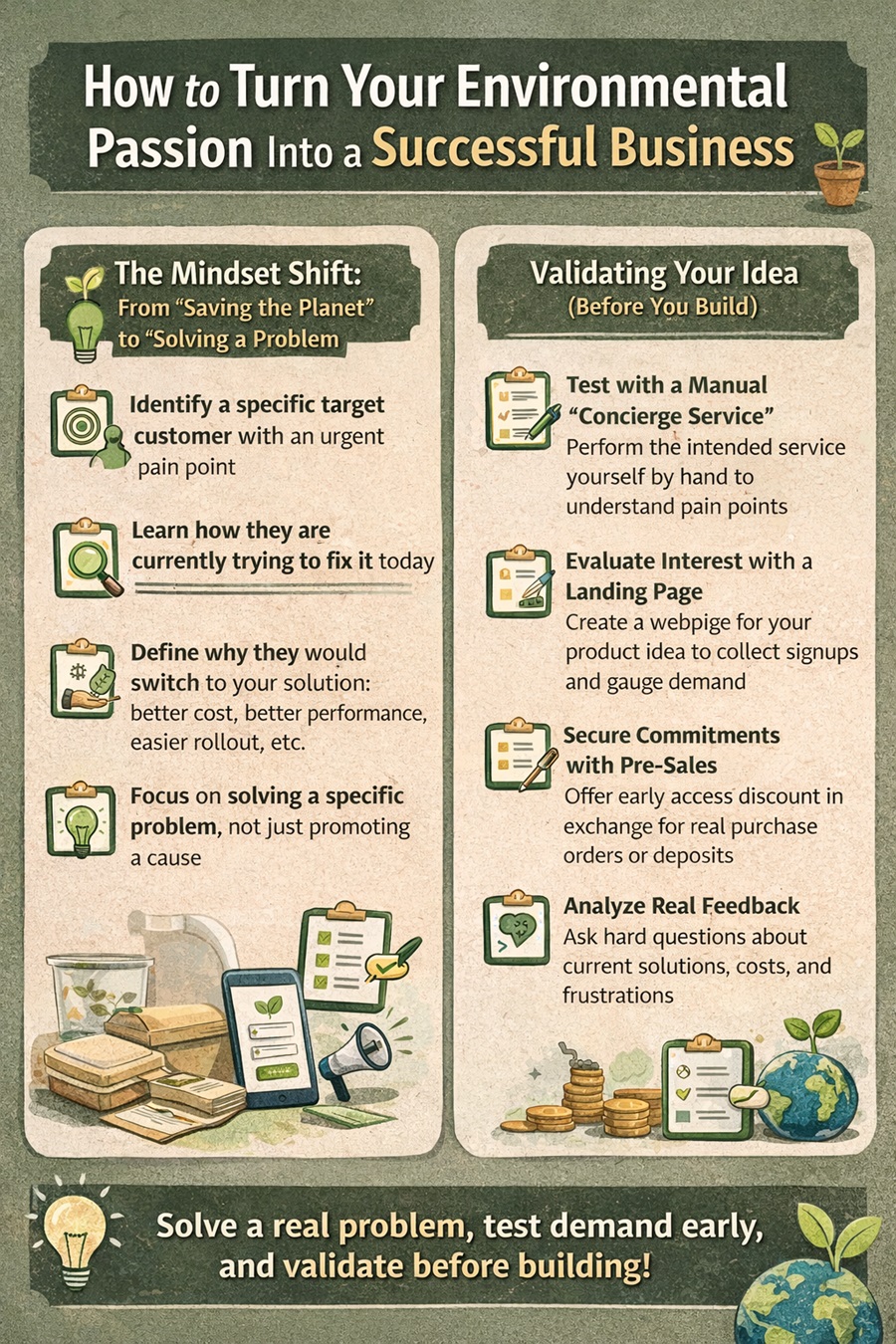
The Mindset Shift: From “Saving the Planet” to “Solving a Problem”
This is where many activist founders get stuck. They build around a cause. Buyers spend money on a problem.
A cause sounds like this: we need to reduce plastic waste in the ocean.
A business case sounds different: restaurant groups spend thousands each year on single-use packaging, face rising pressure from local rules and customer expectations, and need a replacement that does not disrupt ordering, storage, or margins.
Both point to the same environmental issue. Only one gives a buyer a reason to act.
In practice, this is the shift that separates a strong mission from a weak startup. Buyers do not pay because your product reflects their values. They pay because it removes friction, cuts cost, lowers risk, helps them meet a rule, or makes an existing job easier. If the environmental gain comes with that, even better. But it rarely closes the sale by itself.
You can see this pattern across successful climate businesses. The winning pitch is rarely “help us save the planet.” It is “this performs as well as what you use now, costs less over time, and helps you avoid a growing problem.” That is a much easier decision inside a real company, where budgets are tight and people answer to procurement, finance, and operations.
This means your early work is not branding, product design, or a pitch deck. It is definition.
Who has the problem, in exact terms? Name the role, the industry, the company size, the operating pressure. “Small food brands shipping direct to consumers” is useful. “Everyone who cares about waste” is not.
What are they already doing about it? If the problem is real, money is already being spent somewhere. It may show up as labor, delays, compliance costs, product loss, customer churn, or ugly manual work no one wants to own. If there is no current spend, there is usually no active pain.
Why do they switch? “Because it is greener” is not enough. Buyers switch for concrete reasons. Lower cost. Better performance. Easier rollout. Less reporting risk. Faster installation. Fewer failures. A cleaner fit with new rules.
This is the discipline activism does not always teach. In advocacy, moral clarity can be enough to rally people. In business, it is not enough to win adoption. You need proof that the pain is real, that the buyer feels it now, and that your offer beats the current fix in plain terms.
Until you can answer those questions with names, numbers, and a believable reason to switch, you are not ready to build. You are ready to research.
From Idea to Product: Why Your First Version Should Embarrass You, a Little
Most first-time green founders want to build too much.
They picture a full sustainability platform, a complete circular marketplace, or a carbon tool that handles every scope, every sector, and every region from day one. It sounds serious. It also drains time and cash before the market gives you a clear answer.
That matters more now than it did a few years ago. Trellis reported that the median early-stage climate tech raise climbed from $766,000 to $2.1 million between 2022 and 2025. That looks healthy on paper. In practice, it disappears fast when a startup tries to build an entire product stack at once. PwC’s 2024 State of Climate Tech report made the bigger point plain enough: getting from early funding to later rounds is getting harder, and fewer investors are showing up after the early stages. You get a short runway to prove that the thing you are building deserves more money.
That is why the MVP matters.
An MVP is not a weak version of a big idea. It is a narrow test of one belief. If your long-term plan is a reporting platform for mid-market companies, the first version does not need to cover everything. It can do one job for one buyer. Auto-calculate Scope 1 emissions for U.S. manufacturers in one region. Pull one recurring data set into one report. That is enough for version one if it solves a real pain.
This matters even more in green startups because the products get messy fast. Emissions factors change. Supply chains are uneven. Rules differ by market. Data quality is rarely clean. Founders lose months trying to design for every edge case before they have one paying customer. The smarter move is simpler. Building the one piece that proves customers will pay takes weeks, if you work with the right startup MVP development services team that understands how to scope ruthlessly and ship fast.
That is the point of the first version. Not to look complete. To answer one hard question.
Dropbox is the standard example because it proved demand with a short demo before building the full product. Your startup does not need to copy that move exactly. The principle is still right. Test demand before you pour time into polish.
A useful green MVP usually follows a tight frame:
- Pick one buyer. Not “sustainability managers at large companies.” Pick something closer to “sustainability managers at U.S. food manufacturers with 200 to 500 employees.”
- Fix one broken workflow. Not “handle ESG reporting.” Focus on one recurring pain, like collecting monthly emissions data from three supplier categories.
- Set a real deadline. Eight weeks works for many software MVPs. Hardware takes longer, but the deadline still needs to force choices.
- Choose one result that counts. Five paying customers. Fifty active users. Three signed letters of intent. Something real, not vague interest.
Founders hate this stage because it feels small compared with the mission. That discomfort is useful. If your first version feels a little narrow, even a little embarrassing, you are probably doing it right.
Validation Before Scale: How to Know If Anyone Will Pay
Once you have an MVP idea, the next job is not development. It is validation.
This is where a lot of green founders get misled by polite feedback. The sustainability space is collaborative, and people want new ideas to succeed. They will praise the concept, nod through the demo, and tell you it sounds promising. None of that means they will buy.
So stop asking soft questions.
“Would you use a tool that tracks your carbon footprint?” is useless. People say yes because it sounds responsible.
Ask what they did last time. Ask how the work gets done today. Ask what dragged, what broke, what got pushed to the last minute, and where money or staff time got wasted. Real products live inside those details.
Three low-cost validation methods work well in climate and sustainability:
- The concierge test. Do the work by hand for a few customers before you build software. If you want to build a waste tracking product, track waste manually for five customers using spreadsheets and email. You will learn where the real friction sits.
- The landing page test. Put one clear promise on a page and send the right traffic to it. If people do not sign up, the message is weak, the pain is weak, or both.
- Pre-sell before launch. Offer early access at a lower price in exchange for a real commitment. Interest is cheap. A purchase order tells the truth.
The broader startup numbers make the point. The U.S. Bureau of Labor Statistics has found that about 48 percent of startups fail within their first five years. Tech startups fail at even higher rates. The founders who last usually do one thing early: they check demand before they scale spending.
Funding Your Green Startup: Grants, VCs, and the Missing Middle
Early-stage startups run on oxygen, and oxygen is money.
Climate tech still attracts real capital. U.S. climate tech startups logged 382 clean energy venture deals in 2024, according to Silicon Valley Bank. New funds are still being formed, including vehicles built to help climate companies move from pilot work into commercial rollout.
The other side is harder. Global climate tech venture funding fell by roughly 40 percent between 2022 and 2024, dropping from $25.9 billion to about $17 billion. Investors did not leave the category, but they got stricter. A strong mission no longer carries a weak business case.
That changes how founders need to think about funding.
At the earliest stage, grants are often the best source of capital. Government programs in the U.S. and Europe still back green research, pilot work, and early commercialization without taking equity. That matters because it buys proof. Solugen is a useful example. It used early grant support to help validate its bio-based chemical platform before it raised major private capital.
After you have an MVP and signs of demand, seed investors become more realistic targets. Climate-focused firms such as Breakthrough Energy Ventures, Lower carbon Capital, and Congruent Ventures look for early proof, not just a strong narrative. That is why your first customer data often matters more than your vision slide.
Then comes the harder stretch, what many founders call the missing middle. A climate company can raise seed money and even a Series A, then hit a wall when it needs much larger sums for commercial deployment. That gap is one reason new funds have started targeting project-heavy climate businesses that are too advanced for seed money and too early for traditional growth capital.
The lesson is simple. Match the funding source to the stage you are actually in, not the stage you want to be in. At every point, lead with unit economics and buyer demand. The environmental upside matters. It does not replace business proof.
Building the Right Team When You’re Not Technical
CB Insights has found that team problems sit behind a large share of startup failures. For founders coming from activism, policy, research, or nonprofit work, that problem usually shows up in one place first: product and engineering.
You need technical talent, but you also need a way to judge it.
Most non-technical green founders have three real options.
The first is finding a technical co-founder. This is still the best version when it works. You get someone who can shape the product, make architecture calls, and own the build. The problem is that strong technical people with climate interest get attention from everywhere. Finding the right match takes time.
The second is hiring a development partner. This is faster, and for many founders it is the cleanest way to get an MVP out. A good partner helps you cut features, choose tools that fit the stage, and push back when you are asking for too much. A bad one takes your wishlist, builds all of it, and hands you an expensive product nobody wanted.
The third is joining an accelerator. Programs like Greentown Labs, Third Derivative, and Google for Startups’ climate-focused work can help with mentoring, technical access, and investor connections. Harvard Business Review has also pointed to evidence that accelerator participation lowers failure rates for some startups.
No matter which path you choose, the same rule applies: do not hire a full engineering team before you have demand. Payroll burns through pre-seed money fast. Keep the team tight until customers confirm the product deserves a bigger build.
The Regulatory Tailwind You Cannot Ignore
A lot of activist founders underestimate how much regulation shapes a market.
In climate tech, rules create deadlines, and deadlines create budgets.
The EU’s Corporate Sustainability Reporting Directive already forces thousands of companies to report more environmental data. In the U.S., the path has been less clean, but the direction is still clear. The UK, Canada, Australia, and other markets are also tightening disclosure and reporting rules.
That changes the sales conversation.
A company that ignored carbon accounting five years ago may now need data systems, reporting help, audit trails, and cleaner records because the work is no longer optional. If your product helps a buyer meet a rule, reduce reporting pain, or avoid compliance trouble, you are not selling a nice extra. You are helping them get through a deadline with less risk.
That is one reason investor interest stays strong in carbon data tools, ESG software, reporting automation, and climate adaptation technology. The buyer need is tied to regulation, operations, and risk, not just brand image.
For a founder, that means timing matters. If policy is shifting in your target market, your message should make that plain. Do not pitch the product as a general good. Pitch it as a way to get required work done with less pain.
Ship, Learn, Repeat
Most startups fail. That number gets repeated so often it starts to sound empty. What matters more is the pattern inside the survivors.
They ship something small. They watch what happens. They talk to users. They fix what is wrong. Then they do it again.
Green founders often struggle here because the mission feels too important for an imperfect launch. They want the product to be broader, smarter, and more complete before anyone sees it. That instinct slows learning.
Your first version will be wrong about something. Usually more than one thing. The buyer you chose may not be the buyer who cares most. The feature you thought mattered most may barely matter at all. Your dashboard may impress users while the real need is a plain export they can send to a CFO or compliance lead. Pricing gets missed all the time too, and many green products launch too cheap because founders confuse affordability with trust.
You do not learn any of that in a planning document. You learn it by putting a real thing in front of real users and watching what they do when the work is theirs and the money is real.
A better operating rhythm looks like this:
- Write down your single most important assumption in one sentence.
- Build the cheapest test you can run against it.
- Put a decision date on the calendar.
- Keep going only if the evidence is real.
The climate startups that move fastest are not always the ones with the biggest vision. They are the ones that learn faster than their own assumptions.
Your environmental passion is the fuel. What keeps the company alive is speed, judgment, and the discipline to test reality before you expand.
The planet does not need your perfect first version. It needs a business that survives long enough to matter.