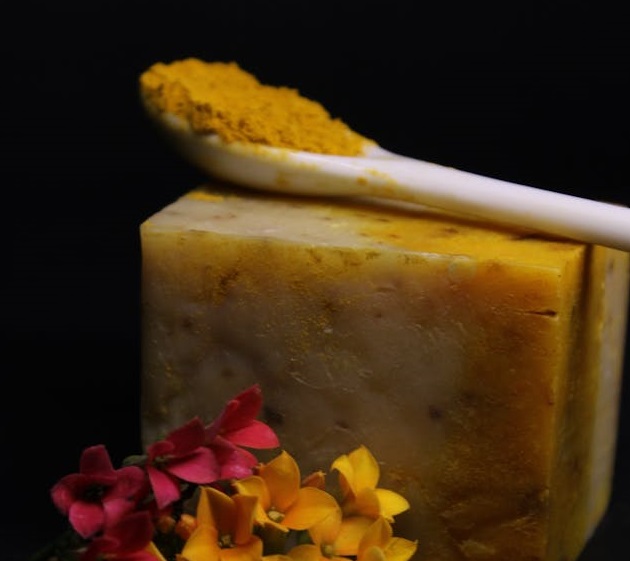

Turmeric Soap has crept its way from traditional Ayurvedic cleansing rituals into the mainstream of modern skincare routines, and it’s now showing up in U.S. drugstores, wellness blogs and the occasional viral social media skincare video – getting touted as a “natural fix” for acne, dark spots and uneven skin tone.
But just because it’s popular, doesn’t mean it actually works.
Does Turmeric Soap really have any benefits for acne, or does it just fade into the background as just another online trend?
Here’s a rundown of what turmeric soap really does, what it can’t do, and who might see some real benefits from adding it to their routine.
Quick Answer: Does Turmeric Soap Actually Work?
Turmeric soap is great for helping to manage mild to moderate acne , to calm down skin inflammation and to give your skin a more even look over time. It may even help to brighten up dullness and fade those annoying post acne dark spots if you stick with it. Just keep in mind that its not a medical acne treatment and works best when you use it as a gentle cleaning tool rather than trying to cure your acne.
Why Turmeric Soap Is Becoming So Popular
Turmeric soap isn’t a flash in the pan. Several things are happening in the world of skincare that have created this buzz around turmeric soap. Some of those are:
- People are getting fed up with the harsh acne treatments that dry out their skin and damage their skin’s natural barrier
- There’s a big interest right now in using Ayurvedic and plant-based skincare products
- Social media is basically selling turmeric as a “chemical-free” acne solution
- There’s growing awareness that acne and dark spots are often caused by inflammation – not just by how oily you are
This is worth paying attention to, because a lot of people who are turning to turmeric soap are not looking for a magic fix that will give them overnight results. They want something that is gentle on their skin, won’t cause them problems in the long term and is easy to use.
What Is Turmeric Soap?
Turmeric soap is a cleansing soap or soap bar that’s been made with turmeric powder or turmeric extract, and is usually mixed with moisturizing oils like coconut, olive or shea butter.
Most turmeric soaps fall into one of three categories:
- Traditionally made Ayurvedic Turmeric Soaps (these are the simple, no frills kinds made with minimal added ingredients)
- Natural Turmeric Soaps (these use plant oils and turmeric as the main ingredients)
- Commercial Turmeric Soaps (these can have all sorts of added ingredients like fragrances and brighteners)
The actual magic happens with curcumin – the compound that’s found in turmeric and that gives it its anti-inflammatory and antibacterial properties.
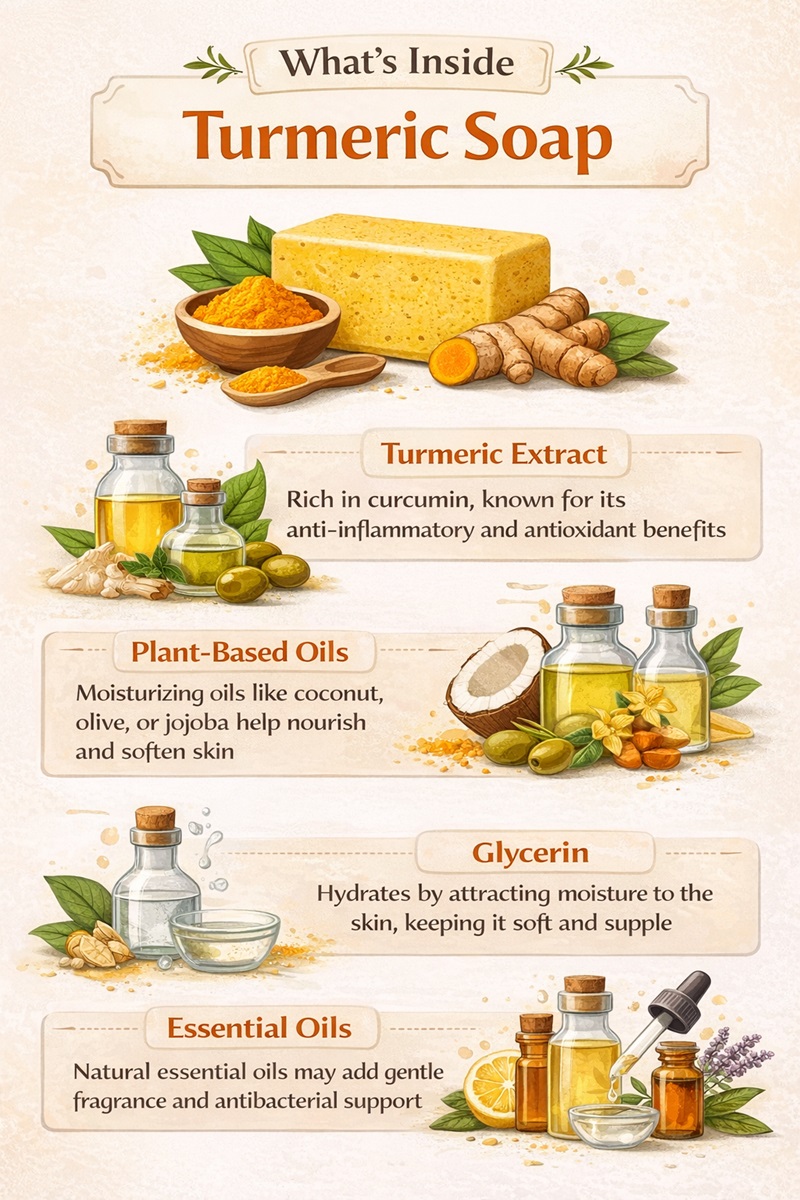
What’s Really Inside Turmeric Soap
Turmerics skin benefits come down to a handful of natural chemicals in the spice. If you understand these compounds, you can see why turmeric soap is gentle, and why its effects are more about long-term support than instant miracles.
Curcumin – The Big Name in Turmeric Skincare
Curcumin is the superstar of turmeric compounds. Its the main reason turmeric ends up in skincare products – and for good reason.
What Curcumin Actually Does:
- Helps take the edge off acne-related inflammation and redness
- Supports its antibacterial properties on the skin
- May even help with the oxidative stress that can leave skin looking dull
A Word of Caution about Curcumin:
The thing is – curcumin doesn’t get absorbed very well by the skin, and its only present in small amounts in soap. Because turmeric soap is washed off, curcumin’s effects are limited to just the skins surface, and they dont last long.
Curcuminoids – Turmeric’s Supporting Cast
Turmeric contains something called curcuminoids, which include curcumin, demethoxycurcumin, and bisdemethoxycurcumin.
What These Compounds Do:
- Act as antioxidants, helping to neutralize damage from the environment
- Support overall skin calmness
- May even help improve uneven skin tone over time
The thing is – these compounds are best at working their magic when used regularly and gently.
Turmerones – The Minor Players
Turmerones are the aromatic compounds in the essential oil of turmeric.
What They Might Help With:
- Mildly antibacterial properties
- Skin-soothing qualities
- That distinctive turmeric scent in some soaps
In soap, turmerones are usually present in tiny amounts, but they contribute to what makes turmeric soap so distinctive.
Soap Base – The Other half of the Equation
But its not all about the turmeric itself – the soap base is just as important as the active ingredients.
Some common ingredients in soap bases include:
- Fatty acids from coconuts or olive oil – they help clean and support the skin
- Glycerin – it prevents dryness and keeps the skin hydrated
- Mild surfactants – they gently lift off dirt and oil without stripping the skin
If the base is formulated well, its the difference between a gentle and drying product.
Why Turmeric Soap is a Better Bet than Harsh Acne Cleansers
Unlike those strong, harsh acne products, turmeric soap supports the skin with:
- Low-grade antibacterial action
- Anti-inflammatory powers (but not harsh exfoliation)
- Minimal disruption to the skin barrier
This makes turmeric soap perfect for daily use, especially if you get irritated by stronger acne products.
Important Caveat
Even though turmeric has its perks – turmeric soap is still just a rinse-off product. Which means:
- Its not there long enough to really penetrate
- Results are gradual and may take a while to show up
- Its not a leave-on treatment, and its not a prescription medication.
Turmeric Soap Benefits (The Down and Dirty)
With regular use, turmeric soap may help:
- Reduce acne-causing bacteria on the skin’s surface
- Calm down the redness and inflammation
- Support oil balance without stripping the skin
- Gradually improve dull or uneven-looking skin tone
- Fade away post-acne dark spots
Just remember – these are long-term benefits, not overnight fixes.
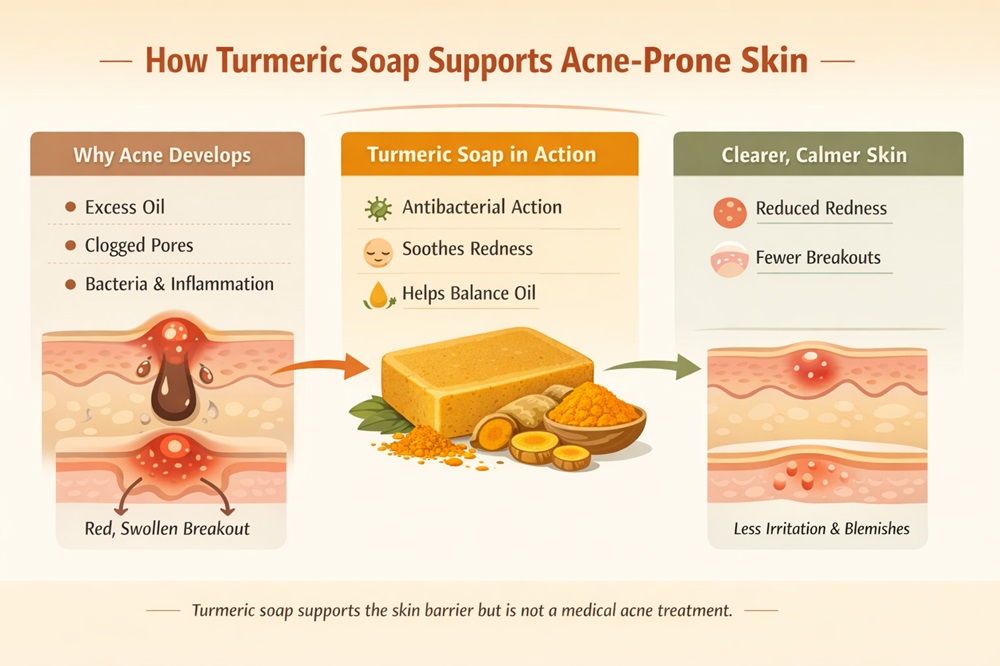
Does Turmeric Soap Do Anything for Acne?
How Acne Goes Down (A Skin Basics Crash Course)
Acne starts to get out of hand when too many things happen at the same time:
- Your skin just makes too much oil
- Dead skin builds up in your pores & clogs them
- Bacteria that love causing acne start to grow
- Your skin gets all inflamed & red
A good cleaner can help manage the bacteria and oil without stripping your skin bare.
How Turmeric Actually Helps With Acne
Turmeric does some solid stuff for acne-dimpled skin – basically three main things:
- Slowing down Bacteria Growth
Curcumin might help keep acne-causing bacteria under control on the surface of your skin - Reducing Inflammation
Turmeric can help calm down redness & swelling, making breakouts look a whole lot calmer - Gentle Oil Cleaning
Turmeric soap gets rid of excess oil without completely drying you out like those harsh acne washes do
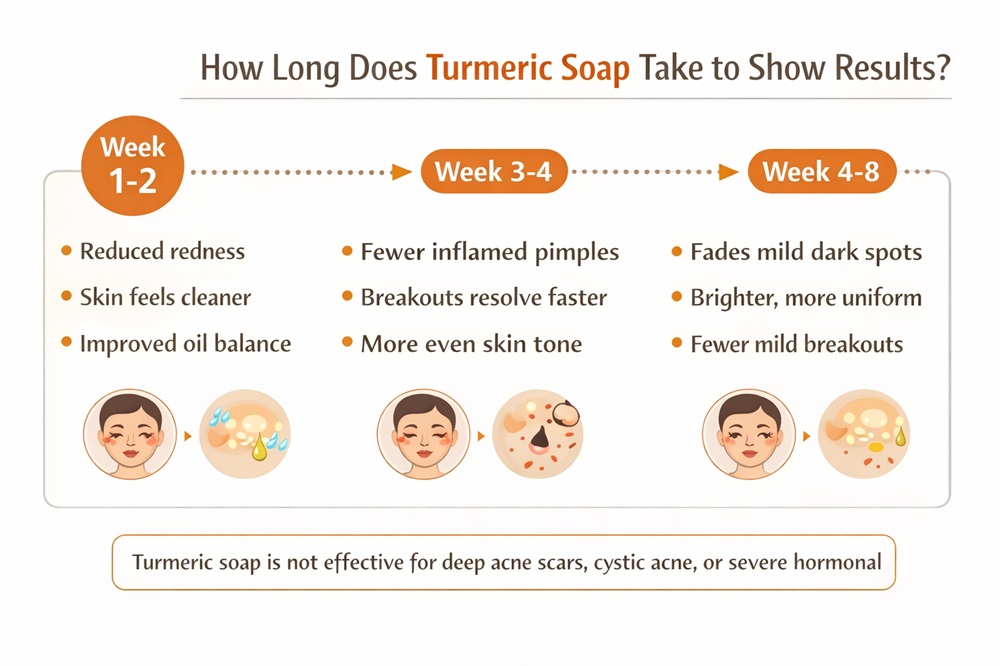
When Can I Expect To See Results From Turmeric Soap?
Turmeric soap isn’t a magic trick that fixes everything overnight because it’s just a face wash you wash off. Its effects will build up as you keep using it, but the pace & outcome all depend on how consistently you use it, your skin type & what’s actually causing your breakouts.
Generally, people don’t see changes overnight, but notice them over time.
What You Might Notice The First 1-2 Weeks
- Redness gets a little better around active breakouts
- Your skin feels cleaner without being too dry
- You might notice a small improvement in oil balance, especially if you have oily or combination skin
At this point, turmeric soap is mainly helping by soothing the redness, not actually clearing up the acne.
What Often Happens After 3-4 Weeks
- You get fewer inflamed pimples
- Breakouts get over faster
- Your skin starts to look a bit more even
These changes are thanks to the anti-inflammatory & antibacterial properties of turmeric.
What Can Change After 4-8 Weeks
- Those pesky post-acne dark spots fade a bit
- Dull skin gets brighter & more even
- Mild breakouts become a bit less frequent
Note that improvements in skin tone will be pretty subtle & will take time.
What Turmeric Soap Won’t Do
- Clear up deep acne scars
- Fix cystic or severe acne
- Stop hormonal acne without other treatment
Factors That Affect How Well It Works
- How often you use it (once a day vs sporadically)
- How often you use a moisturizer after
- The severity of your acne
- What else you’re putting on your skin
If you want the best results, use turmeric soap once a day, finish with a gentle moisturizer & have realistic expectations.
Our Editor’s Take
Doctors usually recommend letting a cleanser work on your skin for at least one full skin cycle (4-6 weeks) before deciding it’s actually doing anything.
What Turmeric Soap Can & Can’t Do For Acne
This soap might be able to help with:
- Mild to moderate acne
- Occasional hormonal breakouts
- Body acne on your back & elsewhere
- Acne that’s accompanied by redness & irritation
But it won’t:
- Replace strong prescription acne treatments
- Instantly clear up cystic or severe acne
- Work magic overnight
What really matters is sticking to it – not how strong it is.
Killing Off Viral Skincare Myths About Turmeric
Social media often perches turmeric on a pedestal as some kind of “all natural cure” for acne or pigmentation. Well, let’s knock that down a peg. That kind of framing is misleading, to say the least.
The Real Story:
Turmeric soap is a rinse-off product. Its benefits are limited by how long it gets to hang around on your skin, which is basically never. And lab studies have shown some promising properties in turmeric extracts but when you’re talking about soap, its results are pretty much palliative – not a fix-all.
Claims that turmeric soap can:
- “Just erase acne scars” – nope, not happening
- “Whiten your skin” – sorry, that’s just not true
- “Replace dermatology treatments” – not on your life
are not supported by evidence.
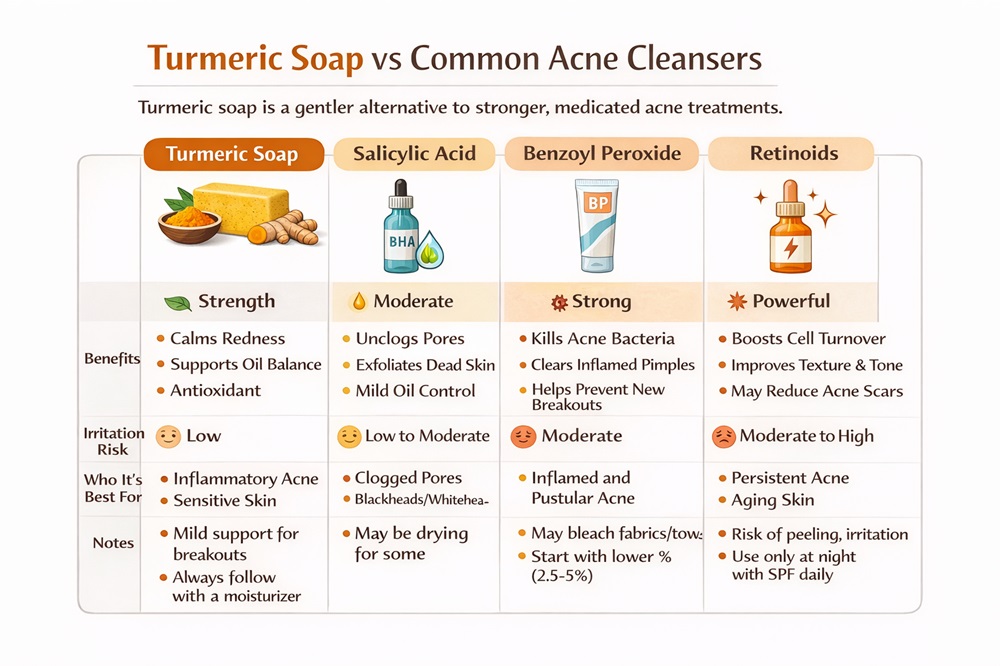
Turmeric Soap vs Dermatologist-Approved Acne Actives
| Ingredient | Strength | Best For | Trade-Off |
| Turmeric Soap | Gentle | Redness, mild acne | Slow results |
| Salicylic Acid | Moderate | Clogged pores | Can irritate |
| Benzoyl Peroxide | Strong | Active acne | Dryness, peeling |
| Retinoids | Very strong | Acne + texture | Requires tolerance |
Dermatological Perspective:
Turmeric soap is best seen as a low-risk cleanser, not some kind of miracle cure for acne.
Turmeric Soap and Dark Spots – Can It Really Help?
You get dark spots because your skin has been irritated or after acne has gone and healed. That’s what’s known as post-inflammatory hyperpigmentation (PIH).
Turmeric soap might help with that by:
- Reducing inflammation that makes pigmentation worse
- Gradually evening out your skin tone
- Help prevent new acne marks
What You Need to Expect:
It usually takes a bit of time – 4-8 weeks of regular use to see any real improvement.
Turmeric does not bleach your skin or change your natural skin colour permanently.
Is Turmeric Soap Safe for Darker Skin Tones?
Absolutely, it is. Turmeric soap is generally considered safe for all skin tones – including deeper complexions. And it might be especially helpful for PIH, which is more common in darker skin.
But it still won’t help with melasma or deep scarring.
Turmeric Soap for Dull Skin and Uneven Tone
Dull skin is often about:
- Dead skin building up
- Dehydration
- All the things that environmental stress throws at you
- Low-grade inflammation.
Turmeric soap can help by gently cleansing without leaving a residue and calming irritation that makes your skin look tired. And don’t forget to moisturise afterwards.
| Soap Type | Best For | Drawback |
| Turmeric Soap | Balanced acne + redness | May stain if overused |
| Tea Tree Soap | Oily, inflamed acne | Can be drying |
| Charcoal Soap | Very oily skin | Barrier disruption |
| Vitamin C Soap | Brightening | Often unstable in soap form |
Who Should Be Trying Turmeric Soap – And Who Should Be Careful About
Best For You If
- You’ve got oily or combination skin and are looking for something to help with shine and breakouts
- You’re a teen or adult dealing with acne
- You’re trying to address some mild hyperpigmentation
- You’ve got body acne that needs a little tlc
But If You’ve Got Any of These Skin Issues… You Might Want to Approach With Caution
- If you’ve got really sensitive skin. Turmeric can be a bit harsh if you’re not careful
- If you’ve got eczema or rosacea and need to be gentle with your skin
- If you think you might be allergic to turmeric (we’ll get to that patch testing business in a minute)
Things You Might Experience When Using Turmeric Soap
- A temporary yellow stain: Just rinse skin really well and you’ll be okay
- Dryness: No biggie, just try using it once a day instead of twice
- Breaking out at first: This is normal – your pores are just clearing out all the gunk
- Irritation: If this happens, just stop using it for a while and see if things calm down
Using Turmeric Soap Safely
- Wet your skin with warm water – not scalding hot, not icy cold. Just nice and toasty
- Lather it up gently. Don’t scrub like crazy
- Leave it on for 20-30 seconds or so
- Rinse it all off
- Follow up with a nice light moisturiser. We’re talking non-comedogenic, not clog-prone
How Often to Use Turmeric Soap
- Daily on your face (be gentle)
- Every other day on your body (just to keep things balanced)
Don’t mix with strong exfoliating acids or retinoids. That’s just asking for a world of trouble.
Some Examples of Turmeric Soap You Can Find in the U.S.
You can find turmeric soap all over the place in the States, usually priced between $5 and $15. Some popular options are:
- AMVital Turmeric Soap Bar – a budget-friendly option to start with
- ArtNaturals Kojic Acid & Turmeric Soap – often chosen for its dark spot-chasing abilities
- DermaXgen Organic Turmeric Soap – all about moisturising and soothing
- Himalaya Neem & Turmeric Cleansing Bar – an Ayurvedic-inspired formula that’s all about balancing your skin
Just remember these are cosmetic cleansers, not medical treatments. They’re here to help you on your skincare journey, but they can’t fix everything
Q&A Time
Will turmeric soap help with acne scars?
Yep, it might help with fading dark marks, but it’s not a magic cure for deep scars
Can I use turmeric soap every day?
If your skin can handle it, sure. If not, try reducing to every other day
Does turmeric soap lighten skin?
Nope, it just helps even out your skin tone. It’s not a skin lightening product
So is turmeric soap worth it?
If you’ve got mild acne or a few dark spots and are after a gentle, anti-inflammatory skincare option, turmeric soap can be a great choice. It’s low-risk and pretty affordable. Just remember to use it with a little patience, a moisturiser, and some realistic expectations.
It works best:
- When you use it regularly (no surprise there)\
- When you pair it with a moisturiser (to keep your skin happy and hydrated)\
When you’re not expecting it to fix everything overnight (sorry, that’s just not how skincare works)