

Many buildings in the United States are more vulnerable to earthquakes than their owners realize. People often think seismic risk starts and ends with California. It does not. Earthquake hazard maps show serious risk across the West Coast, Alaska, parts of the Intermountain West, and central U.S. regions tied to faults such as the New Madrid Seismic Zone.
That is why seismic retrofit matters. A seismic retrofit strengthens an existing building so it can perform better during earthquake shaking. The goal is simple. Engineers find the weak parts of the structure and reinforce them before an earthquake exposes them.
For homeowners, property managers, architects, developers, and engineers, this is about more than code. It is about life safety, repair costs, liability, downtime, and the long-term survival of the building itself. In practice, retrofit often marks the line between damage that can be repaired and damage that changes the future of the property.
This article explains what a seismic retrofit is, why it matters, how engineers assess a building, which retrofit methods are most common, what the process usually looks like, what affects cost, and why retrofit also has value from a sustainability standpoint.
What Is a Seismic Retrofit?
A seismic retrofit is a structural upgrade made to an existing building so it can better resist earthquake forces. Older buildings, poorly laid out buildings, and buildings designed under outdated codes often do not handle ground movement well. Retrofit work fixes those weaknesses before the shaking starts.
That is different from designing a new earthquake-resistant building from scratch. New construction gives engineers a clean slate. Retrofit work does not. Engineers have to study the structure as it exists, understand how forces move through it, and improve the weak links without rebuilding the whole property.
In plain terms, they work on the building’s load path. That means the route earthquake forces take through the roof, floors, walls, frames, and foundation. If that path is weak, broken, or inconsistent, the building is far more likely to fail under lateral movement.
The building types most often retrofitted include:
- soft-story apartment buildings
- older wood-frame houses
- unreinforced masonry buildings
- older commercial, mixed-use, and institutional properties
A simple comparison helps. Think of an older chair that still looks fine but has loose joints underneath. It can hold up for years, right up until real pressure hits it. A seismic retrofit is the work of tightening and reinforcing those joints before that moment comes.
Retrofit vs. Rebuild
Retrofitting strengthens an existing building. Rebuilding replaces it.
In many cases, retrofit is the more practical choice. It usually costs less than demolition and new construction. It causes less disruption. It preserves usable space. It also lets owners fix a clear structural problem without throwing away the whole building around it.
That matters even more in dense cities, occupied apartment buildings, and older properties with historic or architectural value. Once demolition enters the picture, the cost, waste, permitting, and downtime all rise quickly.
There is also an environmental reason to prefer retrofit when the building is worth saving. Reusing an existing structure avoids demolition waste and reduces the material demand that comes with a full rebuild. That does not mean retrofit is always the right call. Some buildings are too far gone, too badly altered, or too outdated to justify major reinforcement. But many are strong candidates for upgrade rather than replacement.
Why Seismic Retrofitting Matters
Earthquakes do not leave much room for structural weakness.
When a vulnerable building faces strong shaking, the damage can move fast from cracked finishes to displaced walls, broken connections, partial collapse, or total loss of occupancy. The problem is not limited to the frame. It often leads to injuries, tenant displacement, business interruption, insurance disputes, legal claims, and a sharp drop in property value.
Some weaknesses show up again and again after damaging earthquakes. A soft-story building may have an open first floor that lacks enough stiffness and strength. An older house may not be firmly anchored to its foundation. A masonry building may have heavy walls that behave in a brittle way during shaking. These are known structural problems, not rare surprises.
That is why some cities no longer treat retrofit as optional for certain building types. In Los Angeles, for example, mandatory retrofit rules target vulnerable existing buildings, including many pre-1978 wood-frame soft-story properties. The reason is straightforward. These buildings have a record of poor seismic performance, and delaying repairs pushes the risk onto tenants, owners, neighbors, and emergency services.
Which Buildings Face the Highest Risk?
Some buildings are far more likely than others to need seismic upgrades.
The highest-risk group usually includes older buildings designed before modern seismic provisions became common, especially those built before the late twentieth century. Risk also rises when a building sits in a high-hazard area, has an irregular layout, or relies on weak structural systems.
In practice, the properties most likely to need retrofit work include:
- older buildings in active seismic regions
- soft-story multifamily buildings
- unreinforced masonry structures
- older wood-frame homes with weak foundation connections
- buildings altered over time without a clear structural plan
- properties whose original design no longer matches current code expectations
A building does not need visible damage to be vulnerable. Many of the most at-risk buildings look ordinary right up until an earthquake reveals what they cannot handle.
How Engineers Assess a Building for Seismic Retrofit
A good retrofit starts with assessment, not guesswork.
The first step is usually a preliminary review. At this stage, structural engineering principles guide how the engineer evaluates the building’s age, size, occupancy, structural type, layout, and visible condition. Even that first review can expose likely trouble spots. A house with a crawl space raises different concerns than an apartment building with tuck-under parking. A masonry storefront poses different risks than a timber-framed duplex.
Next comes the document review and structural analysis. If the original drawings, old engineering reports, inspection records, or renovation plans still exist, they help. If they do not, engineers often have to verify conditions in the field and piece together how the structure actually works.
After that comes seismic hazard review. The building has to be judged in context. Where is it located? How much shaking is expected there? Are local soil conditions likely to increase demand on the structure? A retrofit design that makes sense in one place does not automatically fit another.
Then the engineer identifies the real weak points. Common findings include:
- weak stories
- poor anchorage
- brittle wall systems
- weak floor or roof diaphragm behavior
- bad connections
- incomplete or inconsistent load paths
The end result is usually a report that explains what is vulnerable, what needs to be reinforced, and what the likely scope of work looks like.
What Engineers Use to Evaluate Retrofit Needs
The tools vary by project. A small house does not need the same level of analysis as a hospital or a large apartment block.
Depending on the building, engineers may use:
- structural modeling software
- finite element analysis
- ground motion simulations
- non-destructive testing
- laser measurement tools
- as-built documentation methods
- 3D coordination models for retrofit design
Not every project needs advanced modeling. Some residential retrofits are fairly direct once the weak connection points are identified. Larger commercial or institutional projects often need far deeper analysis before a design is ready.
Common Seismic Retrofit Methods
There is no universal fix. The right retrofit depends on the building’s actual weakness.
Some structures need basic anchorage and bracing. Others need major frame reinforcement, new walls, or advanced motion-control systems. Good retrofit design is not about adding the biggest intervention. It is about matching the repair to the failure risk.
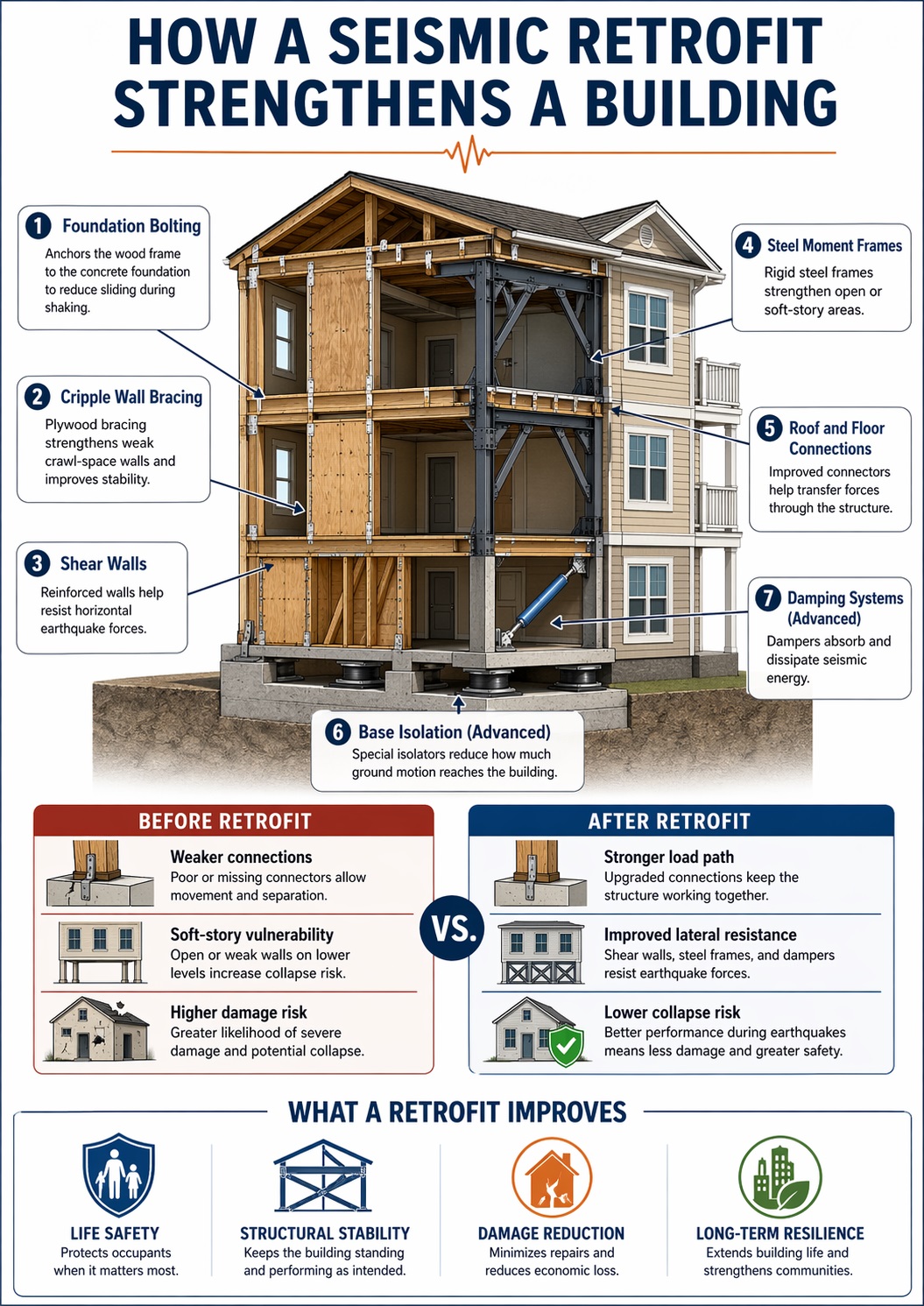
Cripple Wall Bracing
Cripple walls are short walls between the foundation and the first floor, common in older wood-frame homes with crawl spaces. During an earthquake, weak cripple walls can rack or collapse.
A retrofit usually adds plywood sheathing and stronger fastening so the wall can act as a proper lateral element. That helps transfer earthquake forces into the foundation instead of allowing the wall to buckle.
Foundation Bolting
Foundation bolting is one of the most common residential seismic upgrades because it addresses a basic problem. Many older houses are not firmly anchored to their foundations.
If that connection is weak, the house can shift sideways during shaking or tear itself loose at the base. Bolting strengthens the connection and helps keep the building in place.
Shear Walls
Shear walls are vertical structural elements that resist lateral force. In retrofit work, engineers may strengthen existing walls or add new ones where the building lacks enough side-to-side resistance.
This is common in soft-story buildings, where the ground floor is too weak compared with the levels above it. The goal is not just to make the building stronger. It is to create a more reliable distribution of stiffness and strength from top to bottom.
Steel Moment Frames
Steel moment frames are often used when a building needs more seismic strength but cannot lose open space at the lower level. This is common in apartment buildings with parking below, storefront buildings, and mixed-use properties.
Instead of filling the opening with solid walls, engineers install rigid steel frames that can flex under shaking while maintaining access, parking, or retail frontage.
Base Isolation
Base isolation is a more advanced method that places special isolator units between the structure and its foundation. These units reduce how much ground motion transfers into the building above.
It does not remove earthquake force altogether, but it sharply reduces damaging movement in the superstructure. Base isolation is most common in critical buildings such as hospitals, civic facilities, and emergency operations centers, where continued use after an earthquake matters almost as much as life safety.
Damping Systems
Damping systems reduce building movement by absorbing and dissipating seismic energy. These systems can include viscous dampers, friction dampers, and other motion-control devices.
They are more common in larger or more complex buildings. The core idea is simple. Instead of forcing the main structure to absorb all the motion on its own, the building gets another mechanism to handle part of that demand.
What a Seismic Retrofit Project Usually Looks Like
From the owner’s side, a retrofit project usually follows a clear sequence.
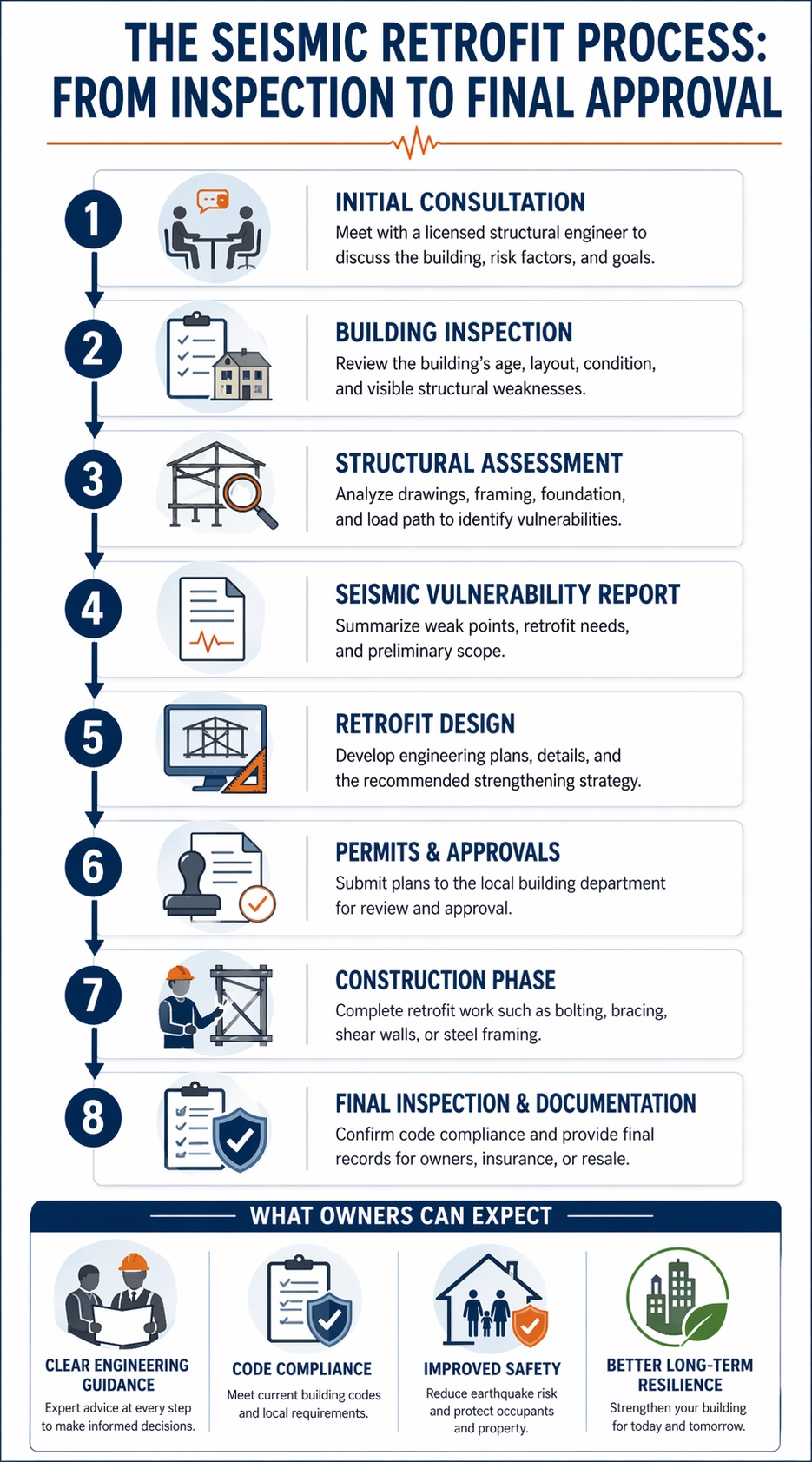
It starts with an initial consultation with a licensed structural engineer. That conversation covers the building type, known concerns, local code or ordinance triggers, and the owner’s goals. Sometimes the process starts after a city notice. Sometimes it starts during a sale, refinance, renovation, or insurance review.
Then comes the engineering assessment. The building is examined, weak points are documented, and possible retrofit paths are compared. Once the engineer defines the structural strategy, the project moves into design and permitting.
Permitting matters more than many owners expect. Local building departments often review retrofit work closely, and some cities have special compliance paths for certain vulnerable building types. That affects timing, inspections, submittals, and final approval.
Construction comes after that. Some retrofits are fairly contained. Others require staging, temporary access limits, tenant coordination, or short-term changes to how the building is used.
Once the work is finished, the project closes out with final inspection, sign-off, and documentation. That record can later help with resale, insurance review, lender questions, and general property files.
A simple timeline looks like this:
Assessment → Engineering report → Design and permitting → Construction → Final inspection → Documentation
What Seismic Retrofits Cost
Seismic retrofit costs vary widely, and generic numbers often create false expectations.
Still, rough planning ranges are useful:
| Building Type | Estimated Cost Range |
| Single-family wood-frame home | $3,000 to $10,000 |
| Soft-story apartment building | $60,000 to $130,000+ |
| Unreinforced masonry building | $100,000 to $300,000+ |
| Large commercial structure | Custom engineering quote |
The biggest cost drivers are building size, age, layout, structural system, retrofit method, permitting demands, and site access. Hidden conditions also matter. Once finishes, framing, or foundation areas are opened up, the scope often changes.
Owners should also know that some mitigation funding and resilience grant programs exist. FEMA’s BRIC program has been one of the major federal channels tied to hazard reduction, though eligibility and timing depend on the funding cycle and local application path.
The larger point is simple. Retrofit costs can feel substantial before the work starts. Earthquake damage is usually far more expensive after the fact.
Seismic Retrofit and Sustainability
Seismic retrofit is usually discussed as a safety issue, but it also has a clear place in sustainable construction.
Strengthening an existing building preserves much of the material, labor, and embodied energy already locked into that structure. That means less demolition waste and less demand for new construction materials.
Retrofit projects also create a practical chance to combine other upgrades. If a building is already open for structural work, owners often fold in envelope repairs, insulation, moisture fixes, window replacement, or HVAC improvements at the same time. Done well, that turns a structural necessity into a broader building-performance upgrade.
That is one reason retrofit deserves to be seen as part of long-term building stewardship. A building that stays safe and usable for decades avoids the waste that comes with neglect, emergency repair, or demolition.
The Main Point
A seismic retrofit strengthens an existing building so it performs better during earthquake shaking. For one property, that may mean foundation bolts and cripple wall bracing. For another, it may mean shear walls, steel frames, damping systems, or base isolation.
The reason it matters does not change. Weak buildings fail where stronger buildings hold together. In seismic regions, waiting until after a damaging event is usually the most expensive way to learn what the structure could not handle.
The good news is that the process is not mysterious. Engineers assess the building, identify the weak points, design the reinforcement, obtain permits, complete the work, and document compliance. Once the steps are clear, the decision becomes much easier to evaluate.
For owners of older homes, apartment buildings, masonry properties, and aging commercial structures, the right time to ask about retrofit is before the next earthquake, not after it.
Frequently Asked Questions
What buildings usually need a seismic retrofit?
Older wood-frame homes, soft-story apartment buildings, unreinforced masonry buildings, and many older commercial or institutional properties are the most common candidates.
Is seismic retrofitting required by law in the United States?
Not across the whole country. Retrofit rules are local, not national. Some cities require upgrades for certain vulnerable building types. Many others do not, unless the work is triggered by renovation, change of use, or a local ordinance.
How long does a seismic retrofit take?
It depends on the building and the scope. A smaller residential retrofit can move fairly quickly once construction starts. A multifamily or commercial retrofit usually takes longer because engineering, permitting, staging, and inspections add time.
Does seismic retrofitting increase property value?
It often improves marketability, reduces perceived risk, and gives buyers or lenders more confidence, especially in active seismic regions.
Can people stay in the building during retrofit work?
Often yes for smaller residential jobs. Larger or more invasive projects may require temporary restrictions, tenant coordination, or partial relocation.
What is the difference between seismic retrofit and earthquake-proofing?
Seismic retrofit is a real engineering process that reduces structural risk and improves building performance. “Earthquake-proofing” is a loose phrase. No retrofit promises zero damage under every earthquake scenario.