
(And how to choose the right unit—without wasting money or sleeping through another sticky night)
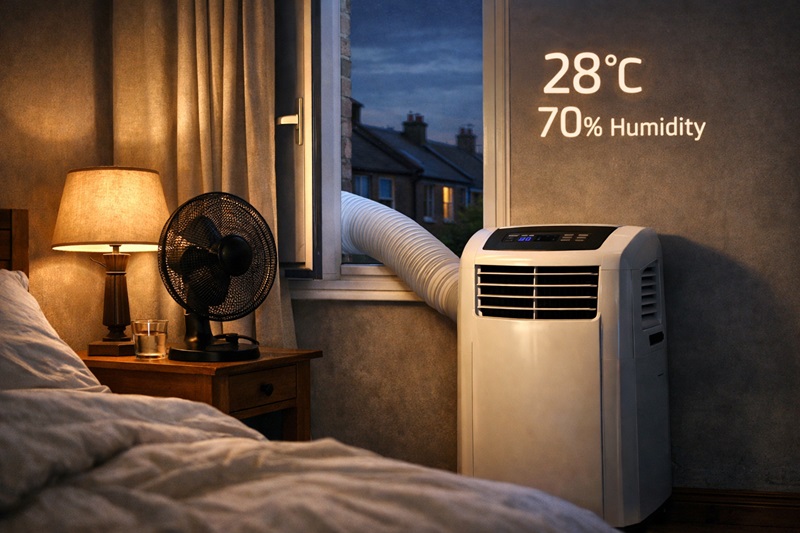
British weather has a habit of flipping fast: one week it’s grey and drizzly, the next it’s 28°C, the bedroom won’t drop below “oven,” and every retailer’s “portable cooling” category looks like a clearance rack in reverse.
That panic-buy cycle is exactly where the most common summer cooling mistake happens:
The big mistake
Buying an evaporative “air cooler” expecting air-conditioner results.
They can look similar. Marketing language can sound similar. But the technology is not even playing the same sport—and in typical humid UK heatwave conditions, the difference matters a lot.
With extreme heat events projected to become more frequent, longer-lasting, and more intense, this is becoming less of a one-off problem and more of a recurring seasonal purchase decision.
Key takeaway (save this)
If you want the room temperature to drop (and humidity to ease), you need an air conditioner.
If you mainly want airflow and “feels cooler” relief—especially with windows open—a fan is usually the best value.
An evaporative air cooler can help in hot, dry air, but in humid weather it often performs like a stronger fan and can add moisture.
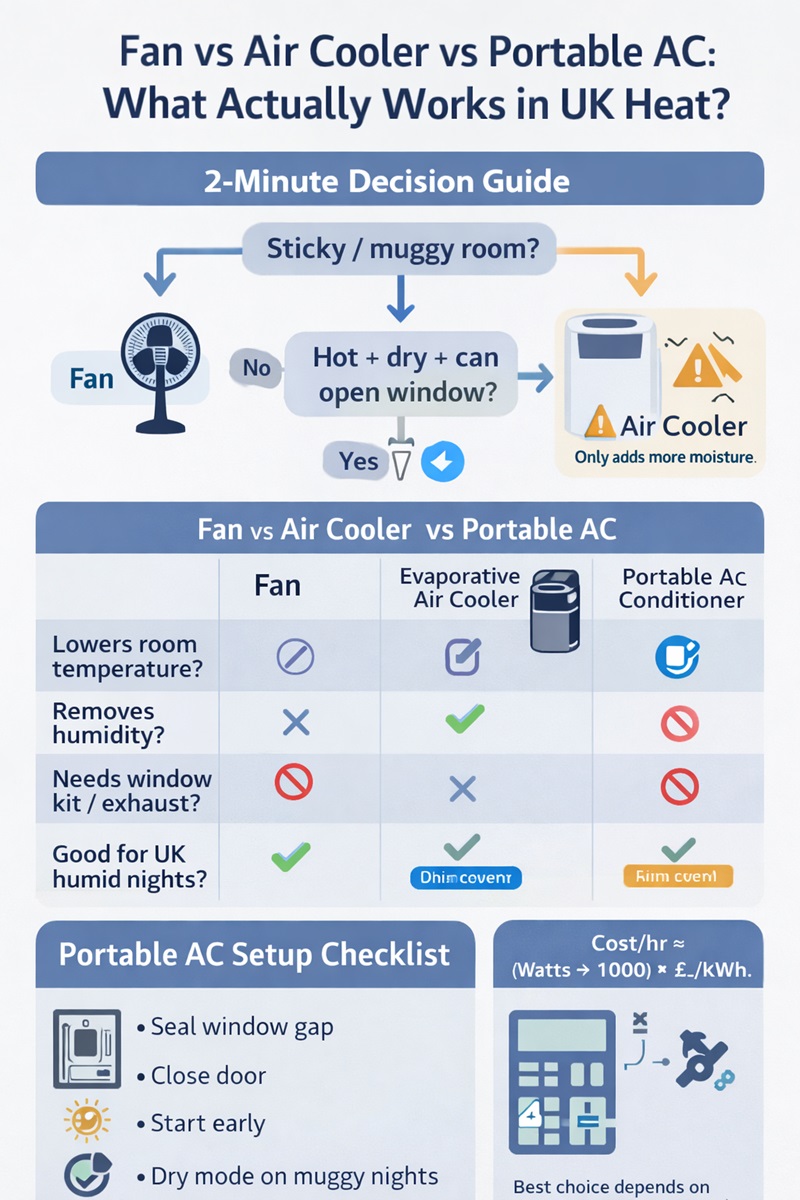
The 2-Minute Decision Guide (choose fast, choose right)
Choose a fan if…
- You mainly want airflow and comfort relief
- Your room is warm but not sticky, and you can ventilate at night
- You want the cheapest running cost option
Choose an air conditioner if…
- You want measurable temperature reduction
- Nights feel muggy/sticky and sleep is poor (humidity is a big culprit)
- You can vent hot air outside (window kit / hose)
Consider an evaporative air cooler only if…
- Air is hot and dry (low humidity)
- You can keep a window/door slightly open for airflow
- You understand it does not remove heat from a room like AC does
- You’re okay with adding moisture to the air
Air Cooler vs Air Conditioner: what they actually do
What an evaporative “air cooler” does
An air cooler (evaporative cooler) pulls warm air through a wet pad. Water evaporates and absorbs heat, so the air coming out can feel cooler.
Pros
- Lower power draw than AC
- No refrigerant, compressor, or exhaust hose
- Often cheaper upfront
Where UK buyers get caught out
- Evaporation slows down as humidity rises
- In humid conditions (common in UK heatwaves), it may feel like a fancy fan
- It can increase moisture in the room, especially if ventilation is poor
What an air conditioner does
A portable air conditioner uses a refrigeration cycle. It removes heat from indoor air and dumps that heat outdoors via an exhaust hose. It also removes moisture as it cools, which can be a big deal on muggy nights.
Pros
- Actively lowers room temperature
- Dehumidifies while cooling (often improves sleep comfort)
- Works in both dry and humid weather
Constraints
- Must vent heat outside (hose + window kit)
- Higher electricity use than fans/coolers
- Best for one room at a time with doors closed
The simplest comparison table
| Feature | Fan | Evaporative air cooler | Portable air conditioner |
| Lowers room temperature | No | Sometimes slightly (best in dry air) | Yes |
| Helps in humid “sticky” heat | Limited | Often poor | Strong |
| Adds moisture | No | Yes (can) | No (removes moisture) |
| Needs window open | Optional | Often helpful/needed | Usually keep closed (except for exhaust kit) |
| Setup complexity | Very low | Low | Medium (hose + sealing) |
| Running cost | Lowest | Low–moderate | Highest |
Why the UK makes this decision harder than it looks
Heatwaves in the UK are expected to become more frequent and intense as the climate warms.
That means more homes will face “cooling decisions” that used to feel optional.
But UK homes also tend to have:
- Bedrooms that hold heat (loft rooms, sun-facing walls, smaller windows)
- Variable humidity during warm spells
- A market flooded with products labelled “cooling” that do very different things
So the best cooling choice is rarely “the cheapest unit with next-day delivery.” It’s:
the right tool for your specific problem.
The second mistake: buying the wrong size (and paying for it later)
Even if you choose the right category (cooler vs AC), size mismatch is the next costly error.
For air coolers (evaporative)
Sizing is often based on airflow (e.g., m³/h or CFM). If airflow is too low for the room volume, you get lots of noise and not much effect.
For air conditioners
You’ll see:
- BTU ratings (common in listings)
- kW cooling capacity (common in UK/EU spec sheets)
- Efficiency metrics (often EER/energy label information)
Quick rule of thumb (use lightly)
Room size alone isn’t enough. Cooling needs change with:
- ceiling height
- insulation and loft heat
- number/size of windows
- sun exposure (south/west-facing)
- number of occupants and electronics
Why it matters:
- Too small: runs constantly, struggles, costs more, disappoints
- Too big: cycles on/off inefficiently and can reduce comfort
If you do nothing else, do this: treat portable AC as a “single-room appliance,” not a whole-home solution.
Running costs: the truth (and a simple calculator)
Fans are usually the cheapest way to feel cooler. Retailer guidance commonly frames fans as “pennies per hour,” while portable air conditioners cost far more to run.
Energy Saving Trust also notes evaporative coolers can have running costs similar to or slightly higher than a fan, while using less energy than portable air con.
Use this calculator (works for any unit)
Cost per hour (£/hour) = (Watts ÷ 1000) × your electricity unit rate (£/kWh)
Example (you swap in your tariff)
- 50W fan → 0.05 kWh/hour
- 1,000W portable AC → 1.0 kWh/hour
Multiply each by your £/kWh to see the difference.
The “cheapest upfront” trap
A cheaper unit that’s undersized or poorly set up can cost more over a summer, because you run it harder for less comfort. That’s why choosing correctly and setting it up properly beats panic-buying.
How to use each option properly (so you actually feel the difference)
If you’re using a fan (do this)
- Use it on you, not at an empty corner. Fans cool people by moving air over skin.
- Time ventilation: open windows early morning and later evening, close during the hottest part of the day.
- Keep curtains/blinds closed on sun-facing windows to reduce heat gain (this is standard UK heat guidance).
Safety note: Electric fans can help ventilation, but guidance warns they’re not useful above certain extreme temperatures (around 35°C) because they can just move hot air around.
If you’re using an evaporative air cooler (avoid disappointment)
Do not treat it like AC. Use it like “humidified airflow with a light cooling effect.”
Make it work better:
- Keep a window/door slightly open for airflow
- Don’t use it in a sealed room
- Expect modest comfort improvement—not a dramatic temperature drop
- If the room already feels sticky, be cautious: these units can add moisture.
If you’re using a portable air conditioner (where most people mess up)
portable air conditioners can work brilliantly in one room—but only if you stop it fighting your house.
The portable AC setup checklist (printable logic)
- Seal the window gap properly
If hot outside air leaks back in, your unit “cools” while your window kit reheats the room. - Close the door
Cool one space well instead of cooling a corridor badly. - Start early
Don’t wait until the room is already baking; pulling temperatures down from a high peak costs more. - Use “dry” / dehumidify mode when it’s muggy
Lower humidity often improves comfort fast. - Keep filters clean
Dirty filters reduce airflow and efficiency.
Before you buy anything: reduce the heat load (UK health guidance, simplified)
You can often make a noticeable difference with no new appliance:
- Block sunlight: close curtains on sun-facing windows during the day
- Ventilate at the right times: use cooler early-morning/night air
- Avoid adding indoor heat (ovens, dryers, unnecessary electronics)
- Cool your body: cold drinks, cool showers/cloths, lighter bedding (common NHS guidance)
These steps won’t replace AC in extreme indoor overheating—but they reduce how hard any device has to work.
So… which should you choose?
Pick a fan if you want:
- Lowest running cost
- Simple comfort relief
- A practical option that you’ll use regularly
Pick an evaporative air cooler if:
- Your space is genuinely dry (or dries out quickly with ventilation)
- You want a modest cooling sensation and can keep air moving through the room
- You accept it may underperform in UK humidity and can add moisture
Pick a portable air conditioner if you need:
- Reliable temperature control during heatwaves
- Better sleep in muggy conditions (humidity removal helps)
- A true “cool room” rather than “cool breeze”
Buying early makes sense (and not just for stock)
When heat spikes, availability drops and rushed decisions rise. Buying ahead of peak season lets you:
- Compare capacity and efficiency properly
- Plan the window sealing/venting setup
- Avoid “looks like AC, must be AC” mistakes
With UK heat risk increasing over time, this is becoming a repeat purchase category—so doing it once, correctly, pays off.
FAQ
Do air coolers work in UK heatwaves?
They can help a bit, especially with ventilation, but performance drops when humidity is high. They may feel closer to a powerful fan than true AC in muggy conditions.
Do portable air conditioners remove humidity?
Yes—cooling via refrigeration typically removes moisture from the air, which often improves comfort on sticky nights.
Should windows be open with a portable air conditioner?
Not generally. You need the exhaust hose vented outside, but you typically want the room sealed so hot air doesn’t leak back in through gaps.
Why does my portable AC feel weak?
Most common causes: poor window sealing, doors open, unit undersized, filters clogged, or trying to cool multiple rooms at once.
Is a fan enough for sleep in hot weather?
Often yes, especially with shading and night ventilation—but in very high indoor temps and humidity, it may not be enough. NHS and UKHSA advice emphasises keeping rooms cool, blocking sun-facing windows, and cooling the body directly.
Are fans unsafe in extreme heat?
Guidance notes fans can be unhelpful once air temperature is extremely high (around 35°C), because they may circulate hot air rather than cool you.
Is it cheaper to run a fan or portable AC?
Fans are typically far cheaper to run; consumer guidance frequently frames fan use as “pennies per hour,” while portable AC can be much higher.
Can I use an evaporative cooler in a sealed bedroom?
It usually performs worse in sealed rooms because moisture builds up and evaporation becomes less effective. Ventilation helps.
Final word: align expectations with the technology
Every summer, UK households buy the wrong thing for the right reason: they want relief.
The fix isn’t complicated:
- Decide what you need (airflow vs temperature drop vs humidity relief)
- Choose the right tool (fan, cooler, or AC)
- Size and set it up properly (especially the window seal for portable AC)
Do that before the first heatwave hits, and you’ll avoid the expensive disappointment cycle entirely.