

When people search for mold inspection cost, they want a clear answer.
What am I paying for?
Do I really need it?
The mix-up is easy to see. Mold inspection and mold testing sound alike. But they are not the same service.
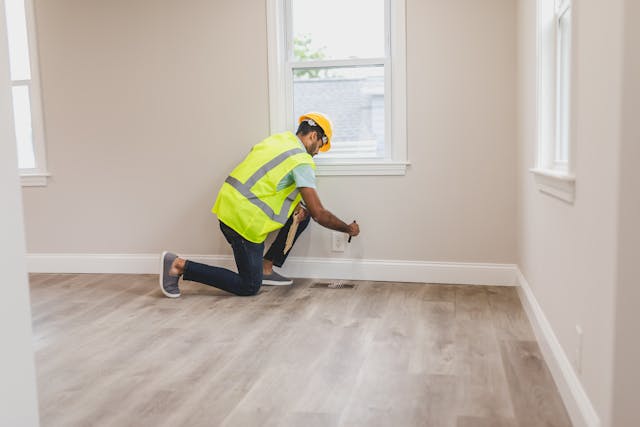
A mold inspection looks for signs of a mold problem. The inspector checks for leaks, damp spots, musty smells, water stains, and hidden wet areas. They may also check the attic, crawl space, basement, walls, and areas near air vents.
A mold test is different. A pro takes air, surface, tape, or material samples. Then the samples go to a lab.
Most homes should start with an inspection. Testing helps in some cases. But it is not always the first step.
The EPA says testing is often not needed when you can already see mold. One reason is simple. There are no federal limits for mold or mold spores inside homes.
This guide explains the cost difference. It also shows when each service makes sense, what can change the price, and how to avoid tests you do not need.
Quick Answer: Mold Inspection Cost vs. Mold Testing Cost
A mold inspection helps find where the mold problem starts. A mold test helps show what type of mold is there. It can also compare indoor mold spores with outdoor air.
Start with a mold inspection if you notice:
- Musty smells
- Water stains
- Past roof leaks
- Past pipe leaks
- Damp basement areas
- Wet crawl spaces
- Attic moisture
- Peeling paint
- Bubbled drywall
- Mold-like spots
Mold testing helps more when you cannot see mold. It can also help when you need proof. This can happen during a home sale, an insurance claim, or after mold cleanup. It can also help when people disagree about the source.
The main price gap comes from lab work. An inspection is based on time, tools, access, and skill. Testing adds sample work, lab fees, and a written report.
Mold Inspection and Testing Cost at a Glance
Prices change by city, home size, access, report detail, and sample count. Still, these ranges give a useful starting point.
| Service | Typical U.S. Cost Range | What Affects the Price |
| Basic visual mold inspection | $150–$400 | Small area, easy access, no lab test |
| Standard mold inspection | $300–$1,050 | Home size, attic or crawl space access, report detail |
| Mold testing only | Often priced per sample | Air samples, swabs, tape lifts, lab fees |
| Inspection plus lab samples | $500–$1,500+ | Several rooms, outdoor samples, rush lab work |
| Post-cleanup check | Varies widely | Scope, sample count, third-party report |
Many mold inspections cost a few hundred dollars. A wider U.S. range is often about $300 to $1,050. Angi’s 2026 guide lists mold inspection at $303 to $1,043. It gives an average cost of about $670.
Use these numbers as rough guides, not fixed prices. A small bathroom check costs less than a full home check. A large job can include the basement, attic, crawl space, air vent areas, and several lab samples.
What Is a Mold Inspection?
A mold inspection is a home check for mold and moisture.
The inspector looks for visible mold. They also look for leaks, damp spots, and wet materials. These things help mold grow.
A good inspector does not just ask, “Is mold here?” They ask a better question:
“Where is the water coming from?”
That question matters. Mold usually grows where moisture is present.
A stained ceiling can point to a roof leak. A damp crawl space can point to poor drainage. A wet basement wall can point to outside water. Poor bathroom airflow can also lead to mold.
A standard mold inspection often includes:
- Checks of areas where mold often grows
- Moisture meter readings
- A review of past leaks or water damage
- Checks of bathrooms, basements, attics, and crawl spaces
- Checks near HVAC areas
- A search for musty smells
- Notes on stains, damp spots, or wet materials
- Photos and written notes, based on the service plan
- Advice on repair, cleanup, or more testing
The CDC says indoor humidity should stay at 50% or lower. It also says homes need good airflow. Exhaust fans should vent outside. Leaks in roofs, walls, and pipes should be fixed.
That is why moisture control is the main goal of a mold inspection.
What a Mold Inspection May Not Include
A basic mold inspection does not always include lab testing.
Some companies include one or two samples in the price. Others charge for each sample. This can include air samples, swabs, tape lifts, or material samples.
A mold inspection may not include:
- Mold type ID
- Air testing
- Surface swab testing
- Tape-lift testing
- Material testing
- Lab reports
- Opening walls
- Full HVAC duct checks
- Mold cleanup
- Insurance claim forms
- Post-cleanup clearance testing
Before you book, ask what the price includes.
A low inspection price can rise fast. This happens when each sample, report, photo, or follow-up visit costs extra.
What Is Mold Testing?
Mold testing means taking samples and sending them to a lab.
Testing can help show what type of mold is present. It can compare indoor air with outdoor air. It can also help with home sales, claims, or proof after cleanup.
Common mold testing methods include:
- Air sampling: This collects mold spores from the air. It often compares indoor air with outdoor air.
- Surface swab testing: This takes a sample from a visible surface.
- Tape-lift testing: This uses clear tape to pick up particles from a surface.
- Material testing: This sends a small piece of damaged material to a lab.
- Post-cleanup testing: This checks if cleanup met a set goal.
Testing can help, but it does not replace an inspection.
A lab report shows what was found in a sample. It does not always show where the moisture started. It also does not always show which materials are wet or what repairs are needed.
The EPA says mold sampling should be done by trained pros. They need to know how to collect samples and read the results.
Surface sampling can help after cleaning or mold cleanup. But mold testing is not a simple pass-or-fail test. It does not prove that a home meets a federal mold limit.
Mold Inspection vs. Mold Testing: Key Differences
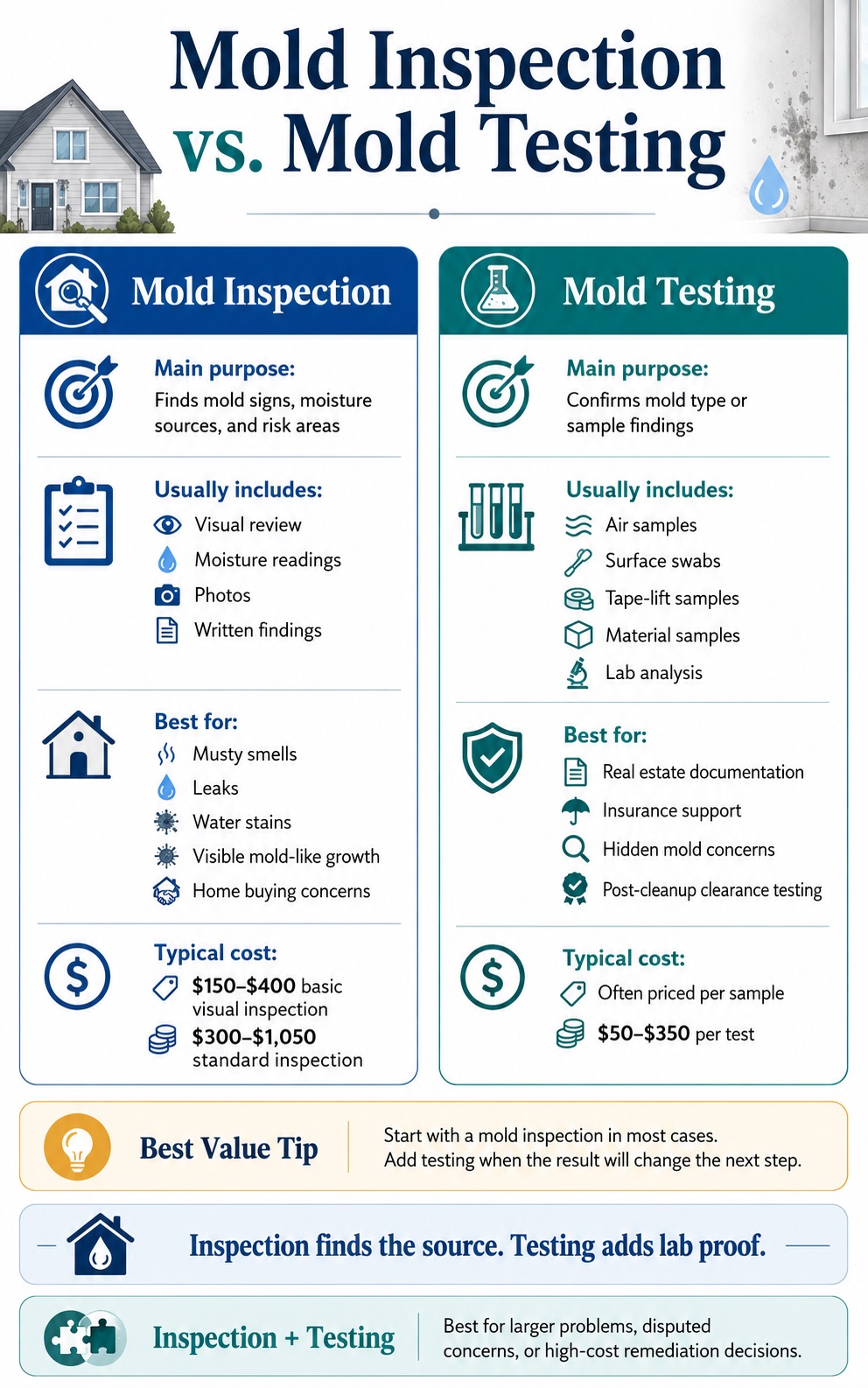
A mold inspection and a mold test do different jobs.
A mold inspection helps find mold signs, leaks, damp spots, and risk areas. It often includes a visual check, moisture readings, photos, and written notes.
It is best when you smell mold, see stains, find leaks, or plan to buy a home.
A mold test checks a sample. It can show what type of mold is present. It can also show what was found in the air or on a surface.
Testing can include air samples, swabs, tape lifts, or small pieces of material. It is often used for home sales, insurance claims, hidden mold concerns, or cleanup checks.
Some homes need both. An inspection can find the source. Testing can add lab proof. This helps with larger mold problems, disputes, or costly cleanup choices.
The best value comes from testing only when the result changes what you do next.
For example, mold under a sink is often clear. If a long leak caused it, the first step is simple. Fix the leak. Remove the damaged material. Clean the area safely.
Testing that visible mold may not add much value.
But testing can help when people disagree. A buyer and seller may not agree about a stain. In that case, a focused test can help show what is there before closing.
How Much Does a Mold Inspection Cost?
Many U.S. homeowners pay a few hundred dollars for a mold inspection.
The price rises when the home is large. It also rises when access is hard, the report is long, or lab testing is added.
A standard mold inspection often costs about $300 to $1,050. This range comes from current consumer price guides.
A small home with one damp spot usually costs less. A large home can cost more.
This is true when the inspector must check a basement, attic, crawl space, several baths, old pipes, and many damp areas.
Main Factors That Affect Mold Inspection Cost
Home size: Large homes take more time to check. More rooms, baths, attic space, and HVAC areas can raise the price.
Problem area: A bathroom wall is easy to check. A tight crawl space, roof space, or attic corner takes more work.
Water damage: Stains, warped floors, wet drywall, and musty smells need closer checks.
Tools used: Moisture meters are common. Thermal cameras or detailed moisture maps can cost more.
Report detail: A short verbal report costs less. A written report with photos, readings, and repair notes costs more.
Fast service: Same-day visits or rush checks often cost more.
Local prices: Big metro areas often cost more than small towns.
Testing: Lab samples usually add to the cost.
How Much Does Mold Testing Cost?
Mold testing cost depends on sample count, sample type, lab fee, and speed.
Some companies give one package price. Others charge a base fee plus a fee for each sample. Fast lab results often cost more.
Testing can include:
- Indoor air samples
- Outdoor air samples
- Surface swabs
- Tape lifts
- Material samples
- Cleanup clearance samples
HomeGuide lists mold testing at about $50 to $350 per test. It lists mold inspection at about $300 to $650 on average.
Large homes or wider mold concerns can cost more.
Why Mold Testing Can Become Expensive
Testing costs more when a home needs:
- Several indoor air samples
- Outdoor air samples
- Samples from many rooms
- Fast lab results
- Written reports for a home sale or claim
- Cleanup clearance testing
- Hard checks in crawl spaces, attics, or near HVAC areas
Ask the inspector to explain each sample.
A good pro should tell you why the sample matters. They should also explain how the result will affect your next step.
Do You Need a Mold Inspection, Mold Testing, or Both?
The right choice depends on what you already know.
Start With a Mold Inspection If:
Start with a mold inspection if you smell a musty odor but cannot find the source.
You should also start with an inspection if you see:
- Stains
- Peeling paint
- Bubbled drywall
- Dark spots
- Signs of water damage
An inspection also helps after a roof leak, pipe leak, flood, or appliance leak.
It is useful when a basement, crawl space, or attic feels damp.
If you are buying a home, an inspection can help too. This is true when the home shows signs of old water damage.
For most homeowners, an inspection is the best first step. It looks for the cause of the problem. It does not just focus on one sample result.
Add Mold Testing If:
Add mold testing if you need lab proof.
Testing also helps when you think mold is hidden but cannot see it.
Testing can help during a home sale. It can also help with an insurance claim.
In some cases, a health concern can make testing useful. This is true when someone has asthma, allergies, immune concerns, or indoor symptoms. A trained pro should guide that choice.
You may also need testing after mold cleanup. This is called a clearance check.
Testing also helps when people disagree.
A seller may say a stain is old. A buyer may want proof before closing. In that case, an inspection plus a focused test can help both sides.
Use Both When the Choice Is Costly
Use both when the choice is costly.
If cleanup may cost thousands of dollars, use a detailed inspection with focused testing.
The inspection shows where the water and damage are. The test adds lab proof.
That is stronger than testing alone.
Is Mold Testing Always Needed?
No. Mold testing is not always needed.
This is a key point for homeowners. If you can already see mold, testing often does not change the next step.
You still need to fix the water source. Then you need to clean or remove the damaged material in the right way.
The EPA says visible mold often does not need sampling. It also says there are no federal mold spore limits for homes.
That does not mean testing has no value. It means the test should have a clear reason.
A useful mold test answers a real question, such as:
- Is this stain really mold?
- Are indoor mold levels high compared with outdoor air?
- Did the cleanup reduce the problem?
- Do I need proof for a sale, rental issue, or claim?
- Is a cleanup clearance check required?
Testing without a clear reason can cause confusion.
A homeowner may get a lab report full of mold names and numbers. But they may still not know what to fix.
Are DIY Mold Test Kits Worth It?
DIY mold test kits seem cheap and easy. But they have a big limit.
Mold spores are common indoors and outdoors. So a positive result does not always prove a serious mold problem.
DIY kits also miss the main issue. They do not find the water source.
A dish or swab does not check behind drywall. It does not inspect a crawl space. It does not test airflow. It does not check wet materials. It does not find a slow pipe leak.
DIY testing can answer basic curiosity. But it is not a replacement for a pro inspection.
Use a pro inspection when you see damage, smell a musty odor, have health concerns, or need proof for a home sale.
What Should a Mold Inspection Report Include?
A mold inspection report should give clear answers.
It should not just say “yes” or “no.” It should show what the inspector found, where they found it, and what you should do next.
A good report should include:
- Areas that were checked
- Areas the inspector could not reach
- Visible mold-like growth or stains
- Moisture readings
- The likely source of moisture
- Photos of problem areas
- Airflow or humidity concerns
- Repair steps
- Cleanup steps
- Whether testing was done
- Sample spots, if samples were taken
- Lab results, if testing was done
- Next steps for cleanup or more checks
For a home sale, claim, or repair quote, a written report is often better than a verbal note.
Is Mold Inspection Included in a Home Inspection?
Usually, no.
A general home inspection is not the same as a full mold inspection.
A home inspector may point out water stains, leaks, poor drainage, or mold-like growth. But a basic home inspection does not always include deep moisture checks, mold samples, lab reports, or a full mold review.
Home buyers should ask these questions before the inspection:
- Will you check for moisture?
- Do you inspect attics and crawl spaces?
- Do you note mold-like growth?
- Is mold testing included?
- Will the report show photos and moisture readings?
A separate mold inspection can be worth the cost when a home has musty smells, old leaks, basement dampness, or past water damage.
Does “Black Mold” Change the Cost?
Not always.
Many molds can look black, green, brown, or gray. Color alone does not name the mold type.
A dark stain does not always mean one exact mold type is present.
Testing can show what was found in a sample. But the first step is still the same.
Find the water source. Stop the leak or dampness. Then clean or remove the damaged material in the right way.
Do not let scary words push you into costly testing with no clear need.
A good inspector should explain what they see. They should explain the moisture source, damaged materials, and whether testing will change your next step.
Mold Inspection Cost for Home Buyers
Mold concerns are common when buying a home.
This is true in older homes. It is also common in homes with basements, crawl spaces, roof stains, old pipes, poor drainage, or weak airflow.
A mold inspection helps buyers understand the problem. It can show if the issue is small, active, or costly to fix.
This matters because mold often links to larger home issues. These can include roof leaks, pipe leaks, poor insulation, bad grading, drainage issues, or HVAC problems.
Home buyers should think about a mold inspection when they notice:
- Musty smells
- Damp basement areas
- Water stains on walls or ceilings
- Recent flooding
- Old roof leaks
- Crawl space moisture
- Poor bathroom airflow
- Seller notes about past water damage
Mold testing can help when a real estate deal needs proof.
Still, the inspection findings often matter more. They point to the repair source.
A lab report can say mold spores were found. An inspection can show where they may have come from. The source may be a leaking window, damp wall, or bathroom fan that vents into an attic.
Mold Inspection Cost and Home Insurance
Home insurance coverage for mold depends on the cause.
A sudden pipe burst is often treated differently from long-term dampness. Poor upkeep, repeated leaks, and high humidity can also affect coverage.
Coverage also depends on your policy, state rules, claim history, and insurer needs.
A pro inspection report can help show:
- The home’s condition
- The likely source
- Affected areas
- Visible damage
- Moisture readings
- Next steps
Mold testing can add support if the insurer asks for lab proof.
Before you start major cleanup, call your insurance company. Ask what proof they need.
Take photos. Save bills. Keep inspection reports.
Do not remove damaged material before you document it, unless there is an urgent safety issue.
Check State Rules Before Hiring
Mold rules are not the same in every state.
Some states require a license or special training. Some states also keep mold inspection and mold cleanup as separate jobs. Other states have fewer rules.
Before you hire anyone, check with your state licensing board, health office, or consumer office.
This matters most when:
- The job costs a lot
- The inspection is part of a home sale
- The report affects an insurance claim
- One company offers both inspection and cleanup
- You need a third-party clearance report
In some states, one company can inspect, test, and clean up mold. Even then, many homeowners still choose an independent mold inspector first.
This can help reduce a conflict of interest when the cleanup quote is high.
Professional Standards and Mold Cleanup Guidance
Mold inspection and mold cleanup are not the same service. Still, good work standards matter.
For cleanup work, the ANSI/IICRC S520 mold standard is an important industry guide. The Fourth Edition came out in 2024. It explains steps and safety care for mold cleanup in homes, offices, and other buildings.
Homeowners do not need to read this full standard before hiring help.
But you should ask one simple question:
Do you follow known mold cleanup practices?
A good pro should explain the process in plain words.
How to Avoid Paying Too Much for Mold Inspection or Testing
Homeowners often pay too much for two reasons.
They book the wrong service first. Or they agree to too many samples without knowing why.
Before you hire a mold inspector, ask these questions.
- Is this price for inspection, testing, or both?
Get the scope in writing.
- How many samples are included?
Some quotes include no lab samples. Some include one or two.
- What does each extra sample cost?
Sample fees can raise the final bill fast.
- Do you use an outside lab?
An outside lab can make the results more trusted.
- Will I get a written report?
A written report helps with home sales, insurance claims, and repair quotes.
- Do you also do mold cleanup?
This is not always bad. But it can create a conflict of interest.
Some homeowners prefer an independent inspection before hiring a cleanup company.
- Will you look for the water source?
If the answer is no, the service is not complete.
- Do I really need testing?
A good inspector should explain when testing helps. They should also explain when it does not.
The cheapest quote is not always the best choice.
The best value is the service that tells you three things: what is wrong, why it happened, and what to do next. In urgent cases, such as a home sale deadline or insurance request, homeowners may look for quick mold test when they need quicker sample results and written documentation.
Red Flags When Hiring a Mold Inspector
Not all mold companies work the same way.
Watch for warning signs before you pay.
Avoid companies that:
- Push costly testing before asking basic questions
- Do not explain sample costs
- Give vague prices
- Call every mold finding an emergency
- Promise to remove all mold spores from a home
- Do not check for moisture
- Give no written report
- Use scare tactics
- Cannot explain the test method
- Push cleanup without proof
Mold is serious. But fear-based selling is a red flag.
A good inspector gives clear facts. They explain limits. Then they help you choose the next practical step.
Final Verdict: Which One Should You Pay For First?
Most homeowners should pay for a mold inspection first.
An inspection answers the main question:
Where is the water coming from, and what needs to be fixed?
Mold testing is worth the extra cost when it supports a clear choice. This can include a home sale, an insurance claim, hidden mold concern, health-sensitive home, or cleanup clearance.
The simple rule is this:
If you need to find the problem, start with inspection. If you need proof, add testing.
Homeowner Questions Before You Book
How much does a mold inspection cost?
Mold inspection cost depends on home size, location, access, report detail, and testing.
Many homeowners pay a few hundred dollars for a standard inspection. Large homes and lab samples cost more.
Is mold testing included in a mold inspection?
Not always.
Some companies include one or two samples. Many charge extra for air samples, swabs, tape lifts, and lab work.
Always ask what is included before you book.
Is mold testing worth the cost?
Mold testing is worth it when you need proof.
It can help with lab results, home sales, insurance claims, or cleanup clearance.
It is less useful when you can already see mold. In that case, the main job is to fix the water source and clean the damaged area.
Can I skip mold testing if I already see mold?
Yes, in many cases.
The EPA says sampling is often not needed when mold is visible.
The main step is to fix the water source. Then clean or remove the damaged material safely.
Testing can still help when you need proof, clearance, or help with a dispute.
Why does mold testing cost more with more samples?
Each sample takes time and lab work.
More rooms, more problem spots, outdoor samples, and fast lab results can all raise the price.
Should I get a mold inspection before buying a house?
Yes, if the home shows warning signs.
These signs include musty smells, stains, damp basement areas, roof leaks, pipe issues, crawl space moisture, or old water damage.
A mold inspection can help you understand the risk before closing.
Can mold come back after removal?
Yes.
Mold can come back if the water source is not fixed.
That is why moisture control matters as much as cleanup. The CDC recommends lower indoor humidity, better airflow, and fixed leaks to reduce mold risk.
What is better: a mold inspector or a mold cleanup company?
For a first opinion, many homeowners prefer an independent mold inspector.
A cleanup company is useful when cleanup is clearly needed.
For larger jobs, using separate inspection and cleanup companies can reduce conflict of interest.
Is a DIY mold test enough?
Usually not.
DIY kits can show that mold spores are present. But mold spores are common indoors and outdoors.
A kit does not find leaks. It does not measure moisture. It does not check hidden areas. It also does not explain what needs repair.
Does black mold always require testing?
No.
Color alone does not identify the mold type.
Dark mold-like growth should be taken seriously. But the first step is still to find and fix the water source.
Testing helps when you need proof or mold type ID.