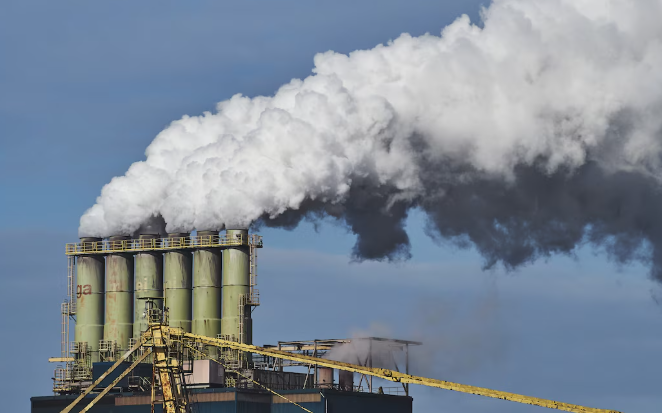

Coalmine country in Queensland and New South Wales is surrounded by a certain kind of silence. You wouldn’t believe that something invisible is rising off the pit walls in quantities that the official ledgers don’t quite capture when you drive past Hail Creek on a clear afternoon. That is the peculiarity of methane. It is not visible to you. It is not detectable. However, satellites can, and the Australian government is beginning to look foolish in front of the world due to what they have been witnessing for years.
Australian coalmine methane emissions were estimated to be around 1.7 million tonnes in 2025 by the International Energy Agency’s most recent Global Methane Tracker, which was published in early May. Canberra’s own figure, which it dutifully submitted to the UN, is approximately 0.82 million tonnes. It’s not a rounding error. That is more than twice as much. It’s the kind of gap that you can’t really get rid of once you see it.
From a distance, Americans may perceive this as someone else’s mess. It isn’t. Methane knows no geographical boundaries, and its warming affects Florida coastlines and cornfields in Iowa just as easily as it does the Great Barrier Reef. Since the gas is about 80 times more potent than carbon dioxide over a 20-year period, every tonne that goes unaccounted for in Brisbane is actually equivalent to a tonne that goes unaccounted for in Boston. The Global Methane Pledge has required significant diplomatic effort from the United States. The entire company appears a little shaky when one of its closest allies underreports its coal industry by this much.
The awkward American mirror is another thing to think about. The same measurement issues that affect Australia also affect the Appalachian coal basins, the Powder River, and the abandoned mine workings strewn throughout Pennsylvania and West Virginia. The IEA has been gently but persis
tently pointing out that nations whose numbers don’t match what satellites see are typically those that rely on standard emissions factors instead of direct measurement. Although the political will and technology have not yet caught up, the United States is gradually moving toward direct monitoring.
The new results are a wake-up call, according to Sabina Assan, an Ember methane analyst who has been studying this for years. Australian climate analyst Tim Baxter was more direct, saying Canberra is “increasingly isolated” in its defense of its accounting practices. You don’t need to believe what they say. Emissions from a single mine in Queensland were discovered to be three to eight times higher than what the operator had reported during a UN-backed flyover. The scope of the issue begins to feel less like a bookkeeping dispute and more like a structural failure when you multiply that by an export industry that ships coal to South Korea, Japan, India, and yes, occasionally to American buyers.
This is especially annoying because it is inexpensive to fix. Methane abatement from coal mines is nearly inexpensive by climate policy standards. No new invention is needed for ventilation air capture, flaring, or drainage systems. Despite the IEA’s long-standing claim that this is the energy transition’s lowest-hanging fruit, emissions from fossil fuel operations around the world aren’t decreasing. They are flat.
It’s difficult not to wonder how much longer this will last. When allies start to look bad, American policymakers usually take action, and Australia is beginning to look bad. Technically correct, but politically insufficient, the federal government in Canberra claims it complies with all established international regulations. There is a sense that this will not be tolerated in the upcoming climate negotiations. And Washington will be forced to participate in a discussion that it can’t pretend isn’t also about its own backyard when the reckoning occurs, whether through trade pressure, satellite transparency, or just plain diplomatic embarrassment.