


Many UK businesses use cold storage every day. This includes kitchens, food shops, hotels, hospitals, labs, and factories.
But old fridges are not just scrap metal. A fridge, freezer, display case, cold room unit, or cooling system needs safe disposal.
Old units can hold gases, foam, metal, plastic, wires, motors, and other parts. If a unit is crushed or dumped, harmful gas can leak. Good parts can also go to waste.
This is why safe commercial fridge removal matters. A business should use a registered waste carrier. It should also use a site that can handle old cooling units.
This helps cut harm to the climate. It also helps the business meet UK waste rules.
Quick Answer: Why Can Old Fridge Disposal Harm the Environment?
Old commercial fridges can hold cooling gas. They can also contain gas inside the foam walls.
These gases must be removed before the unit is taken apart. Some old gases warm the planet far more than carbon dioxide.
UK businesses also have a duty of care for waste. They must use the right waste handler. They must keep records. They must make sure waste is moved in a legal way.
GOV.UK says recovered F-gas can go to a licensed waste site. There it can be reclaimed, recycled, or destroyed. A registered waste carrier must also be used.
Why Old Fridges Are a Problem
Commercial fridges are built to last for years. They work in busy places like shops, hotels, food plants, labs, and warehouses.
That strong build is useful while the unit works. But it makes disposal more complex.
Many cooling units can hold gas in two places. One is the cooling system. The other is the foam inside the walls.
The Environment Agency says the gas type and amount can change by age, size, and unit type. It also says units made before 1995 often used CFC and HCFC gases. Later units used other gases, such as HFCs and some hydrocarbon gases.
The main risk is not the metal case. The bigger risk starts before recycling.
If gas leaks during rough handling, it can harm the climate. If foam is broken without care, gas can escape too. With proper removal and treatment, much of this harm can be avoided.
Refrigerant Gases Can Have a High Climate Cost
Some old cooling gases can harm the climate a lot.
These gases are called refrigerants. They help fridges and freezers stay cold. But some older types trap far more heat than carbon dioxide.
R-404A is one example. It was used in many commercial fridges. Its global warming potential is about 3,920.
That means even a small leak can cause a big climate cost.
This is why leak control matters. Gas can escape when old kit is cut, crushed, moved, or stripped in the wrong way.
Safe disposal starts with gas recovery. The gas should be removed with the right tools first.
This should happen before the unit is taken apart. It should also happen before it is moved for treatment or sent for recycling.
Commercial Fridges Are Not Just Scrap Metal
A commercial fridge has useful parts inside. These can include steel, aluminium, copper, wires, motors, and plastic.
But it should not be treated like plain scrap metal.
First, the gases and other controlled parts must be handled safely. Only then should the metal and other parts be recovered.
Old fridge units can also fall under WEEE rules. WEEE means waste electrical and electronic equipment.
This matters because a fridge is both an electrical item and a special waste item.
A business should not use an unknown collector just because the unit has scrap value.
The business is still responsible for its waste. It needs to know where the old unit goes.
The Scale of the Problem in the UK
The UK has many commercial fridge units in use. They are found in food shops, kitchens, hotels, hospitals, stores, and factories. The Institute of Refrigeration has cited industry figures for display cabinets. These figures put the UK stock at about 2 million units. They also suggest that about 160,000 to 200,000 cabinets enter the waste stream each year. This is after refurbishment is counted. That is only part of the picture.
It does not include every cold room, freezer, catering fridge, medical fridge, or large cooling system. Still, it shows the size of the issue.
Old fridge disposal is not a small waste topic. Thousands of units leave service each year. When poor handling happens again and again, the damage adds up fast. The harm comes from many losses. Gas is not recovered. Foam is handled badly. Metal is not recycled. Waste moves with no clear record. One mistake at one site may look small. Across the UK, many small mistakes create a much bigger problem.
What UK Businesses Need to Know About Waste Duties
UK businesses are responsible for the waste they make. This is called the waste duty of care.
GOV.UK says businesses must deal with commercial waste in a proper way.
The Waste Duty of Care Code of Practice applies in England and Wales. It covers people and firms that make, carry, keep, treat, dispose of, or control waste.
For old fridge disposal, a business should check three things.
Who is taking the unit? Where is it going? Will the right papers be given?
GOV.UK says each load of non-hazardous waste needs a waste transfer note. A similar document with the same details can also be used.
The business and the waste handler must fill in and sign the right parts.
Paperwork is not just admin. It is proof that the business handled the waste with care.
F-Gas Recovery and Safe Treatment
F-gases need careful handling. These are gases used in some cooling systems and foam. GOV.UK says recovered F-gas can go to a licensed waste site. The site must accept waste F-gas and ozone-depleting gas.
There, the gas can be reclaimed, recycled, or destroyed.
GOV.UK also says a registered waste carrier must be used. This also applies when F-gas is inside equipment, such as foam.
This matters for old commercial fridges and freezers. The gas is not always only in the cooling pipework. In some old units, gas can also be inside the foam walls.
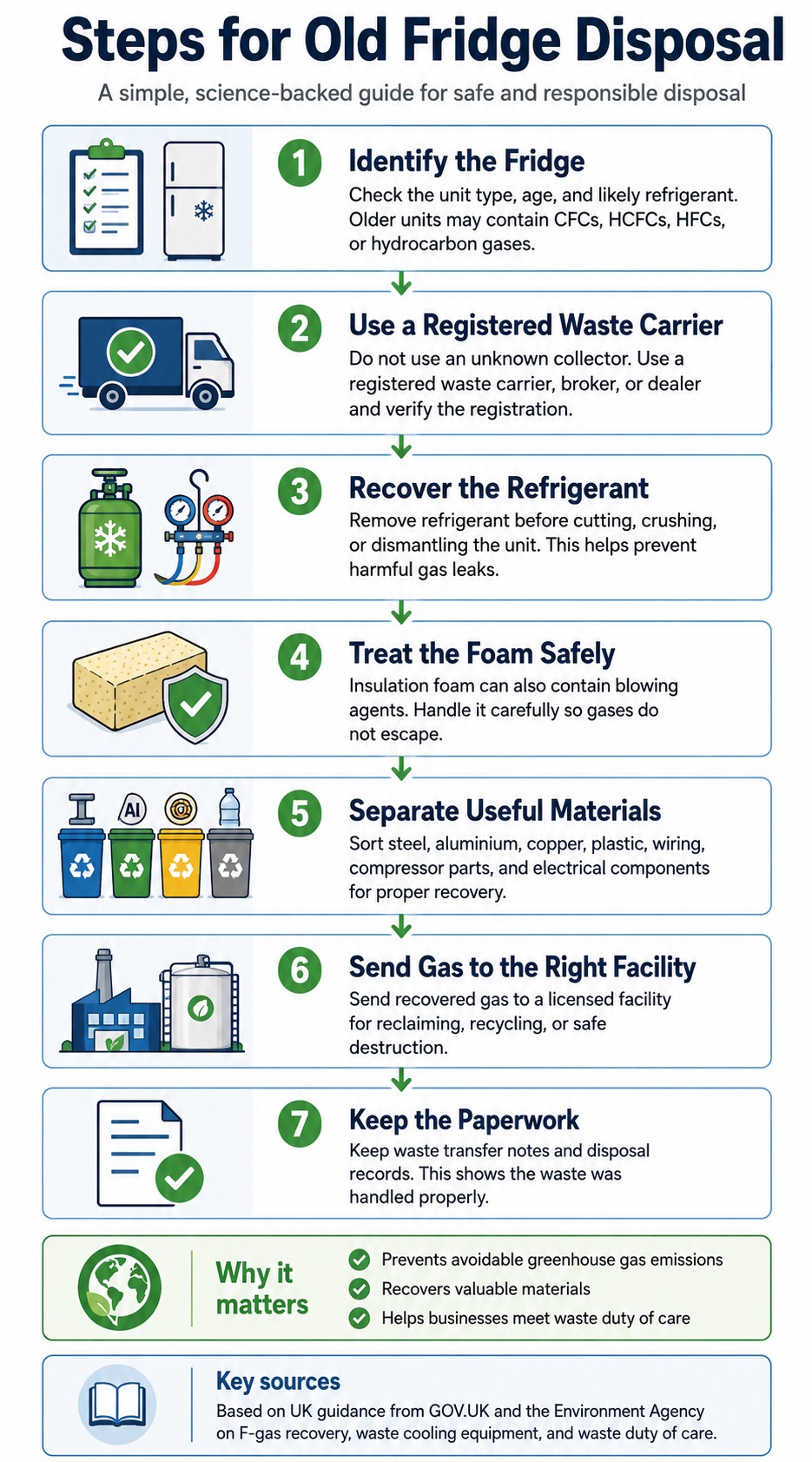
A safe disposal job should follow clear steps:
- Check the type of cooling unit.
- Find out what gas it may contain.
- Remove the gas before cutting or crushing the unit.
- Treat the foam so gas does not escape.
- Sort the metal, plastic, wires, motors, and other parts.
- Send recovered gas for reuse, recycling, or safe destruction.
- Keep the right waste papers.
This protects the environment. It also protects the business that made the waste.
The Environmental Benefits of Safe Disposal
Safe disposal changes the story. Gas recovery helps stop leaks that harm the climate. Foam treatment helps stop old gases from escaping.
Metal recycling also saves useful materials. Steel, aluminium, copper, and other parts can go back into use. Good sorting also cuts waste. Less material goes to landfill or poor-value disposal. This is why commercial fridge recycling has real value.
It does more than remove an old unit from a site. It captures harmful gas. It saves useful parts. It also creates a clear record from pickup to treatment. That record matters for businesses with green goals. Customers, partners, investors, and regulators want proof. They do not want vague claims or loose promises.
Commercial Fridge Disposal Checklist for UK Businesses
Before booking commercial fridge removal, ask these questions:
- Is the company a registered waste carrier, broker, or dealer?
- Can I check the registration on the public register?
- Will I get a waste transfer note?
- Where will the fridge or freezer be taken?
- Can the site treat waste cooling equipment?
- Will the gas be removed before the unit is taken apart?
- How will the foam be treated?
- What happens to the metal, plastic, wires, motors, and gas?
- Will I get records after collection?
- Are extra steps needed if the waste is hazardous?
The Environment Agency has a public register. Businesses can use it to check waste carriers, brokers, and dealers.
This helps confirm that a company is allowed to move, buy, sell, dispose of, or arrange waste disposal.
GOV.UK also says these firms must register. This includes firms that carry, buy, sell, dispose of, or arrange waste disposal.
A business that does not register can face an unlimited fine.
Why the Cheapest Quote Can Cost More
The cheapest quote is not always the best choice.
A low price can look good when you need space fast. But poor waste handling can cause bigger problems later. Old equipment can be dumped. It can be stripped in the wrong way. It can also be sent to the wrong type of site. If that happens, the original business can still face questions. Did it check the collector? Did it take fair steps? Did it keep the right records?
The harm to the environment is one risk. The legal risk is another. A good provider should show its registration details. It should explain where the unit will go. It should also give the right waste papers. Be careful if a collector avoids simple questions. Be careful if they ask for cash only. Be careful if they cannot say where the unit will be taken. These are warning signs.
Choosing a Safe Commercial Fridge Removal Partner
Do not choose a disposal partner by price alone.
A proper firm should understand old fridge units. It should also understand UK waste rules.
A good disposal partner should:
- Hold the right waste carrier registration.
- Explain the collection and treatment steps.
- Remove the gas before the unit is taken apart.
- Use a site that can treat waste cooling equipment.
- Give a waste transfer note or the right document.
- Keep the route clear from pickup to treatment.
- Explain what happens to gas, foam, metal, and parts.
These checks protect the business.
They also make the business’s green claims easier to trust.
Building Disposal Into a Wider Green Plan
For one old fridge, disposal can feel like a small job. For larger firms, it needs a better plan.
This matters for firms with many sites. It also matters during kitchen upgrades, shop refits, warehouse changes, or planned equipment swaps. The best time to plan disposal is before the unit is removed.
Buying teams can ask suppliers about take-back options. Site teams can keep records of installed units. Green teams can track how old fridge units are treated. This creates a stronger system.
It helps avoid rushed choices. It cuts the risk of unclear collections. It also supports better green reports. It also fits the move away from high-GWP gases. Many UK firms are replacing older cooling units with cleaner systems. But the old unit still matters.
Buying better equipment is only part of the work. The replaced unit must also be handled with care.
Final Thoughts
Old commercial fridges can hide a real climate cost. The problem is not just the unit size. It is not just the scrap value either.
The bigger issue is what sits inside. Old units can contain cooling gas, foam gas, wires, parts, and useful materials. These all need proper care.
For UK businesses, safe disposal is both a green choice and a waste duty. A business should use a registered waste carrier. It should check where the unit will go. It should make sure gas is removed first. It should also keep the right records.
Commercial fridge disposal should not be an afterthought. When done well, it stops needless leaks. It saves useful materials. It also gives a business a stronger and more honest green record.