
I had to read the statement twice when I first learned that eastern diamondback rattlesnakes were sliding into rivers. Rather than riverbanks, diamondbacks prefer dry pine flats and sun-warmed sand. However, researchers in Georgia are currently observing precisely that, as radio-tracking collars show animals engaging in activities that their ancestors most likely never did. Even though it’s a minor detail that can be easily overlooked in a news cycle that is dominated by louder things, it stays in the mind.
All of this has been explained calmly by Daniel Sollenberger, a senior wildlife biologist with the Georgia Department of Natural Resources. He claims that snakes can survive brief droughts. Larger ones can retain water fairly well. The fires that once crackled low through the longleaf pine are now climbing into canopies and tearing through landscapes, and the droughts are no longer brief. The animals are reacting by leaving, which is the only response they are capable of.
| Subject Snapshot | Detail |
|---|---|
| Region observed | Georgia, United States |
| Total native snake species | 47 |
| Venomous species | 7 |
| Federally protected species | Eastern indigo snake |
| Primary source | Daniel Sollenberger, Senior Wildlife Biologist, Georgia Department of Natural Resources |
| Climate triggers documented | Prolonged drought, larger wildfires |
| Notable behavioral shift | Eastern diamondbacks retreating from dry uplands to rivers |
| Major wildfire event referenced | South Georgia, April 2026 |
| Public guidance resource | Venomous Snakes of Georgia brochure |
| Human-snake encounter trend | Rising, due to suburban expansion |
There’s a temptation to approach this as an inquisitive wildlife tale, the kind that sits between the sports and weather sections on a Sunday morning. That misinterprets the situation, in my opinion. When upland snakes begin to overrun wetlands, they are in competition with the local fauna. smaller snakes, fish, frogs, and nesting birds. A diamondback in a river is not a picture-perfect animal; rather, it is a stressed-out predator seeking water, and everything downstream senses this.
Of course, Georgia has burned in the past. In the past, lightning fires in the spring and summer cleaned the forests slowly and thoroughly, leaving the soil and species acclimated to that rhythm. Sollenberger made this point, almost subtly, as biologists do when they want you to realize that fire is not the enemy in and of itself. Intensity is the villain. Longer dry spells, drier soil, hotter summers, and decades of fuel accumulation are what cause a familiar process to become something the land cannot absorb.
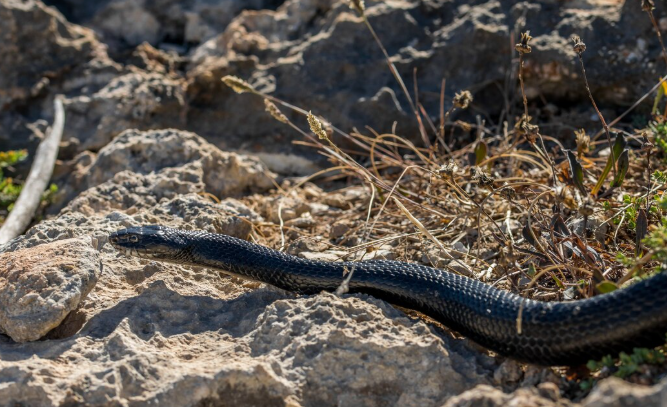
From a distance, the shift appears to be quite quiet, which disturbs me. The migration of snakes doesn’t make headlines. The yellow rat snake that was moving along a dried-out canal bed at Corkscrew Watershed in April was captured on camera because someone happened to be there, not because it was unusual. The image starts to feel different when you multiply that one image over a state with 47 different species of snakes. More like rearranging than adaptation.
The human side of this is also difficult to ignore. Georgia’s suburbs continue to encroach on wetland boundaries and pine forests. Snakes frequently approach areas where people are building as they migrate toward wetter habitats. Encounters will increase, according to the Department of Natural Resources. Biologists note that most bites occur when someone tries to kill or seize the animal. Snakes only want to get away the rest of the time.
Collapse is sometimes described by ecologists as a prolonged sequence of silent rearrangements rather than a single crash. species that change their range. There are predators in the wrong location. The old fire cycles are disintegrating. It’s not loud at all. It doesn’t form a coherent story. However, it’s hard to argue that the system is still operating as it once did when you watch a rattlesnake choose a river over a pine flat. Perhaps the snakes have been communicating with us for some time. We simply haven’t been paying close attention.