

Heat and fire are changing timber cladding, but not in the same way. Thermal modification is the more established preservative-free option for external above-ground cladding because it improves moisture behavior, dimensional stability, and durability. Charred timber is mainly a surface finish unless a supplier provides independent proof for wider claims about decay resistance or fire performance. In UK practice, fire compliance still depends on the full cladding system, test evidence, and the building context, not just the board itself.
Key Takeaways
- Thermally modified timber has the stronger technical track record for above-ground cladding use.
- Heat treatment improves stability and lowers moisture uptake, but it also makes timber more brittle and less suitable for load-bearing use.
- Charred timber should be treated as a visual finish unless independent evidence supports broader durability or fire claims.
- Fire performance cannot be judged by finish alone. Cavities, substrates, orientation, and system design all affect risk.
- “No chemicals” is not enough on its own. A strong specification also looks at service life, maintenance, end of life, and verified product data.
Where the Limits Still Matter
Timber cladding has always carried a real contradiction in low-carbon construction. Wood is valued for its renewable source, stored carbon, and natural finish. At the same time, many external timber products still rely on preservative systems built around biocides and industrial treatment. In the UK, that treatment sits inside a regulated framework because wood preservatives and timber treatment bring real health, safety, and environmental control duties. HSE guidance for industrial timber treatment plants makes that plain, and wood preservatives are regulated under the GB Biocidal Products Regulation as Product Type 8.
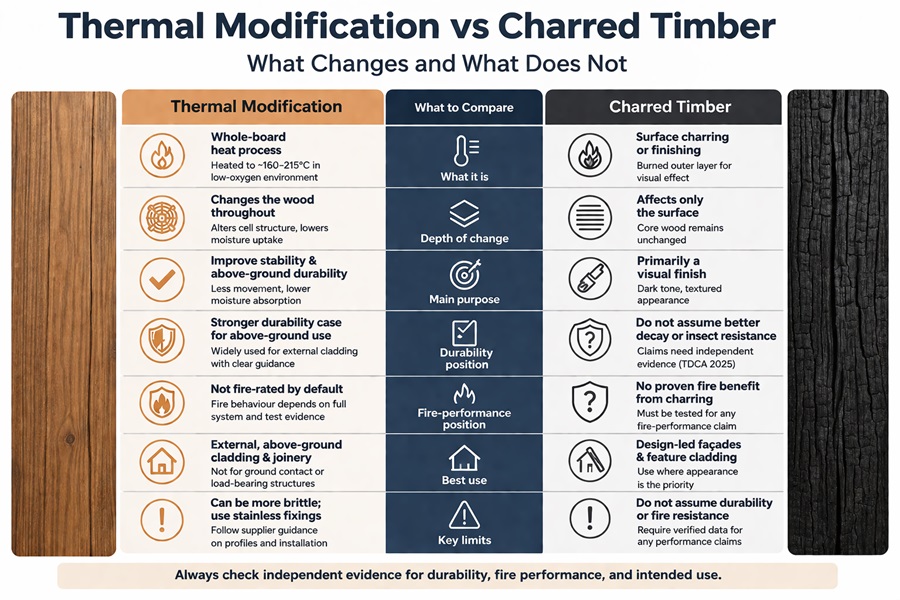
That tension has pushed more attention toward preservative-free routes, especially thermal modification and charred timber. They are often talked about as if they belong in the same category. They do not. One is a material process with a longer technical track record. The other is usually a surface finish with a strong visual effect. That difference matters once a project moves past mood boards and into real questions about durability, fire, and compliance.
Why Preservative-Free Timber Gets More Attention
Pressure-treated softwood became the default answer for exposed timber because untreated softwood does not perform well outdoors for long. Treatment extends service life, but it also adds another layer of chemical management. For teams working on lower-toxicity or more circular specifications, that becomes a harder sell over time.
Preservative-free timber draws attention because it promises a different logic. Instead of adding biocides, it tries to improve timber by changing the wood itself or by altering the outer surface. That sounds simple. In practice, the technical gap between these methods is wide.
Thermal Modification Has the Stronger Technical Case
Heat-treated timber is the more established route. Swedish Wood states that thermally modified timber is produced by heating wood to about 160 to 215 degrees Celsius in an oxygen-free atmosphere. The treatment changes the wood’s chemical and physical structure, lowers moisture absorption, and limits movement compared with untreated timber. It also distinguishes between products sold for stability and those sold for durability, which is a useful reminder that not every heat-treated board performs to the same level.
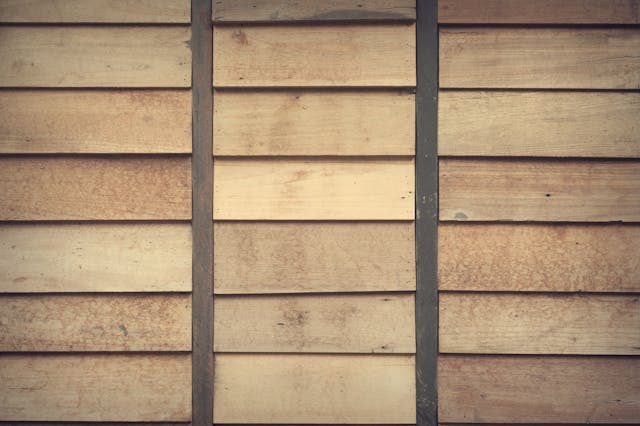
That matters for cladding because moisture sits at the center of most timber problems. Boards that take up less moisture move less through wet and dry cycles. That helps profile stability and reduces the conditions that support fungal decay. For external above-ground use, that is a practical benefit, not just a lab claim. It is why thermally modified timber cladding has earned a more credible place in this part of the market, especially where reduced movement, better moisture behavior, and improved durability matter.
The Limits of Heat-Treated Timber Still Matter
Thermal modification is not a free upgrade. The same Swedish Wood guidance says heat-treated wood becomes more brittle, loses strength as treatment temperature rises, should not be used in load-bearing structures, and should be limited to above-ground applications. It also recommends stainless steel for fasteners and fixings. Those details are easy to skip in sales copy, but they matter on site.
That means thermally modified timber is best understood as a good cladding and joinery material in the right exposure, not as a universal substitute for preservative-treated wood. Real performance still depends on drainage, ventilation, profile design, fixings, and whether the board is being used in the way the supplier actually supports.
Charred Timber Needs a Much Harder Look
Charred timber has grown in popularity because the finish is striking. It gives façades a darker tone, more texture, and a look many designers prefer over painted or heavily coated boards. That design value is real. The technical claims around it are where the trouble starts.
Timber Development UK published TDCA guidance in August 2025 stating that protection against fungal decay, insects, or fire must not be assumed as a benefit of current charring and finishing processes. The guidance says scientific studies do not support automatic gains in durability or fire performance, and any supplier making those claims must provide independent evidence. It goes further and says charring processes should be considered visual enhancements only unless performance is properly substantiated.
That changes the way charred cladding should be written about. It can still be a valid cladding choice. It can still make architectural sense. What it should not be is a catch-all “chemical-free” substitute presented as if appearance alone proves durability or fire resistance.
Fire Performance Is a System Question
Any serious discussion of external timber cladding has to deal with fire without hand-waving. GOV.UK’s Approved Document B fire safety FAQ says designers should consider form, orientation, cavities, and combinations with other materials such as substrates when judging timber cladding in a building. That tells you something important right away. Fire performance does not sit in the board alone. It sits in the system.
UK government-backed research on the fire hazards of timber cladding has also examined how material changes, including thermal modification, can affect fire behavior and whether broad timber cladding guidance can really cover such varied assemblies. The report shows why blanket claims are a bad fit for this subject. Thickness, configuration, and cavity-side behavior all matter.
For specifiers, the message is straightforward. Charring does not settle the fire question. Thermal modification does not settle it either. Fire compliance depends on tested evidence, classification, the full assembly, and the rules that apply to the building in question.
Sustainability Is Bigger Than “No Chemicals”
It is tempting to reduce this topic to one clean line, no chemicals equals more sustainable. Real projects are not that tidy. A preservative-free board is not automatically the better environmental choice, and a treated product is not automatically ruled out.
The stronger sustainability case looks at service life, maintenance, coatings, moisture behavior, replacement rate, end-of-life handling, and whether the supplier can show credible product data. In practice, a thermally modified board with clear durability data and installation guidance often has a stronger case than a charred board sold mostly on appearance and vague performance language. The absence of biocides matters, but it is only one part of the specification.
You may like to Know: Eco-Friendly Furniture Choices
What This Means for Specifiers
The market is easier to read when the two routes are separated clearly.
Thermal modification is the more established preservative-free option for external above-ground timber cladding, especially where stability and durability matter most. Charred timber is mainly an architectural finish unless its broader durability or fire claims are backed by independent evidence.
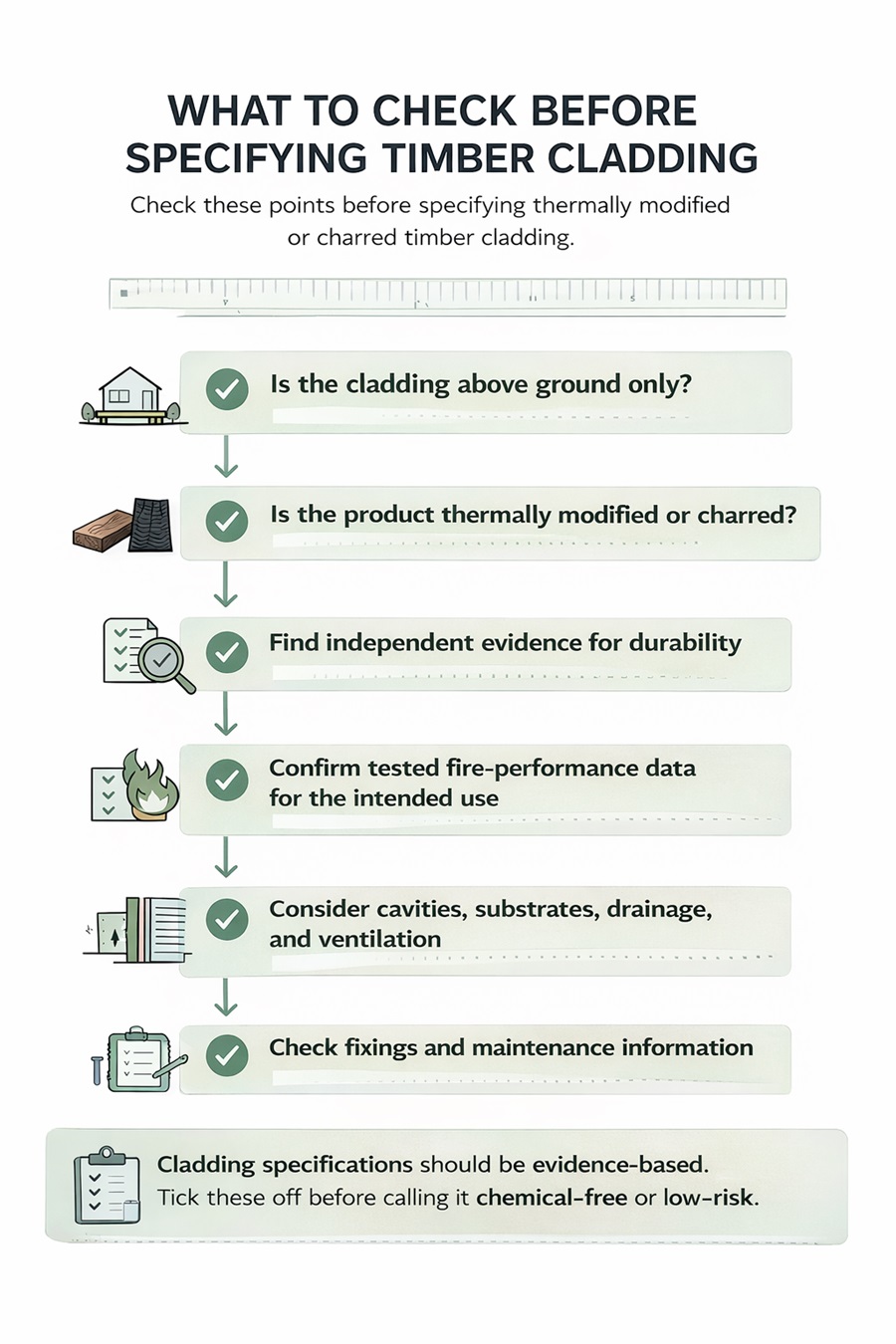
Before specifying either one, the important checks are basic:
- Does the intended use stay above ground, and does it match the supplier’s stated exposure limit
- Is there independent evidence for durability and fire performance, not just marketing language
- Has the façade design accounted for cavities, substrates, orientation, drainage, and ventilation
- Are the fixings, coatings, and maintenance assumptions compatible with the timber product
Those are the checks that turn a good-looking material story into a reliable specification.
Conclusion
Heat and fire are changing the timber cladding conversation, but they are not changing it in the same way. Thermal modification has earned a stronger place as a preservative-free durability route for many above-ground cladding applications. Charred timber has real design value, but it should be treated as a finish first, unless the proof for broader claims is there.
That is where the market now stands. The best timber cladding choices are not the ones with the cleanest story. They are the ones that can show how they perform in weather, in service, and under current fire and product scrutiny.
FAQ
Is thermally modified timber better than charred timber for cladding?
For most external above-ground cladding uses, thermally modified timber has the stronger technical record. It is backed by clearer guidance on durability and dimensional stability. Charred timber can still be used, but wider claims need independent proof.
Does charred timber resist fire?
You should not assume that it does. TDCA guidance published through Timber Development UK in 2025 says protection against fire should not be assumed from current charring and finishing processes unless independent evidence supports the claim.
Can thermally modified timber be used in ground contact?
No. Swedish Wood states that heat-treated wood is suitable for above-ground use and should not be used in contact with the ground.
Does preservative-free always mean more sustainable?
No. A fair judgment also includes service life, maintenance needs, moisture behavior, replacement intervals, and end-of-life handling. “No chemicals” is only one part of the environmental picture.