


When your product has a green heartbeat, whether it’s a carbon-tracking app or an AI-enabled waste-sorting platform, every delay in shipping code feels like a delay in helping the planet. That’s why more climate-tech founders, project managers, and sustainability-driven executives look beyond in-house recruitment and partner with focused, fully staffed engineering units. You’ve probably heard the term “dedicated team” tossed around in calls with investors or CTO meet-ups, but the real question is: how do you hire one that delivers excellent software and still aligns with your eco values? This practical roadmap answers exactly that, steering clear of fluff while keeping the tone conversational and down-to-earth.
The Mission Fit: Why Dedicated Teams Work So Well for Green Products
Eco-oriented startups live in a high-stakes world. You juggle funding milestones, certification deadlines (think B-Corp or ISO 14064-1), and a constant push to validate environmental impact. Speed is essential, but your brand can’t afford shortcuts that inflate your carbon footprint or compromise data integrity. In-house hiring often stretches to six or nine months – an eternity in climate tech. A dedicated development team can compress that timeline to weeks while giving you immediate access to senior engineers who already know clean-tech protocols, from energy-efficient coding patterns to lifecycle-assessment data structures.
Just as important, the model boosts resilience. Instead of draining your cash runway on long-term employment contracts, you pay a predictable monthly fee that covers salaries, benefits, project management overhead, and a shared commitment to continuous improvement. That financial clarity gives you more room to invest in field pilots, lab certifications, and community outreach – the real levers that advance your mission.
Finally, there’s cultural alignment. Vendors who focus on sustainability often measure their own emissions, run projects on renewable-powered cloud providers, and encourage low-carbon collaboration habits (fewer flights, more async updates). When your developers live those values every day, ESG compliance slides naturally into the development lifecycle instead of becoming a post-launch scramble.
Decoding the Term “Dedicated Development Team”
Before you can hire dedicated development teams, it helps to unpack what the phrase really means. At its core, a dedicated team is a long-term, full-time extension of your in-house workforce, provided by an external partner. The engineers, QA analysts, UX researchers, and DevOps specialists work exclusively on your roadmap, sign your NDAs, and attend your sprint ceremonies, yet they remain on their vendor’s payroll.
That “exclusivity” is the main difference from classical outsourcing. In traditional project outsourcing, you get a statement of work, hand off specs, and wait for delivery. With a dedicated model, you’re still the product owner. You shape the backlog, accept or reject pull requests, and change priorities anytime without renegotiating cost per feature. The vendor supplies stable capacity; you supply product vision.
For sustainability-driven founders, this structure is gold. You can embed green guidelines – say, “every feature must pass the Green Software Foundation’s energy-efficiency rubric” – into daily stand-ups, not just executive review. The same goes for telemetry that tracks compute energy or API call efficiency. Because the team is “yours,” they’ll treat these metrics as first-class citizens rather than optional extras.
Of course, the setup isn’t magic. You still have to define scope, governance, and key performance indicators (KPIs). Without those guardrails, even a talented squad can drift or over-engineer. The next sections walk through a repeatable, seven-step process for hiring dedicated development team members who deliver both speed and sustainability.
Step-by-Step Guide to Hiring a Dedicated Development Team
Step 1 – Nail Down Product Vision and Success Metrics
Never start vendor outreach with “We just need five full-stack devs.” Instead, crystallize what success looks like in 12 and 24 months. Are you targeting 50,000 daily active users on a carbon-tracking dashboard? A 30% reduction in churn for a community solar subscription platform? Spell out functional goals and green KPIs – energy usage per user, for example. This clarity keeps later conversations grounded. When a vendor claims they have TypeScript gurus on standby, you can immediately ask how those engineers optimize bundle size to cut CDN emissions.
Pro tip: Find at least one measure that revolves around environmental delivery, not merely on business expansion. You will make the team feel that you mean it, and that will attract engineers with concern.
Step 2 – Build a Vendor Long-List That Shares Your Sustainability DNA
Having now seen clearly, draw a list of companies whose green credentials have not been compromised. Search specifically mentioned ESG policies, donations to open-source sustainability applications (e.g., Cloud Carbon Footprint), or examples in the fields of renewable energy. Public registries such as the 2026 B-Corp directory and the Green Software Foundation membership page make this easier.
Don’t ignore location, but don’t obsess over it either. Remote-first teams in Poland or Colombia can operate on renewable-powered data centers just as easily as those in Berlin. All that is required is to report openly regarding the Scope 2 emission, fair trade labor, and the readiness to sign a code of conduct that reflects your climate values.
Step 3 – Issue an RFP That Prioritizes Impact and Technical Depth
A lightweight request for proposal (RFP) works fine if it zeroes in on the right questions. Beyond the usual “show me your tech stack,” include prompts like:
- Describe a feature you optimized to reduce compute energy by at least 20%.
- Outline your internal policy for sustainable travel and remote-work carbon tracking.
- Provide two client references who can speak to post-deployment maintainability.
Ask for a short Loom walkthrough of previous codebases rather than a glossy slide deck. Recorded screen shares reveal genuine engineering decisions, like cache invalidation or database indexing choices, that marketing brochures gloss over. Vendors that cannot provide working examples of green optimizations quickly disqualify themselves, saving you time.
Step 4 – Evaluate Cultural and Process Alignment in Live Workshops
It is half the story told in written proposals. The second filter is a synchronous workshop that can be two hours on video of you whiteboarding with the future team on a feature of your roadmap. Select something small – such as the inclusion of real-time CO₂ savings graphs in your mobile app. describes the acceptance criteria and environmental restrictions. Then observe the way the engineers think.
Are they clarifying about the user journeys? Do they mention such tools as the SCI (Software Carbon Intensity) specification? Do they take the initiative of collaborating with your designer on energy-efficient animations on UI? These indicators show attitude, not only competence. Finally, the end, communication cadence, sprint rituals, and knowledge sharing by remote teams.
Step 5 – Run a Short, Paid Pilot Before Committing
Even if the workshop feels great, leapfrog buyer’s remorse with a defined pilot – a two- to four-week engagement capped at 40 hours per engineer. You pay standard rates, the vendor assigns the same people promised for long-term work, and everyone treats the sprint as a real deliverable. This approach de-risks both sides: you see code quality, and they gauge your product ownership style.
Draft a micro-statement of work: feature scope, acceptance tests, sustainability checklist, and success metrics (e.g., code passes Green Metrics Tool with score ≥ AA). During the pilot, monitor collaboration: Do pull requests include energy-efficiency notes? Are story points realistic? Post-pilot, run a candid retrospective. If trust and velocity feel right, move to a 6- or 12-month master agreement. If not, you’ve lost only a fraction of the budget and saved months of misaligned work.
Step 6 – Structure the Contract to Protect Both Mission and Momentum
Team contracts appear to be different than the conventional fixed-price deals. It won’t be expensive; it will be a monthly rate per position – senior back-end, DevOps, QA, etc. – with a minimum subscription (three months is the norm). Build the following clauses:
- Green KPIs baked into the definition of done. For example, each release must score below a certain kWh threshold in continuous performance monitoring.
- Knowledge-transfer cadence. Weekly or bi-weekly demo videos and documented architecture decisions, guaranteeing you could onboard a new vendor if needed without losing IP.
- Change-out policy. If an engineer underperforms, the vendor replaces them within two weeks, no cost penalties.
- Carbon auditing rights. You may request quarterly data on the team’s energy consumption from cloud and hardware use.
Such clauses ensure your core mission survives staff rotations and company pivots. They also set transparent boundaries, so disputes get solved early rather than in court.
Step 7 – Create an Integration Plan for Day-to-Day Collaboration
Talent locked behind a Zoom window won’t help if your company lacks the scaffolding for remote teamwork. Before the first sprint, finalize toolchains: Slack channels, linear or Jira boards, Git branching rules, and access to renewable-powered test environments. Assign an internal product owner to be the team’s single source of truth. Schedule overlapping hours, at least two to three hours of shared time, so blockers never linger overnight.
Encourage eco-centric rituals. For example, open sprint reviews with a quick look at the project’s carbon dashboard. Celebrate achievements like “30% smaller Docker image” or “Database queries dropped from 300 ms to 120 ms.” Recognition keeps sustainability top-of-mind and fosters long-term engagement.
Costs, Savings, and the Bigger Picture
How to hire dedicated developers and where? Let’s talk money. In 2025, average salaries for senior full-stack developers in San Francisco reached $174,000 on average, excluding benefits.
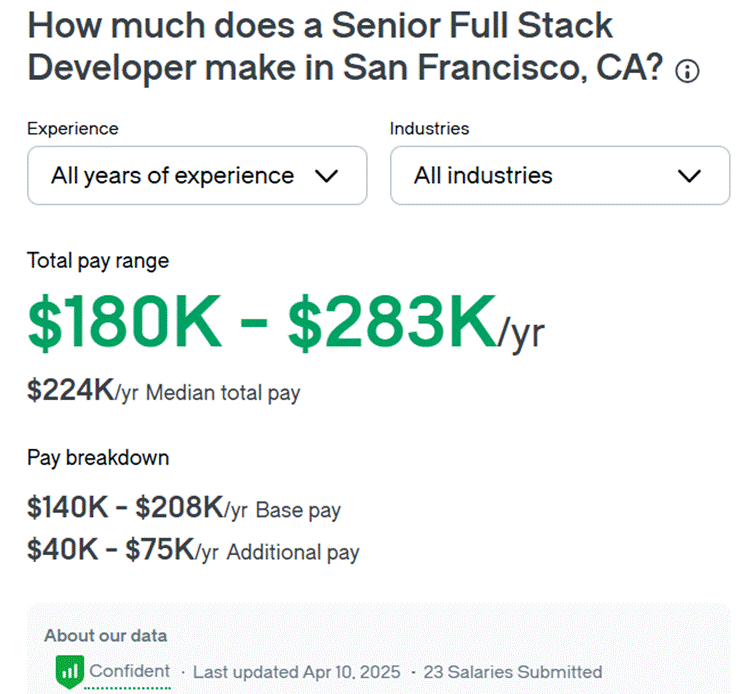
Source: Glassdoor
A comparable senior in Eastern Europe or Latin America, engaged through a dedicated team model, often costs 40-60% less fully loaded. Multiply that by five or six roles, and annual savings can reach the mid-six figures.
But raw salary comparison misses two crucial factors. First, time-to-hire drops from months to weeks, translating into faster revenue or impact milestones. Second, specialized vendors usually absorb overhead – payroll taxes, hardware, training on new frameworks – which can account for another 20-25% of hidden costs in direct hiring. When you roll those into your financial model, the dedicated approach often delivers a 30% total-cost advantage over local contracts, even after adding a vendor fee.
What about planet savings? Teams experienced in energy‑efficient coding and refactoring can reduce cloud resource usage and thus lower both costs and associated carbon emissions, because more efficient code consumes fewer compute cycles and energy.
Common Pitfalls – and How to Dodge Them
Even seasoned founders stumble when they rush. Three missteps show up repeatedly:
Shiny-stack syndrome. You might be sold on Rust or Elixir because it looks efficient on paper, but your legacy code is in Node.js, and your team knows TypeScript. If the dedicated team proposes a language switch, ask for a documented migration plan, impact on energy use, and fallback path.
Over-allocation. The whole point of dedicated teams is exclusivity. If your vendor starts dipping your developers into other projects, velocity drops and burnout spikes. Insist on monthly timesheets (anonymized if needed) to verify focus.
Neglecting knowledge transfer. Rapid delivery feels great until your Series B due diligence asks for architecture diagrams, and nobody on staff can explain the microservices layout. Schedule quarterly “teach-backs” where vendor engineers present system components to in-house tech leads. Record sessions and store them in your knowledge base.
Steering clear of these traps isn’t hard if you remember the earlier steps: clear vision, pilot first, and contract safeguards.
Sustaining the Relationship Beyond the First Release
The day version 1.0 ships is not the finish line; it’s mile marker two in a marathon. Keep the partnership fresh with continuous feedback loops. Hold joint quarterly business reviews that examine not only velocity and bug counts, but also carbon metrics, team morale, and upcoming regulatory changes (think CSRD in the EU or SEC climate disclosures in the U.S.).
Invest in co-learning. Sponsor vendor engineers to attend the same sustainability conferences as your leadership, whether that’s GreenTech Festival or SustainableUX. Encourage them to publish lessons learned (after clearing NDAs) on your company blog. The external visibility increases talent retention and positions your product as a thought leader in green tech.
Lastly, renegotiate the contract on an annual basis. As you increase your number of users, you might have to expand your team of six to an organization of twenty plus. Talk about hybrid models, that combine dedicated cores with elastic pods during peak workloads. Put those changes in line with the carbon budgets and financial projections such that growth does not water down the mission.
Wrapping Up: Your Next Action
You are creating something bigger than software; you are creating an advantage in the anti-climate-change struggle. The team of committed staff is providing you with senior talents, consistent expenses, and an opportunity to incorporate sustainability into each sprint. Begin with a vision that is crystal clear, identify partners that share your values, and confirm fit using a paid pilot. After the conclusion of signing the contract, maintaining the mission with carbon-conscious KPIs and unceasing knowledge exchange. By doing this, you will not only be able to write code at a faster rate – you will also be able to scale faster.