


For decades, many U.S. horse owners followed a simple rule: deworm every six to eight weeks. It was easy, predictable, and widely recommended. Today, that advice no longer reflects how parasites behave—or how horses stay healthiest.
Modern research shows that most horses do not need frequent deworming. In fact, over-deworming is now one of the biggest contributors to drug-resistant parasites, a growing problem across American barns and farms.
So how often should you deworm a horse in the U.S.?
The answer depends on age, parasite risk, management style, and fecal testing, not a calendar reminder.
This guide explains what a modern horse deworming schedule looks like, why it changed, and how to protect your horse without unnecessary treatments.
Short Answer (How Often Should You Deworm a Horse in the U.S.)
Most horses in the U.S. only need deworming one to three times per year, based on fecal egg counts, age, and risk level. Routine deworming every 6–8 weeks is no longer recommended because it accelerates parasite resistance and often provides no added health benefit.
What Are Horse Dewormers?
Horse dewormers are medicines that control internal parasites. These include roundworms, strongyles, bots, and tapeworms.
These parasites live in a horse’s gut. If left untreated, they can cause weight loss, dull coats, colic, diarrhea, and poor performance.
Dewormers do not remove parasites forever. They lower parasite levels so the horse’s body can stay healthy.
Veterinarians now stress that dewormers are tools, not supplements used on a fixed schedule.
What Are Horse Dewormers Used For?
Horse dewormers help in several important ways.
They:
- Lower parasite levels that affect digestion
- Help prevent illness and colic
- Protect young and weak horses
- Reduce parasite spread in pastures
- Help keep deworming drugs effective long-term
When used the right way, dewormers support horse health and farm balance.
Types of Horse Dewormers
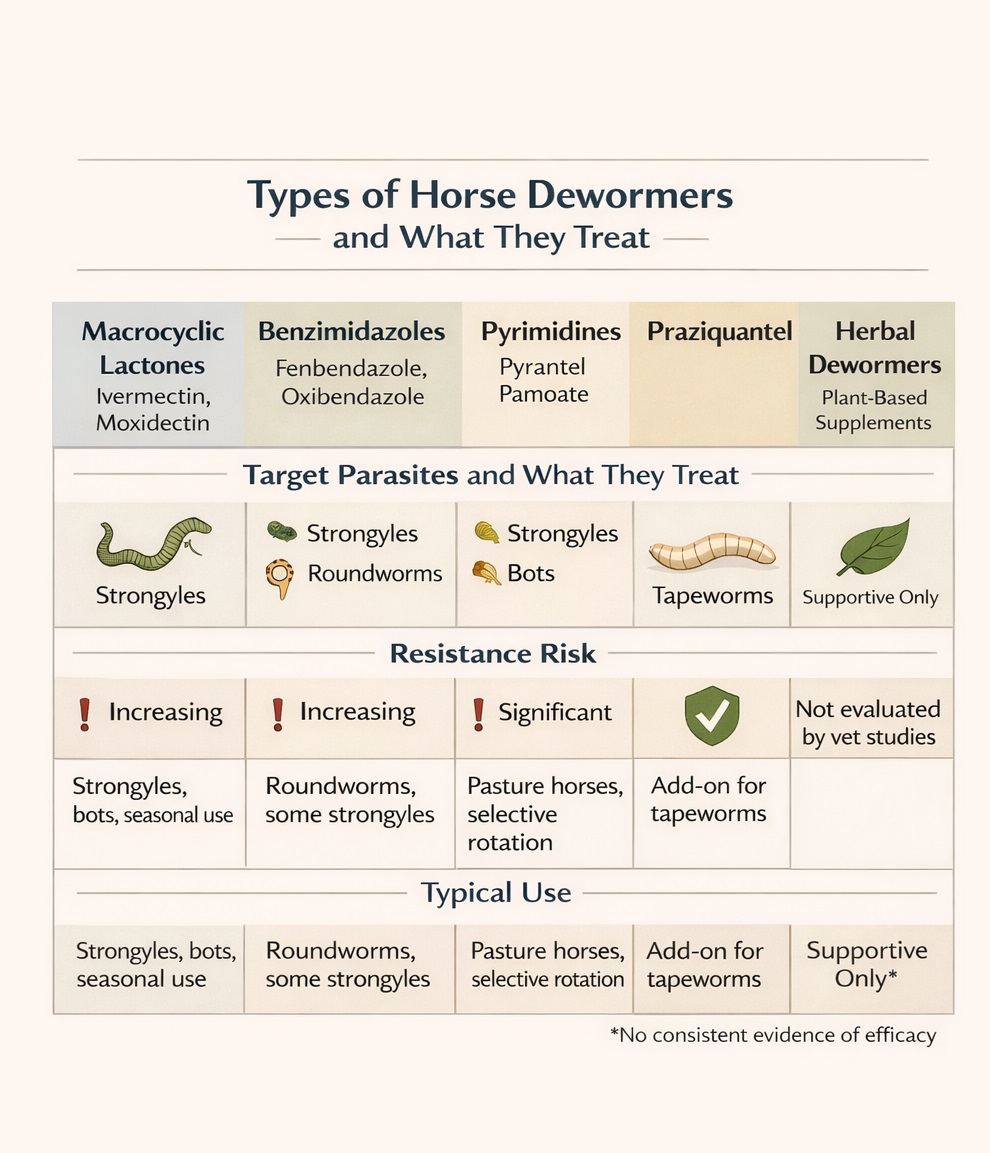
Horse dewormers fall into a few main groups. Each works on different parasites and has different risks.
Macrocyclic Lactones
Examples: Ivermectin, Moxidectin
These are common dewormers in the U.S. They treat many strongyles and bots.
Some parasites are becoming resistant. Moxidectin lasts longer but needs careful dosing, especially in young or thin horses.
Benzimidazoles
Examples: Fenbendazole, Oxibendazole
These drugs once worked well. Today, many parasites resist them.
Vets may still use them in special cases.
Pyrimidines
Examples: Pyrantel pamoate, Pyrantel tartrate
These drugs treat some roundworms and strongyles.
Resistance can develop if used too often or without testing.
Praziquantel (Tapeworm Treatment)
Praziquantel targets tapeworms. Most dewormers do not kill tapeworms alone.
It is often mixed with other drugs.
Herbal and Natural Dewormers
Herbal products use plant extracts or oils. Some may support gut health.
There is little proof they control parasites on their own. They should not replace proven treatments.
Which Horse Dewormer Is Best?
There is no single best dewormer for every horse. Many owners compare chemical products with herbal alternatives, especially when looking for a highly effective horse dewormer that does not rely on harsh ingredients. This change in thinking reflects a broader move toward prevention, balance, and sustainability rather than constant chemical intervention.
The best plan uses the right drug, at the right time, for the right horse. This decision should be based on risk level and testing.
Vets now recommend targeted deworming, not routine rotation.
Using fewer treatments—done wisely—often works better than frequent dosing.
Why “How Often Should You Deworm a Horse?” Is No Longer a Simple Question
Parasites have not become more aggressive—but they have become more resistant.
Years of frequent, blanket deworming exposed parasites to the same drugs repeatedly. As a result, many common parasites, especially small strongyles, now survive treatments that once worked reliably. Resistance to ivermectin, fenbendazole, and pyrantel has been documented across the U.S.
Veterinary organizations such as the American Association of Equine Practitioners (AAEP) now recommend targeted deworming, which focuses on treating horses that actually need it.
In other words, the goal is no longer to eliminate every parasite.
It is to control parasite burden while preserving drug effectiveness.
What a Modern Horse Deworming Schedule Looks Like
A modern horse deworming schedule is built around three principles:
- Testing before treating
- Adjusting frequency based on risk
- Timing treatments to parasite life cycles
Instead of deworming all horses the same way, owners evaluate each horse individually. Many adult horses turn out to be low parasite shedders and require minimal intervention.
This approach reduces costs, lowers chemical exposure, and helps preserve the effectiveness of available medications.
Why Location and Management Matter in the U.S.
Parasite pressure varies widely across the United States.
- Horses in warm, humid regions often face longer parasite seasons
- Northern climates may have more seasonal risk
- Overcrowded pastures increase exposure
- Regular manure removal lowers parasite load
A small private pasture with one or two horses carries far less risk than a busy boarding barn with frequent new arrivals. That difference directly affects how often deworming is needed.
You may like to read: Horse Virus Outbreak Across Multiple States
How Often Should You Deworm a Horse by Age
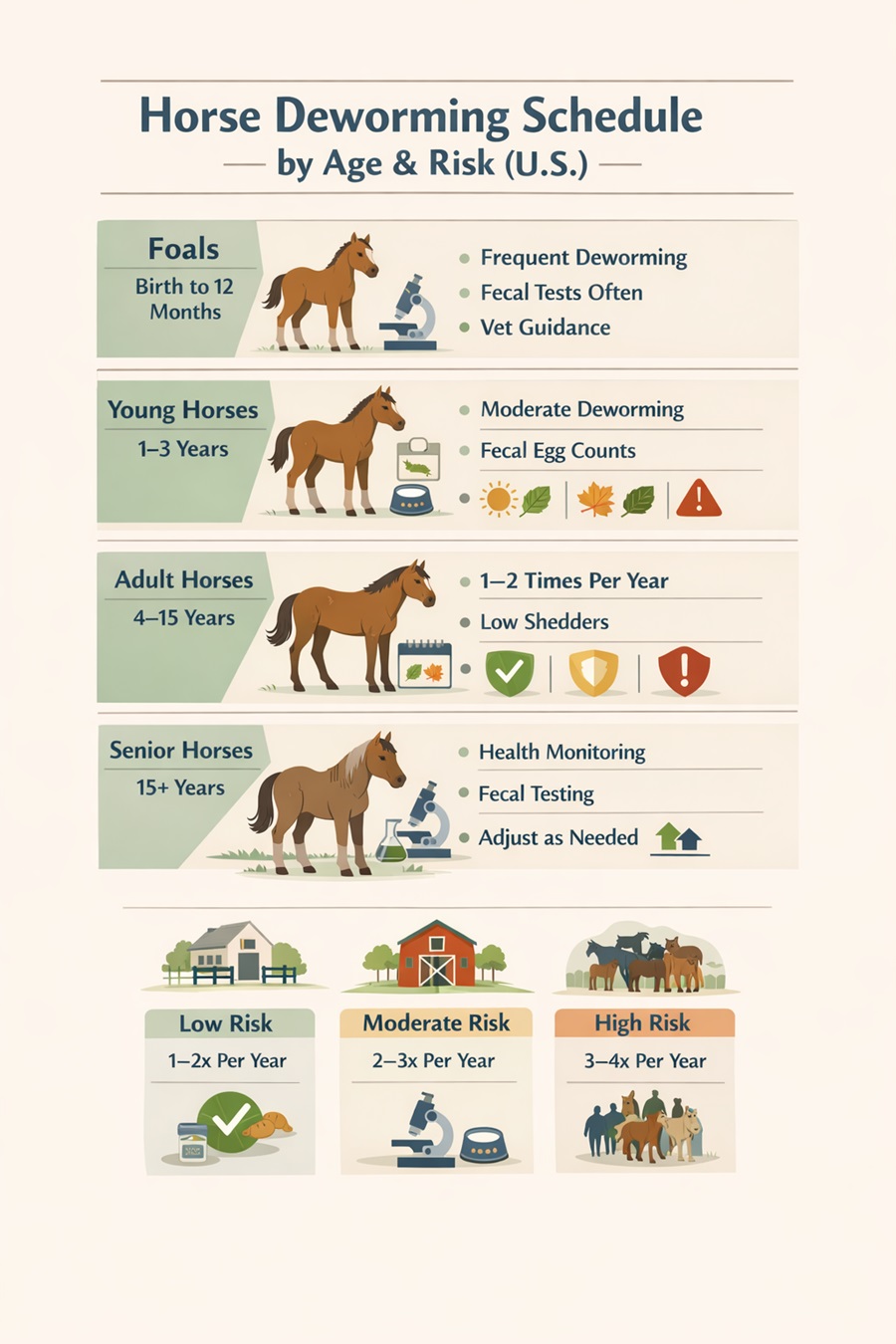
Foals (Birth to 12 Months)
Foals are the exception to low-frequency deworming. Their immune systems are immature, and they are vulnerable to specific parasites such as ascarids.
Foals typically require more frequent, carefully timed treatments, guided by a veterinarian. This schedule gradually tapers as immunity develops.
Yearlings and Young Horses (1–3 Years)
Young horses still carry higher parasite loads than mature adults. Deworming frequency usually decreases during this stage but remains higher than for fully mature horses.
Fecal testing becomes especially useful here to avoid unnecessary treatments.
Adult Horses (4–15 Years)
Most adult horses are low shedders. Many only need one or two deworming treatments per year, often timed for spring and fall.
This is the group most commonly over-dewormed in the past.
Senior Horses (15+ Years)
Older horses may experience immune changes that affect parasite resistance. Some seniors remain low shedders, while others benefit from closer monitoring.
Testing—not age alone—should guide treatment decisions.
How Often Should You Deworm a Horse Based on Risk Level
Not all horses with the same age need the same schedule.
Low-risk horses
- Minimal herd size
- Clean pasture management
- Consistently low fecal egg counts
These horses may only need annual or twice-yearly treatment.
Moderate-risk horses
- Shared pastures
- Boarding barns
- Occasional travel
Often require targeted treatments based on testing.
High-risk horses
- High fecal egg counts
- Crowded environments
- Frequent new arrivals
May need more frequent, vet-guided deworming.
Seasonal Horse Deworming Schedule in the U.S.
Most targeted programs focus on seasonal timing, not monthly dosing.
- Spring: Address strongyles before peak grazing
- Summer: Often no deworming unless tests indicate need
- Fall: Treat bots and encysted larvae when appropriate
- Winter: Minimal activity in colder regions; climate-dependent
Seasonal strategies align treatment with parasite biology rather than habit.
Fecal Egg Counts: The Key to Knowing How Often to Deworm
A fecal egg count (FEC) measures how many parasite eggs a horse sheds. It is simple, affordable, and transformative for parasite management.
Most programs recommend testing once or twice per year. Results classify horses as low, moderate, or high shedders.
This information allows owners to:
- Treat only when necessary
- Identify high-risk horses
- Reduce drug resistance
- Save money long-term
FEC testing is now considered the foundation of responsible deworming.
Common Horse Deworming Schedule Mistakes
Many parasite problems today stem from outdated habits.
Common mistakes include:
- Deworming too often “just in case”
- Rotating drugs without testing
- Treating every horse the same
- Ignoring pasture hygiene
Better parasite control comes from strategy, not frequency.
Horse Deworming Schedule
| Horse Type | FEC Testing | Typical Deworming Frequency | Timing |
| Adult low shedder | 1×/year | 1–2×/year | Spring/Fall |
| High shedder | 2×/year | 3–4×/year | Vet-guided |
| Foal | Multiple | Age-based | Veterinary plan |
This example is for education only and should not replace veterinary advice.
Should You Still Rotate Dewormers?
Routine rotation without testing is no longer recommended.
Instead, veterinarians now suggest:
- Using the right drug at the right time
- Rotating only when resistance risk or parasite type requires it
- Preserving effective medications for when they are truly needed
Blind rotation can worsen resistance rather than prevent it.
When to Talk to a Veterinarian
Professional guidance is especially important if:
- Fecal egg counts stay high after treatment
- Horses lose weight or condition
- Multiple horses show parasite issues
- You manage a large or high-turnover farm
Veterinarians can help tailor schedules that protect both horses and medications.
Frequently Asked Questions
How often should you deworm a horse without fecal testing?
Usually once or twice per year, but testing is strongly recommended for accuracy.
Can you deworm a horse too much?
Yes. Over-deworming accelerates resistance and may offer no health benefit.
Is once a year enough?
For many adult, low-risk horses, yes.
Do pasture horses need more deworming?
Not necessarily. Good pasture management can reduce parasite pressure.
The Bottom Line
A modern horse deworming schedule is not about doing more—it is about doing what is appropriate.
For most U.S. horses, fewer treatments guided by testing lead to better health, lower costs, and long-term parasite control. Asking “How often should you deworm a horse?” is the right question—but the best answer comes from evidence, not habit.