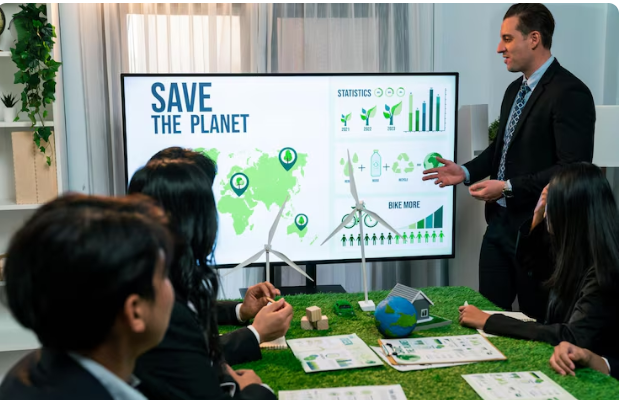

At the side events of climate conferences, you enter a specific type of space where you can practically feel the weight of the statistics on the walls. charts affixed on easels. screen-projected bar graphs. Whichever world leader happens to be in the room at that particular hour will be told the same story by the same numbers in various formats. One of the more helpful summaries of the world situation is the seven climate graphs in the PreventionWeb collection, which are mostly based on UNEP analyses. The graphs present a straightforward argument. The trajectory is incorrect. The window is becoming smaller. For billions of people, the decisions made at G7 summits in the next years will determine the real course of the second half of this century.
The first graph, which projects warming under various scenarios, is the one that typically results in the longest pauses in policy briefings. By 2100, global temperatures would climb by 2.5°C to 4.6°C if current policies are maintained. Warming falls between 2.1°C and 2.9°C even if every country fulfills all of its present climate commitments. In light of these estimates, the 1.5°C objective set by the Paris Agreement, which world leaders ceremoniously agreed upon in 2015, now seems almost ridiculous. Speaking with climate diplomats who have witnessed the last ten years of negotiations, it seems that the 1.5°C target has evolved from an operational objective to a moral benchmark. Instead of preventing damage at greater temperatures, more and more work is being done to control it.
| Topic Snapshot | Details |
|---|---|
| Subject | Seven critical climate graphs synthesized by PreventionWeb |
| Source Body | United Nations Environment Programme (UNEP) |
| Audience | World leaders preparing for upcoming G7 summits |
| Current Policy Warming Range | Projected 2.5°C to 4.6°C by 2100 |
| Pledge-Based Warming Range | Still projected at 2.1°C to 2.9°C |
| Paris Agreement Threshold | 1.5°C target |
| Estimated Annual Economic Loss | Up to $133 trillion in lost global wealth by 2100 |
| Historical Emissions Pattern | G7 and industrialized economies bear primary responsibility |
| Urban Heat Exposure | Billions of city dwellers facing unprecedented heat |
| Continuing Subsidy Issue | Fossil fuel subsidies still outpacing clean energy transition |
| Climate Damage Burden | 80% borne by low- and middle-income countries per IPCC reports |
The policy difficulty is further illustrated in the second graph, the greenhouse gas emission gap chart. Global emissions must drastically decrease over the next ten years in order to meet any variation of the 1.5°C objective. In contrast, in the majority of big economies, the actual emissions trajectory is either flat or steadily rising. There is a huge discrepancy between what governments are actually providing and what scientists claim is necessary. Executives in any other industry would immediately conduct a strategy review if they saw this kind of discrepancy. Somehow, it leads to additional discussions about climate policy.
The fact that finance ministers find the economic cost of inaction graph more compelling than environment ministers suggests something about the real distribution of power and decision-making. According to the prediction, which is based on economic modeling connected to UNEP, climate change could cause a 22% decline in world GDP by the year 2100 if immediate mitigation is not implemented. That translates to an annual loss of wealth of over $133 trillion. The scale is important, yet the number is so big that most people find it meaningless. Inaction on climate change is not just a moral shortcoming. For children who are now enrolled in school, it is a financial catastrophe that is just waiting to happen.
The fourth graph, which shows historical cumulative emissions, is the one that causes the most uncomfortable silences in G7 conferences. The information is clear. Most of the carbon dioxide in the atmosphere now is caused by the G7 countries and the larger group of historically industrialized economies. Developing countries have long argued that this historical obligation should result in increased financial assistance for vulnerable states as well as increased leadership in reducing emissions. Richer countries have frequently argued that, regardless of past trends, present emissions, especially those from China and India, require attention. Both points of contention are valid. Diplomatic solutions have not been found for either.
The fifth graph illustrates an aspect of climate risk that is frequently overlooked: the exposure of urban populations to high heat. As global baselines change, billions of urban dwellers will experience extreme and unprecedented heat exposure. Mumbai, Lagos, Karachi, and Phoenix. Cities that already endure oppressive summer heat may encounter circumstances that are nearly intolerable, especially for low-income citizens who lack access to dependable conditioning. The planning windows are limited, and a significant infrastructure investment is needed to make cities livable during these transitions. You get the impression that the political class is just starting to realize the scope of what’s coming when you speak with urban planners who are working on these issues.
The sixth graph, which contrasts investments in renewable energy with continuing subsidies for fossil fuels, paints a more dire picture than is typically acknowledged in public discourse. Global fossil fuel support continues to outrun investment in the clean energy transition in many industries and areas, despite repeated promises over the past ten years to phase out fossil fuel subsidies. It is really challenging to unravel the political economy of these subsidies. They maintain reduced fuel prices for consumers in the working class. They promote jobs in areas that rely on fossil fuels. They are the result of decades of policy choices that centered entire economies on low-cost carbon. However, the math is flawed. The shift cannot proceed at the rate required by science as long as governments continue to fund the issue.
One of the most challenging moral and political issues in international diplomacy is captured in the seventh and final graph, which deals with climate finance for vulnerable countries. Despite contributing significantly less to past emissions, low- and middle-income nations carry about 80% of the burden of climate effects. Both the amount of money contributed and the amount of money guaranteed to these countries for adaptation have continuously fallen short of what is required. New finance announcements are made at every significant climate summit. Every year after that shows deficiencies in actual delivery. One of the ongoing issues in international climate negotiations is the imbalance, which isn’t moving any closer to being resolved.
When combined, these seven graphs present a convincing case that is genuinely uncontested in the field of serious climate policy. The present course is incorrect. The financial costs of doing nothing are orders of magnitude higher than those of taking action. Historically, the nations most accountable for the issue are those with the greatest capacity to take action. The worst effects are felt by the nations with the fewest resources. The changeover is both economically and technically possible. The limiting factor is the political will to carry it out.
These graphs are more than just adornment for G7 leaders getting ready for the next series of summits. They are the fundamental limitation on what constitutes excellent policy. Observing the last few cycles of climate diplomacy, it seems that the pomp of summit images has too frequently taken the place of substantive action. That won’t be altered by the seven charts alone. However, they gradually make it more difficult for any leader to claim ignorance of what the data actually reveals. The entire globe is observing. It’s evident from the numbers. There will soon be another summit. Whether the residents in those rooms have complied with PreventionWeb’s request will determine whether it results in anything more than another picture opportunity. Learn the graphs by heart. Then take action on them.