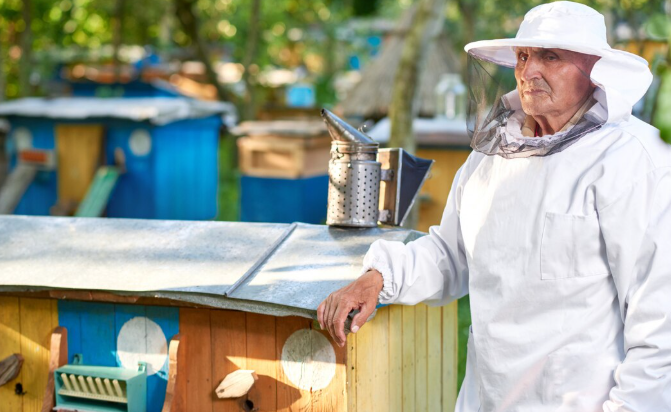

There’s a moment in early June when you stand on the edge of a Michigan backyard and realize something is genuinely working. It’s a thick clover. There’s a hint of warm wax in the air. And somewhere behind a neighbor’s fence, behind a garden shed, there’s a hive humming with more purpose than the majority of environmental press releases can ever express.
Despite decades of funding and bureaucratic intent, backyard beekeepers in the American Midwest have been quietly doing what federal conservation programs have struggled to do consistently: keeping bees alive and landscapes blooming. It’s not ostentatious. No ribbon-cutting is taking place. And that’s most likely why it continues to function.
Think about what the figures truly indicate. Between April 2024 and April 2025, U.S. beekeepers lost an estimated 55.6 percent of their managed honey bee colonies, the highest annual loss rate since tracking started in 2010, according to the most recent national beekeeping survey. Winter losses reached a record high of 40.2%. Particularly hard hit were commercial operations, the large-scale ones that transport truckloads of hives from blueberry fields in Maine to almond orchards in California. In the meantime, small-scale beekeepers—those who oversee fewer than 50 colonies in someone’s side yard in Ohio or Indiana—kept showing up, re-queening, and paying attention in ways that scale tends to hinder.
It’s not a coincidence. It’s most likely a structural reality of how care is provided. On a Tuesday morning, a commercial beekeeper overseeing thousands of colonies in several states is unable to recognize that one hive is behaving strangely. In rural Wisconsin, a retired teacher can.
Based on this idea, Michigan apiarist Justin Fairchild, also known as the Kilted Farmer, created the Community Apiary Project Hive Adoption program. His objective is not merely poetic: he wants to establish healthy, productive hives every three to five miles throughout his county. It nearly perfectly corresponds to a healthy honey bee colony’s foraging radius. He’s not speculating. Without the concrete and the federal grant cycle, he is constructing infrastructure. In addition to learning something, his neighbors can adopt a hive and harvest their own honey. Practical instruction has a tendency to stick.
Whether initiatives like his can grow quickly enough to have an impact on the decades-long acceleration of habitat loss is still up for debate. Native grasslands and conservation lands, the kinds of fields that used to feed millions of bees without anyone having to try, have been disappearing from Midwestern states. That loss takes time to recover. However, there is a feeling that local beekeepers are producing real investment, something that federally funded programs frequently cannot produce. You approach the issue differently when your kitchen window is three feet away from your hive.
The total annual contribution of pollinators to the U.S. economy is estimated to be $34 billion. More than 130 fruits, nuts, and vegetables are said to have been pollinated by honey bees alone. It is estimated that one-fifth of North America’s pollinators are in danger of going extinct. When you watch a single bee work a patch of lavender someone planted two summers ago because they read it would help, these are the kinds of statistics that are highlighted by researchers and circulate in policy papers.
Serious environmental policy cannot be replaced by what is taking place in backyards in the Midwest. To suggest otherwise would be naive. However, it is also not insignificant. It’s imperfect, hyper-local, and maintained by people who deliberately chose it, making it perhaps the most honest form of conservation currently available. That’s what survival looks like sometimes.