
Quick Answer: Is Baja Gold Sea Salt Good for You
Baja Gold sea salt can be a fine choice if you prefer a less refined salt with trace minerals, but it is not a major nutrition upgrade over other salts. It is still mostly sodium chloride, so the bigger health issue is how much sodium you eat in a day, not whether the salt looks more natural. For many people, that matters more than mineral marketing.
That is where a lot of the confusion starts. Specialty salts often get treated like they belong in a separate health category, but salt is still salt. Baja Gold may bring a different taste, texture, and mineral profile, yet those differences do not erase the basic sodium question. The most useful way to judge it is as a culinary choice with a modest nutrition angle, not as a health food.
Why Baja Gold Sea Salt Gets So Much Attention
Baja Gold sits in a category that gets a lot of wellness attention. It is sold as less refined, mineral-rich, and closer to its natural source than standard table salt. For health-focused shoppers, that checks a lot of boxes.
It also fits a broader habit in food shopping now. People do not just ask what an ingredient does in a recipe. They ask whether it is cleaner, more natural, better for hydration, or better for daily health. That is why Baja Gold gets more scrutiny than plain salt ever did.
The interest makes sense. The problem is that trace minerals are easy to overrate. A product can contain minerals without becoming a meaningful source of them.
What Is Baja Gold Sea Salt?
Baja Gold sea salt is a sea salt sold as a less refined alternative to regular table salt. In plain terms, that usually means it keeps more of the minerals that occur naturally in seawater and goes through less processing than standard table salt.
That changes the product in a few noticeable ways. It can have a softer texture, a more mineral-forward taste, and a less uniform look. It also tends to appeal to people who prefer pantry staples that feel less industrial. Still, its main job stays the same. It seasons food.
What Minerals Are in Baja Gold Sea Salt?
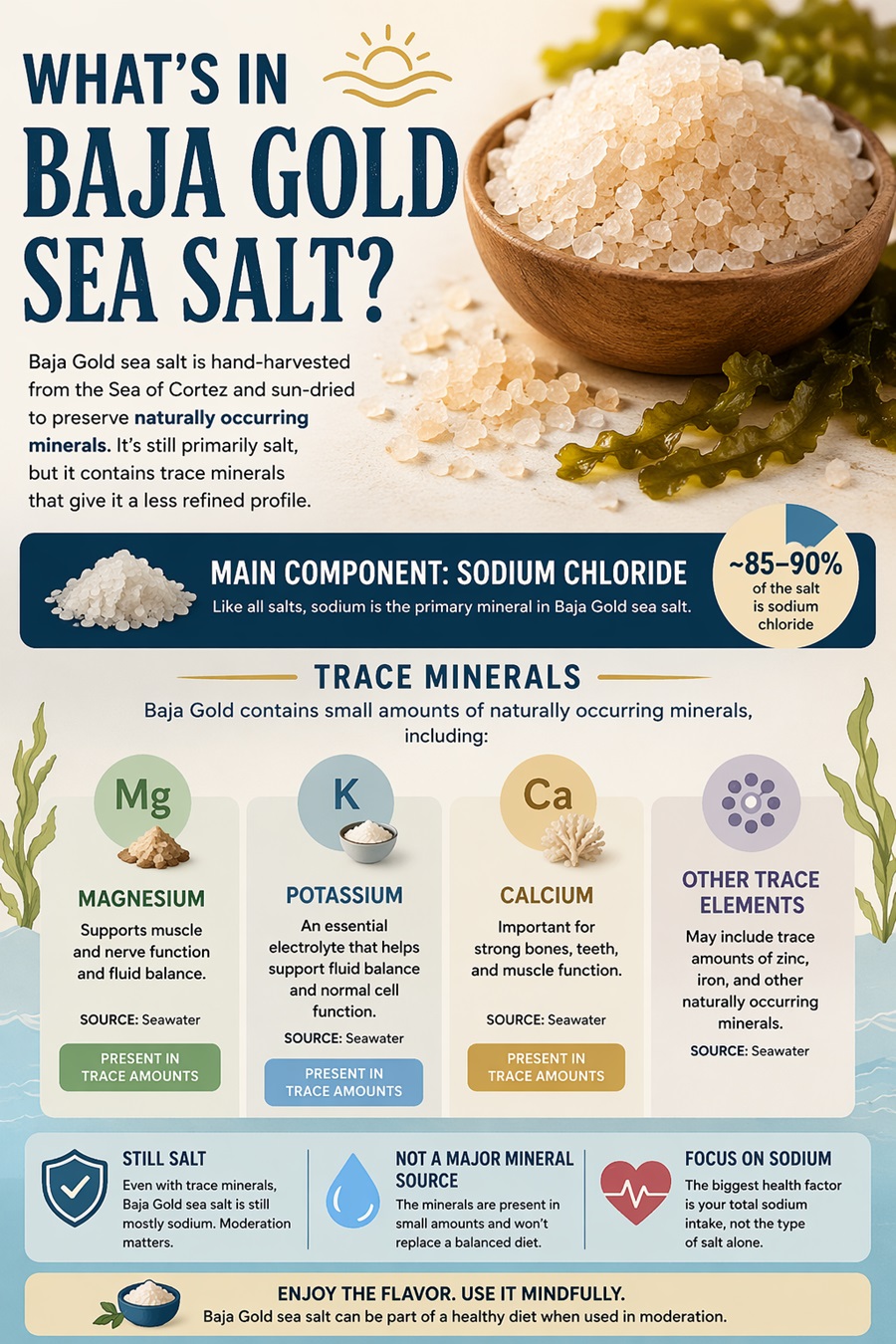
Baja Gold sea salt is still mainly salt, but it also contains naturally occurring trace minerals. Based on the company’s published ranges, the minerals most often highlighted are magnesium, potassium, and calcium.
Minerals often listed in Baja Gold sea salt
- Magnesium: about 0.8% to 1.4% in the Signature version
- Potassium: about 0.6% to 1.0%
- Calcium: about 0.1% to 0.4%
- Overall salt content: about 75% to 80% for the Signature version, and about 84% to 89% for some shaker or grinder versions
Those numbers help explain the appeal, but they also keep the claim in proportion. The product contains minerals, but it is not a strong mineral source in the way foods like dairy, beans, leafy greens, nuts, or fruit can be.
Is Baja Gold Sea Salt Actually Healthier?
Not in a dramatic way.
That is the clearest answer. Baja Gold can appeal to people who want a less refined salt and like the idea of getting trace minerals from a pantry staple. But those minerals are present in small amounts. They do not turn salt into a major nutrition upgrade.
The bigger issue is sodium. That remains true whether the salt is sea salt, pink salt, flaky salt, or standard table salt. If a person already eats too much sodium, switching to a more natural-looking salt does not fix the real problem.
This is where specialty salt marketing often gets ahead of nutrition reality. Baja Gold is not unhealthy because it is specialty salt. It just does not escape the same limit that applies to every other salt.
What Makes Baja Gold Different From Regular Table Salt?
The biggest differences are processing, texture, iodine, and how the product is positioned. The basic nutrition story is much closer than many people expect.
| Feature | Baja Gold Sea Salt | Regular Table Salt |
| Source | Harvested from seawater | Usually mined or heavily processed salt sources |
| Processing | Less refined | More refined for uniform texture |
| Mineral content | Contains trace minerals | Mostly sodium chloride, with fewer natural trace minerals |
| Sodium role | Still mainly sodium chloride | Still mainly sodium chloride |
| Iodine | Often not iodized | Often iodized |
| Texture | Softer, less uniform | Fine and consistent |
| Taste | More mineral-forward | Straightforward salty taste |
| Best use | Finishing salt, specialty cooking | Everyday cooking and baking |
| Health takeaway | Some trace minerals, but still use in moderation | Practical, often iodized, still use in moderation |
Key Takeaway
Baja Gold may feel more natural and contain trace minerals, but the health difference is usually smaller than the branding suggests. The real nutrition issue with both Baja Gold and table salt is total sodium intake. In some households, iodized table salt also has a practical edge because it helps support iodine intake.
Baja Gold Sea Salt vs Himalayan Pink Salt
This is one of the most common comparisons, and the answer is less dramatic than the branding on either product suggests.
Baja Gold and Himalayan pink salt are both sold as less refined alternatives to regular salt. Both are linked to trace minerals. Both attract buyers who want a pantry staple that feels less processed and more natural. That is why they often get framed as healthier options.
In practice, they are closer than they are different.
Baja Gold comes from seawater, so it is often associated with an ocean-sourced, mineral-rich identity. Himalayan pink salt comes from ancient rock salt deposits and is best known for its color, crystal texture, and premium image. Those differences affect taste, feel, and visual appeal more than they change the core nutrition story.
Both are still mostly sodium chloride. Both contain trace minerals, but not in amounts that make them major nutrient sources. For most people, this is a taste and preference decision, not a serious nutrition decision.
| Feature | Baja Gold Sea Salt | Himalayan Pink Salt |
| Source | Harvested from seawater | Mined from ancient rock salt deposits |
| Color | Off-white to light golden | Pink |
| Processing | Less refined | Less refined |
| Mineral profile | Trace minerals from seawater | Trace minerals from rock deposits |
| Texture | Often slightly soft or moist | Usually dry and crystalline |
| Taste | Briny, more mineral-forward | Mild, clean, lightly mineral |
| Nutrition reality | Still mostly sodium chloride | Still mostly sodium chloride |
| Best fit | People who prefer sea salt | People who prefer mined salt |
Bottom line on the comparison
Baja Gold and Himalayan pink salt are closer nutritionally than their shelf image suggests. The better choice usually comes down to taste, texture, sourcing, and how you cook. Neither changes the basic need to keep sodium intake under control.
Are the Minerals a Real Benefit or Just a Marketing Halo?
This is where the conversation needs a little discipline.
Yes, less refined salts can contain trace minerals. That part is real. But “contains minerals” and “meaningful mineral source” are not the same thing. A seasoning can have trace amounts of magnesium or potassium without making a noticeable difference in your daily intake.
For most people, the better nutritional sources of those minerals are foods, not salt. That does not make Baja Gold pointless. It just puts it in the right category. It is a seasoning with some extra mineral content, not a shortcut to better nutrition.
Can Baja Gold Sea Salt Help With Hydration?
It can contribute sodium, and sodium is an electrolyte. That is the truthful part.
The problem is how quickly that idea gets stretched into a larger claim. Hydration is not about one premium salt. It depends on total fluid intake, activity level, climate, sweat loss, and overall electrolyte balance. For many people, better hydration comes from drinking enough fluids and having a balanced diet, not from upgrading the salt in the pantry.
So the practical answer is simple. Baja Gold can play a small role in electrolyte intake because it contains sodium. That does not make it a special hydration tool on its own.
Does Baja Gold Sea Salt Have Iodine?
This is one of the most important questions in the whole topic.
Many specialty salts are not iodized. That matters because iodized salt can be a steady iodine source in the diet, and iodine is important for thyroid hormone production. People who switch fully from iodized table salt to a non-iodized specialty salt sometimes overlook that tradeoff.
That does not make Baja Gold a bad option. It just means less processed is not always better in every nutritional sense. If a person uses little seafood, dairy, or other iodine-containing foods, this detail deserves more attention than the trace mineral story.
Who Might Like Baja Gold Sea Salt?
Baja Gold makes the most sense for people who care about flavor, texture, and a less refined product. It can work well as a finishing salt or as part of a cooking style centered on simple ingredients and whole foods.
In that role, it has a clear appeal. It feels more distinctive than regular table salt, and some people prefer the taste. That is a solid reason to buy it. The strongest case for it is culinary, not medical.
Who Should Be More Careful?
Anyone watching sodium intake should keep expectations grounded. The body does not treat excess sodium differently because the salt looks more natural or comes from seawater.
People who rely on iodized salt for iodine should also think twice before replacing it completely with a non-iodized specialty salt. That is not a warning against Baja Gold. It is just a reminder that one preference can quietly replace another nutritional benefit.
Bottom Line
Baja Gold sea salt can be a perfectly reasonable choice if you want a less refined salt with trace minerals and a different flavor profile. But the health story is smaller than the branding story. It is still mainly sodium chloride, and that remains the main nutritional fact that matters.
The better question is not whether Baja Gold is good in isolation. The better question is whether your overall diet keeps sodium in a sensible range and still covers basics like iodine. If the answer is yes, Baja Gold can fit just fine. If not, switching salts does not solve the bigger issue.
FAQ
Is Baja Gold sea salt healthier than regular salt?
It can seem healthier because it is less refined and contains trace minerals, but it is still mostly sodium chloride. For most people, overall sodium intake matters more than the salt type.
Does Baja Gold sea salt contain minerals?
Yes. It contains trace minerals such as magnesium, potassium, and calcium, but not in amounts that make it a major nutrient source.
Can Baja Gold sea salt improve hydration?
It provides sodium, which is an electrolyte, but hydration depends on fluids, diet, activity, and overall electrolyte balance, not one specialty salt alone.
Does Baja Gold sea salt have iodine?
Many specialty salts are not iodized. That means Baja Gold does not automatically provide the same iodine benefit as iodized table salt.
Is Baja Gold better than Himalayan pink salt?
Neither has a clear major health advantage. For most people, the difference comes down to source, taste, texture, and personal preference.
Can you use Baja Gold sea salt every day?
Yes, but it still needs moderation. Daily sodium intake adds up no matter which type of salt you use.