
Keeping a home comfortable in Australia is no longer about buying a bigger heater or a stronger air conditioner. Energy prices are higher, weather swings are sharper, and heating and cooling now take a large share of household energy use, around 40% on average, and anywhere from 20% to 50% depending on climate zone. The homes that perform best usually get the basics right first. They reduce the heating and cooling load, then choose equipment that suits the house and the local climate.
Fix the house before you upgrade the system
The first dollars often belong in the building shell, not the appliance. Australian government guidance says roof, wall, and floor insulation can cut heating and cooling costs by more than 50%. Gap sealing around doors, windows, and other leakage points lowers the load even further. In practice, this changes everything. A tighter, better-insulated home usually needs a smaller unit, costs less to run, and stays more even through the day instead of swinging from too hot to too cold.
Reverse-cycle air conditioning still leads for most homes
Energy efficiency means using less energy to achieve the same level of comfort. In Heating and Cooling Systems, this involves selecting technologies designed to deliver optimal performance without excessive energy use.
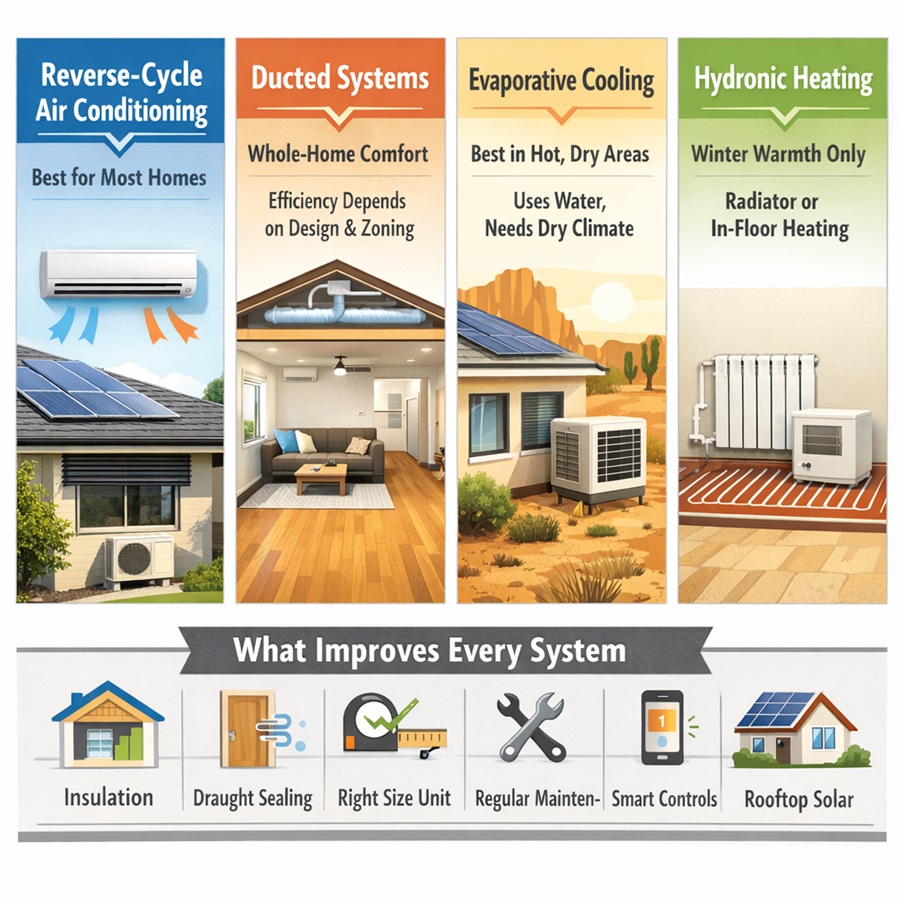
For most Australian households, reverse-cycle air conditioning remains the strongest all-round option. It handles both heating and cooling in one system, and official guidance says reverse-cycle units on the Australian market often operate at 300% to 600% efficiency because they move heat rather than create it directly. Put simply, one unit of electricity can deliver about 3 to 6 units of heating or cooling energy. Energy Rating guidance also says reverse-cycle air conditioners are generally the most energy-efficient combined heating and cooling system available to households.
That does not mean every unit is worth buying. Size matters, and so does climate fit. The Zoned Energy Rating Label gives a far better read than a generic star label because it shows heating and cooling performance across hot, average, and cold climate zones, along with estimated annual electricity use in kWh. It also gives a clearer sense of whether a model suits Darwin, Sydney, or Hobart, which is the real question buyers need answered. Energy Rating guidance is also blunt on sizing: units that are too small work harder, and units that are too large cost more upfront and more to run.
Ducted systems can work, but design decides the result
Ducted systems still make sense in some larger homes, especially where people want whole-home coverage and less visible indoor hardware. But ducted does not automatically mean lower bills. Energy.gov.au notes that ducted systems are generally less efficient than wall units because they rely on larger fans and lose energy through ductwork. Zoning helps, but only when the duct layout, sealing, insulation, and controls are well done. A weak design can wipe out the benefit quickly.
There is also an indoor air point that many homeowners miss. Comfort and ventilation are not the same thing. YourHome notes that ducted air systems can heat or cool recirculated indoor air without bringing in fresh outdoor air or removing pollutants. That is why filter cleaning, duct maintenance, and ventilation planning still matter, especially in homes that stay closed up for long periods.
Evaporative cooling suits some Australian homes, not all of them
Evaporative cooling still earns its place, but only in the right climate. YourHome says evaporative coolers work best in low-humidity climates, and energy.gov.au describes them as highly effective in hot, dry inland areas such as Alice Springs. They use less electricity than refrigerated air conditioning in the right conditions, but they also add moisture to the air, need windows or doors open while running, and can use large amounts of water on very hot days.
That is why evaporative cooling should be sold honestly. It is not a whole-country answer. In humid coastal regions, its performance drops, and YourHome warns that evaporative systems can raise indoor humidity and increase mould or dust-mite pressure if maintenance is poor. It can still be a very good fit in dry areas, but it needs to match the climate, the home, and the household’s tolerance for moisture and outdoor air intake.
Hydronic heating remains a narrower choice
Hydronic heating still appeals in some colder homes and renovation projects, but it solves a smaller problem. It deals with winter comfort only. For households trying to move away from gas, simplify the house, and keep one main electric system for both seasons, reverse-cycle air conditioning is usually the cleaner fit. That is one reason it keeps coming out on top in Australian guidance and incentive programs.
Controls help most when the house and system already make sense
Smart controls are useful, but they are not magic. Energy.gov.au says connected home systems can turn equipment on or off, run it on schedules, adjust to changing conditions, and work with time-of-use tariffs to avoid expensive peak periods. That can trim waste, especially when heating and cooling are matched to occupied rooms instead of empty ones.
The point is not that a controller is “smart.” The point is that it helps a good house run more precisely. Schedules, zoning, remote control, and occupancy-based settings sharpen the result. They do not rescue a poorly insulated home or a badly sized system.
Solar, batteries, and electrification are changing the maths
Heating and cooling choices now sit inside a larger household energy plan. Energy.gov.au notes that the value of electric heating improves when the power comes from rooftop solar. The federal Cheaper Home Batteries Program is also now in place, offering around a 30% upfront discount for eligible small-scale battery systems connected to new or existing solar PV. The program was updated again in 2026, with changes commencing on 1 May 2026.
For homeowners replacing old gas heating, worn-out split systems, or a patchwork of separate appliances, this matters. The stronger long-term move is often to think in one package, better insulation, all-electric heating and cooling, rooftop solar, and where it stacks up, battery storage. Piecemeal upgrades still happen, but the economics now favour joined-up decisions more than they did a few years ago.
What matters in 2026
The policy picture has moved closer to existing homes, not just new builds. Energy Ministers released the Home Energy Ratings Disclosure Framework Version 2 on 6 December 2024, setting out a national model for home energy ratings at the point of sale or lease. NatHERS also says stage 2 of its existing-homes rollout is expected from mid-2026, which should widen access to assessments for ordinary households.
State support still shapes the buying decision too. Victoria’s Energy Upgrades program says households can access sizeable discounts when moving to reverse-cycle systems, including much higher support in some cases when replacing ducted gas heating. In New South Wales, the air conditioner upgrade incentive remains available as an upfront discount for eligible new installs or replacements. At the code level, NCC 2025 did not proceed with the proposed new residential energy-efficiency changes, leaving NCC 2022 Amendment 2 in place for those parts.
Final thoughts
The best result for a modern Australian home rarely comes from a single product. It comes from getting the order right. Cut the load first with insulation, draught sealing, shading, and better fabric performance. Then choose equipment that suits the house, the climate zone, and the way people actually live in it. For most homes, that still points to reverse-cycle air conditioning, chosen by the right size and climate label, backed by regular maintenance, sensible controls, and, where the numbers work, solar-powered electrification.