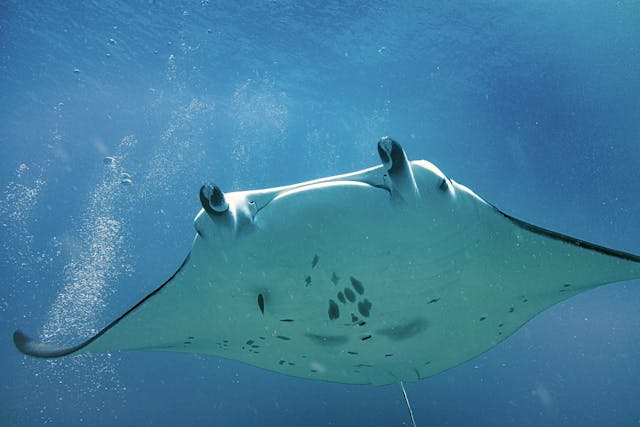

A manta ray’s size can make it look dangerous at first glance. Many people assume that means it has a stinger. It does not, and that mistake usually comes from confusing manta rays with stingrays.
Quick Answer: Do Manta Rays Have Stingers?
No, manta rays do not have stingers. They do not have a venomous barb on the tail like many stingrays do. Florida Museum states that a manta ray’s tail lacks a spine, and Ocean Conservancy describes manta rays as having a harmless, slender tail. NOAA also identifies giant manta rays as large filter feeders, not dangerous animals.
Seeing a huge ray pass under you can feel intense at first. That reaction makes sense. Manta rays are massive, dark across the back, and powerful in open water. Many people see that shape and assume it works like a stingray. It does not. Manta rays are built for feeding on plankton, not for stabbing or defending themselves with a tail barb.
What a Stinger Means in Rays
In rays, a stinger is a sharp barbed spine on the tail. Many stingray species use it for defense. If the animal feels trapped or threatened, that barb can injure a predator and deliver venom.
Manta rays do not have that structure. Their tails are smooth and lack a spine or barb. That is the clearest answer to the question.
Why People Mix Up Manta Rays and Stingrays
The confusion is easy to understand. Both animals are rays, and both have broad, flattened bodies. From far away, that shared shape can make them look alike.
Up close, the differences are clear. Manta rays have a wide mouth at the front of the body, plus two cephalic fins that help guide food inward. Their tail has no stinger. Stingrays are the group most people associate with a defensive tail barb.
That single detail drives most of the confusion. People hear the word “ray,” think “stinger,” and carry that idea over to mantas. In practice, manta rays live very differently and are built very differently. Understanding their anatomy and lifestyle helps replace fear with appreciation, showing that these creatures are built for grace, not aggression, making it safe to enjoy activities like snorkeling with manta ray in their natural habitat.
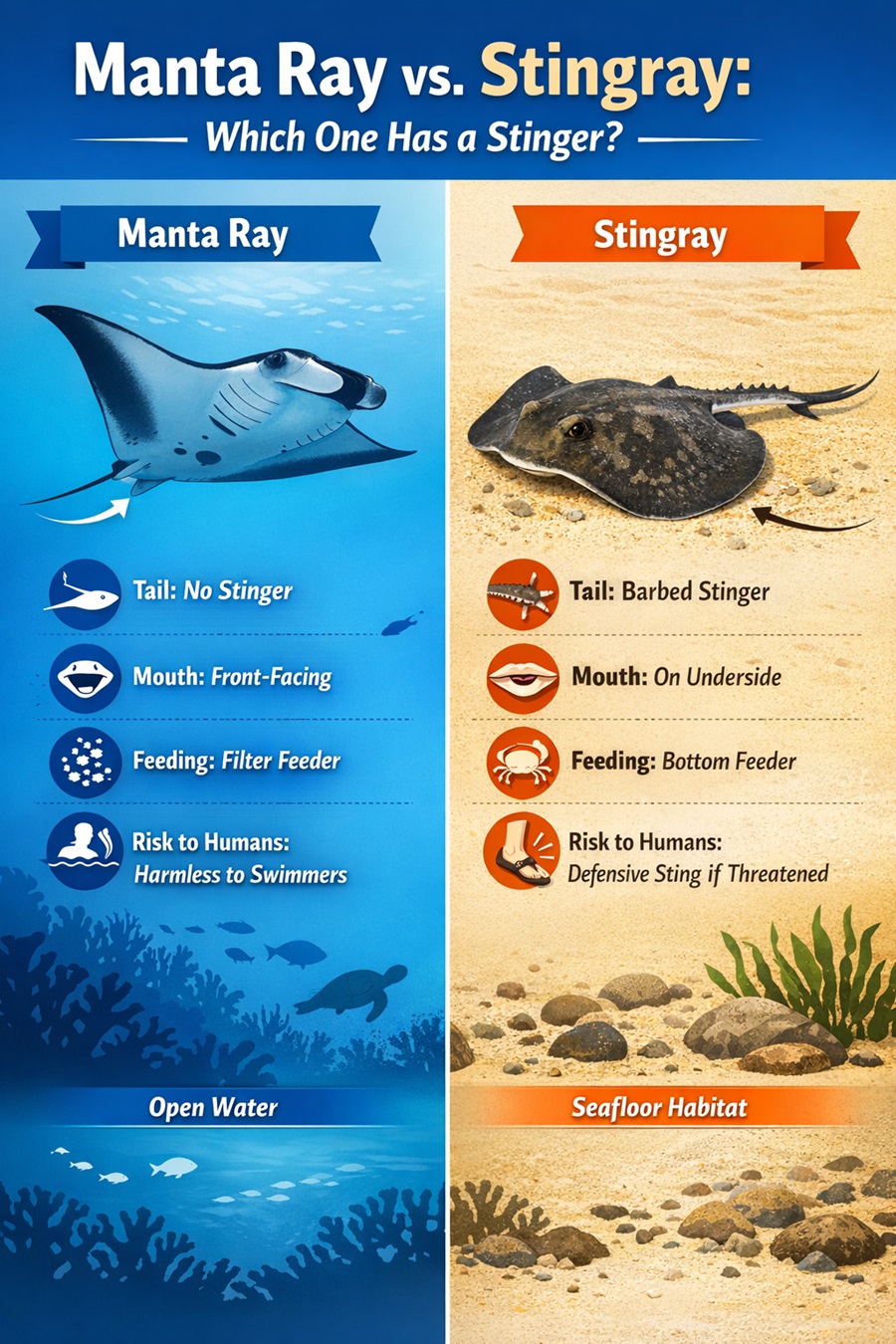
Manta Rays vs. Stingrays
| Feature | Manta Rays | Stingrays |
| Tail | Smooth tail, no stinger or spine | Many species have a defensive tail barb |
| Feeding style | Filter feeders that eat zooplankton in open water | Often feed on prey near or on the seafloor |
| Mouth and fins | Front-facing mouth with cephalic fins | Different head and mouth structure |
| Usual behavior | Open-water gliders | Often linked with bottom-dwelling habits |
| Risk to people | No stinger | Some species can injure with the tail barb |
This comparison matches descriptions from Florida Museum, NOAA, and Ocean Conservancy.
you make interested in : Ocean Animal Extinction: How Can We Help?
Why Manta Rays Do Not Need Stingers
Manta rays live a different kind of life from stingrays. NOAA describes the giant manta ray as the largest ray in the world and identifies it as a filter feeder that eats large amounts of zooplankton. Florida Museum describes the manta’s broad mouth at the front of the head and the cephalic fins that help direct food inward.
That body plan tells the story. Manta rays are made for cruising through open water and feeding as they swim. They are not built to rest on the seafloor and defend themselves with a tail weapon. Their tail is not a tool for attack. Florida Museum puts it plainly, the tail lacks a spine.
Are Manta Rays Dangerous to Humans?
In normal encounters, manta rays are not dangerous to humans. They do not have a stinger, and they do not hunt people. NOAA describes them as filter feeders, and Ocean Conservancy draws the same distinction when comparing mantas with stingrays.
That said, harmless does not mean people should crowd them. A giant manta ray is still a large wild animal. NOAA advises people to watch from a safe distance and not try to touch, chase, or lure them closer. Human pressure can disrupt feeding, resting, and breeding behavior.
The better way to think about it is simple. Manta rays are safe to observe, but they still deserve space.
Why Manta Rays Look Intimidating
Most of the fear comes from size. Giant manta rays are huge, and anything that large moving under you in open water gets your attention fast. Their shape also adds to the drama. Wide fins, a dark back, and slow powerful movement can make them look more threatening than they are.
But appearance and behavior are not the same thing. Manta rays eat tiny prey from the water column. They are not built like animals that rely on a stinger for defense.
Why Respect Still Matters
The most useful takeaway is not only that manta rays cannot sting you. It is that these animals need protection. NOAA lists the giant manta ray as threatened under the Endangered Species Act and points to risks such as fishing pressure and bycatch. NOAA also updated the accepted scientific name in federal rulemaking in 2023, using Mobula birostris.
So the real story is bigger than a yes or no question. Manta rays are harmless filter feeders, but they are also vulnerable marine animals that need careful treatment in the wild.
Bottom Line
No, manta rays do not have stingers. They do not carry a venomous barb, and their tails are not built for defense the way many stingray tails are. Manta rays are large open-water filter feeders with a smooth, harmless tail. If you see one while diving or snorkeling, the right response is simple, enjoy the moment, keep your distance, and respect the animal.
FAQs About Manta Rays and Stingers
Do manta rays have stingers?
No. Manta rays do not have stingers or barbed tails. Florida Museum states that their tail lacks a spine, and Ocean Conservancy describes it as harmless.
Can manta rays sting you?
No. They do not have the venomous tail barb people associate with stingrays.
Are manta rays dangerous to humans?
Generally, no. They are filter feeders, not aggressive predators, and public guidance focuses on respectful wildlife viewing.
Are manta rays safe to swim with?
Yes, when people act responsibly. Observe them from a safe distance and do not touch, chase, or lure them.
What is the main difference between a manta ray and a stingray?
The simplest difference is the tail. Manta rays do not have a stinger, while many stingrays do. Manta rays also have a front-facing mouth and cephalic fins for filter feeding.
Why do manta rays look scary if they are harmless?
Mostly because of their size. Giant manta rays are the largest rays in the world, so they can look intimidating even though they feed on plankton.