
Environmental responsibility is no longer a side project for businesses. It now sits much closer to operations, cost control, procurement, and reputation. That shift has become more visible as companies face stronger expectations around sustainability data, climate-related planning, and supplier practices. Even businesses that do not file formal sustainability disclosures are increasingly asked by customers, investors, and partners to explain how they use energy, buy materials, manage waste, and support environmental claims. IFRS S2 has been effective for annual reporting periods beginning on or after January 1, 2024, which reflects how quickly business sustainability has moved from broad messaging to measurable action.
That does not mean every company needs a sweeping reinvention. In practice, the smartest pivot is usually a practical one. The businesses that make real progress tend to start with the parts of the operation they can measure, improve, and repeat: energy use, purchasing, waste, commuting, and supplier standards. The goal is not to look green. The goal is to build a company that wastes less, runs better, and can show clear progress when customers, partners, or regulators start asking harder questions.
Start With the Biggest Levers
One reason business sustainability efforts stall is that companies often begin with the most visible actions rather than the most important ones. Branded reusable items, office posters, and a few recycled products may look like progress, but they rarely address the biggest sources of impact. In many workplaces, the larger levers are building energy use, purchased goods, packaging, employee commuting, and waste generation. EPA’s supply-chain guidance reflects that broader view and emphasizes that environmental impact often extends well beyond the office itself.
A better starting question is not, “What green item should we buy first?” It is, “Where do we use the most energy, create the most waste, and make the most purchasing decisions?” Once that becomes clear, the next steps usually become more practical.
Start With What You Can Measure
Before buying new products or launching an internal campaign, get a baseline. Many businesses jump straight to reusable items or sustainability messaging without first learning where their environmental impact actually sits. A more useful first move is to track a short list of operating indicators: electricity use, paper purchasing, waste hauling volume, water use, business travel, employee commuting patterns, and the biggest categories of purchased goods. EPA’s sustainability planning and emissions resources support this baseline-first approach.
That baseline gives a business something many weak sustainability efforts never get: a way to prioritize. Once the data is visible, it becomes much easier to tell the difference between symbolic changes and meaningful ones.
How to Track Progress
A sustainability effort becomes far more useful when it is measured consistently. That does not require a complicated reporting system. For many small and mid-sized businesses, a simple monthly dashboard is enough. Track electricity bills, waste pickups, paper purchases, water use, commuting survey results, and any purchasing categories the company is actively trying to improve. When those numbers are reviewed every month or quarter, it becomes easier to see whether changes are producing real results.
For facilities, benchmarking is especially valuable. ENERGY STAR Portfolio Manager is a widely used benchmarking tool for commercial buildings, and ENERGY STAR says it can help organizations track energy, water, waste, and greenhouse gas emissions over time.
Rethink Supplies, but Focus on Reduction First
A lot of business sustainability advice starts with buying greener versions of the same things. Sometimes that helps, but the more effective rule is simpler: reduce first, reuse second, recycle third. EPA’s recycling guidance places source reduction and reuse above recycling because the best waste is the waste that never gets created in the first place.
That changes how everyday purchasing decisions should be framed. Instead of asking whether the office should switch to a greener disposable product, ask whether the disposable item can be avoided altogether. Refillable kitchen supplies, durable breakroom ware, reusable shipping materials where feasible, and tighter inventory controls often do more than swapping one throwaway item for another. Recycled-content paper can still make sense, and better packaging choices matter, but a business usually sees bigger long-term gains when it cuts unnecessary consumption at the source.
If your team frequently grabs cold drinks from the local cafe, they likely discard dozens of disposable cardboard wraps each week. Providing a reusable iced coffee sleeve for every staff member eliminates the need for those flimsy paper versions that fill your trash bins daily. You can even customize the sleeves with your company logo, turning a simple item into a subtle reminder of your commitment to sustainability.
Make Digital Workflows More Disciplined
Moving files to the cloud and reducing printing are still sensible steps, but a digital-first model only works when the workflow itself improves. Otherwise, companies end up with fewer filing cabinets and more duplicate files, unnecessary printing, and weak document control. A stronger digital system sets default rules: double-sided printing where printing is unavoidable, shared records that reduce duplication, approval flows that cut routine printouts, and clear retention practices so teams stop storing everything forever.
Paper reduction still matters, but this becomes more valuable when it is treated as an operations issue rather than just a sustainability gesture. The business that prints less, stores documents better, and reduces routine rework is usually operating more efficiently at the same time.
Treat Energy as a Management Issue
For many businesses, energy is still the fastest place to find savings that are both environmental and financial. Replacing outdated bulbs with LEDs remains one of the easiest upgrades because LEDs use far less energy than incandescent lighting and last much longer. But a strong energy strategy should not stop at lighting replacement. DOE and ENERGY STAR guidance point toward a more useful operational model: benchmark the building, identify high-use patterns, tighten schedules, and use controls so equipment runs only when needed. ENERGY STAR says occupancy sensors can reduce lighting costs in the right applications, and Portfolio Manager has become a standard tool for tracking commercial building performance.
That is why the better approach is not simply “swap in LEDs.” It is to benchmark the workspace, fix obvious waste, and then use controls to keep those gains from slipping away. Motion sensors in lower-traffic areas, improved thermostat setbacks during off-hours, and better use of daylight can all help, but they matter most when the business is actually tracking performance over time.
Why Benchmarking Beats Guessing
Many offices assume they are doing reasonably well on energy simply because utility bills are not outrageous. That is not the same thing as knowing how the building performs. Benchmarking gives context. It helps a company see whether its site is improving, underperforming, or simply drifting along unchanged. ENERGY STAR Portfolio Manager is useful here because it organizes energy, water, waste, and emissions data in one place.
Instead of only saying “save energy,” a business can identify where waste is actually happening and decide what to fix first.
Reevaluate the Supply Chain
Supplier choices shape far more than office operations. Modern business sustainability is no longer just about buying local or picking products that sound responsible. EPA’s supply-chain guidance reflects a broader reality: a company’s footprint often sits beyond its own walls, in purchased goods, packaging, transport, and vendor practices.
A stronger supply-chain approach starts with direct questions. Do key vendors offer lower-packaging options? Do they provide recycled-content alternatives? Are their environmental claims documented? Can shipments be consolidated? Are the products durable, repairable, and built to last? Those questions push procurement away from marketing language and toward evidence.
Questions to Ask Suppliers Before You Buy
A short supplier checklist makes procurement decisions more practical:
- Can this product be purchased with recycled or lower-impact materials?
- Is excess packaging avoidable?
- Is the product durable enough to reduce replacement cycles?
- Can it be repaired instead of discarded?
- Can deliveries be consolidated to reduce transport waste?
- Are environmental claims backed by documentation or recognized standards?
These questions help turn sustainability from a vague preference into a purchasing standard.
Encourage Lower-Emission Commuting
Employee commuting is often treated as a side issue, when in many businesses it is part of the actual emissions picture. EPA’s emissions resources include factors for categories such as commuting, which means this area is measurable, not just aspirational.
That gives employers a better way to think about commuting programs. Transit subsidies, bike storage, carpool matching, and limited remote-work flexibility are all reasonable tools, but they work best when they are linked to participation data. Even a short annual transportation survey can show which changes matter most for the workforce. In one office, secure bike parking may help. In another, hybrid work or transit support may do more.
Build a Culture of Sustainability With Structure
Culture matters, but culture alone is not a plan. Companies often announce green initiatives, ask employees for ideas, and then wonder why the momentum fades after a month. The fix is straightforward: give the effort ownership, goals, and review points. EPA’s sustainability planning materials follow that same logic, moving from assessment to targets to implementation instead of treating sustainability as a one-time campaign.
Invite employee ideas. Run challenges if they fit the workplace. Recognize useful suggestions. But also assign responsibility. Someone should own the waste policy. Someone should review building energy use. Someone should manage supplier standards. Someone should report progress every quarter. When sustainability becomes part of ordinary management rather than an occasional morale exercise, it tends to last.
Common Sustainability Mistakes That Waste Time and Budget
Many businesses do not fall short because they lack interest. They fall short because they prioritize poorly. Common mistakes include focusing on low-impact symbolic items, making broad environmental claims without evidence, treating local sourcing as automatically sustainable, launching initiatives without a clear owner, and failing to measure results. Those mistakes waste budget because they create activity without producing much operational change.
Avoiding weak sustainability habits is often just as important as adopting stronger ones.
Be Careful How You Describe Your Efforts
If a company starts calling itself “eco-friendly,” “green,” or “sustainable,” those claims should be specific and supportable. The FTC’s Green Guides are intended to help businesses avoid environmental marketing claims that mislead consumers, and the FTC says broad, unqualified claims are difficult to substantiate.
That does not mean businesses should avoid talking about progress. It means they should talk about it precisely. “We reduced office electricity use by 12% over 12 months” is much stronger than “we are committed to going green.” “We shifted to packaging with 60% recycled content” is better than “our packaging is eco-friendly.” Specific language builds trust. Broad language creates risk.
Quick Wins, Mid-Level Changes, and Bigger Long-Term Moves
Some improvements are easy to make quickly. Others take more planning but deliver stronger long-term value.
Quick wins include double-sided print defaults, LED replacements, thermostat schedules, better waste sorting, and reusable breakroom supplies.
Mid-level changes include motion sensors, transit subsidies, vendor reviews, packaging reductions, and basic commuting surveys.
Bigger long-term moves include building benchmarking, procurement standards, supplier documentation requirements, durable product policies, and more formal emissions tracking.
This framework helps businesses move in stages instead of feeling that sustainability is either trivial or overwhelming.
A Practical 90-Day Plan
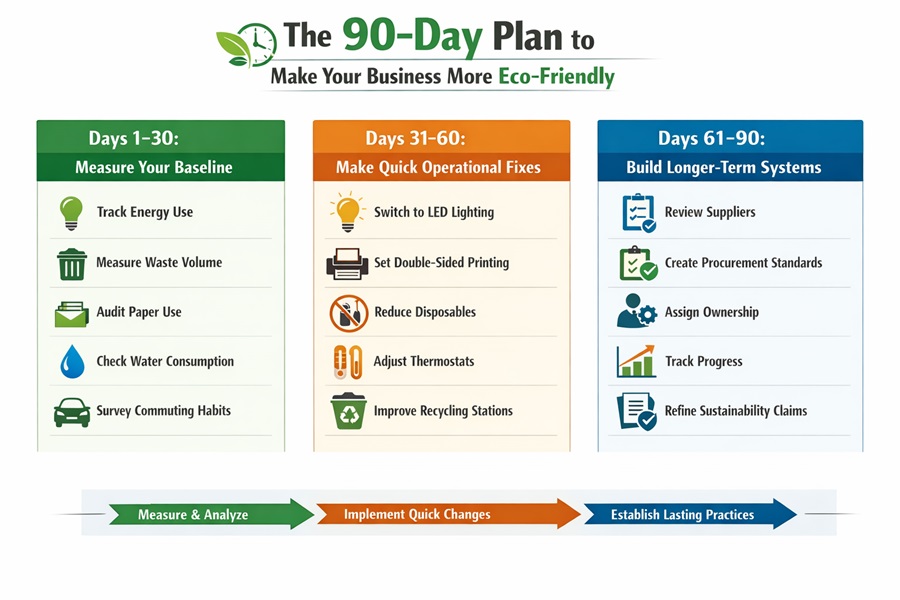
A short implementation plan helps turn ideas into action.
First 30 days: gather baseline data on energy, waste, printing, water, and commuting. Identify the largest purchasing categories.
Next 30 days: implement quick operational fixes such as print defaults, LED replacements, thermostat schedules, and reusable supply changes.
Final 30 days: review vendors, create simple procurement questions, assign internal ownership, and decide how progress will be tracked and communicated.
Small, steady changes tend to produce stronger long-term results than dramatic but short-lived initiatives.
The Smartest Pivot Is the One Your Business Can Sustain
A more eco-friendly company is usually not built through a dramatic gesture. It is built through a sequence of practical decisions that reduce waste, improve efficiency, sharpen purchasing, and make environmental claims easier to defend. Some of those decisions are simple, like tightening print defaults or replacing old lighting. Others are more strategic, like benchmarking building performance, asking better questions of suppliers, and tracking commuting data. Together, they move sustainability out of the realm of branding and into the realm of operations.
That is where the strongest business case sits today. A greener company is not just one that uses nicer language or buys a few better products. It is one that knows where its impact is, acts on the biggest levers first, and can show its work when customers, partners, or regulators ask harder questions.