
Spring in Tompkins County carries a particular kind of momentum. Snow retreats, the gorges swell with meltwater, and projects that sat on hold all winter suddenly feel urgent. Homeowners start long-delayed repairs. Contractors kick off jobs that couldn’t run in the cold. Businesses finally tackle refreshes, reorganizations, and buildouts.
That seasonal surge is good for the community—but it also creates a predictable spike in trash, renovation debris, and “where do we even take this?” confusion. The good news: Tompkins County has real infrastructure for diversion (reuse, recycling, and special programs), and Ithaca has a culture that’s already aligned with doing this well. The difference between “landfill by default” and a cleaner outcome is usually a simple plan made before demo starts. Tompkins County’s Recycling & Materials Management program and Recycling and Solid Waste Center (RSWC) are key anchors for that plan.
Key takeaway
Unplanned cleanup becomes landfill cleanup. Planned cleanup—salvage first, then sort, then dispose—keeps more material in use, reduces contamination, and makes the entire project smoother.
Start here: the 30-minute plan (works for homes, businesses, and job sites)
Step 1: Do a quick “salvage sweep” before demolition
Walk the space and tag anything that still has reuse value:
- Solid wood doors, cabinets, hardware, shelving
- Fixtures that still work (lighting, sinks if acceptable)
- Clean dimensional lumber, old-growth boards
- Appliances in working order (often donatable; otherwise special handling may apply)
Why this matters: once materials are smashed, mixed, or wet, their reuse/recycling options narrow fast.
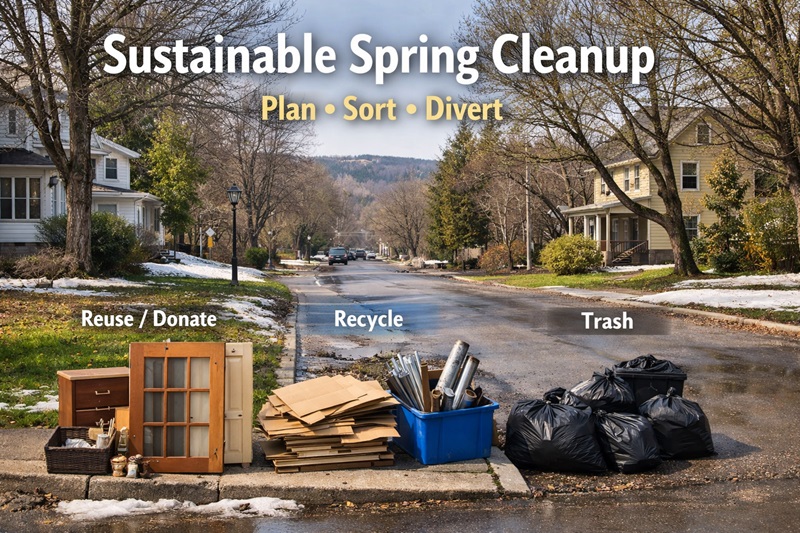
Step 2: Choose a simple sorting setup you’ll actually follow
Most projects do best with 2–4 streams:
- Donate/Reuse (kept clean and intact)
- Recycling (clean metal, cardboard, eligible containers, etc.)
- Construction debris (drywall, roofing, mixed C&D)
- Trash (true landfill-bound items)
Step 3: Confirm your local drop-off pathways
Tompkins County’s RSWC is open Monday–Saturday, 7:00 am–3:30 pm, and the county maintains guidelines and program info through Recycling & Materials Management.
Disposal at the facility generally involves permits for county residents and businesses, and the county publishes a permits/fees page.
Step 4: Identify “special handling” items early
Household hazardous waste (HHW), lead paint concerns, refrigerants in appliances, and other regulated items are where well-meaning projects go wrong. Tompkins County runs HHW drop-off events (by appointment/permit), with 2026 dates published (Apr 18, May 16, Jul 18, Aug 15, Oct 17, Nov 21).
What goes where in Tompkins County
Use this as a starting point, then verify specifics for your exact item and condition.
| Material | Best path | Notes that prevent mistakes |
| Cabinets, doors, intact fixtures | Reuse/Donation | Donation rules vary; keep items complete, clean, and undamaged. Many ReStores publish acceptance criteria. |
| Cardboard & mixed paper | Curbside recycling / recycling program | Tompkins County lists accepted curbside items (e.g., cardboard & mixed paper). Keep clean/dry. |
| Metal (clean scrap) | Recycling | High diversion potential if kept uncontaminated (no food/trash mixed in). |
| Appliances | Recycling/special handling | Some appliances involve refrigerants—handle through approved channels and follow facility rules. (Confirm current guidance locally.) |
| Clean, separated job-site material streams | C&D recovery / recycling pathways | NYSDEC defines C&D debris and supports proper handling and recovery approaches. |
| Paint, solvents, chemicals, automotive fluids | HHW event | Tompkins County HHW events require appointment/permit. |
| Unknown old flooring/insulation/pipe wrap | Stop and assess | Potential asbestos-containing materials: don’t disturb until you’ve checked proper handling/testing routes. (Confirm locally.) |
| Mixed, contaminated debris | Landfill | Mixing is the fastest way to turn recyclable material into trash. |
The residential picture: older homes, higher reuse value—and higher risk items
Tompkins County’s older housing stock is a gift for salvage. Solid wood doors, old-growth lumber, cast iron, vintage hardware, and intact cabinetry can often be reused—if you remove them carefully before demolition.
Make salvage realistic (not aspirational)
A lot of “I’ll donate it later” fails because items get damaged or time runs out. Two ways to make it stick:
- Schedule one “deconstruction day” before demo begins.
- Stage donations immediately (garage/patio) so they don’t get mixed into debris.
ReStore rules matter (so you don’t waste a trip)
ReStores vary by region, but many publish detailed acceptance checklists (for example, cabinet condition requirements and exclusions). Use those lists to avoid “good intentions, rejected at the dock.”
Safety and compliance: lead is the big one in older housing
If your home was built before 1978, renovation work that disturbs painted surfaces can generate lead dust. EPA’s Renovation, Repair and Painting (RRP) program requires lead-safe certified contractors for certain paid work in pre-1978 housing and child-occupied facilities; EPA also notes the rule generally doesn’t apply to homeowners working in their own homes (with important exceptions, such as rentals).
Practical takeaway: if you’re hiring help, ask whether the firm follows lead-safe practices on older homes. It’s not a “nice-to-have,” it’s a health protection step.
The commercial picture: the real problem is mixed loads and time pressure
Commercial cleanouts and refreshes fail on diversion for one reason: speed. When time is tight, everything goes into the same pile.
The fix is simple: a written “sorting map”
Before work begins, define:
- Where donation items go (even a taped-off corner)
- Where recyclables go (cardboard/metal)
- Where everything else goes (debris/trash)
This costs almost nothing and changes outcomes dramatically. It also reduces the “end-of-project panic” when a space needs to reopen.
Add a “last chance” donation pass
Right before pickup:
- Pull usable chairs/desks/shelving
- Pull working fixtures
- Pull unopened boxes of supplies
Commercial waste often contains the most donatable stuff, because it’s frequently replaced for aesthetic or operational reasons—not because it’s broken.
The construction picture: where volume makes organization pay off
Contractors and active job sites generate the biggest debris volumes. New York State explicitly defines construction and demolition (C&D) debris as waste from construction, remodeling, repair, and demolition, and treats it as a distinct waste stream with handling/recovery pathways and facility requirements.
A job-site sorting system that crews will actually follow (2–4 streams)
Option A (simplest):
- Clean metal
- Cardboard
- Everything else
Option B (higher diversion):
- Clean wood (unpainted/untreated)
- Clean metal
- Cardboard/packaging
- Mixed C&D/trash
The operational rule: keep streams uncontaminated. The minute food waste, insulation, wet drywall, or random trash gets mixed in, recycling options shrink and disposal costs often rise. If your project will generate more than a few car-loads of debris, pricing out a dumpster rental near you early can help you choose the right container size and avoid last-minute mixed loads.
Responsible disposal, Ithaca-specific: permits and right-of-way basics
If you’re bringing material to the county facility, Tompkins County describes permits for disposal at the Recycling and Solid Waste Center and how residents/businesses obtain them.
For container placement (like roll-offs), the most consistent rule across cities is:
- Private property: permits are often not required.
- Public right-of-way (street/sidewalk): a permit is often required—check with the city before placing anything in the ROW.
(For Ithaca, permit information and application pathways are hosted on the City of Ithaca’s official site; project type determines the exact permit category.)
Tompkins County resources to build into your plan
Recycling & Materials Management (County)
- County program hub, hours, and contact info are published on the Tompkins County site.
Recycling and Solid Waste Center (RSWC)
- Listed as open Mon–Sat, 7:00 am–3:30 pm, with published guidance and facility information.
Household Hazardous Waste (HHW)
- Tompkins County publishes HHW event details and 2026 dates, and notes appointment/permit requirements.
Common mistakes (and how to avoid them)
- Demo first, sort later
Fix: salvage + separate before you break things. - “Mixed debris is fine” thinking
Fix: even two-stream sorting (recycling vs everything else) is a big improvement. - Ignoring special handling items
Fix: identify paint/chemicals/batteries/unknown materials early; use HHW events when appropriate. - Treating lead-safe practices as optional in older homes
Fix: if hiring, confirm lead-safe compliance for pre-1978 work; EPA RRP guidance is clear on when certification applies.
FAQ
Do I need a permit to dispose of waste at the Tompkins County facility?
Tompkins County publishes permit and fee information for disposal at the Recycling and Solid Waste Center, including eligibility (residents/businesses).
When is the Recycling and Solid Waste Center open?
Tompkins County lists RSWC hours as Monday–Saturday, 7:00 am–3:30 pm.
What’s accepted in curbside recycling in Tompkins County?
The county publishes curbside “What’s accepted” guidance (e.g., cardboard & mixed paper, glass containers, metal cans/foil, and certain plastics).
How do HHW drop-offs work?
Tompkins County lists HHW drop-off events (six per year) and states that registration/appointments and a valid permit are required.
If my house is older, should I worry about lead paint during renovation?
If your home was built before 1978, renovation work disturbing paint can create lead dust. EPA’s RRP program outlines when certified, lead-safe work practices are required (typically for paid contractors and certain settings).
Is a donation center guaranteed to accept my cabinets/fixtures?
No—reuse organizations often have condition requirements and exclusions. Check published acceptance lists/checklists before you load up.
Do I need a permit for a dumpster/roll-off in Ithaca?
Often not if it stays on private property, but permits are commonly required for placement in the public right-of-way (street/sidewalk). Verify with the City before placement.
Closing: Ithaca’s sustainability looks like logistics
Ithaca’s environmental identity isn’t only big policy and big values—it’s also small operational choices made in advance: pulling reusable materials before demo, keeping recyclables clean, and routing hazardous items correctly.
Spring cleanup season is one of the most tangible moments to practice that ethic—not perfectly, but deliberately—one home, one storefront, and one job site at a time.