
Buying a house is a huge financial decision most people will ever make & the look and feel of a property is obviously important – but how its actually performing is perhaps even more so. In the UK, household energy costs still play a massive role in shaping our monthly budgets – and that performance is no small detail.
That’s one reason new build homes keep getting so much attention. The truth is they typically use less energy than older properties because they’ve been built to much newer, tighter standards and with better overall specs. The government took another step in that direction in March 2026 with the introduction of the new Future Homes and Buildings Standards and updated Part L rules – this means new homes are being pushed towards lower carbon heating systems, stronger building fabric and on-site renewable energy.
Modern standards start at the start – with the building fabric
The main energy advantage of a new build home usually starts before you even have to turn the heating on. A well built home with good insulation simply doesn’t lose as much heat in the first place
Older UK homes – especially pre-war terraces, converted houses and homes that were built before modern insulation became the norm – tend to lose loads of heat through poorly insulated walls, roofs, floors, windows and all the tiny gaps around the building that make it hard to keep warm. New homes on the other hand are built around a much tighter thermal envelope – which means better insulation, better glazing and more airtight construction all working together to keep the temperatures stable inside.
And that’s a big deal – because a home that holds the heat for longer is going to need less energy to stay comfortable. As opposed to constantly re heating rooms that are dropping in temperature quickly – these new homes start off from a much more efficient base. That’s probably the clearest practical reason Because new build homes are built to high standards, they lose heat at a fraction of the rate of older buildings. This reduces the constant need to blast the radiators, leading to much lower energy waste from day one..
The data backs up the efficiency gap
The gap between new and existing homes isnt just sales patter – the figures actually show it up.
In England from October to December 2025 – most new homes that got an EPC rating got a B – while older homes were much more likely to get a C or D. In fact 69% of new homes were given a B rating, while a massive 88% of existing homes were given a C or D. That gives a pretty clear picture of where new homes fit into the overall housing stock – they tend to be built to perform a lot better from the get go.
The upshot for buyers is that it usually means a more stable indoor climate and lower routine heating demand. Not every new build is perfect, but it does mean the average starting point is a lot stronger.
Features That Really Make a Big Difference to Energy Use
Not all of the fancy features that come with a modern home are created equal when it comes to energy demand. Some make a huge difference while others barely register.
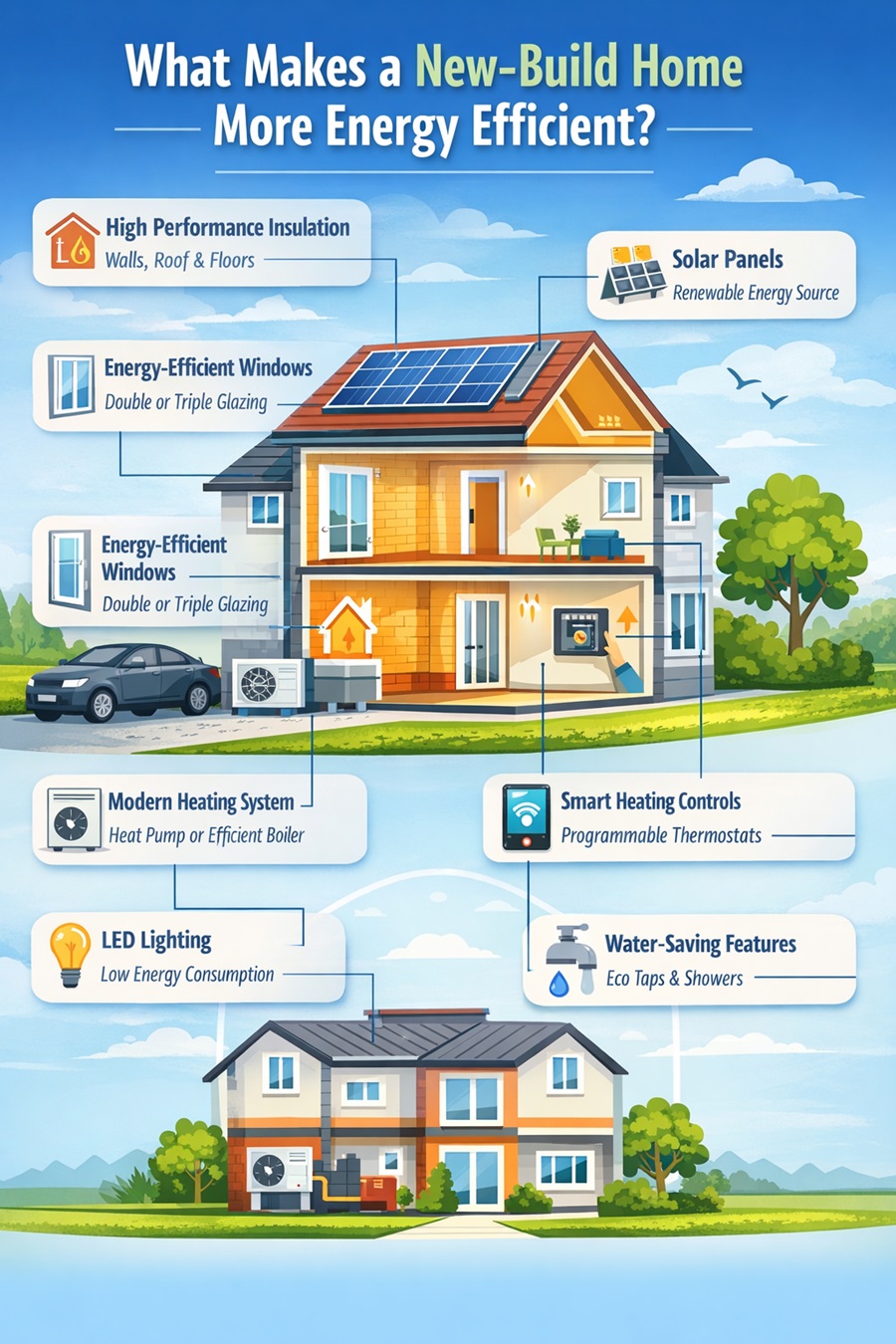
At the top of the list are usually things like insulation, how well sealed the house is, the quality of the windows, and the heating system itself. These are the things that decide just how much energy the house is going to need, long before you even get to the smart thermostats and solar panels.
After that, things like how well your heating controls work, how efficient your hot water system is, how much electricity you’re generating from solar panels, and how efficient your appliances are can all start to make a real difference too.
This is an important point because people often get caught up on the flashy features like a fancy new thermostat and forget about the basics. The thing is, a sleek new thermostat isn’t going to make up for a house that’s just not well insulated. And solar panels are only going to make a real difference if you’re already doing a good job of using energy in the first place. The houses that really do stand out when it comes to energy efficiency are the ones that got the simple things right first, and then built on that foundation.
Heating Systems Are Getting Better Too
Being efficient isn’t just about keeping the heat from leaking out the window. It’s also about how the heat is actually made, controlled and used throughout the day.
Older houses often rely on heating systems and controls that are as out of date as the house itself. They might have old boilers, controls that don’t work very well, and heating systems that just heat the whole house even if one or two rooms are empty. New build homes, on the other hand are more likely to have the kind of smart controls and heating systems that are designed with energy efficiency in mind. Some might even be equipped with underfloor heating, while others will have better thermostats, more efficient hot water systems, or even low-temperature heating systems that work better in well-insulated houses.
Heat pumps are a big part of this change. Theyre not yet universal in the UK, but they’re getting more and more popular – with over 60,000 certified heat pump installations in 2025, the most ever recorded. And the trend matters because modern houses are actually pretty well suited to these kinds of systems. Good insulation and a well sealed house make those efficient heating systems work a lot better.
Solar Power Is Becoming More Mainstream
On the electricity side, another big change is happening.
For a long time, solar panels were seen as a bit of a luxury – a feature you only found on special developments. But now they’re starting to become a lot more common in new housing in England. As of the 2026 Future Homes framework, all new homes will need to have some kind of on-site renewable electricity generation – which is a pretty clear sign that solar and other renewable power are here to stay.
For homeowners that makes a big difference. A home that generates some of its own electricity is in a much better position to reduce its demand on the grid, especially if it’s got smart controls and low-carbon heating. Over time, that makes a pretty strong case for modern housing – both financially and environmentally.
Smaller Features Can Make A Big Difference to Everyday Energy Waste
The energy story isn’t just about insulation , boilers, and solar panels. A lot of the savings come from tiny details that make a difference in your daily routine.
For a start, LED lighting cuts down on electricity demand. Better windows not only keep the cold at bay, but they also stop those annoying cold spots and drafts. Hot water systems that are a bit more clever help cut back on unnecessary heating. And then there’s water-saving fittings – they cut the energy needed to heat water in the first place. Mind you, that’s a bit of an often-ignored angle in discussions about home efficiency.
As you’d expect, that wider view is becoming a lot more important in policy as well. Back in 2025, the government floated the idea of tightening the water-efficiency standard for new homes from 125 litres per person per day all the way down to 105 litres, as part of a broader push to get homes to use fewer resources overall – not just less space heating.
The Importance of Getting Ventilation Right And Summer Comfort Too
An energy-efficient home should keep you warm in winter, but it should also be comfortable and healthy in the warmer months.
Most new homes are built to be airtight, which is great for keeping the heat in. But airtight homes only really work if ventilation is sorted out properly. You still need to get some fresh air moving in, moisture needs to escape, and you need to keep an eye on indoor temps. Without that balance, your home can feel like a stuffy cave in winter or like a oven in the summer.
Summer comfort is becoming a lot more important when it comes to housing performance in the UK. A new-build home that’s designed right should take into account shading, window placement, airflow, and insulation all as one big package, not just as separate features. People often get hung up on heating bills, but being comfortable in July and August matters just as much. A home that traps heat too tightly without enough ventilation might solve one problem, but it’ll create another.
What Homebuyers Should Check Before Putting a Deposit Down on a New-Build
A new-build home might look like it’s got it all on paper, but it can still leave you with plenty of unanswered questions. Before you put a deposit down, get the seller to give you some clear details on how the home actually performs in real life.
Start with the EPC rating, but don’t stop there. Ask what type of heating system is in the home, whether solar panels are included as standard, and how they get the hot water – and where it gets stored. Check out the glazing spec, insulation details, and whether they use that mechanical ventilation or just natural ventilation. It’s also worth getting some rough idea of the annual running costs rather than just taking the seller’s word for it.
Small details can make a big difference over time. Two homes on the same development can be totally different beasts, depending on things like orientation, solar exposure, and which upgrade package they’ve gone for. So you’d do best to focus on the actual plot and the actual spec, rather than just what the marketing material says about the whole scheme.
New Build – It’s Not Just About Being New
Even though a home is brand new, that doesn’t necessarily mean it’s a perfect package.
The truth is, design standards, construction quality and all the little things like ventilation design can vary wildly from one place to another. How a house is oriented, which can be affected by things like shading and summer heat, also plays a huge role in how comfy and energy efficient it feels in real life. You can have a nice headline spec and still see the place underperform if the builder hasn’t paid attention to the details or set the systems up right.
So what’s the best way to judge a new home? By asking the right questions. What’s the EPC rating like? What kind of heating system have they installed? Is there solar power involved? How’s the ventilation handled? What do you think monthly running costs are going to be? A genuinely efficient new-build home should be able to give you clear answers to these questions.
Asking the Right Questions of a Developer or Sales Team
You don’t need to be a technical expert to ask these questions – just direct ones.
A good starting point is to get the EPC rating and annual energy cost for the specific plot. And then you’ve got the practical stuff to consider: what kind of heating system is fitted? Is solar power included? How is the house ventilated? Are smart controls a standard feature or are they something extra? What level of insulation and glazing has been used? Have they included any features to stop the place overheating in the summer?
It’s also worth asking what’s fixed and what can be changed, because sales material often focuses on the best case scenario, whereas the final details can vary depending on the plot or house type. Get the sales team to put it in writing – and especially pay attention to the energy features.
Why New Builds are Starting to Make More Sense Now
To be honest, the case for energy efficient new homes has just got a lot stronger because the pressure to make them that way has increased. People are getting more and more interested in running costs. There’s also policy pushing housing development towards lower operational emissions and the UK’s long term energy and carbon goals. Developers are now being forced to build homes that actually live up to those ideals.
That doesn’t mean older homes are out of the running, though – lots of them can be upgraded and improved. But a well designed new-build home gives you a head start from day one and it’s not just about being new – it’s about everything coming together in a house that just uses less energy to get the job done.