
If you’ve got a high energy dog, then you know the drill: “tired” is just a myth. Whether you’re talking about a Border Collie who chases after balls like their lives depend on it or a Vizsla that thinks running is just a warm-up, active dogs don’t just need more calories – they need a food plan that supports their performance, lets them bounce back after a long day and keeps their joints and muscles healthy in the long haul – without falling hook, line, and sinker for all the marketing hoopla that comes with different labels.
As we push into 2026, a couple of thing are changing what constitutes the best food for our high-energy friends:
- The quality of the food is being judged by the actual results its getting – rather than just some fancy marketing terms, the new vet guidelines make it clear that you should be doing regular nutritional checks on your dog – especially their Body Condition Score (BCS) and Muscle Condition Score (MCS) to make sure you’re feeding the food that fits them, not just what the label says.
- People are getting more serious about the environmental impact of our choices, and it turns out that the impact of dog food can vary drastically depending on what you choose to feed – just because a food says it’s “fresh” or has “premium” meat doesn’t mean its automatically more ecologically friendly.
Below is a pretty practical, and actually evidence-based way to choose food for your high-energy dog – no trying to sell you any particular food or brand here.
What makes high-energy dogs different
All dogs need the basics – protein, fat, and carbs. But your active pet needs the same stuff, but in different quantities and in a way that meets their recovery needs
- Worn out muscles – running, playing, agility, hiking and all the other high-intensity activities mean your dog has higher muscle turnover and recovery needs.
- Increased wear and tear – all that running around also means more oxidative & inflammatory stress on their joints and soft tissue, so antioxidants and Omega-3’s can become more important.
- Burning off energy – the best food is the one that delivers enough calories to keep them going without making them put on too much extra weight (which can slow them down & make their joints ache).
That’s why vets recommend using a nutritional assessment with every check-up, including BCS/MCS, to make sure “fit” doesn’t slip into “overfed”.
The bare minimum for “best” dog food: Complete, balanced and made by people who know what they’re doing
Before you start to compare all the different types of food out there – kibble vs fresh vs raw vs cooked – take care of a couple of basics first.
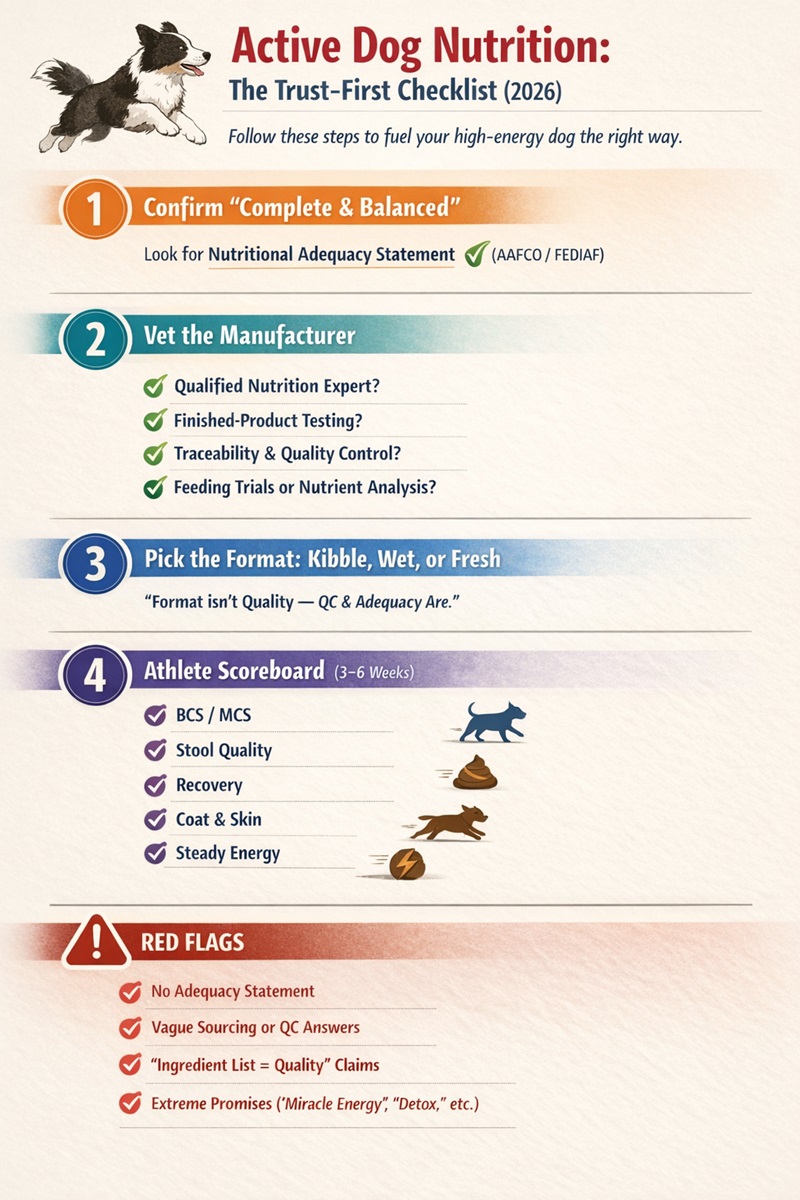
1) make sure it’s complete and balanced for your dog’s age
You should be able to find a nutritional adequacy statement which references AAFCO – in the US at least. This means the food has been formulated to meet your dog’s nutritional needs and often its also been tested in feeding trials.
2) Verify the manufacturer’s credentials (not just their marketing)
The guidelines from WSAVA are all about cutting through all the marketing noise and actually evaluating the company’s nutritional expertise and quality control.
Credibility check (key points to keep an eye out for):
- Do they actually employ qualified nutrition experts?
- Do they do finished-product nutrient analysis and have a good system for checking quality?
- Can they actually tell you where they get their ingredients from and how they track them?
- Do they run feeding trials or publish data on digestibility and quality?
If a company can’t give you clear answers to these questions, then that’s a serious red flag – and one that doesn’t care if the food is “fresh”, “human-grade”, “premium”, or “natural”.
Macronutrients for Your Canine Athlete: What Really Matters
Protein: Don’t Get Fooled by Buzzwords – Look for Quality, Not Just a High Number
Protein is essential for muscle repair and maintenance but simply having a lot of it in your dog food doesn’t mean that much. The processing of that protein can render certain amino acids useless, so you need to look beyond the number and consider the formulation as a whole – whether it’s dry, wet or fresh food.
Practical Tips for Choosing a Good Protein Source:
- Go for a complete and balanced diet that’s been made by a manufacturer who is transparent about their quality control.
- Opt for diets with clear animal protein sources – if your dog can tolerate them.
- Pay attention to your dog, not the label: is their recovery good, do they have healthy stools, and is their coat in good condition? These are far better indicators of quality than arguing over the ingredient list. WSAVA actually warns that a label can be very misleading when it comes to judging quality.
Fat: The Key to Sustained Energy
For all the work your dog is putting in, they need to be able to tap into fat for a steady supply of energy. Active dogs can really benefit from a diet that’s got enough fat and some essential fatty acids to boot.
- Lots of people use Omega-3s to help with joint health and inflammation in dogs that are getting a lot of exercise.
- Just be careful when you increase the fat in your dog’s diet – calories can creep up pretty quickly and you need to keep an eye on their body condition.
Carbs: Not the Enemy, But Don’t Let Them Sneak in
Carbs can provide a quick energy boost and help keep your dog food affordable and sustainable – but they need to be chosen with care. Some dogs do really well on moderate amounts of digestible carbs, while others are super sensitive and need you to be really picky about what they eat.
Focus on:
- Making sure the carbs are digestible for your dog
- Getting consistent stools and stable energy (so they don’t bonk after a big workout)
Food Format: Kibble, Wet and Fresh – What’s Real and What’s Overhyped
Dry Food (Kibble)
Dry dog food is often complete, convenient and good value for money. Extrusion is a processing method – it’s not inherently bad, and the quality really varies depending on the formulation and the manufacturer’s standards. Research shows that the conditions in which extrusion is done can affect the nutrients, so what really matters is the company’s quality control and their know-how when it comes to formulation.
Wet Food
Wet food can be great for getting your dog to eat (it’s often super tasty) and can even help with hydration – but it’s worth noting that some research suggests that wet diets can have a higher environmental impact in some scenarios, largely because of the ingredients and the energy density.
Fresh / Gently Cooked
If done right, fresh-style diets can be great for dogs – especially if they are complete and balanced and produced with strong safety controls in place. The main things to check are:
- Is it actually complete and balanced for your dog’s life stage?
- Are food safety and cold-chain handling robust?
- Can the company demonstrate that they know what they’re doing when it comes to formulation and quality control?
For readers comparing fresh-style options, it can help to review a real-world example of a fresh food provider’s ingredient approach and handling guidance (e.g., California Dog Kitchen).
Important: Being “human-grade”, “organic” or “natural” doesn’t automatically make a food better for your dog – those are just claims that need to be backed up by the basics we’ve covered.
A Crucial Note : Grain-Free, Legumes & DCM Risk Conversations
Because a lot of ‘active dog’ products are being marketed as grain-free and super high in protein, you’ve got to consider a major ongoing uncertainty: the FDA is still looking into a possible link between certain diets and Canine Dilated Cardiomyopathy (DCM) and they’re promising to update folks as they get more info.
Now, don’t go thinking “grain-free is always a no-go” or that one single ingredient is to blame here. What it really means is you should be a bit cautious about those boutique formulations that can’t show they’ve really got their nutritional stuff together or quality controls in place – especially if you’ve got a dog with heart worries or symptoms. If you’re already feeding a grain-free/ legume-heavy diet and you’re getting some concerns, it’s worth having a chat with your vet.
Sustainability: The Food We Eat Does Have a Footprint, But There Are Some Gutsy Trade-Offs To Make
If you care about the environmental impact of what you’re feeding your dog, here’s the takeaway from the current research:
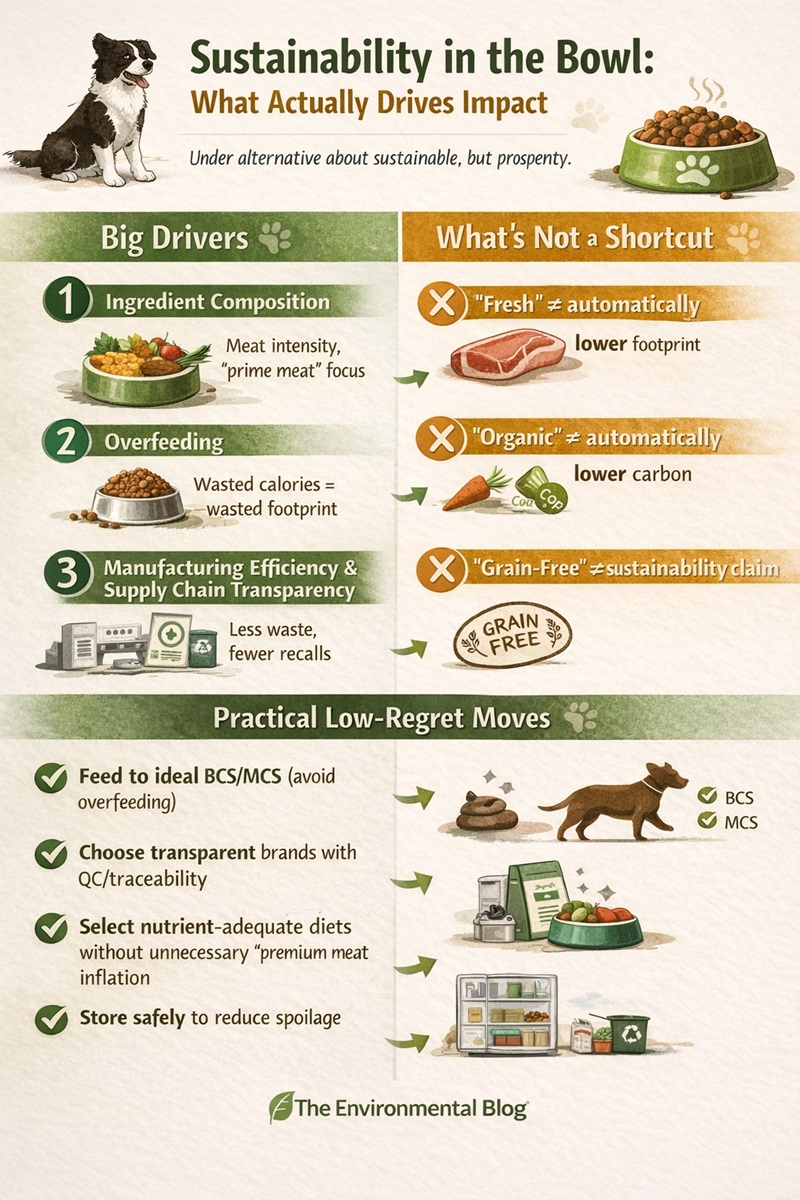
- The impact varies a lot depending on the type of food and the ingredients you choose; it looks like wet diets can sometimes be a lot worse and meat-heavy formulations tend to be a problem.
- There was a study back in 2026 that found huge variation in the greenhouse-gas impact of different dog foods, and it all came down to this: if your food contains lots of prime meat, it’s probably worse for the environment – which basically means that just because a food is ‘premium’ doesn’t make it more eco-friendly.
Practical Sustainability Moves That Don’t Compromise on Nutrition:
- Choose a manufacturer who is transparent about what they do (less waste, fewer recalls).
- Don’t overfeed (all those wasted calories are wasted CO2 emissions too). Use BCS/MCS and adjust the portions accordingly.
- Consider a diet that gives your dog the performance they need without all the unnecessary ‘prime meat’ hype unless they really need it for medical reasons.
What to Look for on the Label (A Checklist to Get Your Trust Back)
Things You Can’t Compromise On
- Nutritional adequacy statement: “complete and balanced” for the right stage of life.
- Manufacturer transparency: they ought to be able to answer questions about who formulated the food and how it was tested ( WSAVA-style questions).
Performance-Boosting Nutrients (The Power Players)
- Protein that’s actually high-quality – that means for the dog’s tolerance and workload.
- Enough fat – that includes omega-3s.
- Micronutrient completeness (iron, zinc, B vitamins, vitamin D, etc.) – that’s why “complete and balanced” is such a big deal.
Joint Support Strategy: and this isn’t just about some random glucosamine words – really focus on your dog’s body condition, conditioning and get some guidance from your vet first
Figuring Out if the Food is Working – The Athlete’s Scoreboard
Instead of jumping on every bandwagon, wait for a few weeks to see how your dog responds:
- BCS/MCS: Getting lean and strong muscle is what you’re aiming for (ask your vet to explain how they work and how to read them).
- Stool quality: Regular, formed stools and minimal bloating are a good sign
- Recovery: Less stiffness, more energy for the next day
- Coat/skin: Less dullness or flaking
- Performance consistency: A steady energy level without wild mood swings
If your dog is always hungry, losing weight or in pain all the time, the issue might be with their calorie intake, getting enough protein, mealtimes or even some underlying health problem – not the “kibble vs fresh” debate.
Making the Switch to a New Food (Especially for Active Dogs)
Gradual change is the way to go to avoid stomach upset:
- Days 1-3: Mix 25% new food with 75% old food
- Days 4-6: 50/50 mix
- Days 7-9: 75% new + 25% old
- Day 10 and beyond: 100% new food
When you’re in the middle of transitioning, stick to your usual exercise routine but don’t suddenly try to add a marathon next week around the same time you change your dog’s food. If diarrhea, vomiting or loss of appetite persists, slow down and get advice from your vet.
Some Important Food Safety Reminders (especially with fresh, wet and raw foods)
- Keep cold foods chilled in the fridge, pay attention to use-by dates and wash your dog’s food bowls
- Don’t leave high-moisture foods out for hours on end
The Bottom Line – “Best” Food is one that delivers, Not one in a Fancy Box
Looking after an active dog isn’t about joining a food clique and following the latest trends – it’s about hitting one key benchmark:
- Nutrition that does the job for the right life stage
- Quality you can trust from a reputable manufacturer (that’s transparent about what they’re doing)
- Results that speak for themselves (good BCS/MCS, recovery, regular stool & steady energy levels)
If you really want to be forward-thinking, let your dog’s performance and condition do the talking – let science and real results decide what makes the cut, not fancy marketing phrases.