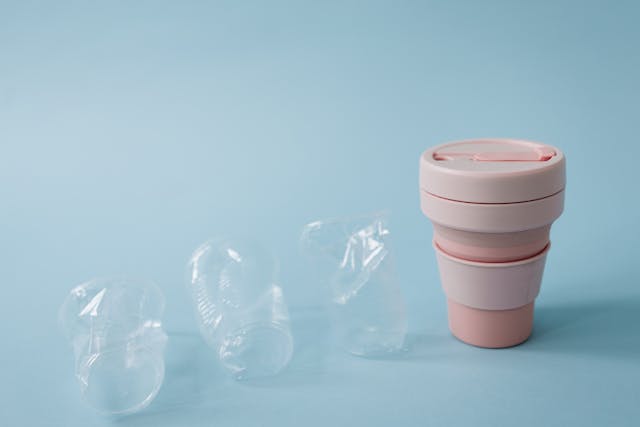

Plastic waste is now a systems problem, not just a litter problem. The OECD estimates global plastic waste rose to 353 million tonnes in 2019, more than double the level in 2000, and that only about 9% was recycled after accounting for losses in the system. UNEP also estimates 19–23 million tonnes of plastic waste leak into aquatic ecosystems every year.
That’s why “plastic alternatives” keep showing up in product roadmaps and packaging redesigns. But swapping materials is not automatically a win. The real question for brands and consumers is more specific:
Can we lower lifecycle impact without weakening product safety, hygiene, and performance?
A credible answer requires three lenses—measurable impact, a clear mechanism for why the alternative helps, and a safety and compliance test.
Key takeaways
- The best plastic alternatives depend on the use case—hot food, liquids, shipping protection, and cleaning tools have different requirements.
- Reuse and refill typically deliver the biggest footprint reduction because they reduce total units produced and discarded.
- “Compostable” only helps when the item matches local composting infrastructure and the material performs under real conditions.
- “Biodegradable” is not a guarantee of low impact; without the right conditions, breakdown may be slow or irrelevant to end-of-life outcomes.
- For food-contact products, safety is a regulatory standard, not a marketing claim—performance under heat, moisture, and time matters.
- Avoid swaps that create end-of-life dead ends (mixed layers, hard-to-sort formats) even if the material sounds “greener.”
What counts as a “plastic alternative” (and what doesn’t)
In practice, “plastic alternatives” refers to materials and systems designed to reduce lifecycle impact compared with conventional plastics in a specific use case. That includes:
- Fiber-based formats (paperboard, molded pulp, cellulose-based materials)
- Metals and glass in applications where reuse or high recycling rates are realistic
- Compostable materials in applications aligned with available compost systems
- Reuse and refill models that reduce single-use throughput altogether
What it does not automatically mean: swapping one disposable format for another without changing end-of-life outcomes. If the “alternative” can’t be reused, recycled, or composted in real conditions, the improvement may be mostly cosmetic.
Start With the Mechanism: What Actually Lowers Impact?
Most alternatives reduce environmental impact through one (or more) of these pathways:
- Eliminate single-use (reusables that displace many disposables)
- Reduce material intensity (lighter designs, less packaging overall)
- Improve end-of-life outcomes (high-quality recycling or composting where infrastructure exists)
- Reduce leakage risk (systems that prevent litter and loss into waterways)
This is why “paper instead of plastic” isn’t always the right framing. The more reliable framing is:
Which option reduces total throughput over time while maintaining safety?
Choosing plastic alternatives by product type
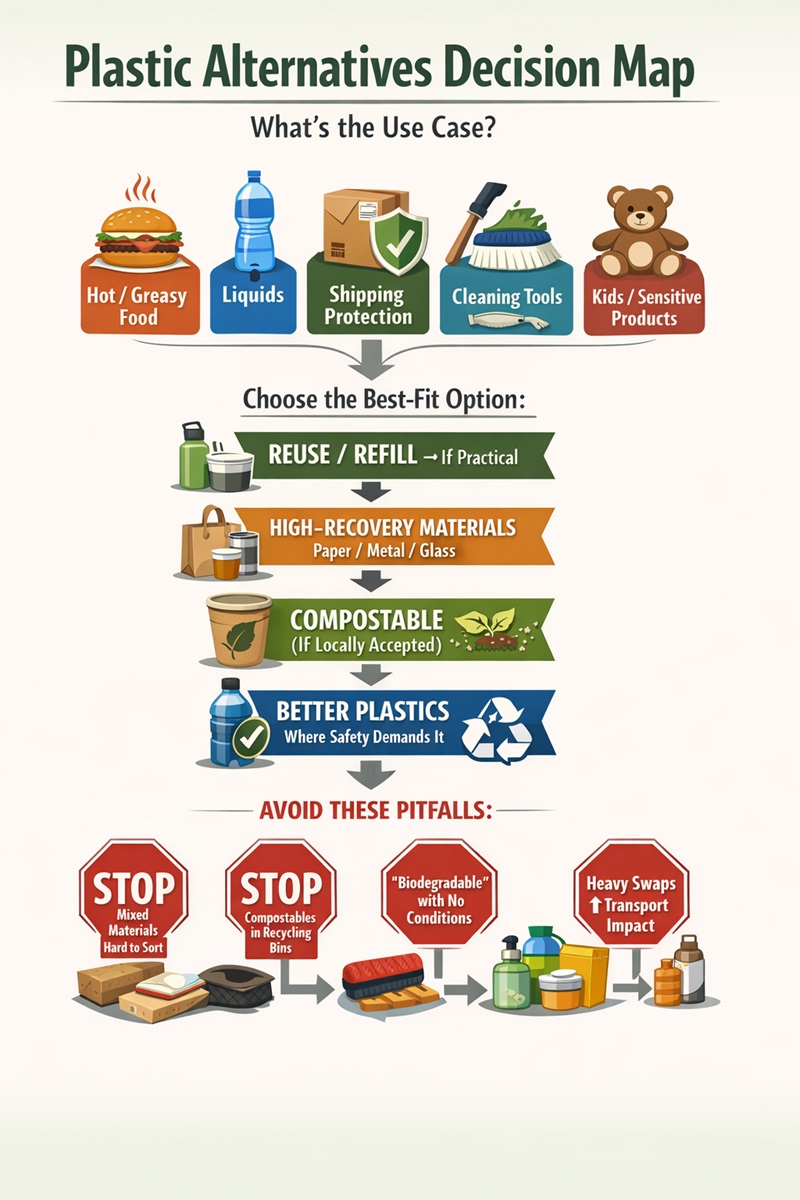
Use case determines everything: heat tolerance, moisture control, hygiene, breakage risk, and end-of-life access. A practical way to choose is to match the alternative to performance needs and local disposal reality.
| Use case | Better-fit plastic alternatives | Safety/performance priorities | End-of-life reality check |
| Hot or greasy food packaging | Molded fiber with appropriate barrier, aluminum formats where suitable | Heat + grease resistance, leakage control, migration risk | Fiber recyclability depends on coatings; compostability depends on access |
| Cold food / dry goods | Paperboard, molded pulp, some compostable formats | Moisture control, contamination protection | Paper stream compatibility; avoid mixed layers |
| Liquids | Reuse/refill containers, metal, glass (where reuse is feasible) | Seal integrity, breakage risk, corrosion compatibility | Reuse requires repeat cycles; recycling rates vary by location |
| Shipping protection | Molded pulp, paper-based cushioning, reusable mailers (where logistics exist) | Shock absorption, compression strength | Avoid mixed materials that reduce sortability |
| Household cleaning tools | Cellulose/plant-fiber scrubbers, replaceable-head brushes | Hygiene (drying time), durability, mold resistance | Compostability varies; durability often matters more than claims |
| Kids products / sensitive uses | Durable long-life materials designed for safety | Fragmentation risk, coatings/inks safety, cleanability | Longevity often outperforms “single-use alternatives” |
Safety Is Not Optional: Alternatives Still Have to Meet Food-Contact and Consumer Standards
For items that touch food, safety is governed by regulation—not marketing language.
- In the U.S., FDA explains that food contact substances that are food additives must be authorized for their intended use before marketing, typically through the Food Contact Notification process, which includes FDA’s safety assessment.
- In the EU, Regulation (EC) No 1935/2004 sets overarching safety requirements for materials intended to contact food.
So a “plastic alternative” has to do two jobs at once:
- reduce environmental harm across its lifecycle, and
- demonstrate it won’t transfer unsafe substances to food or fail under real conditions (heat, acidity, fat contact, moisture, time).
Category 1: Biobased and Biodegradable Materials—High Potential, High Misunderstanding
Materials like cellulose, starch blends, molded fiber, and some compostable bioplastics can reduce persistence in the environment if they’re correctly designed and routed to appropriate end-of-life systems.
Where they often work well:
- dry goods packaging
- molded fiber trays (protective, shock-absorbing)
- paper-based formats with appropriate barrier coatings
Where caution is needed:
- hot, wet, or greasy food applications (barrier chemistry matters)
- situations where “compostable” is claimed but composting access is limited
- products likely to end up in regular trash (where compostability provides less benefit)
Key performance question: Does the alternative maintain structural integrity and hygiene in the use case?
Key systems question: Does it have a realistic pathway to composting or recycling?
Compostable vs. biodegradable vs. recyclable: why the labels aren’t interchangeable
These terms are often used as if they mean the same thing. They don’t—and the differences determine whether an “alternative” actually reduces waste.
- Biodegradable generally means a material can break down via biological activity, but the claim often depends on conditions (temperature, moisture, oxygen) and timelines that aren’t obvious to consumers.
- Compostable implies breakdown under composting conditions. Many products require industrial composting, which isn’t available everywhere, and compostables placed in landfill typically won’t behave as intended.
- Recyclable is a system claim, not a material claim. It depends on local collection, sorting, contamination, and end markets—not just the item’s chemistry.
Biodegradable materials are designed to decompose naturally through microbial activity. Materials such as cornstarch, cellulose, and coconut fibers are increasingly used to replace traditional plastics in packaging and household items. These alternatives reduce the persistence of waste in landfills and waterways.
Household cleaning products offer a clear example. Some modern plastic-free sponges are made from plant-based fibers or other biodegradable materials. They provide similar absorbency and scrubbing power to conventional sponges while breaking down naturally over time. Using these sponges illustrates how products can retain functionality while reducing environmental impact.
A useful rule: if you cannot reasonably route the item to composting or recycling, prioritize reuse or durable alternatives that reduce repeat purchases.
Category 2: Reusable and Refillable Systems—Often the Strongest Impact Lever
If you want a high-confidence impact mechanism, it’s reuse. Reuse reduces total units produced, transported, and disposed.
Good use cases:
- durable food storage (repeated cycles)
- refillable household products (cleaning, personal care)
- shipping and distribution where reverse logistics are feasible
The trade-off is behavioral and operational: a reusable system only wins if it’s actually reused enough times to displace disposables. The most effective reuse designs are the ones that make reuse the default (easy cleaning, convenient refills, durable seals).
Category 3: “Better Plastics” for Hard Use Cases—When Substitutes Don’t Yet Perform
Some applications still require plastics for safety or performance (sterile barriers, medical settings, high moisture resistance, certain durable components). In these cases, the lower-impact move is often:
- reduce plastic mass (lightweighting)
- increase recycled content where safe and permitted
- design for recyclability (mono-materials, fewer mixed layers)
- extend product life (durable goods that don’t get replaced frequently)
FDA also provides guidance and oversight relating to recycled plastics in food packaging when industry proposes using recycled polymers for new food-contact containers.
This is the nuance most consumer content misses: sometimes the most responsible choice is not “no plastic,” but less plastic, used longer, recovered more reliably.
When plastic alternatives backfire
Some substitutions reduce visible plastic but increase total impact or create new waste problems. Common failure modes include:
- Weight penalties: Heavier substitutes can increase transport emissions, especially in long-distance shipping.
- Barrier coatings: Paper-based formats sometimes rely on barrier layers that reduce recyclability or complicate composting.
- Compostables in the wrong stream: Compostable packaging placed in recycling can contaminate sorting, and placed in landfill often delivers little end-of-life benefit.
- “Biodegradable” without clarity: Without defined conditions and timelines, biodegradable claims can encourage false confidence.
- Reuse without reuse: Reusable products only outperform disposables when they’re actually reused enough times to offset production.
The goal isn’t to eliminate trade-offs. It’s to choose the option where trade-offs are small, known, and manageable—instead of hidden.
The Overlooked Product Example: “Plastic-Free” Cleaning Tools Still Need Hygiene Logic
A plant-fiber sponge can be a good alternative if it:
- dries quickly (lower odor/microbial risk)
- maintains scrubbing performance
- doesn’t shed fibers into drains
- lasts long enough to reduce replacement frequency
In other words, the environmental win isn’t just biodegradability. It’s functionality + longevity + appropriate end-of-life.
What “Maintaining Product Safety” Should Mean in Practice
When evaluating alternatives (as a brand, retailer, or consumer), use a simple checklist:
For food contact
- authorized/appropriate for the intended use conditions (heat, fat contact, storage time)
- barrier performance (leaks, grease, moisture)
- chemical safety and migration risk (regulatory-compliant materials)
For children and sensitive uses
- durability (no easy fragmentation into small pieces)
- non-toxic inks/dyes/coatings where relevant
- hygiene performance (cleanability, drying time)
For environmental performance
- credible end-of-life route (recycling stream or composting access)
- reduced replacement frequency (durability matters)
- minimized leakage risk (especially for lightweight items)
Labels and claims worth paying attention to
Because packaging claims are inconsistent, readers benefit from a quick filter. A few principles help:
- Prefer specific claims over vague ones. “Industrial compostable” or “accepted in paper recycling where facilities exist” is more meaningful than “eco-friendly.”
- Look for clarity on where the item should go: recycle, compost (industrial/home), or trash. If the brand can’t say, end-of-life is probably uncertain.
- Treat “made with recycled content” as a different claim than “recyclable.” One describes inputs; the other describes end-of-life.
- For food-contact items, look for language that indicates the material is intended for that use case (heat tolerance, grease resistance, etc.), not just “plant-based.”
High-impact plastic alternatives you can adopt without redesigning your life
If you want impact without complexity, prioritize switches that reduce the most single-use volume first:
- Reuse for the basics: a durable bottle and a dependable food container that you actually use.
- Refill where it’s already easy: cleaning concentrates or refill systems that reduce bottle turnover.
- Fiber-based shipping protection: molded pulp or paper cushioning in shipping and storage contexts.
- Cleaning tools with hygiene logic: plant-fiber scrubbers that dry fast and last long—performance beats labels.
- Avoid mixed-material “eco” packaging: if it can’t be routed to a real end-of-life pathway, it’s rarely a true improvement.
The Bottom Line
Plastic alternatives can lower environmental impact when they change the system, not just the material: fewer single-use cycles, less total throughput, and better end-of-life outcomes—while meeting non-negotiable safety requirements.
Given the scale of the plastic problem—353 million tonnes of waste in 2019 (OECD) and 19–23 million tonnes leaking into aquatic ecosystems annually (UNEP)—the opportunity is real. The path forward isn’t “ban plastic everywhere.” It’s smarter design choices by category: reuse where possible, compostables where infrastructure exists, and improved plastics where safety/performance demand it, backed by regulatory compliance for intended use.
Frequently asked questions about plastic alternatives
Are plastic alternatives always better for the environment?
Not always. Performance, weight, durability, and disposal systems determine whether impact goes down or simply moves elsewhere.
What are the safest plastic alternatives for food storage?
Safety depends on temperature, fat contact, and storage time. For many households, reuse-oriented options with clear food-contact suitability are the safest route.
Is compostable packaging safe for hot foods?
It can be, but only if the material maintains structure and barrier performance under heat and moisture. “Compostable” doesn’t automatically mean “high-performance.”
Are bioplastics actually biodegradable?
Some are designed to break down under specific composting conditions; others behave more like conventional plastics in typical environments. The end-of-life pathway matters more than the label.
What’s the best alternative to plastic wrap?
Reusable containers and washable covers typically reduce more waste over time than swapping one single-use wrap for another.
Is paper packaging always more sustainable than plastic?
No. Coatings, weight, and recyclability determine outcomes. Paper performs best when it can be recovered through existing fiber systems.
What plastic alternatives work best for shipping protection?
Molded pulp and paper cushioning often work well because they protect products while aligning with established paper recovery pathways.
How do I know if my area can compost compostable packaging?
Check whether local programs accept compostable packaging (many focus on food and yard waste only). If acceptance isn’t clear, compostability may not deliver real benefits.
Why do some “eco” packages still end up as trash?
Because mixed layers, adhesives, and unclear disposal instructions can make recovery impractical even if the materials sound sustainable.
If plastic is sometimes necessary, what’s the next-best option?
Use less of it, keep products in service longer, and design for recoverability—mono-materials and durable formats typically outperform complex blends.