
Buying clothes shouldn’t feel like a guessing game. Yet for many people, it does. Items look great online, fine on the hanger, and somehow wrong once worn. The usual advice—“dress for your body shape” or “follow trends”—often makes things worse, not better.
This is where Kibbe Body Types come in.
Unlike trend-based fashion or rigid body-shape charts, the Kibbe system focuses on how clothing interacts with your natural lines and proportions. When understood correctly—and updated for modern fashion—it can remove much of the confusion around fit, style, and shopping decisions.
This guide is written for absolute beginners. By the end, you’ll be able to:
- Understand Kibbe Body Types in plain language
- Identify your own type using a simple quiz
- Choose clothes confidently using modern, realistic guidelines
What Are Kibbe Body Types?
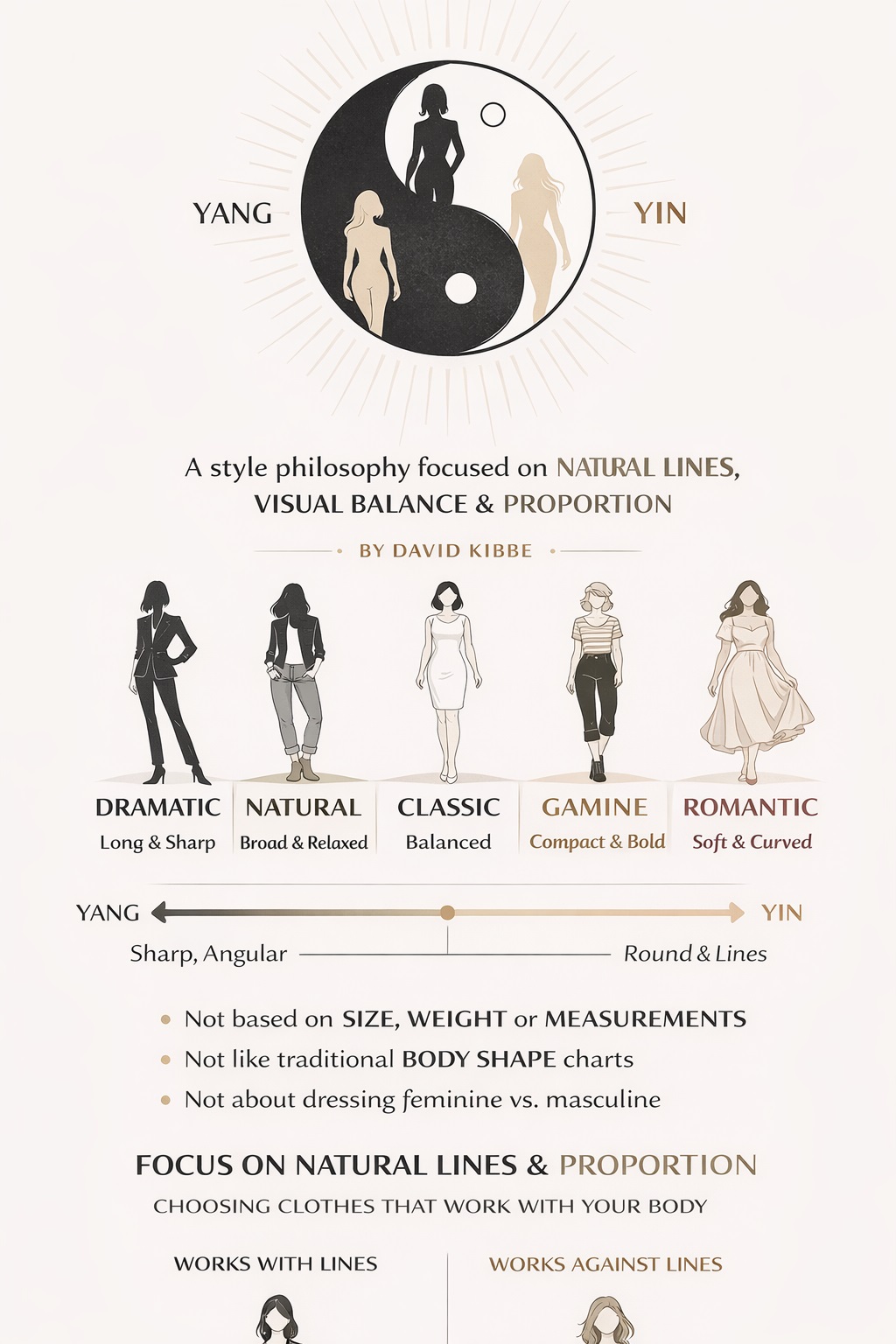
The Kibbe system was created by David Kibbe, a stylist who believed that style works best when it aligns with a person’s natural visual lines, not when it tries to “fix” the body.
Instead of weight, size, or measurements, Kibbe looks at:
- Bone structure
- Overall line (long, moderate, compact)
- Softness vs. sharpness in appearance
These traits exist on a spectrum often described as Yin (soft, rounded) and Yang (sharp, angular). From this spectrum come five main Kibbe families:
- Dramatic
- Natural
- Classic
- Gamine
- Romantic
Kibbe is not about changing your body.
It’s about choosing clothes that work with it.
Why Kibbe Still Matters in 2026 (and Why It’s Often Misunderstood)
Fashion in 2026 looks very different from when Kibbe was introduced:
- Stretch and performance fabrics are everywhere
- Oversized, relaxed, and athleisure styles dominate
- Many people strength-train, changing muscle tone and fit needs
Because of this, old-style Kibbe “rules” floating online often feel outdated or restrictive. The system itself isn’t the problem—rigid interpretations are.
What still works is the foundation:
line, proportion, and fabric behavior.
Before You Identify Your Kibbe Type
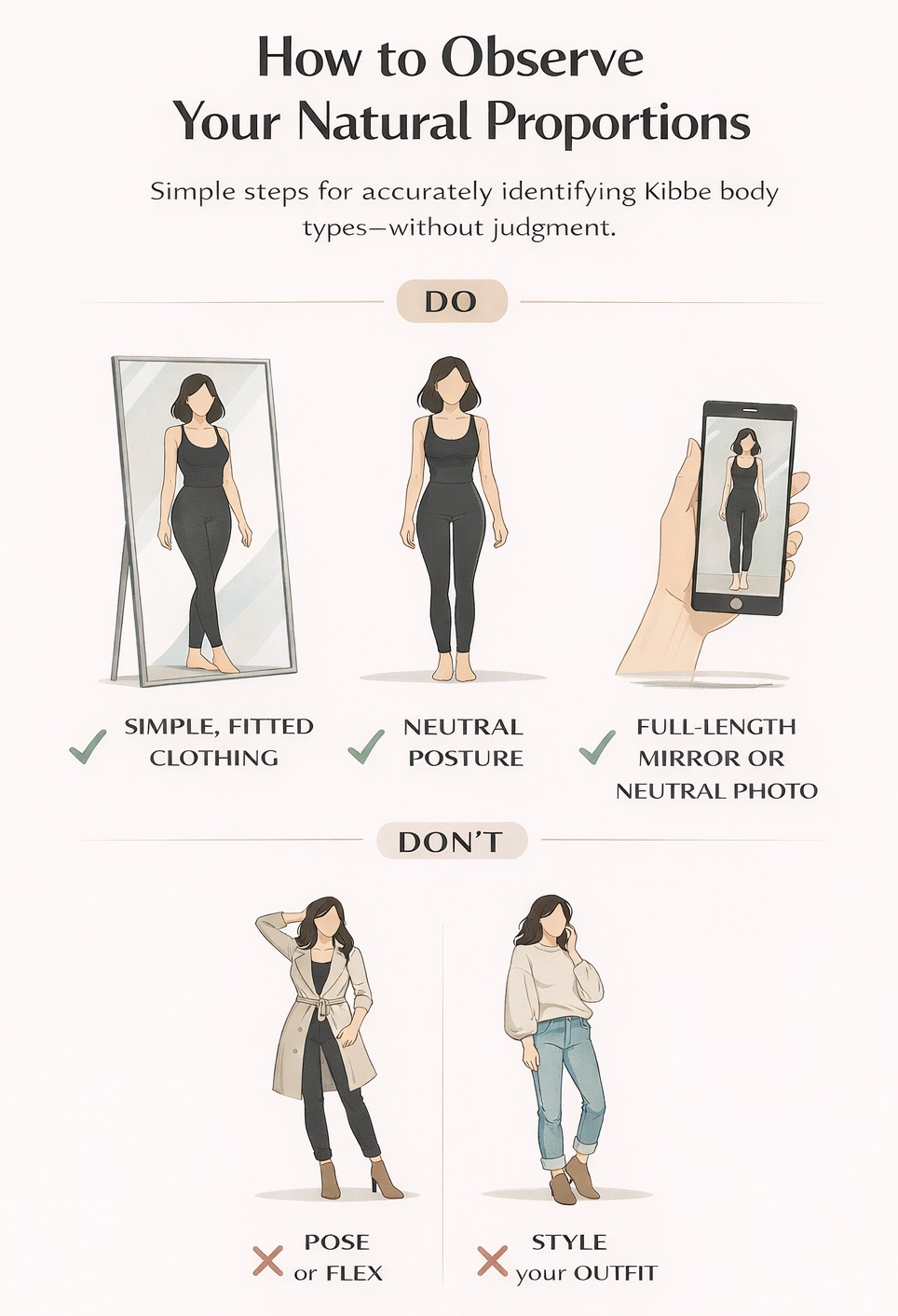
To get accurate results:
- Wear simple, fitted basics
- Stand naturally—don’t pose
- Use a mirror or neutral photo
- Ignore:
- Weight changes
- Clothing size labels
- Fitness level
You’re observing visual structure, not judging your body.
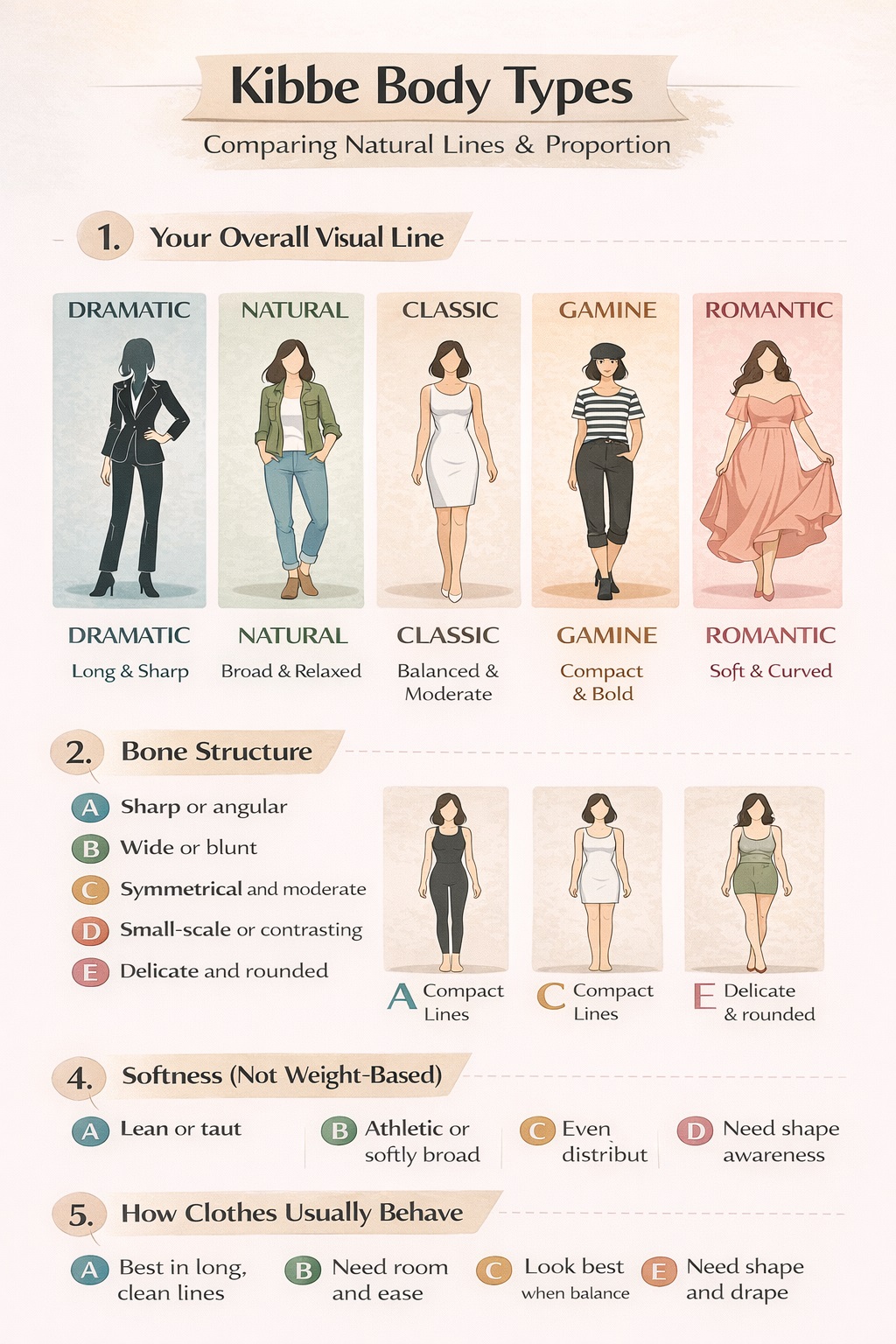
Kibbe Body Types Quiz: Find Your Likely Type
Choose the option that feels most consistently true, not the one you prefer.
1. Your Overall Visual Line
A. Long or elongated
B. Broad or open
C. Balanced and even
D. Compact or mixed
E. Soft and rounded
2. Bone Structure
A. Sharp or angular
B. Wide or blunt
C. Symmetrical and moderate
D. Small-scale or contrasting
E. Delicate and rounded
3. How Height Appears
A. Looks tall even if average
B. Looks grounded or wide
C. Looks moderate
D. Looks short or broken
E. Looks soft rather than tall
4. Softness (Not Weight-Based)
A. Lean or taut
B. Athletic or softly broad
C. Even distribution
D. Compact with contrast
E. Soft, rounded, or lush
5. How Clothes Usually Behave
A. Best in long, clean lines
B. Need room and ease
C. Look best when balanced
D. Need contrast or detail
E. Need shape and drape
Your Results: Understanding the 5 Kibbe Families
Mostly A → Dramatic
- Strong vertical line
- Looks best in elongated silhouettes
- Struggles with excess softness or bulk
Modern tip: Clean lines still work, but modern stretch fabrics prevent stiffness.
Mostly B → Natural
- Broad or blunt structure
- Needs ease and movement
- Feels restricted in heavy tailoring
Modern tip: Relaxed fits work best when fabric quality prevents sloppiness.
Mostly C → Classic
- Balanced proportions
- Easily overwhelmed by extremes
- Needs harmony more than trends
Modern tip: Soft tailoring and updated textures keep Classics current.
Mostly D → Gamine
- Compact with contrast
- Loses energy in long, unbroken lines
- Needs visual interest
Modern tip: Modern cuts, cropped lengths, and contrast—not costume styling.
Mostly E → Romantic
- Soft curves and rounded lines
- Disappears in boxy clothing
- Needs shape awareness
Modern tip: Light structure and fluid fabrics work better than heavy decoration.
If you’re split between two groups, that’s normal. Most people sit near a boundary.
How Kibbe Helps You Choose Clothes Without Confusion
Once you know your family, shopping becomes simpler:
- You stop buying trend pieces that fight your proportions
- You recognize why certain silhouettes always fail
- You build outfits that feel intentional, not accidental
This alone can save money, time, and frustration.
What Still Works from Kibbe in Modern Fashion
Line & Proportion
Long lines, balanced lines, or compact lines still matter—regardless of trends.
Fabric Behavior
How fabric drapes, stretches, or holds shape matters more than the label on the garment.
Head-to-Toe Harmony
Outfits succeed when shoes, accessories, and hair support the same visual line.
What No Longer Works (and Causes Confusion)
- Rigid “never wear this” rules
- Stereotypes like “feminine” or “masculine” types
- Social media quizzes based on height or measurements
- Celebrity typing as proof
These shortcuts create doubt instead of clarity.
Using Kibbe with 2026 Fashion Trends
Oversized Clothing
Works best when intentional. Some bodies need length; others need controlled volume.
Athleisure & Fitness Wear
Seams, fabric weight, and continuity of line matter more than tight vs. loose.
Minimalism vs. Maximalism
Both work across Kibbe types when scaled correctly.
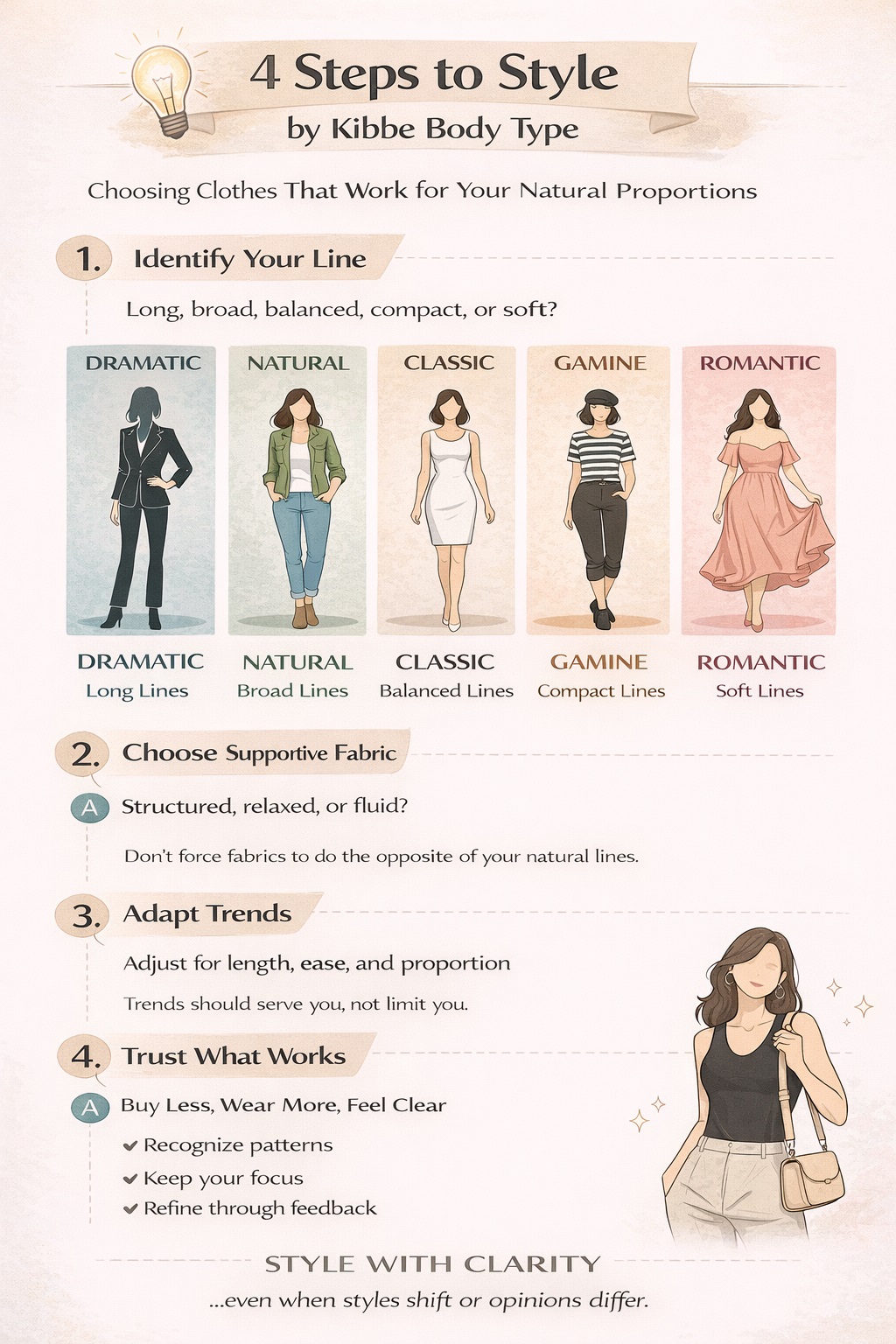
A Simple Way to Apply Kibbe Daily
- Start with your line (long, balanced, compact)
- Choose fabrics that support that line
- Adapt trends instead of rejecting them
- Trust what consistently works on your body
Kibbe is a tool, not a rulebook.
Frequently Asked Questions
Can my Kibbe type change?
No. Weight or fitness changes don’t alter underlying structure.
Is Kibbe only for women?
No. It applies to all genders.
Why do I still feel unsure?
Because Kibbe takes observation, not instant labeling.
Final Takeaway
Kibbe Body Types aren’t about restriction—they’re about clarity. When you understand how clothes interact with your natural lines, style stops being confusing. You buy less, wear more, and feel more confident in your choices.
Use this guide to identify your type, understand what works in modern fashion, and build a wardrobe that finally feels right.