
Lead in paint is still a big health problem in Bangladesh. Recent tests show that many wall paints have very high lead levels. This is dangerous, especially for children.
The government is now working on a national plan to remove lead from paint. Groups like BSTI, UNICEF, the Bangladesh Paint Manufacturer Association, and ESDO are pushing for better rules. They also want strong checks to make sure paints are safe.
What is Lead
Lead is a naturally occurring heavy metal, because its density is very high. Generally, metals that have a very high density are called ‘heavy metals’. These metals have a large metal density of 5 gcm³. The density of lead is about 11.34 grams per cubic centimeter and the atomic number is 82, which indicates a heavy element. And lead is not only heavy, it is a toxic metal that can harm the body and the environment. Lead is easily oxidized and forms various compounds, which are permanent in the environment. Therefore, due to its toxicity and weight, it is considered a dangerous heavy metal.
Lead Sources in Paint & Coatings:
| Source | Component | Purpose of use | Types of Paint | Risk
|
| Pigment | Lead Chromates,
Lead Carbonate, Lead Molybdate |
Vivid Color
Opacity & Durability |
Anticorrosive Primers, Automotive Paints, Protective & Industrial Coating, Road-Marking & Traffic Paints |
High |
| Dryers & stabilizers | Lead Oxides,
Lead Naphthenates, Lead Octoate
|
Drying, Improve Film Hardness,
Moisture & Corrosion Resistant |
Solvent Borne Paint, Industrial & Wood Coating |
High |
| Extender | Calcium Carbonate, Clay, Barytes Powder | Cost Reduction, Opacity, Film Strength, Stability, Coverage, Durability | Water Base Architectural Coating & Decorative Paint |
Moderate |
| Solvent Borne Stainer | Lead Based Pigment, Dryers & Stabilizers | Color Development | Solvent Borne System, Wood Stain & Industrial Coating |
High |
| Water Borne Stainer & Universal Colorant | Lead Based Pigment, Dryers & Stabilizers | Color Development | Water Borne & Solvent Borne System | High |
| Water | Hydrogen & Oxygen | Carrier/Solvent | Water Borne System | Moderate |
Health Impact
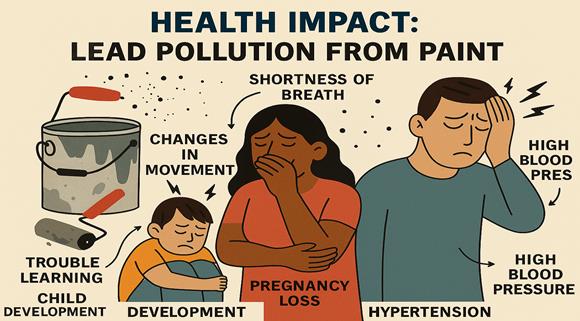
Lead based paint film peels or cracks, it releases fine lead dust, which can easily enter the body with the breath. Breathing in this dust allows lead particles to enter the lungs and then the bloodstream. Lead is a systemic toxicant that impacts every organ in the human body, with its effects posing particularly severe risks to children and pregnant women. According to UNICEF and the Bangladesh Bureau of Statistics, the country indeed ranks 4th globally in terms of children affected by lead poisoning, with over 35 million children showing dangerously high lead levels in their blood.
Environmental Impact
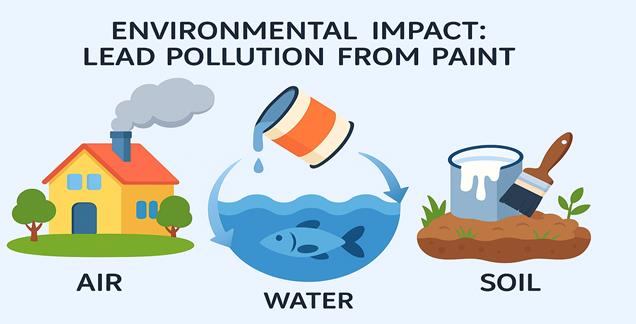
Lead in paint harms the environment in many ways. When old paint breaks down, tiny lead pieces fall into soil, water, and air. These tiny pieces are toxic.
Lead can stay in nature for a long time. It can damage plants and animals. It can also enter our food, which is very unsafe for people and nature.
Many people throw old paint on the ground or into rivers. This is very harmful and should never be done. Paint must always be thrown away in a safe way.
Old buildings also need care. When paint cracks, lead dust can spread in the air. We should repaint old walls as soon as we see damage. This helps protect our health and the environment.
WHO and BSTI Guideline
There is no safe level of lead exposure. Among various environmental pathways, lead-based paints are identified as a major contributors of lead contamination in homes and communities. The WHO, together with UNEP and the Global Alliance to Eliminate Lead Paint (GAELP), sets the recommended maximum lead content in paints at 90 ppm. Through S.R.O 221-Law/2018, the Bangladesh Standards and Testing Institution (BSTI) introduced a 90 ppm total lead limit setting standards for architectural coatings such as emulsion, latex, distemper, and enamel, in alignment with the WHO/UNEP Model Law. So far industrial, marine, automotive, wood, and specialized paints remain unregulated, and enforcement of the existing rule is limited. In this issue, Bangladesh Standards and Testing Institution (BSTI) developed three mandatory standards in 2018 (BDS 1423:2018, BDS 1827:2018, and BDS 1833:2018)
Critical Analysis of the ESDO Findings
In 2025, the Environmental and Social Development Organization (ESDO) conducted a Lead Exposure Elimination Project to assess the presence of lead in household paints. A total of 161 paint samples were collected from Dhaka and Chattogram, covering both major paint brands as well as products from local manufacturers and imported sources. The study provides critical insights into the extent of lead contamination in paints available in Bangladesh, highlighting risks to public health and the urgent need for stronger regulation and consumer awareness.
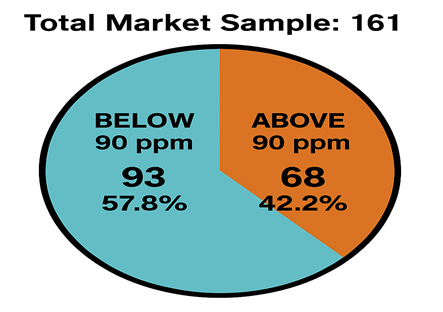
Figure: 01
The pie charts (Figure: 01) shows 42.2% of samples (68/161) exceeded the BSTI standard 90 ppm limit, Most of these were imported and produced by small-scale unregistered manufacturers who failed to maintain safety labeling, manufacturing address, certification marks, TDS, and MSDS. All leading brands (Berger, Asian, Nippon, Elite, etc.) comply with the 90 ppm limit, ensuring safety.
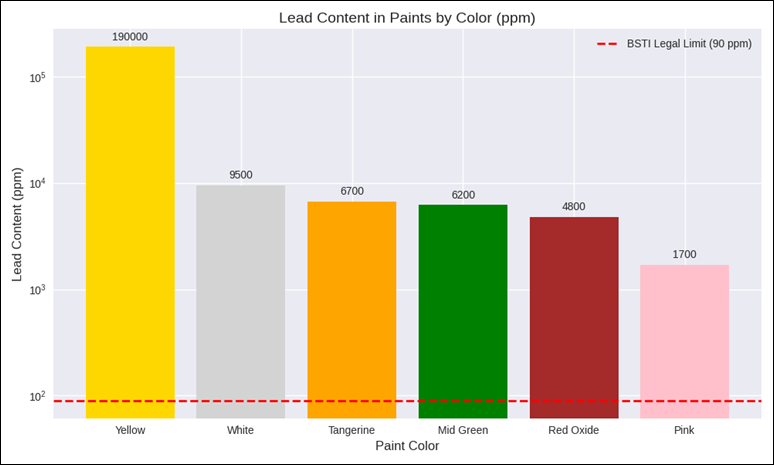
Figure: 02 (color wise lead content in paint)
In Figure: 02, Kangaroo (Imported Brand) yellow paint was found to contain 190,000 ppm of lead—an alarming 2,111 times higher than the BSTI legal limit of 90 ppm. Other brands such as Jhumur (White: 9500 ppm), 777(Tangerine: 6700 ppm), Rauza (Mid Green: 6200 ppm), Anchor Premium (Red Oxide: 4800 ppm), and Penguin (Pink: 1700 ppm) show lead levels that are extremely high compared to the standard legal limit. All are solvent-based decorative paints except for Penguin, which is a spray paint. Bright shades such as Yellow, Red, Tangerine, and Green contain exponentially higher lead content compared to lighter tones. Yellow and orange paints are strongly associated with lead chromate pigments, while green and blue paints often contain lead oxide chromate. These pigments are commonly used in solvent-based formulations. Red paints typically contain lead molybdate pigments or employ lead dryers such as lead naphthenate, which are added to enhance vibrancy and durability.
Lead-Free Progress in Bangladesh’s Paint Sector
In Bangladesh’s rapidly growing paint industry, Berger Paints Bangladesh Ltd stands as the market leader, commanding more than half of the national market share. But beyond commercial dominance, Berger has positioned itself as a pioneer in sustainability and public health by eliminating lead from its paints and eco-friendly innovation. Berger Paints Bangladesh became the first company in the country to eliminate lead from all paints in 2011. Today, all of its water-based products and textile chemicals are formulated to be free from heavy metals, low in volatile organic compounds (VOC), and devoid of carcinogenic, mutagenic, and reproductive (CMR) substances. Looking ahead, Berger has set a clear sustainability target to make all water based products APEO-free by 2025. According to recent studies by the Environment and Social Development Organization (ESDO), several established companies—including Asian Paints, Nippon Paint, and Elite Paint—are maintaining compliance with the Bangladesh Standards and Testing Institution (BSTI) regulation that limits lead content in paints to 90 ppm. In contrast, imported paints and products from unregistered local manufacturers were found to contain dangerously high levels of lead, representing a serious violation of compliance and regulatory standards.
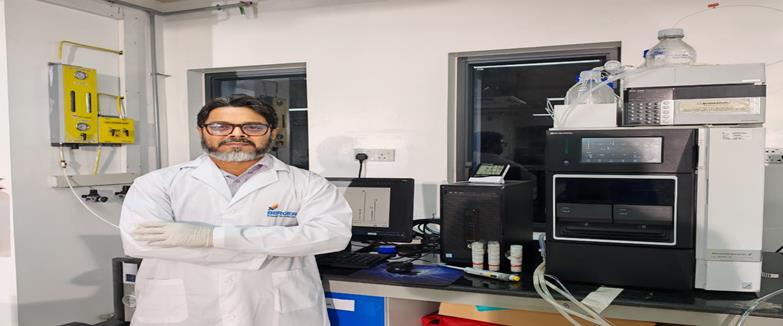
Image: Research & Development Center, Berger Paints Bangladesh Ltd
The tests were conducted using Inductively Coupled Plasma–Optical Emission Spectroscopy (ICP-OES), with a reporting limit of 49 ppm compared to the BSTI standard of 90 ppm. In contrast, third-party reports on Berger Paints showed that lead was not detected, with a reporting threshold as low as 10 ppm.
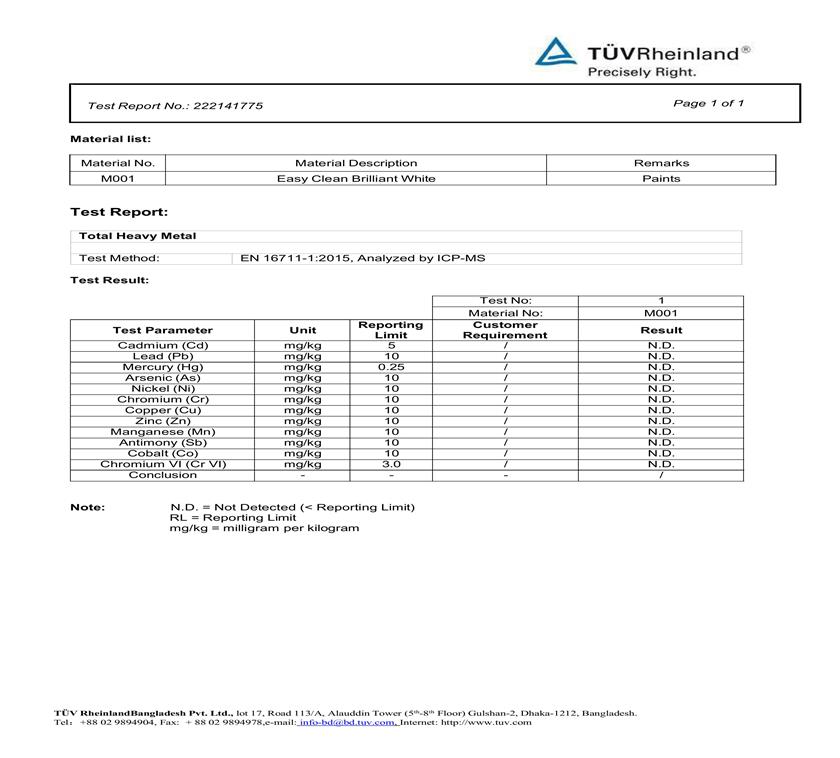
Source: Heavy Metal Test Report of Berger Easy Clean, Lab: TUV Rheinland, Bangladesh
Test reports on Berger’s popular Easy Clean brand confirm that the product is completely lead-free, with no lead detected against a reporting limit of 10 ppm compared to the BSTI standard of 90 ppm. Moreover, Easy Clean is also free from all types of heavy metals, reinforcing Berger’s commitment to consumer safety and environmental responsibility. The company uses lead-free labeling across all of its products to promote consumer awareness and highlight its commitment to safety.
Berger Lead Free Logo
The ESDO report revealed that only 21.6% of paints tested (35 out of 162 samples) carried “Lead-Free” or “Eco-Friendly” labeling. Alarmingly, four of these paints were found to contain lead despite displaying a lead-free logo, highlighting serious gaps in compliance and misleading consumer practices.
When asked about this, Dr ASM Obaidullah Mahmud, Chief R&D Officer at Berger Paints Bangladesh Limited, said lead pollution from paints is a critical public health issue, particularly for children. At Berger Paints Bangladesh, we recognized this risk early and eliminated lead from all our formulations in 2011. Through advanced research and innovation, we replaced lead-based pigments and additives with safe alternatives that deliver the same durability and colour performance without toxicity. Our R&D strategy is clear—innovate safer alternatives, uphold strict quality standards, and collaborate with regulators and stakeholders to build a healthier, lead-free environment for future generations. Our team is committed to embedding climate resilience and green innovation into every product line, ensuring that paint is not just a coating but a contributor to healthier living spaces.
In 2018, the Bangladesh Standards and Testing Institution (BSTI) set a limit of 90 ppm of lead in wall paint. This matched international rules and helped protect people, especially children. But there is still no rule for industrial paint. These paints are used in many places and can harm workers and nearby families. To fix this problem, all groups must work together. A special team is already working to make a national rule for industrial paint.
On November 25, 2025, a meeting was held to talk about this issue. The meeting was arranged by BSTI, UNICEF, and ESDO. Many people joined, such as government offices, paint makers, NGOs, and world groups. They talked about health risks and how to make strong rules. BSTI should ask the government to make laws so all paint companies must test their products and follow safe rules. These rules should include clear labels, regular tests, and strong checks.
ESDO is also working with many world groups, such as UNICEF, WHO, UNEP, and the European Union. These groups work together to stop lead risks around the world. The Bangladesh Paint Manufacturers Association (BPMA) should tell paint companies to stop using lead and follow a clear time plan. All unregistered paint companies should be found and punished if they break the rules.
Md. Mohsin Habib Chowdhury, the head of BPMA, said that the group wants paint makers to learn about the risks. He said they will follow a time plan and work with the government. He also said that if everyone follows the rules, we can protect children, protect our homes, and make a safe future without lead.