

If you’re thinking about starting therapy on BetterHelp, one of the first questions you may have is simple: “Does BetterHelp take insurance?” For many U.S. patients, the cost of mental health care is a real barrier—and understanding how coverage works can help you make the right choice for your budget and your needs.
This guide breaks down everything you need to know before signing up, including coverage rules, pricing, reimbursement, and alternatives that do accept insurance.
Quick Answer: Does BetterHelp Take Insurance ?
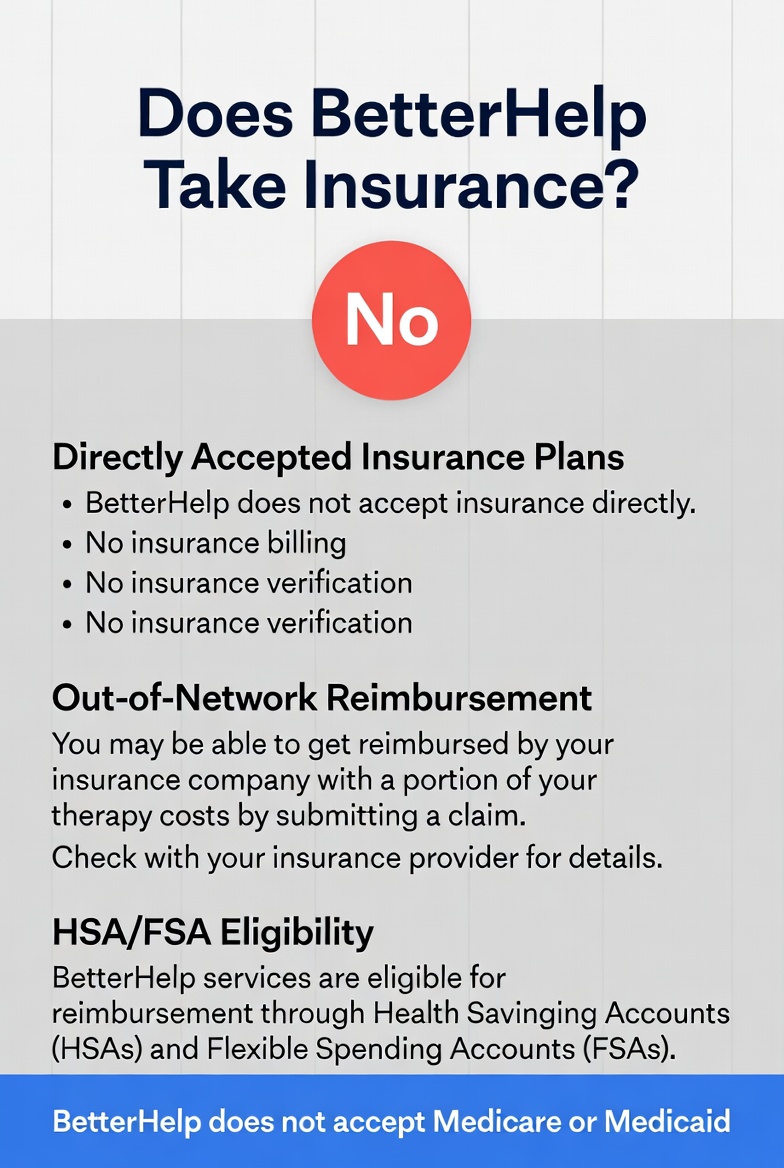
No. BetterHelp does not take insurance directly—not from private insurers, Medicaid, or Medicare.
BetterHelp operates as a cash-pay service, meaning patients pay out of pocket rather than using in-network benefits. This can feel discouraging if you rely on insurance for most health services, but there are still ways to reduce your cost, including:
- Using HSA or FSA funds
- Requesting out-of-network reimbursement
- Applying for financial aid discounts
- Choosing a subscription plan that fits your budget
How Popular Is BetterHelp — Is It Legit or a Scam?
BetterHelp is one of the biggest online therapy platforms in the U.S. Since launching in 2013, it has expanded to all 50 states. Its goal has always been simple: make therapy easier to access, more affordable, and more convenient.
Because of that reach, many people who may never try in-person therapy end up using BetterHelp. For a lot of users, it works well. One review found that 86% of clients said they would use the service again, and many liked the mix of messaging, video, and audio sessions.
However, being popular does not mean it’s perfect. Some users say their experience felt uneven. Therapist quality can vary. Some people get great support, while others feel their sessions were rushed or disconnected. As one Reddit user said, their first therapist was “amazing,” but the next one “did not help at all.”
BetterHelp has also faced real criticism. In 2023, the Federal Trade Commission (FTC) said the company shared sensitive health data with advertisers after telling users their information would stay private. BetterHelp settled the case and paid $7.8 million. The company now says it has changed its privacy practices, but the incident still raises concerns for some people.
So, is BetterHelp a scam? No. It is a legitimate therapy provider with licensed professionals. But like any therapy—online or in person—your experience depends on:
- How well you match with the therapist
- How much you engage in the process
At its best, BetterHelp gives fast, flexible, and often more affordable access to mental health support. At its worst, it can feel inconsistent, and some may be uneasy about past privacy issues.
BetterHelp is real and helpful for many people, but it’s not a perfect solution. If you join, check your therapist’s credentials, set clear expectations, and switch therapists if the match doesn’t feel right.
Why BetterHelp Doesn’t Accept Insurance Directly
Understanding why the platform is cash-pay gives clarity to patients who expect insurance billing like a typical therapist’s office.
Online Therapy Platforms Face Complex Insurance Rules
Insurance coverage for teletherapy varies widely depending on your state, your insurance plan, and whether services are billed as psychotherapy or digital health services.
Licensing Laws Differ Across States
BetterHelp works with licensed professionals nationwide, but each state has its own:
- Billing regulations
- Licensing limitations
- Reimbursement criteria
This makes nationwide claims processing extremely complicated.
Admin + Compliance Costs Would Raise Prices
Filing claims, negotiating rates, and managing audits require significant overhead. Operating outside the insurance system means:
- No surprise bills
- No copays or deductibles
- Transparent pricing
For many users, this simplicity is part of BetterHelp’s appeal.
Does BetterHelp Work With Aetna, Cigna, BCBS, or Kaiser?
BetterHelp is out of network for all major insurers, including:
- Aetna
- Cigna
- UnitedHealthcare
- Blue Cross Blue Shield
- Kaiser Permanente
- Tricare
- Humana
Being out of network doesn’t mean you can’t use your insurance at all—but it does mean the platform won’t file claims on your behalf.
PPO vs. HMO: This Matters
- PPO plans sometimes reimburse for out-of-network therapy
- HMO plans typically do not cover out-of-network services
Before signing up, ask your insurer:
- Do you cover out-of-network psychotherapy (CPT code 90837 or 90834)?
- Do you cover teletherapy specifically?
- What percentage is reimbursed?
- Do you require a diagnosis?
- Do I need a superbill?
Can You Get Reimbursed for BetterHelp? (Sometimes Yes)
You may be able to get partial reimbursement depending on your plan.
How Out-of-Network Reimbursement Works
- You pay BetterHelp out of pocket.
- You request monthly invoices from BetterHelp.
- You submit a superbill to your insurance provider.
- Your insurer reimburses a portion (if eligible).
What You Might Get Back
Reimbursement ranges widely:
- Some users receive 20%–70% back.
- Many receive $0 if their plan excludes online therapy.
Manage expectations—there’s no guarantee.
Paying for BetterHelp With HSA, FSA, or EAP
This is one of the easiest ways to reduce your costs.
✔ BetterHelp Is Eligible for HSA/FSA
BetterHelp provides documentation that meets IRS requirements.
✔ EAP Programs May Cover Some Costs
Some employers offer:
- EAP reimbursement
- Mental health stipends
- Flexible wellness budgets
Ask HR or your benefits manager.
What BetterHelp Actually Costs in 2025
BetterHelp pricing varies by location and therapist type, but most U.S. users pay:
- $70–$100 per week
- $280–$400 per month
Plans include:
- Messaging therapy
- Live video/phone sessions
- Worksheets and tools
Compared to in-person therapy ($120–$220 per session), many patients find the cost manageable even without insurance.
When BetterHelp Might Still Be Cheaper Than Insurance-Based Therapy
Many people think using insurance will always cost less. But that’s not always true. Once you add deductibles, co-pays, and long wait times, therapy through insurance can become expensive and slow. In some cases, BetterHelp can cost less and give faster access to care.
High Deductibles Can Raise Costs
Many U.S. patients don’t know that insurance often won’t pay for therapy until the deductible is met. Some plans have deductibles of $2,000–$5,000.
This means you may expect a small co-pay but end up paying the full session cost—often $120–$200—until you meet that deductible. After only a few visits, you may pay more than an entire month of BetterHelp.
Long Waitlists Can Delay Care
Even if you find a therapist who takes your insurance, getting an appointment can take weeks. Many therapists are:
- Already full
- Only taking a few new patients
- Booking 4–10 weeks out
For someone dealing with stress, anxiety, or depression, waiting that long can feel impossible.
BetterHelp usually matches people with a therapist in 24–48 hours, so you can start talking or messaging right away.
Shorter Sessions and Limited Visits
Insurance plans often limit what they cover. Some only pay for:
- 30–45 minute sessions
- A set number of visits per year
- One visit per week
This can make therapy feel rushed or restricted.
BetterHelp does not set these limits. Users can:
- Message their therapist any time
- Ask for longer sessions
- Schedule more sessions during tough weeks
- Switch therapists without extra fees
BetterHelp is a cash-pay service, but it can still be the cheaper and easier choice for many people. People with high deductibles often learn that insurance won’t cover therapy until they pay thousands out of pocket. This can make in-person therapy more expensive than they expected. Others spend weeks trying to find an in-network therapist, only to face long waitlists or very limited openings.
A big part of BetterHelp’s value is the flexibility it gives. Instead of short, limited sessions set by an insurance plan, users can talk with their therapist more often, message when they need support, and book sessions that fit their schedule. Because matching happens fast, people who are struggling can get help within a day or two instead of waiting weeks.
That’s why choosing between insurance and BetterHelp is not only about price. For many Americans, it comes down to access and timing. BetterHelp removes common barriers like slow scheduling, strict coverage rules, and yearly session caps. In their place, it offers quick, steady, and flexible care that people can use when they need it most.
Does BetterHelp Take Medicare or Medicaid? What to Do If It Doesn’t
Many people who use Medicare or Medicaid hope that BetterHelp will be a low-cost way to get therapy. But the truth is simple: BetterHelp does not accept Medicare or Medicaid. The platform is not part of any federal or state insurance program, so members must pay on their own.
This can feel confusing for older adults, people with disabilities, or families who rely on state health plans. After all, Medicare Part B, Medicaid, and many state mental-health programs do cover therapy with other providers. So why not BetterHelp?
It comes down to billing rules. Federal insurance programs require therapists to follow strict laws, submit detailed paperwork, and meet set standards for every state. BetterHelp works with thousands of therapists across the U.S., and meeting every rule in every state would be hard and very expensive.
If you depend on Medicare or Medicaid, you still have good choices. Many telehealth clinics do take these programs. Community health centers, nonprofit counseling groups, and state-approved online therapy platforms often provide free or very low-cost sessions. Some even offer appointments within the same week.
So even though BetterHelp is not an option for Medicare or Medicaid users, therapy is still within reach. The best steps are:
- Look for in-network telehealth providers
- Ask your plan for a list of covered mental-health specialists
- Check your state’s virtual behavioral-health programs
Both Medicare and Medicaid have expanded online therapy benefits in recent years. That means many people can still get steady and affordable support — just not through BetterHelp.
Best Alternatives if You Need Therapy Covered by Insurance
If insurance coverage is a must, consider:
Online Therapy Platforms That Accept Insurance
- Talkspace (accepts many major plans)
- Brightside Health (accepts Aetna, BCBS, Cigna)
- Amwell (accepts many commercial insurers)
- Teladoc Health (insurance-friendly)
Local In-Network Therapists
Search via:
- Psychology Today
- Zocdoc
- Your insurer’s directory
Low-Cost Options
- University counseling centers
- Community mental health clinics
- Nonprofit support organizations
- Sliding-scale therapists
Is BetterHelp Right for You?
You may prefer BetterHelp if you want:
- Quick access
- Flexible scheduling
- Unlimited messaging
- Clear, upfront pricing
- No insurance involvement
- Privacy from your insurer
You may prefer insurance-based therapy if you want:
- Lower out-of-pocket costs
- Long-term treatment coverage
- Regular in-person sessions
FAQs
Does BetterHelp take insurance for couples therapy?
No. Insurance is not accepted for any therapy type.
Does BetterHelp accept Medicaid or Medicare?
No. Both Medicaid and Medicare are not compatible with BetterHelp’s billing model.
Can you cancel BetterHelp anytime?
Yes. BetterHelp renews weekly or monthly but can be canceled at any time.
What is a superbill?
A document you submit to your insurer for possible reimbursement.
Does using BetterHelp affect insurance privacy?
No. Because BetterHelp doesn’t bill insurance, your mental health information stays off insurance records.
Final Thoughts
BetterHelp’s cash-pay model can be frustrating if you rely on insurance to manage the cost of care. Still, for many people, it offers something they can’t get elsewhere: immediate access, no bureaucracy, and predictable pricing.
Before you sign up, compare your insurance benefits, review your deductible, and think about what matters most—cost, convenience, or coverage. With the right information, you can choose the mental health support that fits your budget, your needs, and your life.