
Quick Answer
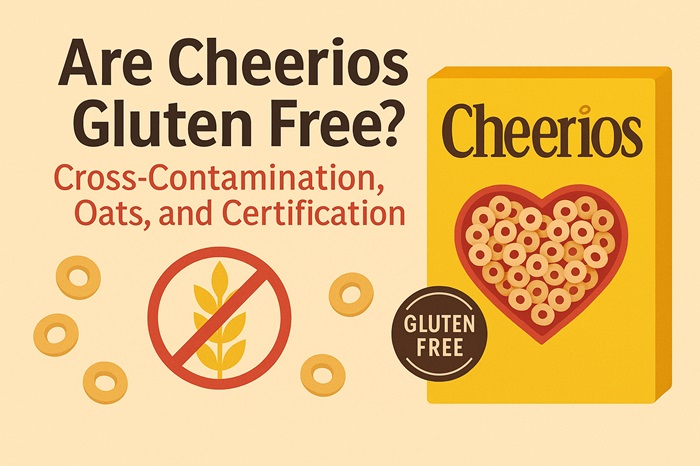
Are Cheerios gluten free? Yes — in the United States, Cheerios are labeled gluten-free and meet the FDA requirement of under 20 parts per million (ppm) of gluten. However, they are not third-party certified, and independent tests have sometimes found variable gluten levels. That means Cheerios may be safe for many gluten-sensitive individuals, but people with celiac disease or severe gluten intolerance should proceed with caution. Cross-contamination from wheat, barley, or rye during oat processing is a known risk, which is why many experts recommend choosing certified gluten-free cereals instead.
Why the Gluten-Free Question Matters
If you’ve stood in the cereal aisle staring at the bright yellow box wondering are Cheerios gluten free, you’re not alone. Cheerios have been a household staple in America for over 80 years. They’re marketed as wholesome, simple, and now — gluten-free.
But “gluten-free” labeling can be complicated. For the 3 million Americans with celiac disease and millions more with non-celiac gluten sensitivity, the difference between safe and harmful food can be a matter of micrograms. Even trace gluten can trigger immune reactions, digestive distress, and long-term intestinal damage.
What Is Gluten and Who Should Avoid It?
Gluten is a protein found in wheat, barley, rye, and related grains. It helps dough stretch and hold shape.
Conditions Requiring Gluten Avoidance
- Celiac Disease – Autoimmune attack on the small intestine triggered by gluten.
- Non-Celiac Gluten Sensitivity (NCGS) – Causes bloating, fatigue, brain fog, without intestinal damage.
- Wheat Allergy – Immune response to wheat proteins, including gluten.
FDA Gluten-Free Rule: Products must contain <20 ppm gluten to be labeled gluten-free. For some, even this limit can cause symptoms.
Key Takeaway: For those with celiac disease, “under 20 ppm” isn’t always enough — stricter standards or certification may be preferred.
Cheerios Ingredients & Nutrition Profile
Core Ingredients in Original Cheerios
- Whole grain oats
- Corn starch
- Sugar (1g per serving)
- Salt
- Tripotassium phosphate
- Vitamin E (preservative)
- Added vitamins & minerals (iron, calcium carbonate, vitamin D3, folic acid)
Notable:
- No wheat, barley, or rye listed.
- Corn starch is naturally gluten-free.
- Sugar content is minimal compared to most cereals.
Sugar Content by Cheerios Variety (Per 1 Cup)
| Flavor | Sugar (g) | Notes |
| Original | 1 | Lowest sugar, best for GF & low-sugar diets |
| Honey Nut | 12 | Honey + brown sugar syrup |
| Multi-Grain | 8 | Multiple grains, added sugar |
| Apple Cinnamon | 10 | Apple puree & cinnamon |
| Frosted | 9 | Sugar-coated oats |
Are Oats Gluten Free or Cross-Contaminated
Oats are naturally gluten-free, containing avenin, a protein similar but not identical to gluten. Most celiac patients tolerate avenin, but 5–8% react to it.
The Problem: Cross-Contact
Oats are often contaminated by gluten during:
- Crop rotation in fields with wheat or barley.
- Shared harvesting machinery.
- Mixed storage in grain elevators.
- Milling in facilities processing wheat.
A 2015 Journal of Food Protection study found 88% of regular oat samples contained detectable gluten — some over 200 ppm.
Key Takeaway: Oats are only truly gluten-free if grown, processed, and packaged under strict contamination controls.
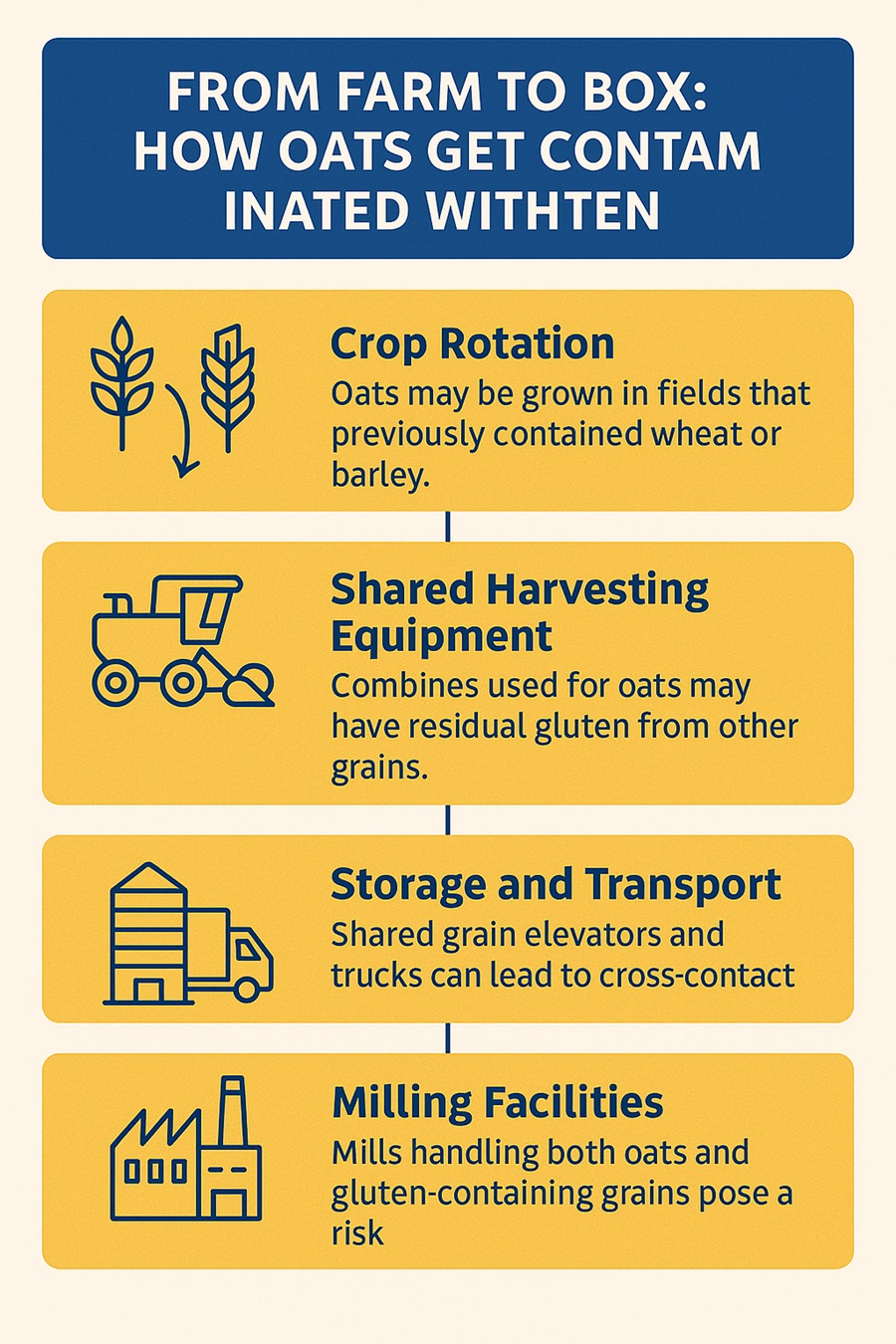
From Farm to Box: How Oats Get Contaminated with Gluten
Even though oats are naturally gluten-free, the journey from farm to cereal box is filled with opportunities for gluten to sneak in. Each step in the supply chain can add risk — and unless every stage is carefully controlled, contamination is hard to avoid.
The main stages where contamination occurs:
- Crop Rotation – Oats often share fields with wheat or barley in alternating seasons, leaving behind residual grain.
- Shared Harvesting Equipment – Combines and other machinery may process multiple grains without full cleaning.
- Storage and Transport – Oats are stored in shared grain elevators or transported in trucks that also carry gluten grains.
- Milling Facilities – Even small amounts of wheat or barley dust from previous batches can contaminate oats during processing.
Key Takeaway: Unless oats are grown, harvested, transported, and milled in strictly gluten-free conditions — as in purity protocol oats — contamination risks remain high.
Are Cheerios Really Gluten Free? The Brand’s Claim Explained
In 2015, General Mills announced Cheerios were gluten-free, using mechanical sorting to remove wheat, barley, and rye from conventional oats.
Sorting Steps:
- Optical sorting – Cameras detect and remove foreign grains.
- Air classification – Air currents separate lighter oats from heavier grains.
- Batch testing – Random testing to ensure under 20 ppm.
Criticism: Advocacy groups like Gluten Free Watchdog say sorting is less reliable than using purity protocol oats grown under strict controls from the start.
Historical Timeline: Cheerios and the Gluten-Free Label
- 2015 (July) – General Mills launches gluten-free Original Cheerios and several other flavors, using mechanical oat-sorting.
- 2015 (September) – Recall of 1.8 million boxes after wheat flour contamination at a California plant.
- 2016–2018 – Mixed celiac community reactions; some batches test above 20 ppm.
- 2020–2023 – Gluten-free labeling continues in the U.S. and Canada; no third-party certification obtained.
- 2025 – Cheerios remain gluten-free by FDA definition but not certified.
Key Takeaway: Cheerios’ gluten-free labeling has been under scrutiny since its introduction.
Independent Testing & Recalls
- 2015 Recall: 1.8 million boxes recalled due to wheat flour contamination.
- Gluten Free Watchdog Findings: Most batches meet FDA limits; some test slightly above.
- Case Example: 2018 consumer illness linked to Cheerios testing at 15–22 ppm.
Gluten-Free Certification vs Cheerios’ Labeling
- FDA Standard: <20 ppm, self-monitored.
- GFCO Certification: <10 ppm, third-party audited.
- CSA Certification: <5 ppm, strictest standard.
Cheerios are not certified by GFCO, CSA, or similar programs.
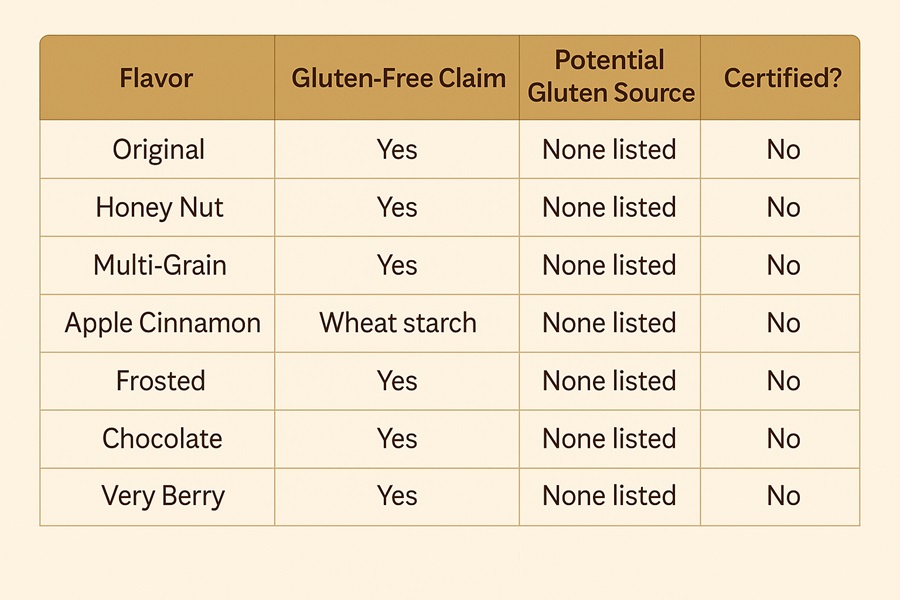
Flavor-by-Flavor Gluten-Free Status
| Flavor | GF Claim | Potential Gluten Source | Certified? |
| Original | Yes | None listed | No |
| Honey Nut | Yes | None listed | No |
| Multi-Grain | Yes | Wheat starch | No |
| Apple Cinnamon | Yes | None listed | No |
| Frosted | Yes | None listed | No |
| Chocolate | Yes | None listed | No |
| Very Berry | Yes | None listed | No |

Are Honey Nut Cheerios Gluten Free?
Yes — Honey Nut Cheerios are labeled gluten-free in the United States and Canada, using the same mechanically sorted oat process as Original Cheerios.
- Potential Gluten Source: None listed on the label.
- Certification: Not certified gluten-free.
- Sugar Content: 12g per cup — higher than Original Cheerios.
Risk Factors: Same cross-contamination risks as Original Cheerios due to oat sourcing and production.
Check out this popular USA drink: Does Olipop Have Caffeine?
Are Cheerios Safe for Celiacs and Gluten Sensitivity?
It depends on the person’s sensitivity level. Cheerios meet FDA gluten-free standards but are not third-party certified and use sorted oats rather than purity protocol oats.
- Gluten levels in Cheerios can vary by batch.
- Oat cross-contamination in cereals remains a known risk.
- Some celiac patients react to avenin, the oat protein.
Recommendation: If you have celiac disease, choose certified gluten-free cereals with purity protocol oats for maximum safety.
Cheerios Around the World
- Canada – Same sorting method and concerns.
- UK & EU – Contains wheat; not gluten-free.
- Australia – Oats cannot be labeled gluten-free by law.
Cheerios Gluten-Free Controversy
Since 2015, Cheerios has faced ongoing debate in the gluten-free community.
- Gluten Free Watchdog testing has been mixed.
- Purity protocol oats vs sorted oats is a core disagreement.
- Supporters praise affordability and accessibility; critics point to contamination risks.
Expert & Advocacy Perspectives
- Shelley Case, RD: “Certification adds a safety net; mechanical sorting leaves uncertainty.”
- Gluten Free Watchdog: “Meets FDA standards, but results vary. Celiacs should consider certified oats.”
Safer Alternatives: Best Gluten-Free Cereals Like Cheerios
Oat-Based Certified GF:
- One Degree Organic Sprouted O’s (purity protocol oats)
Oat-Free GF:
- Nature’s Path Organic Mesa Sunrise
- Barbara’s Puffins (GF varieties)
- Love Grown Power O’s (bean-based)
Check out this popular USA Food: White American Cheese
Cheerios vs Certified Gluten-Free Cereals: Side-by-Side Comparison
| Cereal Brand & Flavor | Gluten-Free Status | Certification | Gluten PPM Target | Sugar (g) | Price/oz |
| Original Cheerios | Yes | No | <20 ppm | 1 | $0.24 |
| Honey Nut Cheerios | Yes | No | <20 ppm | 12 | $0.27 |
| One Degree Organic Sprouted O’s | Yes | GFCO | <10 ppm | 2 | $0.39 |
| Nature’s Path Organic Mesa Sunrise | Yes | GFCO | <10 ppm | 3 | $0.42 |
| Barbara’s Puffins (GF) | Yes | GFCO | <10 ppm | 6 | $0.36 |
Key Takeaway: Certified cereals aim for lower gluten ppm and provide extra safety assurance for celiacs.
At-Home Gluten Testing
- Nima Sensor: Portable, detects gluten ≤20 ppm.
- GlutenTox Home: Strip test, detects lower ranges.
Caution: Gluten contamination can be uneven (“hot spots”).
Final Verdict
Cheerios are gluten-free by FDA definition but not certified. They may be safe for many gluten-sensitive individuals but carry risk for celiacs and avenin-sensitive eaters.
FAQs
- Are Cheerios safe for celiacs?
Some tolerate them; others react due to cross-contamination. Certified GF oats are safer. - Which Cheerios flavors are safest?
Flavors without wheat starch — Original, Honey Nut, Apple Cinnamon, Frosted, Chocolate, Very Berry. - Why are oats contaminated with gluten?
Shared fields, harvesting equipment, storage, and milling. - What’s the difference between gluten-free and certified gluten-free?
Certification means stricter testing and often lower gluten ppm limits. - Are Cheerios gluten-free in Canada?
Yes, but same sorting process and concerns as U.S.