



U.S. fiber crews can often drill the bore. The harder problem is proving where the drill head, existing utilities, and final conduit sit before the job crosses a tolerance zone. This article turns the research into a field-ready control model for planners, contractors, and fiber owners.
Why locating controls fiber HDD risk
Horizontal directional drilling lets fiber builders place conduit under roads, driveways, rail lines, rivers, and dense rights-of-way without open trenching. That advantage comes with a constraint: the crew cannot see the bore path. It must rely on records, markouts, utility designation, guidance readings, and exposed verification.
The research points to one practical conclusion. Downtime does not come only from drilling difficulty. It comes from unresolved uncertainty: unknown plant, bad depth assumptions, noisy tracking conditions, tight separation, weak communication, and slow stop-work decisions.
OSHA, FHWA, PPI, SHRP2, and CGA material all support the same operating rule. Records and surface marks start the job, but they cannot prove safe clearance by themselves. Crews need a layered stack: records, EM locating, GPR where needed, walkover or gyro guidance, and potholing at critical conflicts.
Where HDD fits in U.S. fiber construction
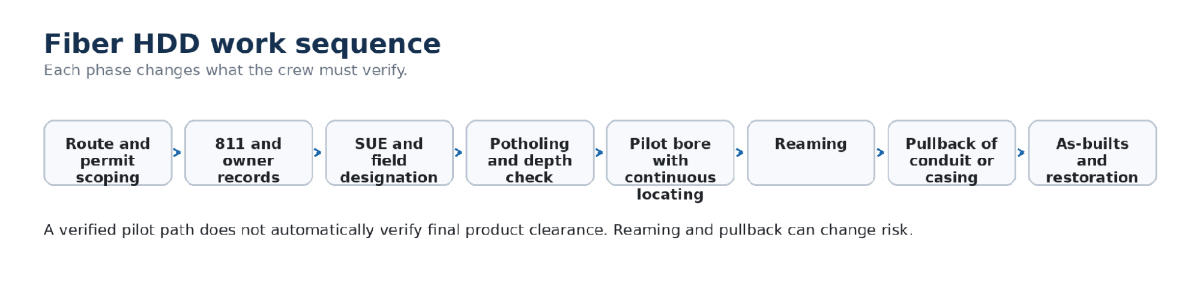
Most fiber HDD jobs follow the same work sequence: route scoping, records review, field designation, depth verification, pilot bore, reaming, pullback, and as-built records. Each step changes the locating task.
During planning, the team asks what could be in the corridor. During the pilot bore, the locator tracks the drill head in real time. During reaming and pullback, the team must protect clearance again because the finished product may not follow the pilot centerline exactly.
Five failure modes that stop fiber HDD jobs
Electromagnetic interference corrupts guidance readings
Interference does not only come from overhead power. It can come from traffic loops, nearby utilities, rebar, tracer wires, and signals already applied to lines in the corridor. DCI guidance tells crews to scan the site, find the highest-noise locations, and change bands when interference demands it.
Signal attenuation hides the target
Wet clay, high moisture, deep sections, metal clutter, and small non-conductive fiber targets can weaken or erase a signal. FHWA notes that GPR can struggle in wet clay and that fiber optic lines can be hard to distinguish because they may look too much like the surrounding soil.
Depth readings create false confidence
A locator reading can help guide the bore, but it does not replace safe exposure near the planned path. OSHA warns that underground service locators typically cannot provide reliable utility depth. PPI also warns crews to keep the drill and reamer out of the tolerance zone and add separation because path deviation and tool size matter.
Subsurface conditions push the tool off path
Cobbles, fractured rock, boulders, coarse soils, tight bends, and insufficient cover can divert the drill head or affect returns. PPI tells crews to measure when contact with obstacles is suspected because the actual path can depart from the planned line.
Crew process breaks before the tool does
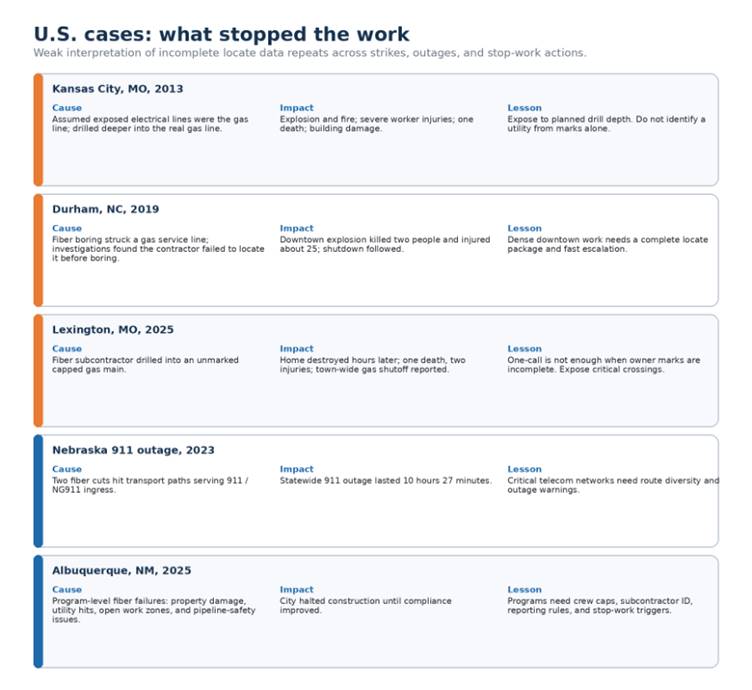
The Kansas City case in the research shows the pattern. The crew exposed lines, made a wrong identity assumption, did not verify the gas line at planned drill depth, and hit the actual gas line. Communication gaps, incomplete locate packages, weak subcontractor control, and slow escalation turn small uncertainty into lost production and public risk.
Build a locating stack, not a one-tool plan
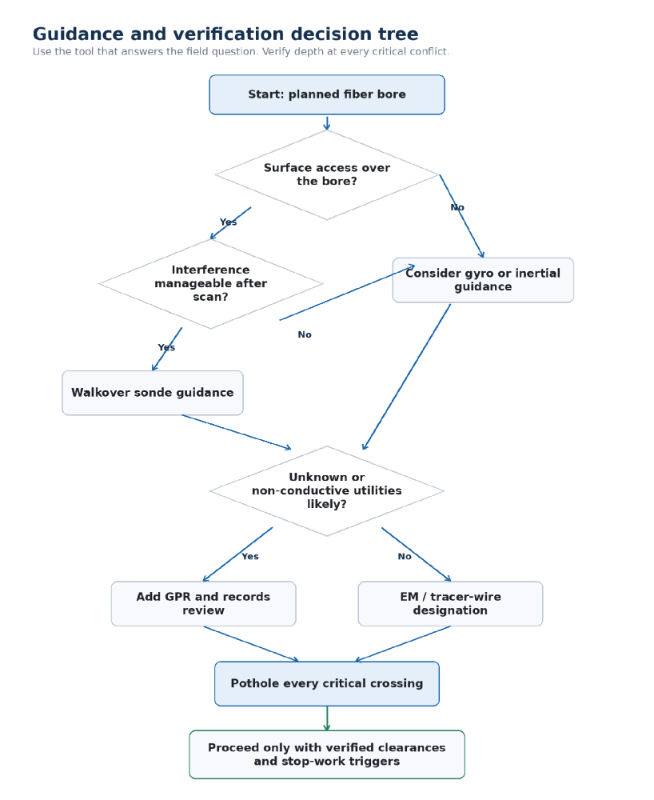
The best programs assign each tool a narrow job. Records and owner data support planning. EM locators trace conductive utilities and tracer wires. GPR screens for non-conductive or unknown plant where soil conditions allow. Walkover guidance tracks the drill head where surface access and magnetic conditions support it. Gyro or inertial guidance fits inaccessible or noisy crossings. Potholing proves true depth at critical points.
That stack also fits ASCE utility quality logic. QL-D and QL-C data help plan. QL-B designation narrows the route. QL-A exposure resolves the conflict that can stop the bore.
Compliance rules that should shape the work plan
811 starts the process, but it does not finish it
PPI notes that most states require contractors to use 811 before excavation, with notice windows that often range from 48 to 240 hours before work, excluding weekends and holidays. Sewer laterals and some local facilities may not be registered. Planners still need owner outreach, local records, and site walkdowns.
Markouts need a field check
APWA color code marks communications in orange. Paint gives the crew a starting point. The crew still has to compare marks with visible structures, records, handholes, vaults, poles, meters, and field readings.
Tolerance-zone work needs non-aggressive exposure
PPI recommends at least 18 inches from the outer edge of the facility unless state or local rules require more. It also states that no part of the pilot cutting tool or reamer may enter the tolerance zone. Use hand tools or vacuum excavation inside that zone and expose crossings where feasible.
Communication is a safety control
The locator and driller must keep continuous contact. If communication fails, the driller stops. This rule prevents one person from making a steering decision while the other person sees a depth, pitch, or interference anomaly.
What U.S. cases show about downtime risk
The research reviews incidents and stop-work actions tied to fiber boring, gas strikes, utility damage, and telecom outages. The cases do not show one isolated technical failure. They show repeated system failures: incomplete utility information, weak depth verification, unclear ownership, poor escalation, and fragile network routing.
For fiber owners, the cost of a strike does not end with the repair invoice. It can include emergency response, outage credits, permit risk, public-safety exposure, municipal stop-work orders, and lost trust with residents.
A practical workflow for planners and contractors
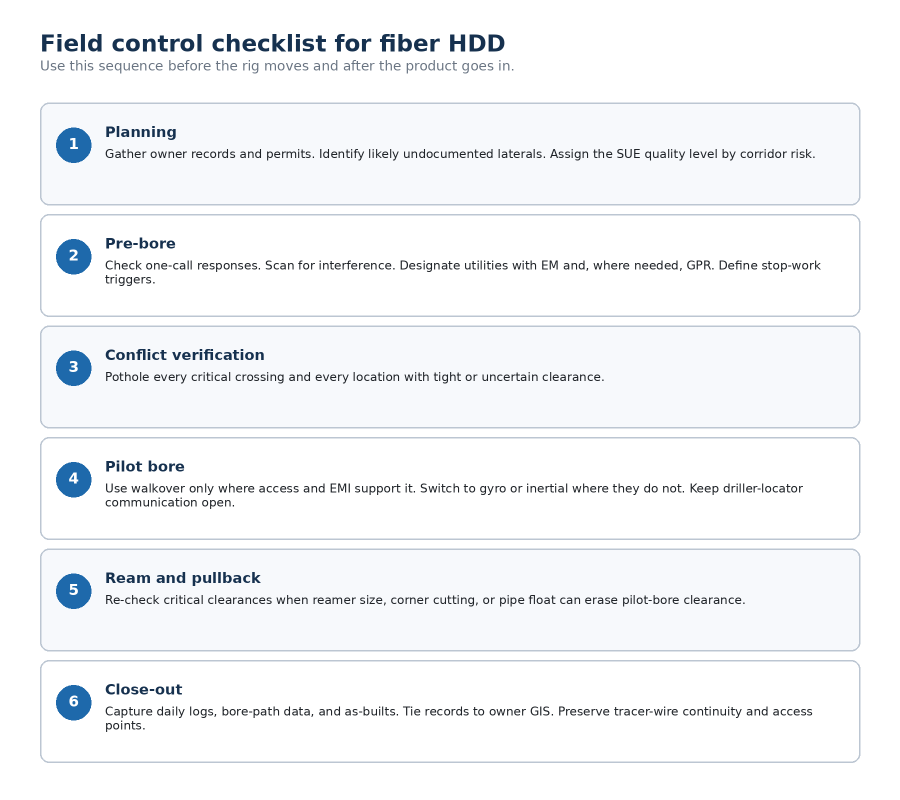
A strong HDD plan removes uncertainty before production starts. The planner defines route risk. The utility engineer assigns quality levels. The field crew confirms interference and designates utilities. The locator and driller select the guidance method. The contractor exposes every critical crossing. The owner preserves the final records so the next crew does not rebuild the same uncertainty.
This workflow works because it makes stop-and-verify behavior normal. A crew should not treat an anomaly as a personal judgment call. It should treat it as a trigger with a named next step.
KPIs that show whether the program is getting safer
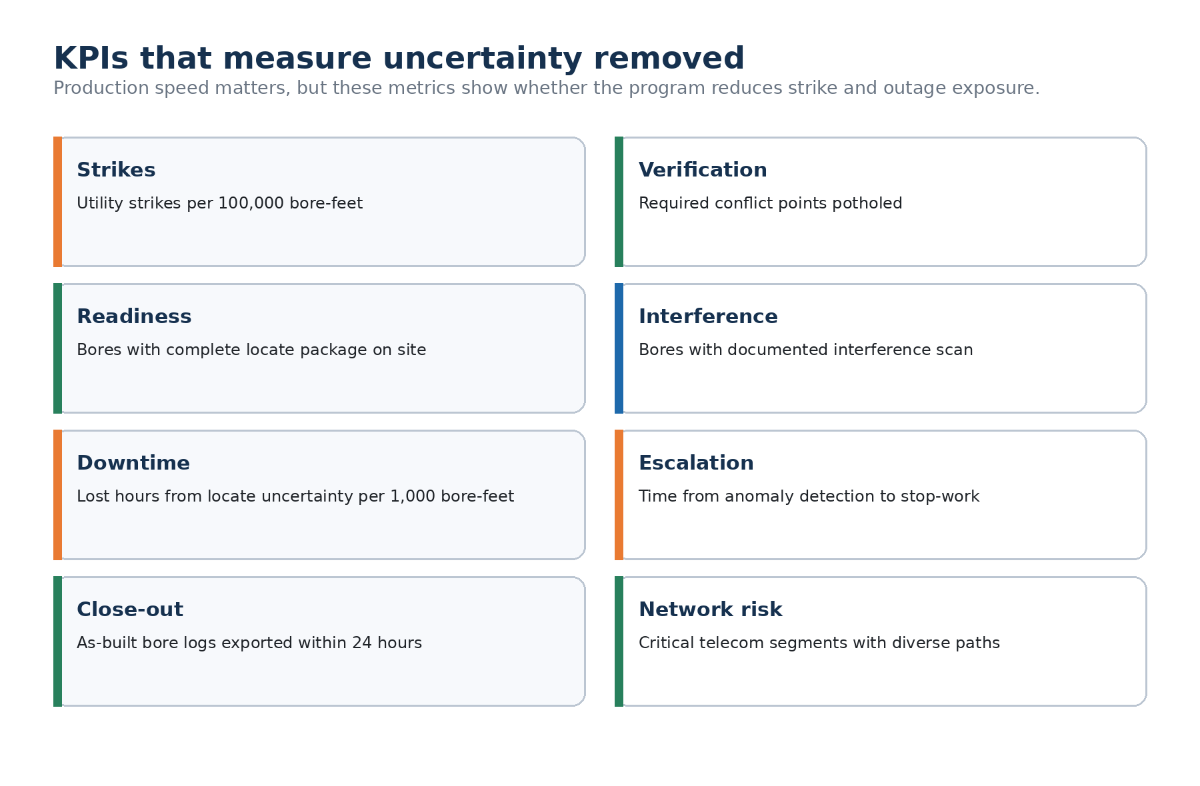
Fiber programs often track feet installed per day. That number matters, but it can hide weak control. A crew can move fast until a conflict stops the job. Better KPIs track uncertainty removed and strike exposure reduced.
Use metrics that tie directly to field behavior: completed locate packages, interference scans, conflict exposure, strike rates, lost production, escalation time, as-built delivery, and route diversity for critical telecom segments.
How to choose equipment and services without overbuying
Procurement should start with corridor risk, not a brand list. Shallow suburban bores with clear access and manageable interference can often use a walkover guidance package. Deep crossings, rail crossings, reinforced corridors, water crossings, and blocked surface access may justify gyro or inertial guidance. Unknown non-conductive plant pushes the team toward GPR and records review. Tight conflict points require potholing no matter which guidance tool tracks the drill head.
Crews that standardize on Underground Magnetics can review transmitters, receivers, and complete guidance kits in the Underground Magnetics HDD locating equipment collection before they choose a walkover stack for a shallow or moderate fiber bore. The choice should still follow field conditions: access, interference, depth, soil, and the number of critical crossings.
Do not buy equipment to avoid verification. A more capable receiver does not turn a tight gas crossing into a safe assumption. A lower-noise band does not prove the depth of an undocumented utility. A clean pilot path does not prove final clearance after reaming and pullback. Use equipment to reduce uncertainty, then expose critical conflicts to remove it.
Common mistakes to remove from the specification
Treating 811 marks as final design data
Require owner records, field designation, and exposure for critical conflicts.
Using one locating method across every corridor
Match EM, GPR, walkover, gyro, and potholing to the corridor and the question.
Reading depth as a guarantee
Calibrate, range-check, and verify near the planned path. Treat unexposed depth as a risk, not a fact.
Ignoring the reaming and pullback phase
Check where reamer size, bends, or pipe float can reduce separation after a good pilot bore.
Letting subcontractors define stop-work thresholds in the field
Set stop-work triggers in the work package. Require reporting, photos, logs, and owner notification.
Final takeaway
HDD reduces surface disruption in fiber construction, but it increases dependence on location quality. The safest and most efficient crews do not rely on one map, one markout, or one receiver reading. They build a stack of controls, verify every critical crossing, and stop when the field data no longer supports the plan.
The operating rule is simple: downtime falls when uncertainty falls. Strong records, right-fit guidance, interference-aware procedures, QL-A exposure, clear driller-locator communication, and accurate close-out records give fiber owners the best chance to finish the bore without a strike, delay, or municipal stop-work order.
Research base
This article is based on the attached research document and its cited materials: OSHA guidance on avoiding underground utilities during HDD, Plastics Pipe Institute TR-46, FHWA utility locating guidance, SHRP2 utility locating technology guidance, CGA 2024 DIRT reporting, DCI and Subsite guidance materials, NTSB and state incident records, Nebraska PSC 911 outage exhibits, and City of Albuquerque fiber construction stop-work material.
State tolerance-zone rules and permit conditions vary. Use the values in this article as a U.S. baseline and check local requirements before construction.