

When people talk about sustainable buildings, the conversation usually starts with the visible upgrades: rooftop solar, high-efficiency HVAC, LED lighting, smart controls. Those features matter, and they often deserve the attention they get. But they are only part of the environmental story.
A building’s real sustainability profile starts earlier and runs deeper. It begins with the structure itself: the materials selected, the amount of waste created during construction, the way the enclosure performs over time, and whether the building can adapt, endure, and avoid becoming tomorrow’s demolition debris. That wider lens is changing how project teams think about performance. It is also one reason prefab metal buildings are back in serious conversation.
Not because steel is a miracle material. Not because prefabrication solves everything. But because, when specified carefully, steel buildings can align with several of the goals that now define smarter construction: lower waste, longer service life, recoverable materials, and better accountability around carbon.
Sustainability Has Moved Beyond Surface-Level Features
For years, green building was often framed around what happened after construction was complete. Would the building use less electricity? Would it heat and cool more efficiently? Would it cost less to operate?
Those questions still matter. Operational energy remains a major part of a building’s long-term footprint. But the market has moved on from the idea that sustainability begins when the lights turn on. Today, the discussion includes embodied carbon too—the emissions tied to raw material extraction, manufacturing, transportation, and installation.
That shift is no longer theoretical. LEED v5 puts greater emphasis on decarbonization, resilience, and life-cycle impact, while public-sector procurement rules increasingly rely on Environmental Product Declarations and global warming potential data to judge whether a material is actually lower impact. In other words, the standard is getting higher. “Recyclable” alone is no longer enough.
That is where steel enters the conversation in a more nuanced way than it used to.
Steel’s Sustainability Case Starts With Circularity
Construction and demolition waste remains one of the built environment’s most persistent problems. The U.S. EPA estimates that the country generated roughly 600 million tons of construction and demolition debris in 2018, with demolition accounting for the vast majority.
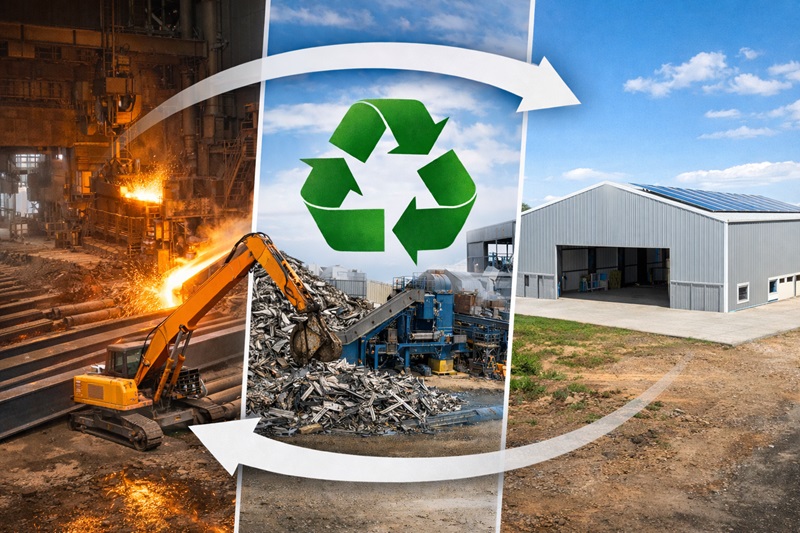
Steel stands apart because the recovery system already exists. Structural steel is widely recyclable, and in the United States the supply chain is heavily tied to recycled input. AISC says the average new structural steel member contains about 92% recycled steel, and structural steel remains fully recyclable at the end of its service life.
That matters because it changes what “end of life” looks like. In many buildings, demolition turns materials into disposal problems. With structural steel, the framing often remains part of a functioning commodity stream. It can be recovered, processed, and put back into use rather than buried in a landfill.
In an industry still struggling with waste, that is a meaningful advantage.
But Recyclable Does Not Automatically Mean Low-Carbon
This is the point many weaker sustainability articles miss.
Steel can support circular construction, but circularity is not the same thing as low embodied carbon. A material can be recyclable and still carry a significant carbon burden depending on how it is produced, what energy source powers its manufacturing, and how far it travels before it reaches the site.
That is why the modern question is no longer “Is steel recyclable?” It is “Which steel, made how, and verified by what data?”
AISC has reported that U.S. structural steel, much of it made through electric arc furnace production with high recycled content, has continued to improve on embodied carbon metrics. In late 2025, the organization said new data showed an 11% drop in the embodied carbon of structural steel. That is important progress, but it also reinforces the bigger point: sustainability now depends on verified product data, not generic green claims.
This is exactly why Buy Clean policies have gained traction. Programs at the federal and state level increasingly require product-specific disclosure and carbon thresholds for materials such as steel. The material category is no longer judged by reputation alone. It is judged by measurable performance.

Prefabrication’s Real Advantage Is That It Reduces Chaos
One of the most romanticized ideas in construction is that waste comes from a few major failures. In reality, most jobsite waste comes from repetition and disorder. A damaged delivery here. A bad cut there. Rework, over-ordering, weather exposure, poor sequencing, inconsistent tolerances, late design changes. None of it looks dramatic in isolation. Together, it becomes a cost and waste problem.
This is where prefabrication earns its place.
Prefabricated steel buildings move more work into controlled manufacturing environments, where components can be cut, formed, and coordinated in advance. That usually means fewer field modifications, less exposure to weather, and fewer materials lost to site improvisation. It can also accelerate enclosure, which matters more than many people realize. The sooner a building is dried in, the lower the chance that moisture, mud, or repeated handling will damage the materials that follow.
That does not make prefab automatically sustainable. Poor coordination can still waste time and money. Long transport routes can eat into some advantages. A rushed or careless installation can undermine the intended performance of the entire system.
But the broader trend is clear: off-site construction is being taken more seriously as a mainstream delivery strategy. GSA’s 2024 P100 update incorporated ICC/MBI off-site construction standards, a sign that the sector is moving further into formal best-practice territory.
Durability Is Still One Of The Most Underrated Green Strategies
Construction likes innovation, but sustainability often comes down to something less glamorous: how long the building stays useful.
A structure that lasts longer generally requires fewer replacement materials, fewer major repairs, fewer tear-offs, and less disruptive renovation over time. That is not abstract theory. It is one of the cleanest ways to reduce waste in the built environment.
Steel has long been favored in applications where long spans, repeated use, and structural reliability matter. It is not maintenance-free, and it does not excuse poor detailing. Corrosion protection, coatings, drainage, and assembly design still matter. But as a category, steel is often part of projects where durability is central to the value proposition.
That matters environmentally because resilience and sustainability increasingly overlap. LEED v5 makes that connection explicit, tying lower-carbon buildings to long-term performance and resilience. A building that fails early is rarely a sustainable one, no matter how many green features it carried on opening day.
The Envelope Still Makes Or Breaks The Building
The steel frame may define the structure, but the enclosure determines whether the building performs.
This is especially important in metal buildings, where poor thermal detailing can quietly lock in decades of energy waste. The biggest issues are not flashy. They are thermal continuity, insulation strategy, air leakage, thermal bridging, vapor control, and transition detailing at edges, penetrations, and openings.
Done badly, these problems drive up heating and cooling demand year after year. Done well, they support comfort, lower operating energy use, and protect durability.
That is why the sustainability argument for prefab metal buildings cannot stop at recycled content or construction efficiency. It also has to include building science.
Cool Roofs Offer A Good Example Of Practical Performance
Roof design is one of the clearest examples of how small enclosure decisions can have long-term environmental consequences.
In many prefab metal buildings, the roof is the largest surface facing sustained solar exposure. The U.S. Department of Energy says that, under the same summer conditions, a reflective roof can stay more than 50°F cooler than a conventional roof. That can reduce heat gain into the occupied space below and lower cooling demand in hot climates.
The key point is not that every project needs the same roof. It is that climate-responsive specification matters. Good sustainability decisions are rarely universal. They are usually project-specific, tied to location, use, insulation levels, and performance priorities.
Moisture Is Where Good Intentions Often Fail
There is one more issue that deserves more attention in metal-building sustainability discussions: moisture.
Condensation may sound minor compared with carbon, waste, or energy, but it can undo all three. When warm, humid air reaches a cool surface and the assembly is not properly detailed, the result can be damaged finishes, reduced insulation performance, corrosion risk, and premature replacement of components that should have lasted much longer.
ASHRAE’s guidance on moisture control makes the broader point well: moisture management is essential to durable, efficient, low-carbon buildings.
This is one reason sustainability cannot be treated as a product label. It is a systems issue. A recyclable structure with poor moisture control is still a compromised building.
Why Steel Buildings Keep Reappearing In Serious Sustainability Discussions
Prefab metal buildings are not sustainable because of one talking point. They are sustainable when several practical advantages come together.
They can reduce construction waste by shifting work into more controlled production settings. They can support circular material use because structural steel is widely recovered and recycled. They can offer long service life when they are properly protected and maintained. They can perform efficiently when the roof and wall systems are detailed for air, heat, and moisture control. And they can fit modern lower-carbon procurement frameworks when the products are selected using credible EPD and GWP data.
That is a far more believable sustainability story than the usual marketing shorthand.
The Smarter Question Is Not Whether Steel Is Green
The smarter question is whether a specific building system helps reduce waste, improve recoverability, extend service life, and limit both operational and embodied impacts over time.
On the right project, prefab metal buildings can do exactly that.
Not because they are perfect. Not because every steel product deserves the same environmental credit. But because construction is moving toward a more disciplined definition of sustainability—one based less on branding and more on measurable performance across the full life of the asset.
That is why steel is getting a second look. And this time, the conversation is more serious.