

Sustainable construction in 2026 in the US is all about reducing the carbon footprint of buildings, which account for 40% of total US energy consumption. That’s right, according to the US Department of Energy , buildings are a major source of energy use and carbon emissions. And it gets even worse when you consider the International Energy Agency’s (IEA) estimate that the building sector contributes nearly 40% of global energy-related CO2 emissions.
Crews are talking about carbon pretty much as much as they used to talk about cost , and designers now think about how a building will do years down the line – not just how it looks the day someone moves in. Even details as small as the type of drywall board you specify for an interior wall get evaluated for how much embodied carbon they have, how long they’ll last, and what kind of impact they’ll have on the environment over their lifecycle . Sustainable construction in the US is now beyond just those niche certifying programs and is becoming business as usual, influencing everything from a typical suburban remodel to a big commercial development.
The owners and developers behind building projects arent just trying to save some money on utilities anymore, theyre looking at the whole environmental picture from the word go. With the federal government offering incentives, the way construction contracts are let, and tough new standards like energy codes & carbon disclosure policies all pushing this change – its starting to become the norm that sustainable building practices are what you just expect at this point.
Below are the top sustainable construction trends shaping 2026.
The Focus Shifts from Efficiency to Whole Life Carbon
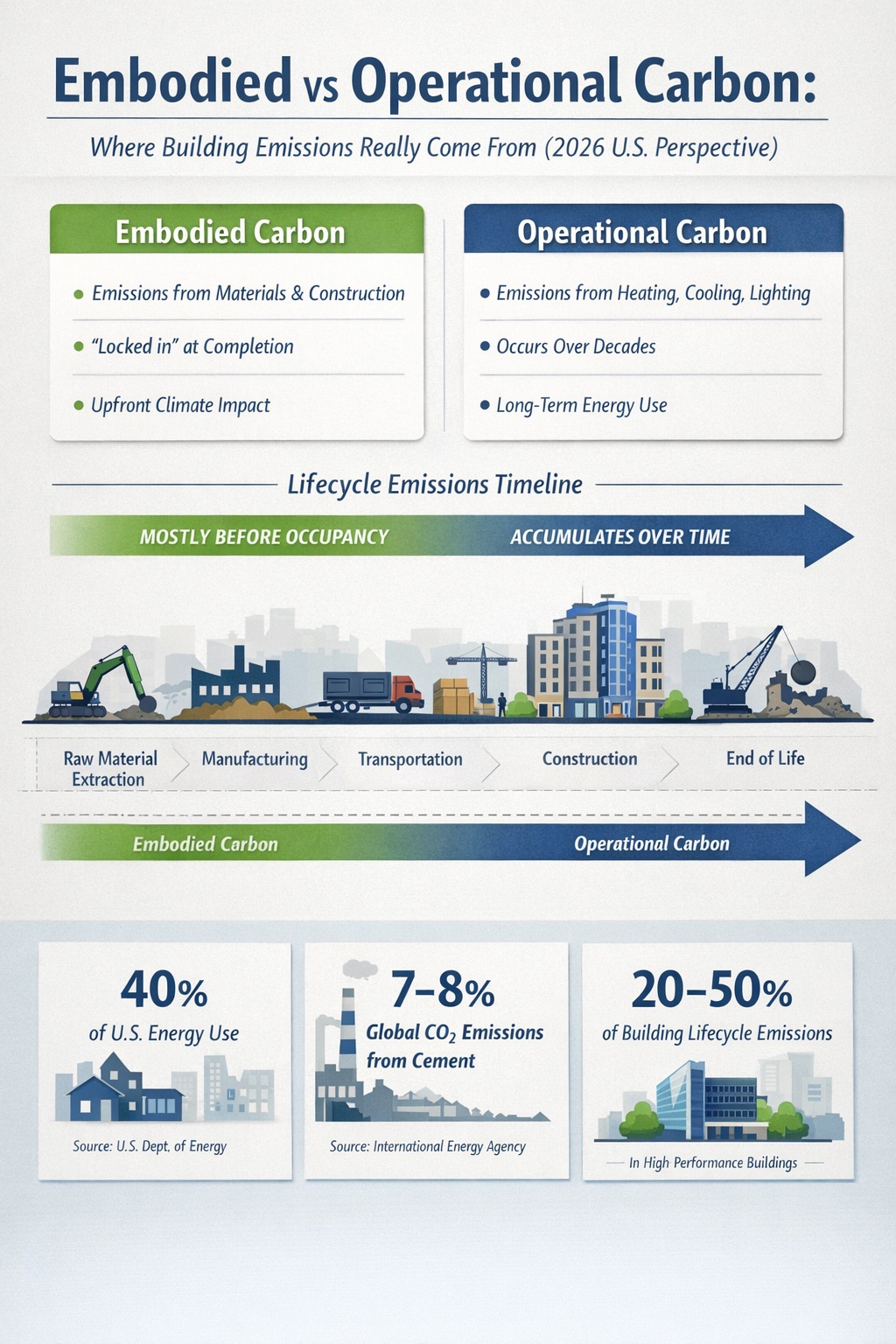
One of the biggest changes in sustainable construction this year is the shift from just focusing on making buildings energy efficient to actually accounting for the whole lifecycle carbon emissions of the building materials used. This is known as whole-life carbon accounting, and it’s really important because embodied carbon – the emissions from manufacturing, transporting and installing building materials – can account for 20-50% of a high-performance building’s total carbon emissions.
What is Embodied Carbon?
Embodied carbon is the bit of a building’s carbon footprint that you can’t avoid, no matter what you do. It’s the greenhouse gas emissions generated during the production and delivery of building materials – before the building is even occupied.
You might be thinking, “But what about operational carbon, which is all the emissions that come from heating, cooling, lighting and powering a building over time?” Well, embodied carbon is kind of the opposite of that – it’s the bit that’s “locked in” at the moment construction is completed, and it’s not going to change no matter how efficient the building becomes.
Here are the sources of embodied carbon:
- Harvesting raw materials (like mining limestone for cement, or cutting down trees for timber)
- Manufacturing and processing materials (like running cement kilns or steel furnaces)
- Transporting materials to factories and job sites
- On-site construction activities
- Replacement and maintenance over a building’s lifespan
- Even end-of-life demolition and disposal
Because these emissions happen upfront, they’re contributing to atmospheric carbon levels right away – which makes them especially important when it comes to our near-term climate targets.
Why Embodied Carbon is Getting Noticed in 2026
The thing is, as buildings become more and more efficient through things like stricter energy codes and better HVAC systems, operational emissions actually go down. And that means embodied carbon is now a much bigger part of the total carbon footprint of a building.
In fact, in high-performance buildings, embodied carbon can account for 20-50% of total emissions over a 50 year lifespan. Which is why architects and developers are now paying much more attention to embodied carbon and trying to reduce it in any way they can.
So what can they do? Here are a few strategies:
- Comparing the environmental impact of different materials using something called Environmental Product Declarations (EPDs)
- Choosing lower-carbon concrete mixes
- Specifying recycled-content steel
- Using mass timber where possible
- Building things to last so they don’t need to be replaced early on.
The key takeaway:
Embodied carbon is what we build with – it’s the emissions from the materials we use, not just the energy we use to power the building.
Why Concrete Is Getting Such A Hard Time
Cement production is chucking up about 7 to 8 percent of global CO2 emissions as a nasty little byproduct. In response, more and more U.S. construction projects are turning to:
- Stuff like Supplementary cementitious materials – (SCMs) to mix-in with their cement
- Micro silica to help make things stronger
- That’s got a lot of people looking at low-clinker “green” concrete blends
- Or carbon-injected concrete systems – which can suck a lot of the bad stuff out
Some states have actually passed laws called “Buy Clean policies” that include things like requiring builders to disclose how much carbon their materials are putting out, and that’s become a pretty big deal for government projects.
EPDs Start Getting Bumped Up As A Procurement Standard
Environmental Product Declarations (or EPDs) are getting a lot more use in commercial contracts – and that helps buildings get bonus points when it comes to things like LEED v4.1 (that’s a U.S. Green Building Council thing).
So by 2026 – it’s no longer just “cool” to ask for EPDs when you’re figuring out what materials to use – it’s standard in lots of big and important developments.
Building Electricity Heats Up, Fossil Fuels Get Left Behind
Another big deal in Sustainable Construction Trends for 2026 is just how fast Buildings are going electric.
Federal Incentives Start To Really Drive Things
The Inflation Reduction Act (IRA) is offering all sorts of incentives for people to switch to more efficient stuff like:
- High-efficiency electric heat pumps
- Heat pump water heaters
- Induction cooking systems
- Better insulation
And you know what – people are actually using those incentives. Heat pump sales have really taken off, some areas are seeing them sell even more than regular gas furnaces.
This whole thing also makes it look like we might actually make it to a carbon-free grid, without all those old combustion engines.
Energy Codes Are Getting A Lot Stricter All Over The Place
Nowadays, more and more places are making sure that energy performance is a big part of how buildings are rated.
You see, the International Energy Conservation Code (IECC) gets updated every three years, and lots of areas are now using the 2021 IECC standard (which says things like you have to have a tighter envelope on your building, seal up all the air leaks and use super efficient heating and cooling systems).
Some places actually reference ASHRAE 90.1 standards for their commercial buildings, but really – it all comes down to making the building as energy-efficient as possible.
And if you do that right – you can cut your heating and cooling bill by 20-40% depending on where you live.
Energy Use Intensity (EUI) Is Turning Out To Be A Big Deal
Energy Use Intensity is basically a fancy way of saying “how much energy does this building use” – and now more and more folks are tracking that number for their big commercial buildings.
Circular Construction And Getting Rid Of Waste
We’re talking about 600 million tons of construction waste in the U.S. every single year. So the Sustainable Construction Trends of 2026 are all about:
- Making a plan for how to manage all that waste on site
- Sorting through the materials as you go
- Building things in a factory (so you can just drop them in)
- Designing it so that you can take things apart and use them again.
And these days – it’s all about making things that don’t generate a lot of waste in the first place, not just recycling what you’ve already thrown away.
That’s all in line with things like ISO 14040 standards – which are all about looking at the whole lifecycle of a building.
Water Efficiency Is Starting To Matter
Water stress is a big deal in some parts of the country, and that’s making builders think harder about water use.
The EPA has a WaterSense program that gives a seal of approval to fixtures that use at least 20% less water than what the feds think is acceptable.
So by 2026, you’ll probably see a lot of buildings with things like:
- Toilets that only use 1.28 gallons per flush
- Showerheads that use 2 gallons per minute or less
- Smart irrigation systems that only water what needs it
Some cities are even starting to track Water Use Intensity (WUI) alongside Energy Use Intensity (EUI) – so you can see how well your building is doing on both fronts.
Climate Resilience Becomes Key Component of Sustainable Design
Sustainability is looking increasingly like climate adaptation in 2026.
Places that are vulnerable to wildfires, floods or scorching heat are starting to include:
- Fire-proofing in the exterior of the building to keep the flames out
- Building foundations high up in flood-prone areas
- Roofs that reflect the suns rays to keep a lid on urban heat island effects
- Strategies to keep buildings cool even when the power goes out
Keeping buildings at a safe temperature during power outages is getting to be a real concern during those extreme weather events – and that’s what passive survivability is all about.
As a result, insurance companies are getting in on the act by changing the way they price risk based on how resilient the building is.
Designing Buildings That Can Last – And Evolve
The idea that buildings last for decades with minimal upkeep is starting to become central to sustainable construction.
You see, changing out finishes every 10-15 years ends up increasing the carbon footprint – so now builders are starting to opt for:
- Flooring that can be refinished instead of replaced
- Panels on the facade that can be swapped out if needed
- Walls that can be taken out and put back in without a lot of fuss
- Wires and plumbing that make it easy to do retrofits in the future
By making buildings adaptable, you save on demolition costs and get to keep the value of all the materials over the years.
The Shift in Sustainable Construction Trends in 2026
2026 is the year that sustainability stops being a series of boxes to check off – or a marketing gimmick.
Now, the defining feature of Sustainable Construction in 2026 is measurement – and what that means is that it’s no longer just about:
- Slapping some eco-friendly materials on the building and calling it a day
- Getting a certification label and then calling yourself green
- Telling a story about being sustainable that just happens to be true
Sustainability is now all about real numbers – such as:
- How much carbon was used to make the building
- How much energy is it using each year
- How much water is it using
- How the total lifecycle cost of the building is going to shape up
- How it stacks up against the local energy codes
In 2026, all of these factors are going to be influencing how building owners make decisions – and it’s all about performance, data and staying on the right side of policy makers.
Frequently Asked Questions (And Some Helpful Info)
What Are The Most Important Sustainable Construction Trends in 2026?
The biggest trends of the year are going to be reducing embodied carbon, switching to electric power, even tighter energy codes, using reclaimed materials in construction, making buildings more resilient to the climate and tracking how buildings perform over time.
Why Is Embodied Carbon So Important in 2026?
As buildings get more efficient and use less energy, the carbon footprint of the materials themselves becomes a bigger and bigger share of the total impact – often up to 20-50% – which is why its so important to get the materials right in the first place.
How Are Federal Policies Impacting Sustainable Construction?
The Inflation Reduction Act is giving building owners incentives to upgrade to electric and energy-efficient systems, while state-level Buy Clean policies are requiring builders to reveal how much carbon is in the materials they use before they can work on government projects.