
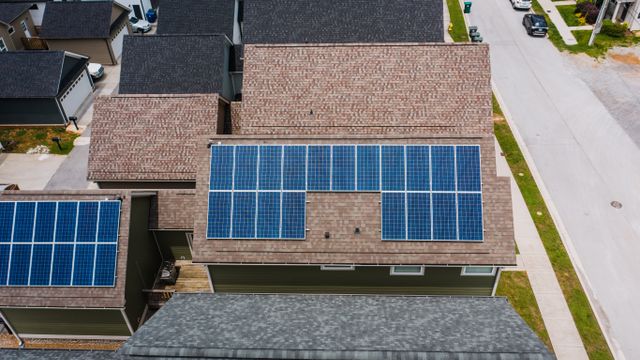

Community solar lets households and businesses receive electricity bill credits from a shared off-site solar array — no rooftop panels, no property modifications, and no upfront equipment purchase required. It is one of the most accessible pathways into renewable energy for the roughly 42% of U.S. households that cannot install rooftop solar due to renting, shading, structural limits, or lease restrictions, according to the National Renewable Energy Laboratory (NREL). Understanding who qualifies — and what common barriers actually do not apply — is the first step toward participation.
Why Community Solar Matters Environmentally
Community solar is not just a billing convenience. It is a meaningful tool in the transition away from fossil fuels. As of June 2024, more than 3,400 community solar projects are operational across 44 U.S. states, representing over 7.87 gigawatts (GW) of installed capacity — enough to power roughly one million homes, according to the U.S. Department of Energy.
Shared solar projects reduce dependence on fossil-fuel peaker plants — the gas-fired stations that grid operators switch on during peak demand. These plants are disproportionately located near lower-income communities and communities of color, contributing to localized air quality problems. By displacing peaker plant output, community solar delivers both carbon reductions and environmental justice benefits. The Solar Energy Industries Association (SEIA) notes that the model also builds a more distributed and resilient electric grid.
The U.S. added a record 1.7 GW of new community solar capacity in 2024, up 35% from 2023, according to Wood Mackenzie research cited by Environment America. Forecasts project more than 15 GW of additional capacity over the next five years, though continued state-level policy support will be essential to sustain that growth.
Core Eligibility: What Actually Matters
Eligibility for community solar is broader than most people expect. The central requirement is an active electric utility account within a participating utility territory. Program managers care primarily about:
Active billing account — the account must be in good standing, with a valid service address that matches the project’s utility territory. Credit checks are not universally required, and some state programs explicitly prohibit them. For most applicants, the first requirement is an active electric account within a participating utility territory. In the Oregon community solar program, subscribers receive credits from a shared project rather than a personal rooftop system. That arrangement makes the service address, billing history, and utility compatibility far more important than roof angle, homeownership, or available yard space during the review process.
Electricity usage history — subscription shares are typically sized to reflect a subscriber’s average monthly consumption. This keeps bill credits aligned with actual demand rather than over-allocating capacity.
Geographic service area — subscribers generally must live or operate within the utility territory linked to the shared project. Eligibility is tied to that utility relationship, not statewide residence alone.
Physical property characteristics — roof condition, sun exposure, structural strength, and ownership status are not eligibility factors. The panels are located elsewhere.
Renters and Homeowners Both Qualify
One of the most important distinctions between community solar and rooftop solar is that renters can participate. A subscriber does not need to own their home, control their roof, or seek construction approval. Residents of apartments, condominiums, duplexes, and homes under short-term leases are eligible in most programs, provided their utility account is active and their address falls within the project’s service territory.
Homeowners who face shading from trees, have aging roofing materials, or live under homeowner association restrictions that prohibit panels can also participate without any changes to their property.
Small Businesses May Also Be Eligible
Many programs extend eligibility beyond residential accounts to small commercial customers — shops, offices, and service businesses with predictable monthly electricity demand. Approval typically depends on meter type, usage history, and available subscription capacity within the project. Larger commercial accounts may face closer review, since project shares are usually calibrated to typical consumption levels.
Income-Qualified Households: Priority Access and Deeper Savings
Many community solar programs reserve a portion of capacity for income-qualified subscribers or weight their applications more heavily in enrollment queues. This reflects the fact that electricity costs consume a disproportionately large share of lower-income household budgets.
As of August 2024, 20 of the 24 states with community solar legislation have enacted specific provisions for low- and moderate-income (LMI) participation, including funding carve-outs and enhanced bill discounts, according to the Department of Energy. Enrollment under priority provisions may require documentation of household income, household size, or participation in a qualifying assistance program such as LIHEAP or SNAP.
For eligible households, participation can deliver bill reductions beyond the standard subscriber discount — in some state programs, LMI subscribers receive additional credits that further reduce energy burden.
How Bill Credits Actually Work
Community solar operates through a mechanism called virtual net metering (VNM). When the shared array generates electricity, those kilowatt-hours are credited to each subscriber’s utility bill in proportion to their subscription share. The credit appears as a line item on the monthly electric bill, reducing the amount owed.
Subscribers typically pay a slightly discounted rate for their allocated solar generation compared to the utility’s standard retail rate. According to NREL and DOE data, typical savings range from 5% to 15% off annual electricity costs — meaningful over time, particularly for households on fixed incomes.
One important distinction from rooftop solar: community solar subscribers do not receive the federal 30% Investment Tax Credit (ITC). That credit goes to the project developer, not the subscriber. Anyone comparing community solar to a rooftop installation should factor this into their financial analysis.
Contract Terms and Exit Conditions
Program terms vary significantly and deserve careful review before enrollment. While many programs offer straightforward month-to-month or short-term agreements, others use multi-year contracts — sometimes as long as 20 years. Some contracts include early termination fees if a subscriber exits before the term ends.
Applicants should ask specifically: How long is the contract? What are the cancellation terms? What happens if I move? What if the project underperforms? Getting clear written answers to these questions is more reliable than general assurances in marketing materials.
What Can Block or Delay Enrollment
Broad eligibility does not guarantee immediate acceptance. Common reasons for delays or denials include:
Closed or inactive accounts — credits cannot be applied to an account that is not in active billing status.
Address mismatch — the service address must fall within the project’s utility territory; adjacent territories do not qualify.
Full project capacity — many programs operate waitlists, and popular projects fill quickly. In oversubscribed markets, timing rather than applicant quality becomes the deciding factor.
Credit allocation limits — some programs cap the percentage of a subscriber’s total usage that can be covered by community solar credits.
How to Find Programs in Your State
Community solar availability varies by state. The following neutral, non-commercial resources can help identify open programs and compare terms:
The Department of Energy Community Solar Finder provides state-by-state program information and links to utility program pages.
The Database of State Incentives for Renewables & Efficiency (DSIRE) lists active state policies and programs, including community solar enabling legislation and LMI provisions.
Your state’s public utility commission (PUC) website is the authoritative source for approved programs, rate structures, and subscriber protections in your area.
Checklist Before You Enroll
Before signing up for any program, confirm these five points:
- Your utility account is active and the service address falls within the project’s territory.
- You understand the subscription size relative to your average monthly electricity use.
- You have reviewed the full contract length and any early termination conditions.
- You know when credits will begin appearing on your bill and how they are calculated.
- You have checked whether income-based priority access applies and whether you qualify.