

Modular foundation systems change how construction addresses resource management and building longevity. These prefabricated components help reduce material waste during installation, accommodate site-specific challenges and enable high-value material recovery when structures reach end-of-life. The importance of these systems cannot be understated, especially with regards to how they benefit the circular economy.
What Are Modular Foundation Systems?
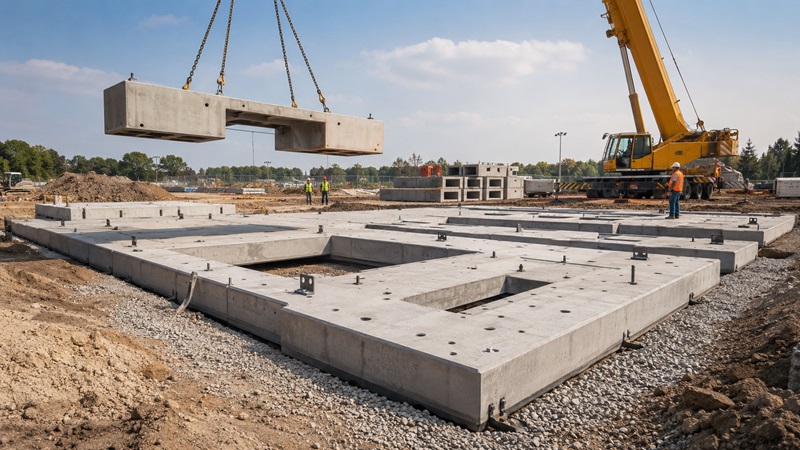
Modular foundation systems are ready-made base parts for buildings. They are made before they reach the job site. Builders do not pour each footing, wall, or support on site. They set factory-made parts in place.
These parts can include concrete panels, steel screw piles, helical piles, ground beams, frames, and removable bases. The best choice depends on the building, soil, weight, and length of use.
The main gain is control. The base is not one large mass of mixed material. It is a set of planned parts.
That makes the work easier to manage. It also gives builders better options later. They can fix, reuse, or recover parts. They do not have to break up the whole base. This helps the circular economy. A foundation is not just a fixed base under a building. It can be part of a wider material cycle.
With the right plan, each part can be tracked and cared for. It can also be changed or removed when the building reaches the end of its life.
How Modular Foundations Support Circular Construction
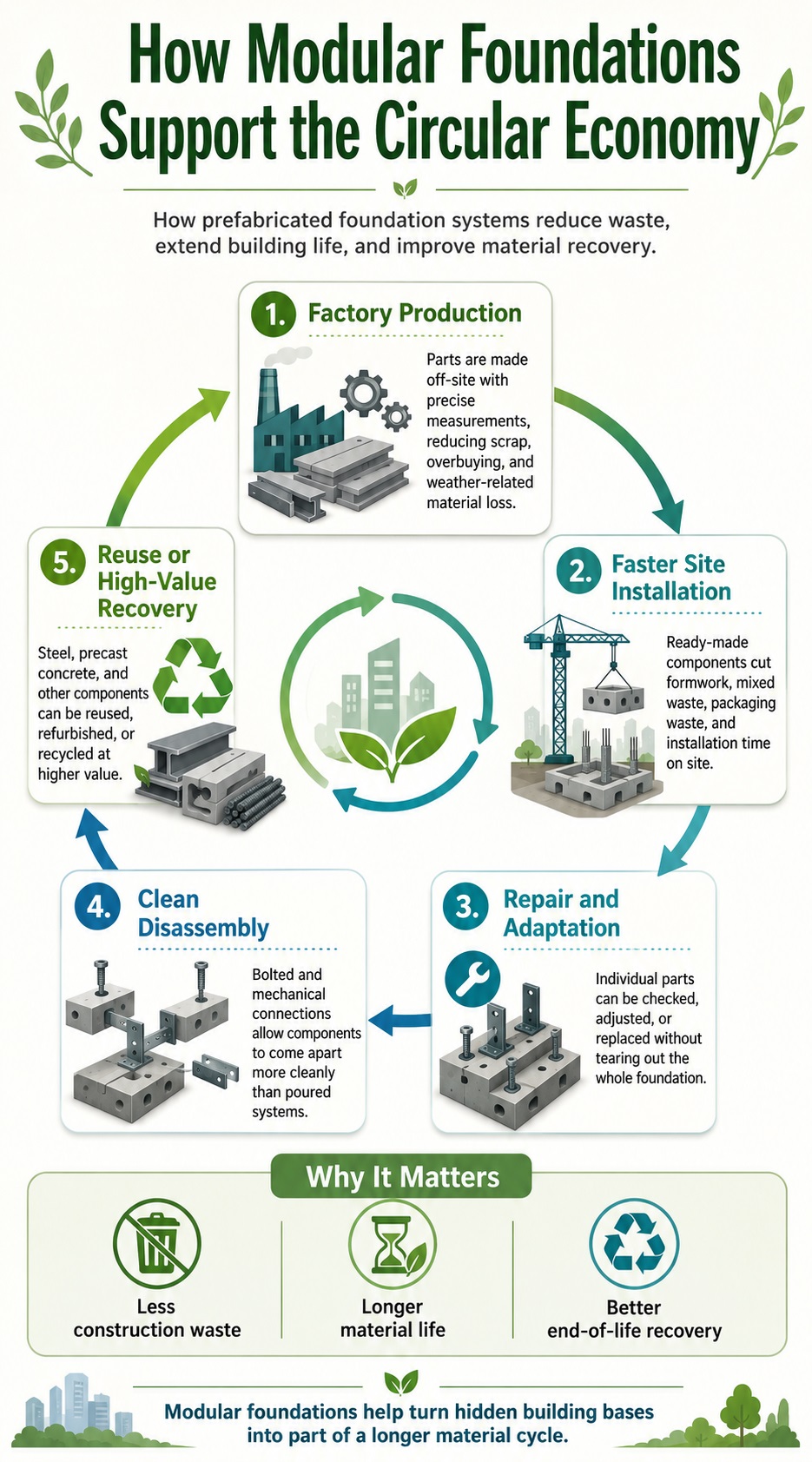
Circular construction means less waste. It keeps materials in use for longer. It also saves value when a building is changed or taken apart. These systems help with this. Their parts are easier to plan, check, fix, and remove than many poured bases.
The value starts in the factory. Factory work can reduce extra cutting, overbuying, weather damage, and wasted material.
On site, ready-made parts can cut formwork, mixed waste, packaging, and long install times. During the building’s life, these systems can make repair easier. If one part is damaged, builders can check it. They can adjust it or replace it. They do not need to break up the whole base. That helps the building last longer. It also reduces the need for large tear-down work.
The biggest gain comes at the end of the building’s life. Parts joined with bolts or brackets can come apart more cleanly than poured concrete or glued layers. If the parts stay in good shape, they can be used again. They can also be rebuilt or recycled at a higher value.
In simple terms, these systems help construction waste less. They keep useful materials in use for longer, even in the hidden base of a building.
These advantages and benefits begin with how the modular systems themselves are manufactured and produced:
1. Efficient Use of Building Materials
Off-site fabrication in controlled factory environments allows modular foundation production to achieve material efficiency levels that traditional on-site methods cannot match. Automated manufacturing processes measure, cut and assemble components with precision that minimizes scrap. Computer-controlled equipment follows exact specifications and eliminates overordering and excess cutting.
Factory settings protect materials from weather exposure and site contamination. Rain-soaked lumber, corroded steel and damaged concrete panels create waste before installation even begins on conventional projects. Having climate-controlled facilities can prevent these losses entirely.
Industry stakeholders recognize this potential. A survey revealed that 80% of respondents believe increased automation holds significant positive potential for construction. Half of the surveyed manufacturers identified concrete prefabricated elements as the greatest opportunity for improving material efficiency. This consensus reflects direct experience with waste reduction through precision manufacturing in the circular economy in construction.
Engineering Factors That Decide Whether Modular Foundations Work
Modular foundations only work when the design is safe. A base is not green if it cannot hold the building well. Soil strength comes first. Engineers need to know if the ground can hold the load. They also need to know how the soil will act over time.
Clay soil, loose fill, wet ground, frost, and soft spots need close checks. These site risks can affect the type of modular base used. Water control also matters. Foundations face water, soil pressure, and heat and cold for many years.
The parts must fit well. Joints, seams, and link points need clear detail. Weak spots can let water in or cause slow damage. Load is another key point. A house, shop, shed, and plant building do not place the same stress on a base. The system must hold weight from above. It must also handle side force, wind, and ground shake in some areas. The way the parts join together is just as important. Bolts, plates, brackets, joints, and support faces must be strong. At the same time, workers need to reach these parts. They must be able to check, adjust, or remove them later.
That balance matters. It helps the base stay safe. It also lets crews recover useful parts at the end of the building’s life. Modular foundations work best when teams plan them early. Soil tests, load checks, water control, and local codes still guide the final design. Circular building does not replace good engineering. It depends on it.
2. Streamlined Project Timelines
Modular foundation systems compress construction schedules through parallel workflows. While site crews excavate and prepare the building pad, factory teams simultaneously fabricate foundation modules to project specifications. This concurrent activity eliminates the sequential delays inherent in traditional construction.
Transportation logistics become simpler when prefabricated modules arrive on predetermined schedules, reducing the staging space needed for storing raw materials and the equipment required for on-site mixing and forming. Installation crews can connect pre-engineered components instead of building from scratch.
The amount of time saved is substantial. Volumetric modular construction can shorten timelines by 50% through decreased on-site work and the number of redesigns and overruns typical in traditional construction. Faster completion means reduced equipment rental costs, shorter financing periods and earlier revenue generation for developers.
3. Adaptive and Resilient Infrastructure
Engineering modular foundations for adaptability distinguishes them from rigid poured-in-place alternatives. These systems accommodate soil movement, settlement patterns and changing structural loads without catastrophic failure or complete replacement.
Component-based design allows targeted interventions when site conditions change. If a differential settlement affects one section of a foundation, crews can adjust or replace specific modules rather than demolishing and reconstructing entire footings. Engineers can easily modify modular systems by adding slip joints to increase tolerance for soil movement.
This flexibility extends the functional lifespan of buildings. Modular structures can respond to environmental changes, load redistributions from tenant improvements or updated seismic requirements through component-level modifications. Meanwhile, traditional foundations require costly underpinning or abandonment when conditions exceed original design parameters.
Lifecycle Carbon Benefits Beyond Waste Reduction
Less waste is only one benefit of modular foundation systems. These systems can also help cut carbon. This matters most when they reduce the need for new concrete, steel, and other high-impact building materials.
Concrete and steel are common in modern building work. Both also have a high carbon cost. Cement needs very high heat during production. It also releases carbon when clinker is made.
Steel also needs a lot of energy to produce. Still, steel has one clear strength. It can be recycled many times. Modular foundations can lower this impact in a few ways.
First, factory-made parts use more exact material amounts. Each part is made to fit a set design. This can reduce extra material, waste, and overbuilt sections.
Second, modular systems can help a building last longer. A foundation that can be adjusted, strengthened, or partly replaced gives the building above it more useful life. That matters for carbon. Keeping a building in use often saves more carbon than tearing it down and building again too soon.
Third, modular systems can be designed to come apart. This helps protect the carbon already stored in the materials.
A precast concrete panel or steel part often keeps more value when reused. Crushing, melting, or replacing it usually loses more of that value.
In this way, modular foundations support both reuse and lower carbon. They help builders use fewer new materials while keeping existing materials useful for longer.
4. Simplified Disassembly and Material Recovery
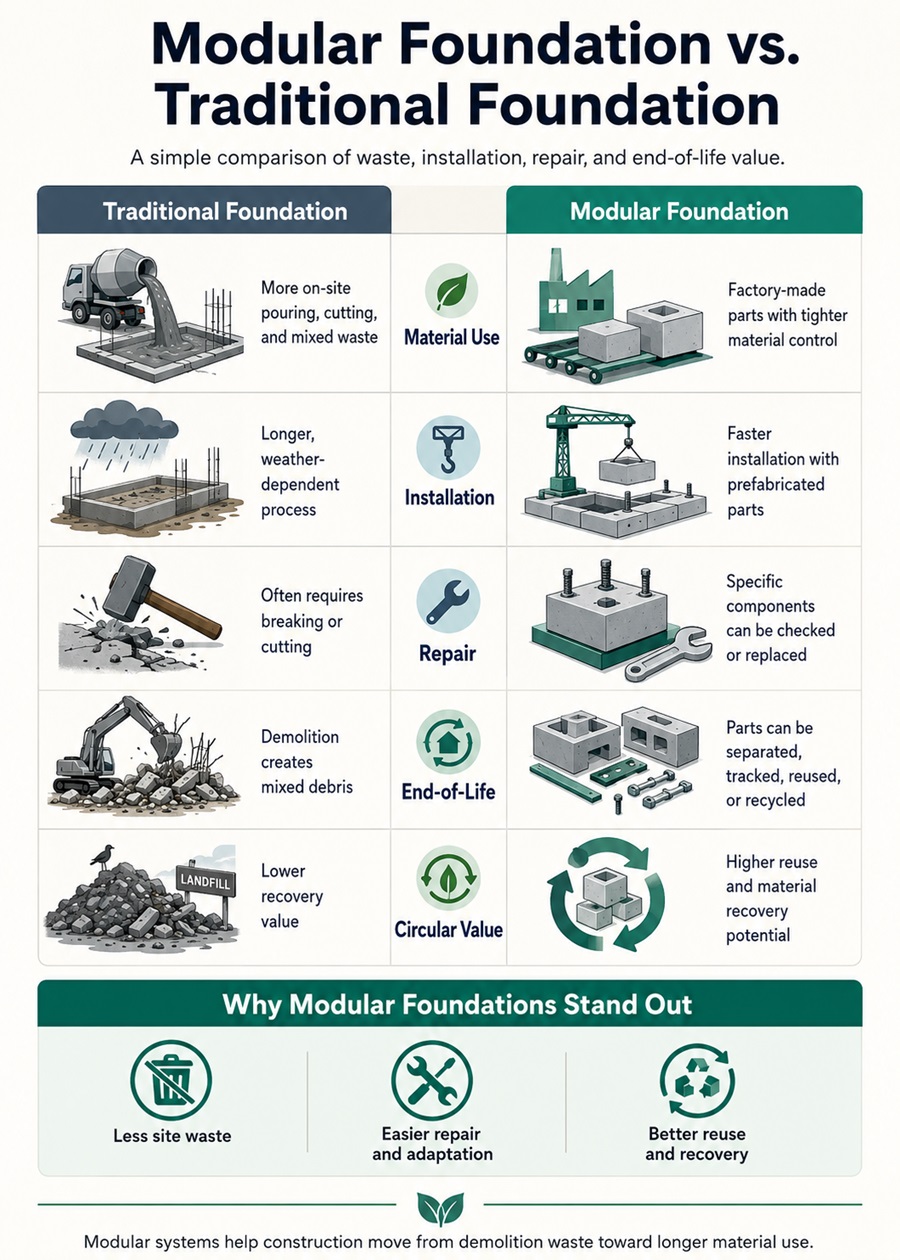
Design for disassembly stands in direct opposition to conventional demolition practices. Traditional buildings fuse materials through chemical bonds, poured connections and permanent adhesives. Removing one component also damages adjacent elements, creating mixed waste streams with limited recovery value.
The scale of demolition waste demands attention. Data from the Environmental Protection Agency shows that demolition accounts for over 90% of all construction and demolition debris. While over 455 million tons are directed to next use, nearly 145 million tons still end up in landfills. Modular foundations offer a path toward reversing this ratio.
Design for Disassembly in Practice
Modular components use mechanical fasteners rather than chemical bonds. Bolted connections and interlocking joints allow workers to cleanly separate elements. Each component comes apart in reverse order of assembly, with no cutting, crushing or contamination involved.
Manufacturers increasingly catalog materials during production, creating digital records of every steel grade, concrete mix design and coating specification. When buildings reach end-of-life decades later, deconstruction teams know exactly what they’re recovering. This documentation transforms demolition from waste generation into inventory management.
High-Value Material Reclamation
Intact recovery preserves material quality and economic value. Steel beams removed from modular foundations retain their structural integrity and can be immediately used to support new construction. Precast concrete panels can retain their strength and finish for direct reuse rather than downcycling into aggregate.
The financial advantages of preservation become clear when comparing market values. Research shows that reusing precast concrete elements can significantly reduce the carbon footprint compared to producing new materials. Both intact concrete panels and structural steel components command substantially higher prices than their recycled or scrap equivalents. Design for disassembly captures this premium by delivering materials in reusable condition.
Real-World Examples of Circular Design
A vast array of projects have already begun to benefit from the implementation and integration of these sustainable construction practices. In particular, two projects across Europe demonstrate how design for adaptability and material recovery function in practice, moving circular principles from theoretical models to large-scale implementation.
The Olympic Village in Saint-Denis
Designers engineered the Olympic Village in Saint-Denis for transformation from athlete housing to permanent residential and commercial use. Modular systems specified for the project allow reconfiguration without demolition, enabling the development to serve multiple functions across its lifespan. The project demonstrates how temporary structures can avoid becoming waste through intentional planning for future adaptation.
The Triodos Bank Headquarters
The Triodos Bank headquarters in the Netherlands took demountability to its logical conclusion. Every component was selected for future disassembly, with a complete materials passport documenting specifications and locations. When the building eventually reaches the end of its life, the catalog will guide the systematic recovery of high-value elements for redeployment in new projects.
Limits and Trade-Offs of Modular Foundation Systems
Modular foundation systems have clear circular benefits. Still, they are not right for every project. Their success depends on the site, building load, design work, and crew skill.
Some sites have hard soil problems. Wet ground, loose fill, clay, steep slopes, and heavy loads can limit the use of modular systems. In these cases, a project may still need deep foundations, poured concrete, or a mix of both.
Transport is another issue. Large factory-made parts must move from the plant to the site. Long travel, heavy loads, or special handling can reduce cost and carbon gains.
Good design also matters. Modular systems need exact sizes, clear joint points, and the right install order. Bad site surveys or poor planning can cause delays. Factory-made parts are not always easy to change on site.
Reuse also needs a real market. A part can be made to come apart, but it only has circular value if someone can check it, approve it, sell it, or use it again. Without clear records or local recovery routes, parts can still lose value. Some may be crushed, recycled at low value, or sent to landfill.
These limits do not make modular foundations weak. They make the case more honest. These systems work best on the right project, with the right design, the right site checks, and clear records across the building’s life.
The Future of Sustainable Foundations
Modular systems demonstrate an evolving relationship between construction and resource stewardship. By treating buildings as material banks rather than permanent fixtures, these foundations advance the circular economy in construction through closed-loop practices. And in the construction field specifically, achieving these sustainable goals is always a top priority that needs to be aimed for.
The transition from disposal to recovery fundamentally alters how the industry values materials across a building’s entire life cycle, and the long-term sustainable benefits speak for themselves.