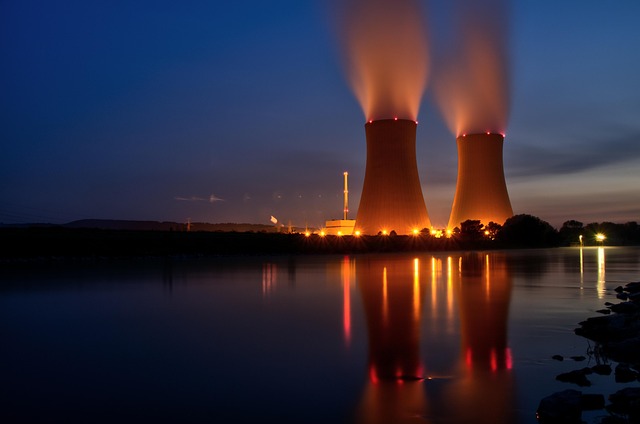

Quick Answer: Are nuclear power plants safe?
Yes, modern nuclear power plants are generally safe when they are well designed, strictly regulated, and run by skilled operators. That does not mean nuclear power is risk free. It means the whole system is built to keep the chance of a serious accident very low through multiple safety layers, constant inspections, backup systems, and emergency planning.
In the United States, the Nuclear Regulatory Commission does not treat safety as a vague promise. It uses clear public-risk goals, including a standard that the risk of cancer fatalities to people living near a normally operating plant should stay below 0.1 percent of the total cancer fatality risk from all other causes.
That is the right way to frame the question. Nuclear power is not perfectly safe, and no major energy source is. The more useful question is whether nuclear plants can operate with very low public-health risk, and how that risk compares with coal, gas, hydropower, wind, and solar. On that broader comparison, nuclear performs much better than many people assume.
Why This Question Still Matters
People keep asking whether nuclear power plants are safe because the risks feel different from other energy risks. Coal pollution is deadly, but it is spread out and familiar. Nuclear accidents are rare, but when they happen, they stay in public memory for decades.
That fear is not irrational. It reflects the fact that a nuclear accident can be severe, even if the odds are low. It also explains why nuclear power is regulated so heavily. Plants are not allowed to rely on one good machine or one smart operator. They are built around the idea that equipment can fail, people can make mistakes, and outside events can test the system.
The question matters even more now because nuclear power is back in the middle of energy policy. Governments want reliable low-carbon electricity. Power demand is rising. Advanced reactors and small modular reactors are moving from theory toward deployment. In the United States, the NRC finalized its Part 53 framework in March 2026, giving advanced reactors a risk-informed licensing path that does not force every new design into older regulatory models.
So this is no longer only a question about the old reactor fleet. It is also a question about whether the next generation of nuclear plants will be safer, simpler, and easier to manage.
What “Safe” Means in Nuclear Power
In nuclear power, safe does not mean nothing can go wrong. It means the plant is built and operated so that public risk stays very low even when something goes wrong.
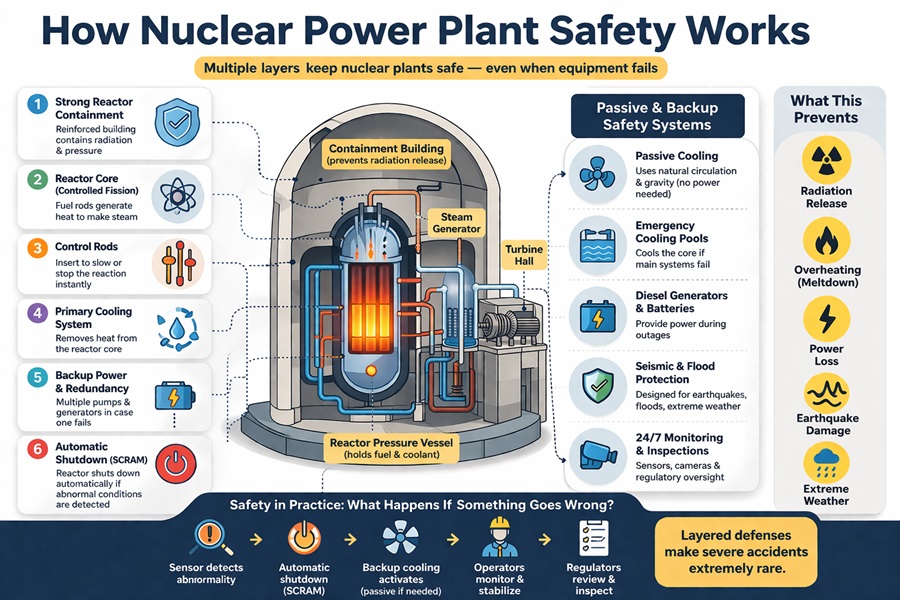
That is why the industry uses the idea of defense in depth. Instead of trusting one barrier, one pump, or one operator decision, nuclear plants use layers of protection. If one layer fails, another is there to help stop the problem from growing.
In practice, that includes reactor shutdown systems, backup power, backup cooling, containment structures, trained operators, emergency procedures, security systems, inspections, and regulatory oversight. The point is simple. Nuclear safety is not one feature. It is a system.
What Is a Nuclear Reactor?
A nuclear reactor is the part of the plant where atoms are split in a controlled process called fission. That process releases heat. The heat makes steam, the steam spins a turbine, and the turbine generates electricity.
The reactor is not the whole power plant. It is the core energy-producing part inside a much larger site that includes cooling systems, safety equipment, control rooms, containment structures, and support systems. Many readers use reactor and plant as if they mean the same thing, but they do not.
How Nuclear Plant Safety Works in Practice
A modern nuclear plant is considered safe because it is designed on the assumption that problems can happen. The goal is to prevent trouble, detect it fast, and keep it from turning into a larger event.
That system usually depends on a few core parts.
Reactor control. The plant must be able to slow or stop the fission process fast if conditions move outside safe limits. Automatic shutdown systems are central to that.
Cooling after shutdown. Even after the chain reaction stops, the reactor still produces decay heat. That heat has to be removed. Loss of cooling is one of the most serious accident pathways in nuclear energy, which is why backup cooling matters so much.
Containment. Plants use strong physical barriers to keep radioactive material from escaping into the environment.
Operator performance and emergency planning. Safety depends on people as well as hardware. Training, drills, communication systems, inspections, and coordination with outside authorities all matter.
This is one of the most important points in the article. Nuclear safety does not come from one machine or one promise. It comes from engineering, procedures, oversight, and preparation working together.
How Modern Reactors Reduce Risk
Modern reactor designs try to lower risk in two ways. They aim to make severe problems less likely, and they aim to make those problems easier to control if they happen.
One major change is the growing use of passive safety features. These systems do not depend as heavily on powered equipment or immediate human action. Instead, they rely on built-in physical forces such as gravity, natural circulation, or pressure differences to help keep the reactor stable.
Advanced designs also tend to use simpler layouts, smaller reactor sizes, and design choices meant to improve fault tolerance. Small modular reactors, or SMRs, are often discussed this way. Their smaller cores and simplified systems are intended to support safer behavior during abnormal conditions.
That needs a clear qualifier. These are design advantages, not a free pass. Safety is not proven by concept art or marketing claims. It is proven through licensing, construction quality, operator performance, inspections, and real operating history over time.
What History Shows
The history of nuclear power rejects two bad arguments. It does not support the idea that nuclear plants are always close to disaster. It also does not support the idea that major accidents do not matter because they are rare.
A more honest reading is this. Serious accidents are uncommon, but when they happen, they change the industry.
Three Mile Island, Chernobyl, and Fukushima did exactly that. They led to harder scrutiny of plant design, emergency planning, operator performance, reporting, inspection practices, and accident analysis. In the United States, the NRC says these events helped drive changes such as resident inspectors at each plant, stronger emergency preparedness, broader public performance reporting, and greater use of risk-informed oversight.
That record matters because nuclear safety is not static. It is shaped by engineering, regulation, safety culture, and lessons learned from failure.
What Causes Severe Nuclear Accidents?
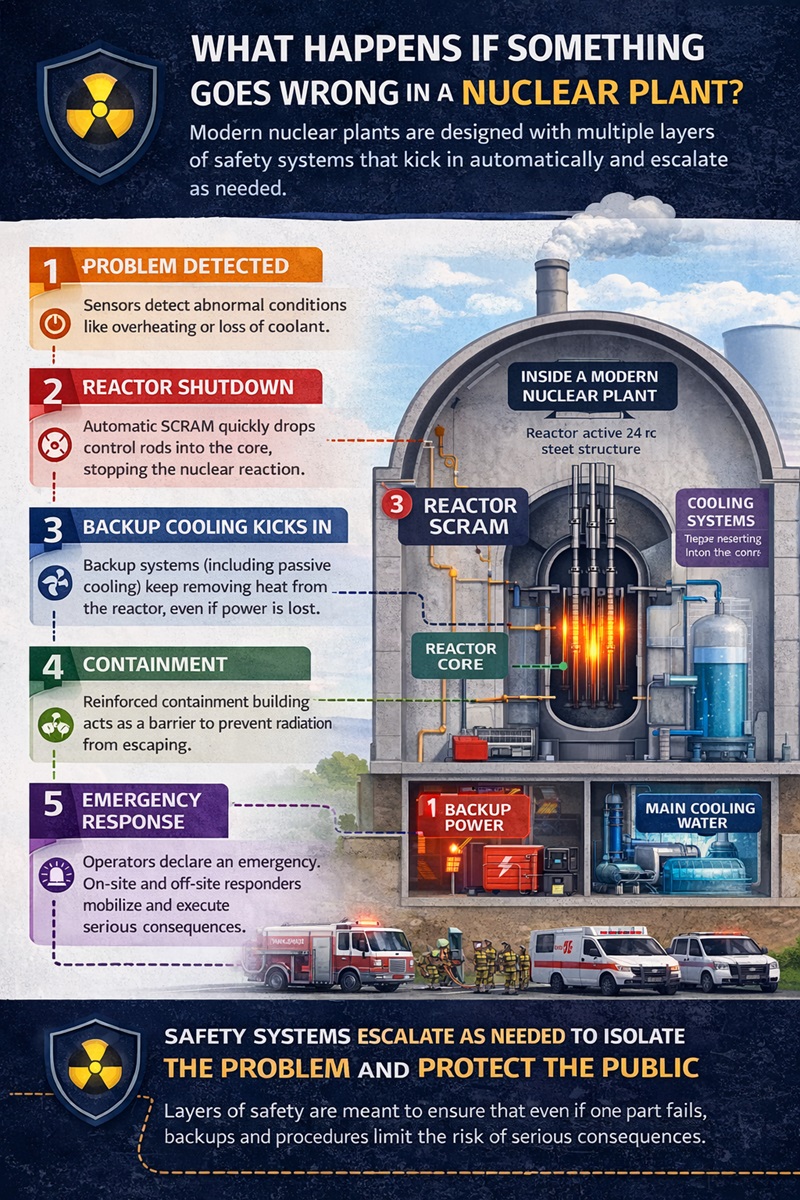
Severe nuclear accidents usually do not come from one simple error. They tend to grow out of a chain of failures.
That chain can include loss of cooling, loss of electrical power, flawed design assumptions, operator error, weak safety culture, or extreme outside events that push the plant beyond what it was built to handle.
This helps explain why modern nuclear safety puts so much weight on redundancy, backup power, severe accident planning, passive cooling, and independent oversight. The system is built to stop one failure from turning into a cascade.
Is It Safe to Live Near a Nuclear Power Plant?
Under normal operation, regulators set a very strict standard for public safety near nuclear plants. In the United States, the NRC says the risk of cancer fatalities to people living near a normally operating plant should not exceed 0.1 percent of the total cancer fatality risk from all other causes.
That does not mean zero risk. No industrial site offers zero risk. It means normal operations are supposed to keep public exposure and public-health risk extremely low.
This is where public perception often breaks from technical reality. Many people hear the word radiation and picture constant danger. In practice, routine plant operations are tightly monitored and regulated. Nearby community safety also depends on emergency planning, drills, communication systems, and coordination with local and state authorities.
Some people still will not feel comfortable living near a plant, and that response is understandable. But from a regulatory and technical standpoint, modern plants are built around keeping normal-operation risk very low.
Security, Cyber Risk, and Extreme Events
For many readers, safety includes more than reactor operations. It also includes sabotage, cyber threats, terrorism, and extreme outside events. That is a sensible way to think about it.
In real life, people do not separate safety from security. They care about both.
Modern nuclear oversight covers physical security requirements, design-basis threats, and rising attention to cybersecurity and site resilience. This matters because a nuclear plant is not judged only by how it performs on a normal day. It is also judged by how well it can withstand rare shocks and intentional threats.
That is another reason nuclear safety should be described as a full governance system, not just an engineering claim.
What About Nuclear Waste?
Nuclear waste is one of the biggest reasons many people hesitate to call nuclear power safe. That concern is fair. Spent fuel remains hazardous and has to be stored and managed carefully for a very long time.
It helps to separate two different questions. One is whether a plant can operate safely day to day. The other is whether a country has a durable long-term disposal plan. Those questions are related, but they are not the same.
On the nearer-term safety issue, spent fuel pools and dry cask storage are designed to protect workers, the public, and the environment. The harder issue is long-term disposal. In the United States and several other countries, that part of the story is still politically and legally unsettled.
The most accurate answer is simple. Nuclear waste is handled more safely than many people assume, but long-term disposal remains one of the industry’s hardest unresolved public-policy problems.
How Nuclear Compares With Coal, Gas, and Renewables
This is where the safety debate gets more grounded.
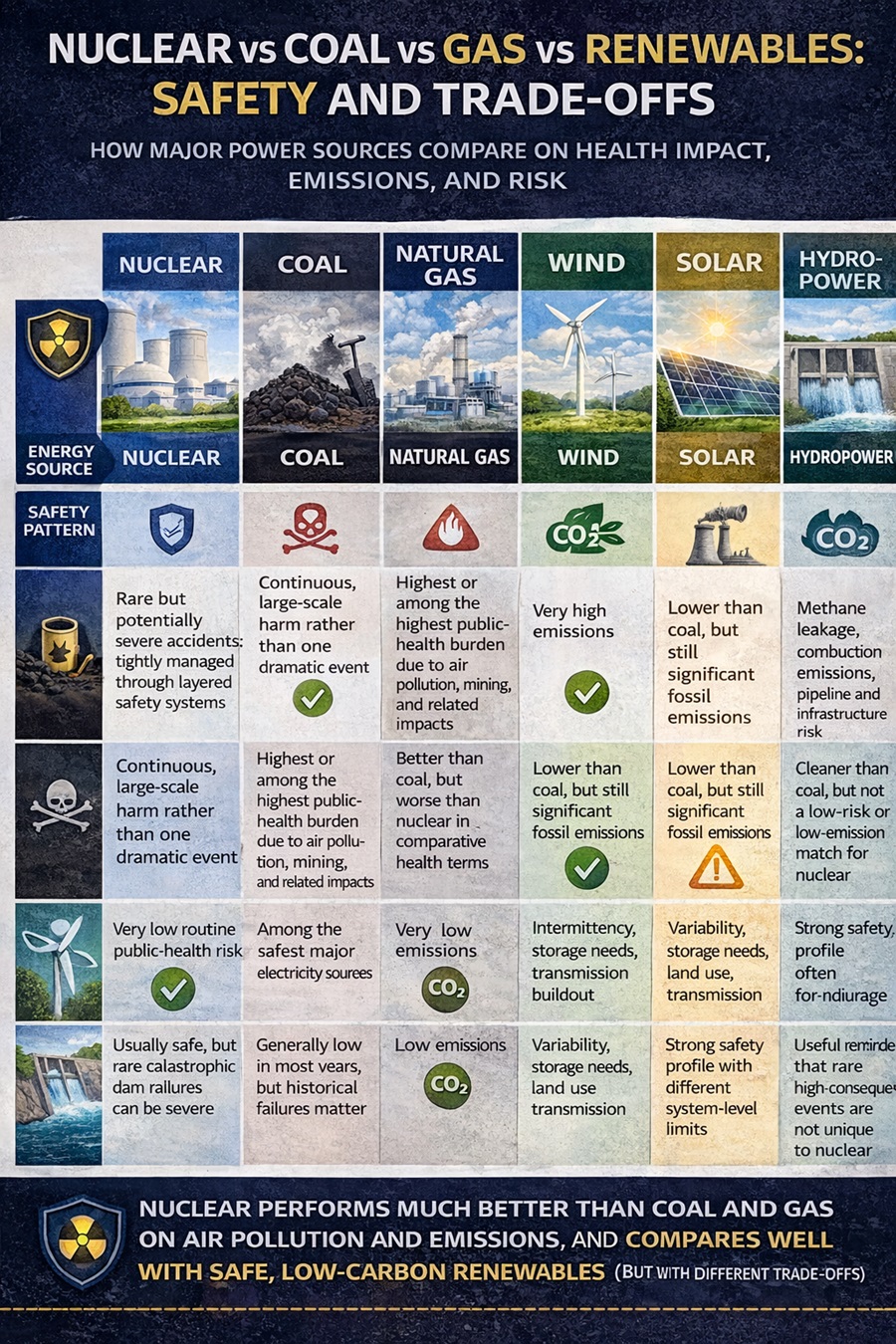
Nuclear’s defining fear is the rare but severe accident. Fossil fuels create a different pattern of harm. Coal and gas cause damage through air pollution, extraction risks, and greenhouse gas emissions over time. Those harms often feel less dramatic than a reactor accident, but they are not smaller.
Comparative energy data has repeatedly shown that coal is among the deadliest major electricity sources per unit of power produced, while nuclear is among the lowest. Wind and solar are also very low.
Coal is the weakest argument against nuclear safety. Its damage rarely comes in one unforgettable event. It comes in steady, large-scale harm from pollution, mining, and emissions. Gas does better than coal on many measures, but it still carries combustion emissions, infrastructure risk, and a weaker public-health profile than nuclear.
Renewables are a more balanced comparison. Wind and solar are also very safe in public-health terms, and they do not create high-level radioactive waste. At the same time, they bring different grid issues around variability, storage, and transmission. That is why nuclear and renewables are often discussed as complements rather than opposites.
Hydropower adds another useful reminder. It is usually very safe, but history includes catastrophic dam failures. That does not make nuclear automatically better. It shows that rare, high-consequence events are not unique to nuclear energy.
The strongest conclusion is this. Nuclear is not uniquely safe, but it is not uniquely dangerous either. Compared with coal and gas, it performs much better on air pollution and emissions, and it compares well in deaths per unit of electricity. Compared with wind and solar, it stays low carbon but comes with different trade-offs around waste, cost, and accident perception.
Are All Nuclear Plants Equally Safe?
No. Nuclear safety is not the same everywhere.
A plant’s safety depends on reactor design, plant age, maintenance quality, operator performance, site conditions, safety culture, and the strength of the regulator. A well-run plant in a mature regulatory system is not the same risk story as a badly governed plant with weaker oversight.
That nuance matters because it keeps the article honest. Nuclear safety is not automatic. It depends on institutions as much as on hardware.
Latest Developments in 2025 and 2026
Recent policy changes show that nuclear safety is not standing still.
In March 2026, the NRC finalized Part 53, a risk-informed and technology-inclusive framework for advanced reactors. That is a meaningful shift because it gives future reactor designs a regulatory path built around their actual risk profile instead of forcing them into rules written for older light-water systems.
Internationally, the IAEA reported continued momentum around advanced reactors and small modular reactors in its 2025 safety review. The agency also stressed that safety and security need to be built into these designs early, not added later.
The broader electricity picture helps explain why this matters. Nuclear remains part of long-term planning because countries want low-carbon electricity that is not dependent on weather conditions alone. So the current nuclear safety debate is not only about legacy plants. It is also about how new reactor types will be reviewed, licensed, built, and watched.
The Bottom Line
So, are nuclear power plants safe?
Yes, modern nuclear power plants can be considered safe when they are well designed, tightly regulated, competently operated, and continuously inspected. That is a strong conclusion, but it is not a casual one.
Nuclear plants are not risk free. Severe accidents are rare, but history shows they still matter. Waste management is technically serious and politically difficult. Security, emergency planning, and strong institutions remain essential.
But the evidence does not support the idea that nuclear power is uniquely reckless or impossible to control. In mature regulatory systems, plants operate under strict public-risk goals, layered protections, and a safety culture shaped by decades of post-accident learning. Compared with fossil fuels, nuclear performs far better on air pollution and carbon emissions. Compared with wind and solar, it is also low carbon, but it comes with a different set of trade-offs.
That makes nuclear safety less a simple yes-or-no issue and more a question of which risks a society is prepared to manage. On the headline question, though, the answer is clear. Modern nuclear power plants are much safer than public memory often suggests, even though they still require serious oversight and constant discipline.
FAQ
Are modern nuclear power plants safer than older ones?
In general, yes. Newer reactor designs are being built with features such as passive safety systems, smaller reactor sizes, and alternative fuels or coolants meant to improve safety performance. Those design gains still need to be proven through regulation, construction quality, and real operating experience.
Is it safe to live near a nuclear power plant?
Under normal operation, public risk is required to remain very low. In the United States, the NRC uses explicit safety goals for nearby communities, and plants rely on monitoring, inspections, design controls, and emergency planning to meet them.
What is the biggest safety concern with nuclear power?
The biggest concern is the possibility of a severe accident tied to loss of cooling, power failure, human error, design weakness, or extreme outside events. Long-term waste management is also a major concern.
Are spent fuel pools and dry casks safe?
They are designed for safe storage of used nuclear fuel under strict controls. That does not settle the long-term disposal debate, but it does mean interim storage is managed with strong technical safeguards.
Are advanced reactors and SMRs changing the safety debate?
Yes. They are shifting the discussion toward passive safety, smaller reactor designs, and more design-specific regulation. The key question now is not just whether these ideas look safer on paper, but how they perform once licensed, built, and operated.