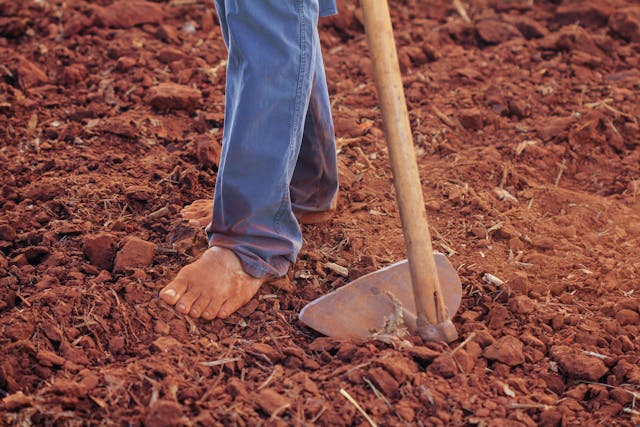

If you want to fix a piece of land, stop looking at it like a flat map. It is much better to see it as a deep, three-dimensional box that needs filling. Most people think saving the environment is only about the green stuff, like leaves and birds. Those are just the ornaments. The foundation is the soil.
If you do not have the volume, the rest is just window dressing. It is like trying to build a skyscraper on a sheet of cardboard. If we are actually serious about global restoration, we have to treat soil as a primary, measurable resource. Most of us look at a forest and see trees. I look at it and see a massive, three-dimensional engineering project. We get caught up in the feel-good side of planting saplings, but we forget that these plants are essentially living machines. They need a specific amount of fuel and room to function. If you try to fix a patch of land by just scratching the surface, you are setting those plants up for failure. Real restoration requires us to think about the payload. We are moving tons of life-sustaining material to rebuild a broken system. When you look at it that way, a pile of compost is not just waste. It is the raw material for a new world.
The 2500 Billion Ton Vault
There is one specific number that puts the entire climate conversation into perspective: 2,500 billion tons. That is the amount of carbon currently tucked away in the Earth’s soil. To be clear, that is roughly three times the amount of carbon currently floating in our atmosphere. When people talk about planting trees to save the climate, they usually focus on the wood and the branches. But the real, heavy-duty carbon vault is the ground itself.
When we scrape away topsoil to build a new road or a housing development, we are not just moving dirt. We are cracking open a massive vault and letting all that stored carbon leak into the sky. Restoration has to be more than just sticking a sapling in a hole. It is about rebuilding that physical volume of soil so the land can actually do its job and suck that carbon back down. If there is no depth, there is no storage. Research from the United Nations Environment Programme makes it obvious that bringing life back to our soil could offset a huge chunk of our annual greenhouse gas emissions. It is about the physical space. If we do not protect the volume, we lose the vault.
This is not just a theory. When topsoil is lost, the land becomes a source of carbon instead of a sink. We see this in industrial farming zones where the soil has been turned into a gray, lifeless powder. To fix this, you have to literally add mass back to the land. You have to rebuild the layers of organic matter that have been stripped away over decades of neglect. This is a physical job that requires moving millions of tons of material globally.
The Logistics of a Living Foundation
Nature is not a flat map. If you are trying to turn a dead, compacted patch of land into a functioning ecosystem, you have to think about the root zone. A tree is a massive biological structure that requires a specific volume of loose, nutrient-rich material to anchor itself and find water. If you are a developer or a conservationist, you quickly realize that you are managing a logistics project. You stop thinking in terms of potted plants and start thinking in cubic yards.
How much earth do you actually need? It depends on what you are trying to build. If you want a healthy lawn, you might get away with 6 inches of topsoil. For shrubs and small perennials, you are looking at 12 to 18 inches. But for a real, long-lived tree, you need at least 3 feet of high-quality soil volume if you want it to survive a decade. This is why tools like a cubic yard calculator are actually more relevant to environmentalism than people realize. If you underestimate the volume, you are essentially starving your trees. They will look fine for a year, but the moment they hit a compacted clay layer, they will stop growing and eventually give up. Precision ensures a foundation for life.
Think about the weight for a second. One cubic yard of topsoil can weigh over 2,000 pounds. When a city decides to plant a thousand street trees, it is not just buying plants. They are committing to moving millions of pounds of soil. If they do not get the math right, those trees will be stunted. They will never grow large enough to provide the shade we need. It is a massive engineering hurdle that gets ignored because people just want to see the green leaves and go home.
Urban Cooling
Think about it this way. A major study in The Lancet recently pointed out that if we just managed to cover 30% of our cities with tree canopy, we could literally save thousands of lives during those brutal summer heatwaves. It is not just some nice-to-have greenery. It is a survival strategy. Leading climate groups have been shouting from the rooftops that nature is our best defense against rising urban temperatures. But here is the catch that nobody talks about. You cannot just stick a tree in a sidewalk crack and expect a miracle. To get that kind of shade, you need millions of cubic yards of healthy soil that simply is not there right now. We have to actually build the foundation, literally the ground beneath our feet, before those trees have a prayer of growing.
Most cities are giant heat sponges. Asphalt and concrete soak up the sun all day and radiate it back at us all night long. This is the urban heat island effect. It is a legitimate public health crisis. In many cities, the downtown core can be 10 to 15 degrees hotter than the leafy suburbs. To fix this, we need trees with massive canopies. But you cannot just cut a small hole in the sidewalk and expect a tree to cool the neighborhood. That tree will be dead in five years because its roots are cooking in a tiny concrete box. To make city trees work, we need engineered soil. These are massive volumes of material hidden under the pavement that give the roots space to breathe and drink.
The Subterranean City
We need to talk about the animals nobody sees. When we restore land, we are rebuilding a city for earthworms, beetles, and billions of microscopic ecosystem engineers. These guys are the ones who actually keep the planet running. They mix the nutrients, and they create air pockets so water can reach the roots. But these engineers need space. The volume of soil you provide determines the height of their city. A thin layer of dirt is like a one-story building. A deep, rich volume of soil is a skyscraper. The more volume you have, the more below-ground biodiversity is supported.
When we think about animals, we usually focus on the ones on the surface. But the reality is that the biomass of life beneath our feet is often far greater. This underground world needs a specific physical environment to survive. If the soil is too shallow or too dense, the engineers cannot do their jobs. They need oxygen and moisture, both of which depend on the soil’s structure and volume. When we move these massive payloads of earth, we are not just moving inanimate matter. We are moving a habitat.
Reclaiming the Waste
Where does all this new soil come from? We should not be digging up the countryside just to save the city. That is just moving the problem from one place to another. The answer is sitting in our trash. Food waste and yard trimmings make up about 30 percent of what we throw away. When that stuff sits in a landfill, it produces methane. But when we compost it, we turn it into high-quality soil volume. This is the circular economy in action. We take the waste from our kitchens and turn it into the cubic yards of material needed to heal a park or a forest. It is the ultimate win-win. We reduce emissions from landfills, and we create the literal foundation for new life.
It is the most impactful way to create land where there was none. When you look at the sheer scale of the restoration needed, the math can be overwhelming. But it also shows us a clear path forward. By focusing on the physical volume of the foundation, we can ensure that our environmental efforts are not just temporary fixes, but permanent parts of the landscape. Nature is a game of volume. We can’t just think green. We have to think deep. Whether you are a gardener fixing up a backyard or a scientist planning a massive reforestation effort, you have to start with the math.