
Automation gets so much attention for making production faster and more efficient. But the real story here is something else entirely: waste. When those automated production lines run smoothly, manufacturers can cut down on scrap, make less rework, get a more consistent product, and make better use of the materials they’ve got on hand. But when they don’t, the systems that are supposed to save time and effort end up producing restart losses, off-spec stuff, and just plain avoidable waste.
And that’s a bigger deal now than it was before, because automation is taking off big time. According to the International Federation of Robotics, there were over 542,000 industrial robots installed around the world in 2024, almost double that from 10 years earlier. As more and more new places start automating, the value of all this is no longer just about the robots themselves, but whether they stay up and running to prevent waste.
How does automation really help reduce material waste in production lines, though?
It can reduce waste by giving manufacturers a more precise, consistent, and repeatable product. But here’s the thing – it all needs to work properly. When automated lines are down for downtime, or when they’re not properly calibrated or have faulty parts, then manufacturers are often facing way more scrap, rework, and lost materials. To have low-waste automation, you need both precision and a solid underlying infrastructure.
Why Downtime Is Also an Environmental Issue
When people talk about downtime, they usually focus on lost production hours and missed delivery deadlines. That’s all well and good, but it only tells half the story. When an automated line just stops, you can also end up with spoiled batches, rejected parts, unstable restart conditions, and having to use up extra materials just to get the system back on track.
That’s why downtime needs to be part of a sustainability conversation. According to the U.S. EPA, sustainable manufacturing is all about making products using processes that are economically sound and don’t harm the environment, all while conserving energy and natural resources. By that standard, waste from interruptions isn’t just a problem for production – it’s also part of a plant’s overall environmental record.
The direct cost of just stopping
When an automated line just kicks the bucket for no reason, it’s pretty easy to see what the effects are. Product just isn’t getting made. Deliveries get backed up, maintenance is on the back foot, and production teams are scrambling to recover.
The hidden cost of that wasted time
The not-so-obvious effects can be just as damaging. Restarting can gobble up extra energy, materials that are in process can get tossed, and even a brief interruption can raise the defect rate until the line is running smoothly again.
How Automated Production Lines Can Reduce Waste When They’re Running Smoothly
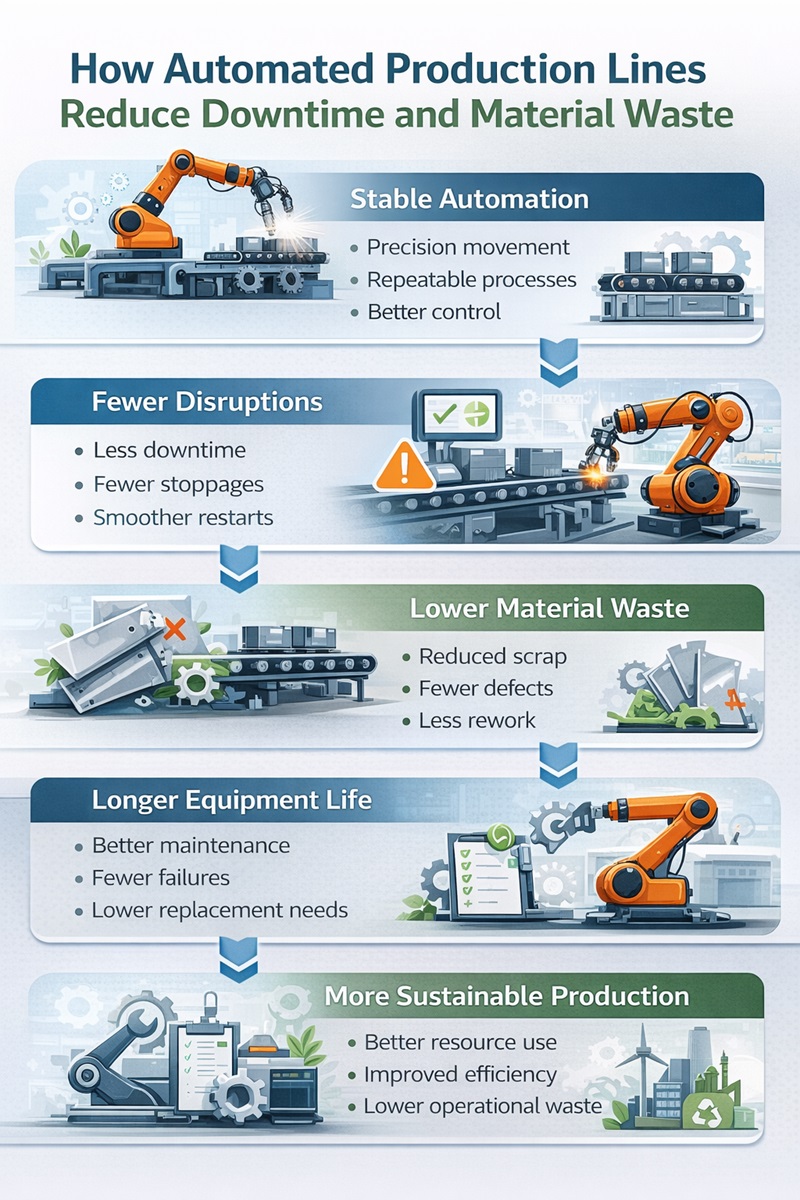
A well-oiled automated line can really make a difference when it comes to sustainability. Consistency is key here – with precise motions, tighter tolerances and handling, you can sharply reduce off-spec output and the small errors that end up as wasted material in big production runs.
Less waste because of better consistency
In many a production setting, waste is directly caused by variation. Small deviations in positioning, cutting, fastening, dosing or aligning can quickly add up to be a real problem. Automation comes in handy when it can tighten the screws on these variables.
And fewer reruns – that’s a big one
Aside from time, reruns eat up extra materials, extra energy and extra machine use. And that’s exactly what stable automation can help reduce.
Where The Weak Point Lies: It’s Not The Automation, It’s Reliability
There’s often an assumption in discussions about smart manufacturing that automation is naturally efficient. But it’s not that simple. An automated line can still turn into a wasteful one if the system behind it is unreliable.
Repeated motion, vibration, flexing, contamination and heat all put a lot of stress on production infrastructure – including smaller support points that can make or break a production cell running smoothly over time. We’re talking about things like sensors, connectors, interconnects and high-motion electrical components that might not seem important, but can bring an entire production line to its knees.
The ripple effect of small failures
In an automated setup, minor breakdowns can quickly escalate. A worn connection or unstable component might not just stop moving, it can also create misalignment, inconsistency or intermittent faults that increase waste long before the real problem is found.
The Importance of Reliability in Cutting Waste
Sustainable manufacturing isn’t just about having efficient motors, modern software or less-carbon energy. It’s also about whether a plant can run with enough control and repeatability to avoid throwing away unnecessary waste.
That’s why real-world examples of plants doing it right are so valuable.
CEAT’s Halol Plant in Gujarat, India
Take CEAT’s Halol plant in Gujarat, India, for example. That’s a radial-tyre manufacturing site that’s been recognised by the World Economic Forum’s Global Lighthouse Network. They’ve used advanced analytics and digitalised operator touchpoints to improve process control and get the volume up while keeping in-process specs tighter. And the results? – Really significant drops in cycle times, process scrap and energy consumption. In fact, they saw a 20% fall in cycle times, a 46% drop in process scrap and a 15% reduction in energy consumption. That’s what we mean by digital manufacturing cutting both efficiency and material waste at the same time – and that’s what makes Halol a great example.
Schneider Electric’s Lexington Smart Factory in Kentucky
Take a look at Schneider Electric’s Lexington Smart Factory in Kentucky, a pretty old brownfield site that was originally built back in the late 1950s and then gradually rebuilt over the years rather than being completely overhauled. The plant is still churning out electrical distribution products like load centers and safety switches and Schneider basically made it their first US smart factory to showcase. Public reports on the plant describe a layered modernization plan built around real-time monitoring, predictive tools, and digital support systems – not some simplistic “just add some robots” approach. According to Schneider, this smart factory resulted in a 20% reduction in mean time to repair on critical equipment and a huge reduction in paperwork at the facility, while the World Economic Forum later pointed to Leeds improvements including 26% less energy being used, 30% lower net CO2 emissions and 20% less water being used. All this shows how a more visible and controlled older plant can support up-time and resource efficiency in practice.
These examples also help close another gap in generic automation chatter: the idea that we only get sustainability gains from just slapping in new shiny machinery. The truth is that line stability usually depends on the whole system. In robotics-heavy environments, that includes things like smaller infrastructure such as sensors, connectors and precision cable assemblies for robotics – because if your smaller parts aren’t up to scratch, it can affect your uptime, precision and all that material getting wasted.
What’s New in Automated Manufacturing
The latest developments in automated manufacturing aren’t just more robots, it’s more control around performance, maintenance and plant stability with the power of data.
That makes a difference because it changes how manufacturers think about waste. Instead of just treating downtime as a narrow maintenance issue, more plants are now using data, digital tools and connected monitoring to spot performance drift early and reduce the waste that follows from it. The CEAT and Schneider examples point in the same direction: the next stage of industrial automation is now about making systems more observable, more predictable and just plain less waste-prone, not just faster.
Ways Manufacturers Can Cut Back on Downtime and Wasted Materials
A smarter productivity strategy usually starts by not treating uptime and waste as two completely separate concerns.
Go back and figure out what’s going on when production stops
If you find that scrap starts piling up again as soon you get back up and running, then that’s not just a quality control problem – it’s a sign that downtime is directly effecting your ability to make the most of the materials you have on hand.
Don’t just focus on the big equipment – look at the weak links too
Those big machines are a major source of disruption, but it’s the smaller, high-wear areas – think interconnect points, sudden change in direction, or repeated motion – that often end up causing the hidden pitfalls that catch you out.
Maintenance should be about real-world use, not just arbitrary schedules
Any bit of equipment that’s subjected to vibration, heat, flexing or contamination is worth taking a closer look at – and that should be based on how it’s actually used in your line, not just some generic maintenance schedule.
Prioritize getting a stable process, not just speed
The truth is, a production line that’s whizzing along but still churning out avoidable scrap isn’t really efficient at all. What you really want is a line that produces the same quality product every time, with fewer and fewer interruptions and much less waste along the way.
The Bottom Line
Automation can be a real game-changer when it comes to cutting back on waste and making your factory more sustainable – but it’s only going to make a real difference if it actually works reliably. That’s the thing that often gets overlooked. The value of an automated line isn’t just in how fast it runs – it’s in the precision, the consistency, the lower scrap rates, and the better use of materials that come from having a system that can be counted on.
As more manufacturers start to automate, the real question is no longer whether all this theory stuff about output actually pans out in practice. What you need to know is if the production system behind all that automation is solid – and can actually deliver the goods without creating more waste in the process.