
When it comes to ensuring food safety, you’ve got two things on your plate – control and proof. Businesses need to be able to control risks as they happen, and have a record to match that shows they actually took control when it counted. That’s where HACCP still comes in. Even though HACCP, short for Hazard Analysis and Critical Control Points, has been around for a while, it remains the fundamental approach to preventing food safety issues in a lot of food businesses. It helps teams spot potential hazards, set important control points, define what’s acceptable, monitor their performance, and document what to do if something goes wrong before it escalates.
Those seven HACCP principles haven’t changed a bit. What’s changed is the way a lot of businesses go about putting them into practice. For years, that meant paper logs, clipboards and binders were the default – which, when you think about it, was just normal business. But in reality, paper systems have some big weak spots. A temperature check gets skipped in a rush, or a reading gets written down too late. A person copies a number down wrong or a binder goes missing at the worst possible moment. These aren’t just minor record-keeping issues – they can really have an impact. They affect how well you monitor your process, delay getting corrective action in place, and make it a whole lot harder to prove that you followed your food safety plan when things counted.
That’s why digital HACCP systems are starting to get more attention. The value isn’t just that they look a bit newer. The real value is that they can make food safety work more reliably. Real time monitoring can step in and replace some of the manual spot checks, for one thing. And records become time-stamped, easily searchable and a whole lot easier to get to. Alerts can flag a problem when it happens, rather than hours later when someone is reviewing the records. Over time, that changes HACCP from being about just keeping records into a much more dynamic control system.
What is HACCP and How Does it Work?
HACCP is a whole system for keeping food safe. It’s built to spot where hazards can slip in to your food process and control them before anything dodgy ends up on the plate. Unlike relying on inspection of the final product, HACCP focuses on the points in the process where losing control is most likely to cause problems.
Day to day, HACCP starts with mapping your process and spotting all the possible hazards – biological, chemical and physical – that could cause issues. From there, the business decides which steps are the critical control points, where a loss of control would be most likely to cause damage. It sets measurable limits like cooking or storage temperatures and then monitors those points and keeps a record of the results. If something doesn’t get done, your staff need to take corrective action, document what went wrong and verify that the whole system still works as it should.
That basic structure still works whether you keep your records on paper or on a digital platform. The difference is how fast you can spot the problems, how easy it is to review your records and how well you can show that you had controls in place.
What Actually Changes When HACCP Goes Digital
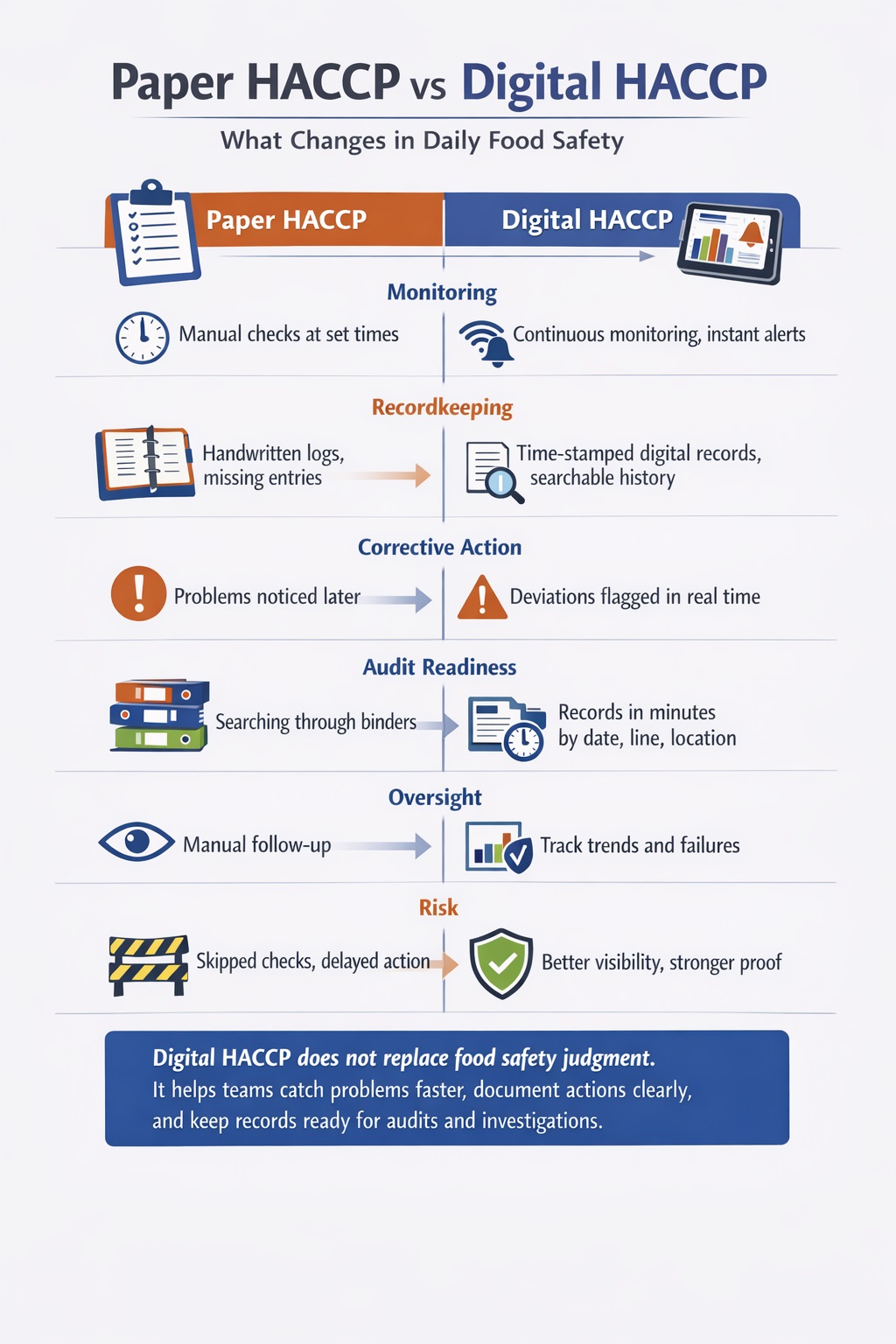
The biggest change you’ll usually see is with the monitoring bit – its all about tracking. With a paper-based system, a lot of checks rely on someone actually remembering to grab a reading at the right time and get it written down properly. With a digital HACCP system, you can have probes, sensors, data loggers, or even cloud tools collecting readings all day long. And that’s what really matters when it comes to critical control points – timing is everything in places like refrigerated storage, hot holding vats, cooking areas and coolers.
A cooler that starts drifting out of range on paper might not get noticed till the next scheduled check. In a digital system though, the same thing can trigger an alert straight away. That gives your team a chance to act fast, save the product and get all the details written down while they still make sense.
And then theres the documentation side of things. Paper logs are just static – you sit there digging through them trying to find something. Digital records by contrast are usually sort-able by date, product, location, production line or control point. Which makes internal reviews a lot easier and audits a heck of a lot less painful. You can have a supervisor look for patterns, repeated deviations or even missed checks without having to dig through everything.
A top-notch digital HACCP system does more than just store temperature readings though (although that’s important enough on its own). It can handle workflows for corrective action, review of signoffs, sanitation checks, all that allergen control and cal stuff, plus review of trends across recurring issues. That is where digital record keeping really starts to pay off – it shows not just that you collected data, but that you actually reviewed it and did something about it.
Why This Is More Important Now
To be honest, this shift is even more important these days because food businesses need to be able to find and defend records super quickly. HACCP’s not new, but the whole food safety environment is moving in a direction that needs faster traceability and better recall readiness. That means your records need to be tidy, easy to search and ready to whip out for regulators, auditors, customers, or internal teams when they ask for them.
There’s also a pretty basic mindset shift going on. Loads of food businesses used to rely on periodic checks followed by a review later on. More and more facilities are now expecting continuous monitoring with responses to exceptions. So the real question is no longer just “Did we fill out the right form?” The harder and more useful question is, “Did we catch the problem early on, take action, document the response and verify that things got back under control?”
That’s where digital systems really have an advantage. They close the gap between what happened, your response and your record.
What Digital HACCP Just Can’t Do On Its Own
Digital tools do improve visibility, but they can never replace good old-fashioned human judgment. Hazard analysis still needs the brains & expertise of qualified people to make sense of things. Critical limits still have to be backed up by some actual science. And when it comes down to it, Corrective actions still come down to someone making a real decision about what to do with the product – hold, discard, or dig deeper.
A dashboard can tell you that a cooler went out of range – no problem, but it can’t decide on its own what should be done about it. Who do you think should get that call? So, while digital HACCP is pretty cool, its usefulness relies on business people having already sorted out things like clear alert rules, training for the staff, steps for escalating things, review responsibilities and a backup plan for when the worst happens. Don’t forget about sensors needing calibration, devices sometimes just plain failing and internet connections dropping off – if the system can’t handle those kinds of things – e.g. offline use, delayed syncing, secure editing, or tightly controlling access – it might end up creating a different kind of weakness.
In other words, digital HACCP isn’t a magic bullet for skirting around good food safety practices. It does best when it’s strengthening a well-defined process.
A Simple Little Example Shows Why
One example is refrigerated storage – pretty straightforward. In a paper-based system a cooler gets checked just a few times a day & If it starts drifting out of range right after one of those checks, the problem can just sit there for hours before anyone spots it. Then, when it does get their attention, staff are left scrambling to figure out what happened, for how long temps were off, and whether product got affected.
But if you’ve got a digital system, a connected sensor can flag the issue right away – and send an alert to the right person. The system will keep a record of the whole timeline – when the problem started, when someone acknowledged it, what was done about it, and whether the issue was fully resolved. Trust me – that kind of record is a lifesaver when it comes to audits. And even more crucial if a food safety event actually happens.
What Food Businesses Need to Check Before Switching to Digital HACCP
A business thinking of ditching paper for a digital HACCP system needs to go deeper than just checking out the demo . Instead, they should focus on the practicalities of record keeping.
- Can a system create a clear audit trail that you can actually trust?
- How do you control who gets to change what, especially when it comes to sensitive records?
- Can you easily review and sign off on records, without anyone messing with them behind your back?
- How does it handle calibration records – are they automatically flagged and reviewed?
- What happens in an emergency like a power outage or network crash?
- Can you get access to months of records in minutes, rather than having to dig through them for hours?
That’s what really matters – not how pretty the screens are, or how many extra features it’s got. A digital system is only going to make a difference in terms of compliance if it actually matches the way your business works day to day.
And don’t forget, not all food businesses are created equal. A processor working with FSIS, a seafood operation, and a retail food service business are all going to have different needs when it comes to HACCP. They may all be using the same principles, but their record volumes, how much monitoring they need to do, and the level of risk they’re at is going to be completely different. So the best system is one that’s tailored to the specific hazards and daily routines of the business.
The Bottom Line
Switching to digital HACCP doesn’t change the science behind keeping food safe – but it does change how consistently you get to apply that science. Monitoring becomes continuous, deviations become easier to spot, records are easier to get a hold of, and verification is easier to keep on record.
That’s what makes digital HACCP more than just going paperless. For food businesses, it’s often a practical way to get your responses up to speed, tighten up your compliance, and build a record that will actually stand up when you need it to.