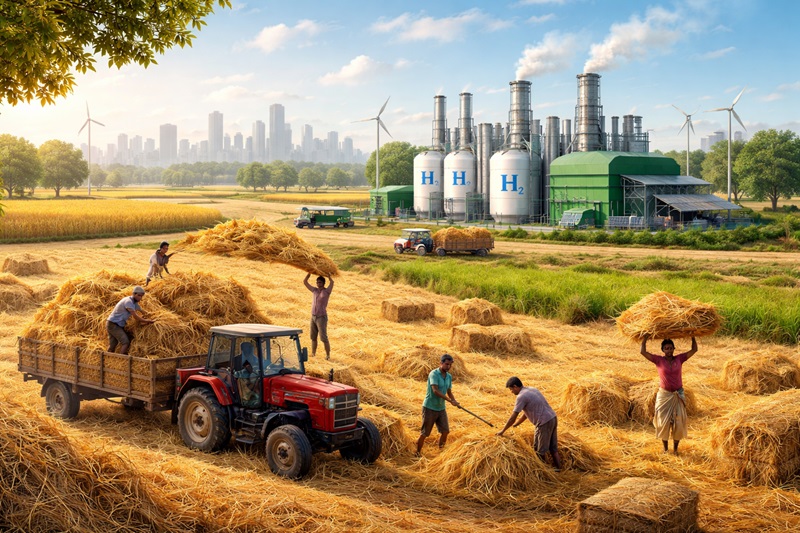

India’s hydrogen strategy is usually framed around solar- and wind-powered electrolysis. But another major opportunity already exists across the country’s agricultural landscape. With over 228 million tonnes of surplus agricultural biomass generated annually, India has a large but underused feedstock base that could support hydrogen production, reduce residue burning, and build stronger rural energy linkages.
This expert commentary explores how agricultural biomass could become part of India’s hydrogen future, why current policy remains too narrowly focused on electrolysis, and what changes are needed to unlock a more decentralised and inclusive model.
Can biomass support India’s hydrogen future?
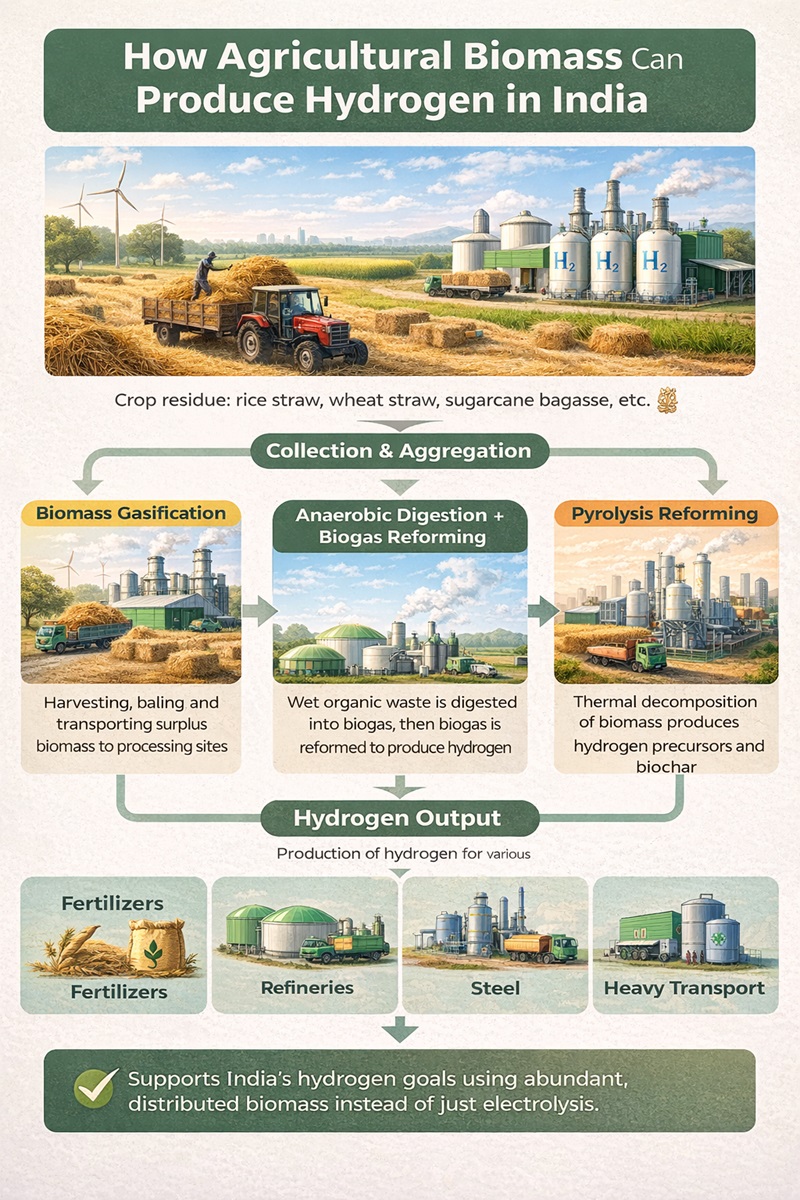
Yes. Agricultural biomass can support India’s hydrogen future by serving as a feedstock for hydrogen production through pathways such as biomass gasification, anaerobic digestion with biogas reforming, and pyrolysis reforming. Unlike large-scale electrolysis, biomass-based hydrogen can be decentralised, linked to rural economies, and built around agricultural residues that are already widely available across India.
Key Takeaways
- India generates over 228 million tonnes of surplus agricultural biomass every year.
- Much of this biomass is still burnt, wasted, or only partly utilised.
- Biomass-to-hydrogen can complement electrolysis-based green hydrogen production.
- Gasification, biogas reforming, and pyrolysis reforming are three promising pathways.
- Current policy support remains heavily tilted toward electrolysis rather than decentralised biomass-based systems.
- Biomass-based hydrogen could create stronger rural linkages, residue markets, and local energy value chains.
Why This Matters Now
India is trying to solve several difficult problems at the same time. It needs cleaner energy systems, lower industrial emissions, better rural income opportunities, and practical alternatives to crop residue burning. Hydrogen is increasingly seen as part of the answer for sectors such as fertilisers, refining, steel, and heavy transport. But if hydrogen policy is built only around large industrial projects, a major domestic resource base may be left out of the transition. That is why biomass deserves a larger place in this conversation now.
What Is Biomass-to-Hydrogen?
Biomass-to-hydrogen refers to producing hydrogen from agricultural residues, dung, agro-industrial waste, or other organic feedstocks instead of relying only on electricity-powered electrolysis. Depending on the pathway used, biomass can be converted into syngas, biogas, or other intermediates that are then processed to recover hydrogen. In India’s case, this matters because biomass is already distributed across agricultural states rather than concentrated only in renewable-power corridors.
Beyond Electrolysis: Bringing Biomass into India’s Hydrogen Future
Every winter, a familiar crisis overtakes the entire northern India when smoke from burning crop residues, blanketing the cities, become a normal view. The result, we all know is, air pollution reaching to hazardous levels. However, what is widely treated as an environmental inconvenience, is in fact, a vast untapped energy resource. India produces over 228 million tonnes of surplus agricultural biomass annually. An enormous resource that is routinely burnt, wasted, or underutilised. At the same time, the country is exploring new opportunities in advanced renewable energy technologies through green hydrogen targeting production of 5 million tonnes of green hydrogen annually by 2030. However, this strategic priority remains largely centralised and capital intensive. The question is can these unresolved crises and extraordinary opportunities be brought in together?
India’s Biomass Challenge and Untapped Energy Resource
Most of the agricultural biomass generated are residues from rice, wheat and sugarcane, followed by other crops that remain after harvest. Burning these residues acts as a contributor to ambient particulate matter. While schemes like Sustainable Alternative Towards Affordable Transportation (SATAT) and Galvanizing Organic Bio-Agro Resources Dhan (GOBARdhan) offer alternatives, they absorb only a fraction of available supply and remain insufficient in scale. The existing biomass utilisation pathways, which focus on power generation, compressed biogas, palletisation for co-firing, end up absorbing only a fraction of available supply. Moreover, they also offer limited farmgate returns, despite the potential it has, to drive the rural energy security.
Suggested Article: Banana Fiber in Pakistan: Turning Agricultural Waste into Climate-Resilient Wealth
How India’s Green Hydrogen Mission Is Currently Structured
India’s National Green Hydrogen Mission (NGHM) was a result of constant need for bringing in some advanced renewable energy technologies. The rationale behind this is that hydrogen is essential for decarbonising fertilisers, refineries, steel, and long-haul transport, where direct electrification is not viable. However, the Mission, currently, is designed in a way that it is entirely centred on large-scale electrolysis powered by solar and wind energy. Projects are concentrated in renewable-rich industrial corridors of Andhra Pradesh, Gujarat, Rajasthan, and Tamil Nadu. The primary end-use revolves around industrial or export offtake. In addition, the cost of electrolysis-based hydrogen remains high, currently ranging from INR 397-560/kg of hydrogen produced. Thus, the pathway requires significant land, grid infrastructure, water, and capital. In a way, India’s hydrogen ambition as currently structured generates almost no direct rural linkage. Farm households, which account for a major share in India’s workforce, have no stake in this nexus, neither as producers, suppliers, nor beneficiaries.
How Agricultural Biomass Can Be Used for Hydrogen Production
There is, indeed, some thermochemistry which can integrate these two fragmented sections into one technical and strategic opportunity. Agricultural biomass can become a feedstock for hydrogen. One tonne of dry biomass can roughly produce 40 to 100 kg of hydrogen depending on the process employed. The major advantage biomass to hydrogen can provide over any other renewable energy source for producing hydrogen, is that the feedstock is already geographically distributed across every agricultural state in the country.
Biomass-to-Hydrogen Pathways That Fit Indian Conditions
Not all biomass to hydrogen pathways suits Indian conditions equally. Three stand out, among all.
Biomass Gasification
First is biomass gasification, which is the most mature technology. In this, agricultural residues are converted into syngas at high temperatures, followed by hydrogen separation. It smoothly integrates with agri-processing clusters, and when coupled with carbon capture, it delivers carbon-negative hydrogen.
Anaerobic Digestion with Biogas Reforming
Second is, anaerobic digestion with biogas reforming. This is the most immediately deployable technology where wet organic waste in the form of dung and agro-industrial effluents, produce biogas, which is then reformed further to produce hydrogen. This directly builds on India’s existing compressed biogas infrastructure, requires moderate capital, and aligns with the village-scale systems.
Pyrolysis Reforming
The third technology is pyrolysis reforming which offers a modular route, where biomass is thermally decomposed to produce hydrogen precursors, with biochar as a co-product. This improves soil fertility and qualifies for carbon credits, ultimately turning, a hydrogen plant into a regenerative agriculture asset. All the three pathways share a critical benefit over electrolysis. They are inherently decentralised and scalable through replication rather than concentration.
Biomass-Based Hydrogen vs Electrolysis in India
| Factor | Biomass-Based Hydrogen | Electrolysis-Based Hydrogen |
|---|---|---|
| Main input | Agricultural residues, dung, agro-industrial waste | Renewable electricity and water |
| Geographic model | Distributed across agricultural regions | Concentrated in renewable-rich industrial corridors |
| Scale model | Decentralised and replicable | Large-scale and capital intensive |
| Rural linkage | Strong potential | Limited direct linkage |
| Co-benefits | Residue management, waste reduction, possible biochar and carbon-credit value | Lower direct residue-management benefit |
| Infrastructure needs | Feedstock collection, processing, distributed plant setup | Large renewable power, water, grid and industrial infrastructure |
What Biomass-Based Hydrogen Could Mean for Farmers and Rural India
One of the strongest arguments for biomass-based hydrogen is that it can create a more visible rural stake in India’s energy transition. Farm households are currently outside the main hydrogen value chain. A decentralised biomass model could help create residue markets, improve farmgate returns, support cooperative ownership structures, and reduce the incentive for open burning. It also offers a way to connect climate goals with rural development rather than treating them as separate policy tracks.
What Is Missing in the Current Policy Architecture
The opportunity for convergence exists, but the policy architecture does not, yet. India’s NGHM is largely centred on renewable electricity-based electrolysis. Existing bioenergy schemes do not treat hydrogen as a priority end-use. There are no standardised biomass procurement contracts, no floor prices for hydrogen-oriented residue markets, and no dedicated financing instruments for decentralised hydrogen systems. Meanwhile, Ministry of New and Renewable Energy (MNRE), Ministry of Agriculture and Farmers Welfare (MoAFW), Ministry of Petroleum and Natural Gas (MoPNG) and the Ministry of Power (MoP) each hold a piece of this puzzle with no integrated coordination mechanism in place.
Policy Interventions Needed to Bring Biomass into India’s Hydrogen Future
Thus, four interventions are essential. First, the green hydrogen mission must move beyond pilot support and create dedicated incentive streams for biomass and waste-based hydrogen. While the mission recognises these pathways, its financial and deployment focus remains overwhelmingly centred on electrolysis. Second, a dedicated part of the mission for decentralised hydrogen, analogous to SATAT for compressed biogas, must be designed with cooperative ownership at its centre, not as an afterthought. Third, targeted financial instruments, including viability gap funding, credit guarantees, interest subvention must be structured specifically for small and medium biomass to hydrogen plants. Fourth, a cross-ministerial coordination platform must be established, bringing all the relevant ministries together around a shared deployment framework.
Challenges Biomass-to-Hydrogen Still Has to Overcome
Even with its promise, biomass-based hydrogen is not a simple plug-in solution. Feedstock collection remains difficult in many regions because residues are seasonal, bulky, and uneven in moisture content. Storage and transport can raise costs quickly. Technology readiness also differs by pathway, with some routes more commercially mature than others. Financing remains another major barrier, especially for small and medium decentralised plants that do not fit neatly into the large-project model that current clean-energy policy often prefers. These constraints do not weaken the case for biomass-to-hydrogen, but they do show why policy design matters so much.
Where Biomass-to-Hydrogen Projects Could Start First
The strongest early opportunities are likely to emerge in agricultural clusters where feedstock is abundant and existing infrastructure already supports bioenergy or agro-processing activity. Rice-growing regions with recurring residue-burning pressure, sugarcane belts with concentrated processing activity, dairy-linked rural areas with steady organic waste streams, and regions with compressed biogas experience could all serve as practical starting points for decentralised biomass-to-hydrogen deployment.
Conclusion: India’s Hydrogen Future Need Not Begin Only in Industrial Hubs
India’s hydrogen future need not be confined to large industrial hubs. It can begin in its fields. The biomass exists, the hydrogen ambition exists, what is needed now is the policy resolve to connect them.
FAQ
What is biomass-to-hydrogen?
Biomass-to-hydrogen is the production of hydrogen from agricultural residues, organic waste, dung, or other biomass feedstocks through conversion pathways such as gasification, biogas reforming, or pyrolysis-based processing.
Can crop residue be used to produce hydrogen?
Yes. Crop residues such as rice straw, wheat straw, and sugarcane-related biomass can be used as feedstocks in biomass-to-hydrogen pathways, depending on the technology used and the quality of the collected material.
How is biomass-based hydrogen different from electrolysis-based hydrogen?
Electrolysis-based hydrogen depends on renewable electricity and water, usually in large-scale industrial settings. Biomass-based hydrogen uses agricultural or organic feedstocks and can be developed in more decentralised systems closer to rural supply sources.
Why is biomass relevant to India’s hydrogen mission?
Biomass is relevant because it is already widely available across India’s agricultural states, offers a possible alternative to residue burning, and can create stronger rural participation in the hydrogen economy.
What are the main benefits of biomass-based hydrogen in India?
The main benefits include better use of agricultural residues, lower open burning, stronger rural linkages, possible new income streams for farmers, and a more distributed hydrogen production model.
Author Note
The author works in the Agriculture Policy Sustainability and Innovation Team at the Indian Council for Research on International Economic Relations (ICRIER), a research-based think-tank.