
Choosing a wholesale ecommerce platform based on unit price alone is one of the fastest ways to misread the real cost of sourcing. A low product price can look attractive at first, but once shipping, duties, taxes, payment fees, delays, and dispute risk enter the picture, the cheapest listing often stops being the cheapest option.
That is why the better question is not simply Which platform has the lowest price? It is Which platform gives you the best total cost outcome for the way you buy?
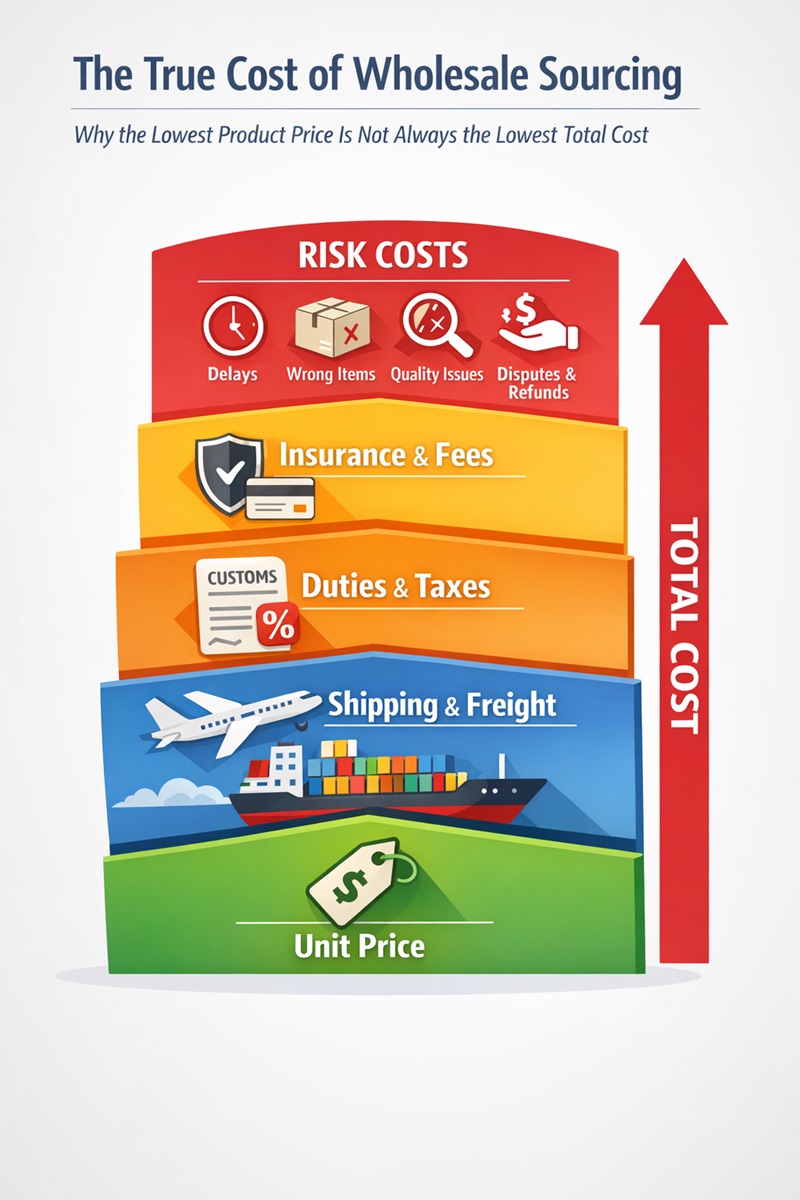
For many buyers, especially small and midsize businesses testing products or sourcing across borders, the smartest comparison starts with landed cost. DHL defines landed cost as the total cost of getting a product to its destination, including freight, duties, taxes, insurance, and related fees. In practice, that makes landed cost a much more useful decision tool than unit price alone.
Why product price alone is misleading
Wholesale buying rarely breaks down over the list price. It usually breaks down in the layers around it.
A supplier may offer a very low unit cost, but that number says little on its own. Shipping may be expensive or slow. Duties and import taxes may push the order well beyond budget. Payment processing or currency conversion can quietly raise the total. If the wrong item arrives, or if quality is inconsistent, the time and money spent resolving the issue become part of the real cost too.
In other words, the visible price is only the opening number. The actual procurement decision should be based on the total cost of getting acceptable goods delivered on time, at the expected quality level, with manageable risk.
A simpler way to compare wholesale platforms
A practical comparison model looks like this:
Total landed cost = unit price + freight/shipping + duties/taxes + insurance/fees + risk cost
The first four pieces are fairly straightforward. The last one is where many buyers underestimate the true difference between platforms.
Risk cost includes things like:
- delayed shipments
- product quality problems
- incorrect quantities or wrong specifications
- refund or dispute friction
- supplier inconsistency across repeat orders
That does not mean risk is always easy to price precisely. But even a rough estimate improves decision-making. If one platform offers slightly higher listed prices but better transaction protection, stronger order records, or better shipping visibility, the total cost may still come out lower in practice.
Not all wholesale platforms do the same job
One reason these comparisons often become confusing is that the term wholesale ecommerce platform covers two very different categories.
The first is the sourcing marketplace. These platforms help buyers find suppliers, compare listings, place orders, and manage cross-border transactions. DHgate and Alibaba fit here.
The second is the wholesale storefront platform. These tools help merchants run their own B2B or wholesale sales channel, with custom pricing, account-based buying, payment terms, and order workflows. Shopify Plus and WooCommerce fit here.
That distinction matters because a buyer choosing where to source inventory is solving a different problem from a brand choosing how to sell wholesale online.
How DHgate fits into the cost conversation
DHgate is best understood as a marketplace for buyers who want to compare multiple suppliers and test products without moving immediately into large-volume procurement. Its practical value is less about claiming the absolute lowest price and more about giving smaller buyers a relatively accessible way to compare listings, shipping options, and seller signals in one place.
That can make DHgate useful for:
- small test orders
- low- to mid-volume sourcing
- product validation before scaling
- buyers who want visible marketplace comparisons rather than one-to-one sourcing negotiations
The limitation is that marketplace convenience does not remove all risk. Buyers still need to evaluate shipping timelines, product detail quality, seller reputation, and refund complexity. A low visible price is still only one part of the equation.
Where Alibaba tends to be stronger
Alibaba is often better suited to buyers sourcing at larger volumes or moving into more structured supplier relationships. One reason is that its ecosystem is built more clearly around supplier sourcing and transaction protection tools for wholesale procurement.
Alibaba’s Trade Assurance program is especially relevant here. The company says Trade Assurance helps protect buyers when suppliers fail to ship on time or when product quality does not match what was agreed. That matters because buyer protection is not just a trust feature; it is a cost-control feature. Fewer disputes, clearer protections, and more formalized transaction terms can reduce the risk side of the landed-cost equation.
For larger or repeat buyers, that can make Alibaba more attractive than a marketplace built mainly around lighter-weight order testing.
Where Shopify Plus belongs in this comparison
Shopify Plus is not a sourcing marketplace. It is a platform for brands, distributors, and manufacturers that want to run their own wholesale or B2B sales operation.
That means its cost logic is different. You do not use Shopify Plus to compare supplier listings. You use it to control the buying experience for your customers.
Its value comes from features such as company accounts, payment terms, and B2B workflows inside the same commerce system. Shopify’s current B2B materials highlight capabilities such as dynamic payment terms, ACH payments, EDI support, and company-based ordering workflows. For merchants selling wholesale direct, those tools can reduce operational friction and manual admin work, which is another form of cost that often gets overlooked in platform comparisons.
So Shopify Plus is not “better” than DHgate or Alibaba in a general sense. It is better for a different use case: selling wholesale direct from your own brand environment.
Where WooCommerce makes sense
WooCommerce also sits on the merchant side, not the sourcing side. Its appeal is control. For businesses that want flexibility, ownership, and a customizable B2B setup, WooCommerce can be a strong option.
But there is a tradeoff. Many wholesale functions in WooCommerce depend on extensions rather than arriving as a tightly integrated B2B system out of the box. WooCommerce documentation and extension pages show support for features such as wholesale pricing, user roles, quote workflows, tax and shipping controls, and restricted product visibility. That can be powerful, but it also means the true cost includes setup complexity, plugin spend, maintenance, and ongoing management.
For businesses with technical control and specific workflow needs, that may be worth it. For teams that want a more unified B2B stack with less configuration overhead, it may not be.
Comparing platform types by real cost logic
Here is a more useful way to frame the comparison:
| Platform | Platform type | Best fit | Cost strength | Main tradeoff |
| DHgate | Sourcing marketplace | SMB buyers testing products or placing smaller orders | Easy listing comparison and accessible cross-border buying | Quality, shipping, and seller consistency still need careful review |
| Alibaba | Sourcing marketplace | Larger-volume buyers and repeat procurement | Stronger sourcing infrastructure and buyer protection tools | Often better for structured procurement than quick, lightweight test buying |
| Shopify Plus | Merchant wholesale platform | Brands selling wholesale direct | Lower operational friction through integrated B2B workflows | Not designed for marketplace supplier sourcing |
| WooCommerce | Merchant wholesale platform | Businesses wanting flexibility and control | Customizable wholesale setup with wide extension support | True cost may rise through plugins, maintenance, and setup complexity |
What buyers should compare before choosing
The best wholesale ecommerce platform is rarely the one with the lowest visible pricing. It is the one that matches your buying model while keeping total cost, delay exposure, and operational friction under control.
Before deciding, compare:
- order size and reorder frequency
- shipping visibility
- duties and tax exposure
- buyer protection or dispute handling
- payment terms and transaction structure
- supplier comparison depth
- technical setup and maintenance burden
- fit for sourcing inventory versus selling wholesale
A marketplace may be the right choice when you are testing products or comparing suppliers. A wholesale storefront platform may be the better option when you already control inventory and want to run a direct B2B sales channel.
Why this matters even more now
This cost-first approach matters more in 2026 because cross-border ecommerce remains sensitive to policy shifts, surcharges, and operational complexity. DHL’s current guidance continues to emphasize that landed cost includes more than freight alone, including duties, taxes, insurance, and other overheads that materially affect profitability. That means the gap between a low listed price and a good buying decision can be wider than many wholesale buyers expect.
Conclusion
The best wholesale ecommerce platform is not the one with the cheapest product listing. It is the one that gives you the most reliable total cost outcome for your specific buying model.
For small and midsize buyers testing products, a marketplace such as DHgate can be useful because it makes supplier comparison and lighter-weight sourcing more accessible. For larger procurement programs, Alibaba may offer stronger structure and transaction protection. For brands selling wholesale direct, Shopify Plus and WooCommerce belong in a different category altogether: they are tools for running your own B2B sales channel, not for comparing external suppliers.
That distinction matters. Once you separate sourcing platforms from merchant wholesale platforms, the comparison becomes clearer, and the cost conversation becomes much more honest.