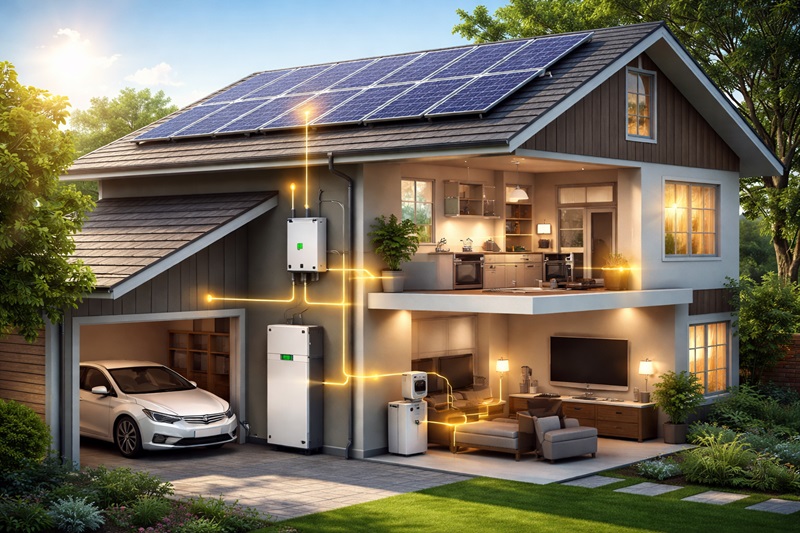

Once a straightforward narrative, sustainable energy now calls for over time replacement of fossil fuels by increasing wind and solar. The tale is evolving quickly today. Apart from increasing renewable energy production, the globe is also modernizing the way electricity is stored, distributed, and utilized. This change is anchored on solar batteries. They help homes, companies, and whole grids get cleaner, more dependable, and more resilient by transforming solar power from a daytime-only asset into an around-the-clock energy solution.
A solar panel generates electricity only when sunlight strikes it. That electricity is valuable later—at night, when prices are high, or during a blackout—thanks to a battery. One easy concept is driving a very greater change. Higher renewable penetration, lower carbon emissions, lower energy prices for many people, and better energy security are all made possible by solar batteries. They are essentially developing into among the most crucial instruments in the green revolution.
Why Solar Batteries Are Now More Important Than Ever
In many parts, solar energy is today among the most affordable sources of fresh electricity. Still solar alone does not solve three big issues:
- People often consume more evening electricity, when solar output declines; hence, there is a timing mismatch.
- Large solar penetration can cause local congestion and ramp-up issues.
- Outages can be brought on by severe weather and aging infrastructure; consumers want backup power.
Solar batteries cover all three. Midday to evening, a battery transfers energy, lowers reliance on fossil-fuel peaking facilities, and can maintain vital loads operating during grid failure. Thousands of batteries working together can also serve as a versatile power plant stabilizing the grid.
One of the main causes of solar-plus-rapid growth is this. It is not only a choice of renewable energy. Furthermore, it’s an operational improvement for the whole electrical grid.
How solar batteries speed decarbonization
Flexibility is needed in a grid that depends much on renewable energy. Gas facilities that could rapidly boost up demand give conventional grids flexibility. A low-carbon grid demands versatility free from emissions. Rapid response and accurate control provide batteries their flexibility.
Solar batteries lower emissions in a number of ways:
Peak shaving is when batteries discharge during peak times, thereby displacing fossil energy production that typically runs then.
Renewable firms provide batteries to level solar fluctuation brought on by clouds or sunset ramping.
Reduction of curtailment: Batteries store extra solar that would otherwise be discarded when demand surpasses supply from the grid.
Many backup situations can see batteries replace diesel generators, hence lowering local carbon footprint and pollution.
From a single house system to massive commercial and utility installations, these advantages range. The outcome is easy: the more storage the grid has, the easier it becomes to add more wind and solar.
The Science Behind Today’s Solar Batteries
Over the past ten years, solar batteries have seen remarkable development; the rate is still quick. Many technical developments are molding current systems.
LiFePO4 and the Change Towards More Secure Chemistries
Lithium iron phosphate (LiFePO4) is found in many current solar batteries. Strong thermal stability, long cycle life, and good performance for daily charging and discharging make this chemistry well-known. A longer lifetime helps to lower the environmental impact per kilowatt-hour sent over the course of the product’s existence.
Better BMS and System-Level Security
A battery is much more than just cells in a box. Safety, cell voltage balancing, temperature monitoring, and overload, over-discharge, and overcurrent protection are all under the direction of a Battery Management System (BMS). One of the primary factors enabling the widespread and dependable deployment of modern batteries is the BMS.
Hybrid Inverters and Integrated Energy Management
Many current solar battery systems interface with hybrid inverters and energy management programs. These control systems help loads get priority during a power outage, decide when to charge and when to discharge. Systems get more effective and more valuable as software advances, particularly in areas with time-of-use pricing.
Knowing Solar Battery Pricing Without the Conflict
Many customers first wonder about the solar battery price. Price results from a combination of technical, market, and installation considerations, to be quite truthful. Because overall installed cost and lifespan value are just as important, the sticker price of a battery also does not reveal the whole truth.
Following are the most important influences on the cost of solar batteries:
1) Rating for Power and Capacitance
Kilowatt-hours (kWh) determine capacity, which indicates how much energy the battery is able to hold. Kilowatts (kW) are used to gauge power; it lets you know how rapidly the battery may supply energy. Normally more than a battery meant mostly for evening load shifting, a battery meant to operate high loads (like HVAC) costs more.
2) Chemistry and the Cycle of Life
Over time, a battery able to accomplish more cycles before it deteriorates surely provides more usable energy. Though the initial solar battery cost is greater, higher cycle life can enhance the value.
3) Certifications and Security
Certifications and compliance testing lower risk but also add expenditure. Many commercial purchasers regard certification as non-negotiable. A premium price is justified by excellent safety design, quality control, and established norms.
4) Installation Difficulty
The final price can be greatly influenced by electrical upgrades, interconnection requirements, site conditions, and labor expenses. Installed expenses of two systems sharing the same battery might vary greatly between houses or areas.
5) Supply Chain and Market Factors
Costs of batteries are affected by worldwide demand, manufacturing volume, and raw materials. As supply chains shift, pricing can rise or decline.
Not just the first purchase price, but also the cost per usable kWh over the life of the system is one way to view the cost of solar batteries. In the long run, a less expensive battery that degrades rapidly can cost more than a sturdy system that performs well for years.
Why modular design is winning: The stackable battery system trend
Modular architecture is among the most significant product developments in energy storage. Starting with a smaller capacity and adding modules later, a stackable battery system lets users grow. Because customers no longer need to overbuy on day one, this is altering the buying experience.
There are several benefits of a stackable battery system:
- Scalability: Users can align storage with evolving demands like as EV adoption or rising home loads.
- Simpler logistics: Smaller modules can be simpler to transport and install.
- Some modular systems let broken modules be swapped out without the need of the whole system.
- Installers can set capacity according to roof area, solar generation, and backup priorities using flexible design.
For commercial uses as well, this modular technique is rather appealing. A little company might install a little system for peak shaving then grow after bill savings are confirmed. As a warehouse adds more rooftop solar or converts forklifts to electric power, it could phase in storage.
The stacking battery system idea is becoming a basic expectation in many marketplaces rather than a premium amenity.
Economics of Energy Independence: Solar Batteries
Reducing emissions is not the only aim of the green revolution. It is also about empowering consumers more over energy prices and dependability. Solar cells help with that management in a number of actual ways.
Saving Based on Time of Use
Electricity can be considerably more expensive during peak hours in time-of-use (TOU) pricing. From solar (or even from the grid during off-peak hours where permissible), a battery charges; during peak pricing it discharges. By using this technique, payback periods can be shortened and costs cut.
Optimizing Self- Consumption
Daylight exports surplus solar from many residences to the grid. Exporting could not be economically viable in areas with poor feed-in tariffs. Storing excess solar for later use, batteries elevate self- consumption.
Reserve Electricity and Resilience Value
Not every advantage is reflected on a utility bill. Particularly for essential loads like cooling, medical devices, communications, and small company operations, backup power is really valuable during outages.
Many neglect resilience value when they assess the cost of solar panels since it is more challenging to measure. Resilience sometimes becomes the deciding element following significant storms and heat waves.
Grid-Scale Advantages: Batteries serving as the backbone of renewable energy systems
Solar batteries help more than just single consumers. They help with the grid itself too. Increasingly relying on batteries for: utilities and grid operators
- Batteries react in milliseconds to stabilize grid frequency.
- Reactive power and local voltage problems can be handled in part with the help of batteries.
- Capacity support: Batteries can postpone costly grid improvements and lower peak demand.
- Black start capability helps to resurrect grid segments following outages in some designs.
These services become more priceless as grids include more renewable energy. Renewable-heavy grids become more stable and simpler to run thanks in batteries, hence accelerating even more clean-energy expansion.
Beyond Operation: Lifecycle and Ethical Deployment of Sustainability
Solar batteries help to lower emissions when they are in use, but their construction, use, and recycling determine sustainability. The industry is developing throughout the lifespan:
Manufacture Efficiency and Quality Control
Better manufacturing prolongs product life, increases yields, and lowers trash. A longer-lasting battery lowers the environmental impact per unit of delivered energy.
Repurposing and Second-Life
Some applications, especially for less intensive stationary storage needs, can make use of second-life batteries from electric vehicles. Though quality control and performance consistency are essential, this strategy might help to cut expenditures and minimize waste.
Recycling and Materials Recovery
Rising battery recycling and continuous upgrades in recovery techniques support this trend. Strong recycling programs support a more circular battery economy and help to lower reliance on virgin materials.
A genuinely sustainable storage future requires long life, great safety, and ethical end-of-life management.
The decade ahead is seen as
Although solar batteries are already transforming energy networks, the following decade will see even more significant improvements.
1) Smarter Operation and Improved Software
When and how batteries charge and discharge will be enhanced by artificial intelligence-driven energy management. Better control can provide more grid services, extend battery life, and raise savings.
2) Fresh Chemistries for Varied Requirements
Although sodium-ion and other chemistry could grow for cost-sensitive or high-volume markets, lithium-based systems will remain major for a number of purposes. Good chemistry will depend on performance needs, tolerance for temperature, cost, and safety.
3) Deeper integration with home loads and electric cars
Under the concepts of vehicle-to-home (V2H) and vehicle-to- grid (V2G), electric cars can become agile energy resources. One integrated system, homes may combine solar, fixed storage, and EV charging.
4) More Modular and Expandable Architectures
The stackable battery system’s strategy will probably grow increasingly popular. More consumers will look for systems that can expand without complete replacement as electrification raises house demands.
5) Market Structures and Policy Encouraging Flexibility
Many areas are rewriting rules to more properly value distributed energy sources. As markets change, batteries could gain value from grid services, virtual power plant involvement, and resilience programs in addition to bill reductions.
Selecting the Appropriate Solar Battery System
Users’ objectives should guide the design of a battery. A purchaser looking for backup power should scale differently from one mostly after TOU savings. Here are some realistic decision points:
- Define the goal: backup, bill savings, self-consumption, or a combination.
- Find necessary burdens; choose what has to run during a power loss.
- Confirm the battery matches the selected inverter and system design by checking inverter compatibility.
- Compare lifetime value by thinking about usable capacity, cycle life, and warranty conditions.
- Think of a stackable battery setup if future expansion seems probable.
While the cost of solar batteries matters, system design and long-run performance are equally so. The best system is the one that regularly offers value for the particular use case.
Batteries Are Changing Solar Into Total Energy Solution, the larger picture.
Already among the most significant clean-energy sources available on Earth is solar electricity. Solar batteries transform it into something even more potent: a user-controlled, flexible dispatchable power source. That shift transforms everything. It helps people and companies seize control of their energy future, lowers emissions, increases grid stability, and backs electrification.
Batteries will evolve from being “an optional add-on” to being commonplace in contemporary solar as technology advances and markets mature. Particularly as time-of-use pricing, grid congestion, and climate-driven blackouts get more prevalent, a solar installation without storage will appear unfinished in many areas.
One innovation is the green revolution is not. It’s an improvement at the system level. One of the most evident illustrations of that upgrade in use is solar batteries—particularly scalable versions like a stackable battery system. They are more than just behind renewable energy. They are assisting to create it.