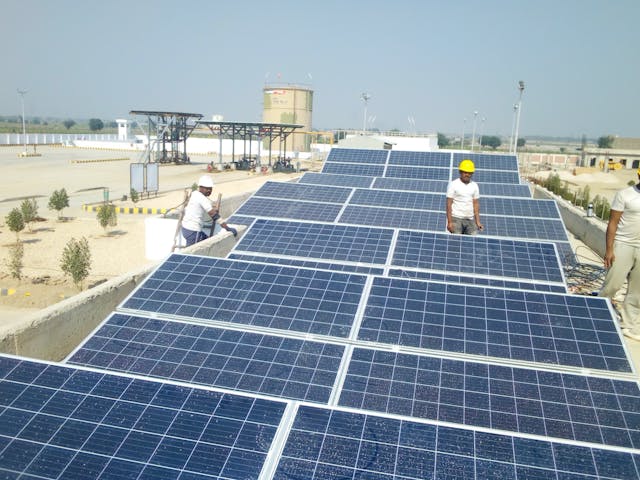

Modern solar solutions improve energy efficiency across properties by generating electricity on-site, reducing grid imports, shaving peak demand charges, and better matching energy use to solar production. When combined with batteries, energy management systems (EMS), and efficiency upgrades, they can cut grid consumption, stabilize bills, and improve long-term operating costs across residential, commercial, industrial, and agricultural sites.
Why “modern solar solutions” matter for energy efficiency (not just clean energy)
Solar used to be marketed almost entirely as “clean energy.” That’s still true. But if you own or manage a property, the more practical question is:
Will solar make this building run more efficiently—with lower bills, fewer surprises, and better long-term operating costs?
Modern solar solutions can absolutely do that. And not just by generating electricity. The real efficiency gains come from how today’s solar systems interact with the property: load timing, demand charges, storage, smarter controls, and monitoring that keeps production high over decades.
Most owners aren’t buying solar because they love panels. They buy solar because they want:
- Lower, more predictable utility bills
- Protection from rate hikes
- Better reliability (especially where outages are common)
- Lower long-term operating costs across 20–30 years
That’s an energy efficiency conversation as much as it’s a sustainability one.
What energy efficiency means in property terms
When people say “efficiency,” they often mean “uses less energy.” For real properties, it’s more specific. A solar upgrade can improve efficiency outcomes by reducing:
- Grid energy consumption (kWh): fewer kilowatt-hours imported from the utility.
- Peak demand (kW): a lower highest 15-minute (or similar) window, which can reduce demand charges for many commercial accounts.
- Mismatch and waste: better alignment between when energy is produced and when the property uses it.
- Losses from delivery: less reliance on transmitted electricity that includes upstream losses. Globally, transmission and distribution (T&D) losses range from around 5% in many OECD countries to over 15–20% in some developing regions.
Solar doesn’t usually change how much energy your appliances or equipment need to do the same job (that’s insulation, HVAC efficiency, lighting, and controls). Instead, modern solar reduces how much you must buy from the grid to run the property—and can reduce expensive peaks and improve operational control.
Why “modern” solar is different than old solar
A decade ago, solar was often “install panels and hope the numbers work.” Today’s systems are more efficient at the property level because the tech stack has improved:
- Higher module efficiency (more power per square foot, better low-light performance)
- Smarter inverters (advanced MPPT, grid support, safer shutdowns, better data)
- Better monitoring (string-level/module-level visibility, faster fault detection)
- Easier integration with batteries, EV charging, and energy management systems (EMS)
The result: you can design solar around how the property actually uses energy—not just the available roof area.
What you’ll learn in this article
- The simple mechanics of how solar improves efficiency outcomes
- The core technologies (panels, inverters, storage, EMS, monitoring)
- Property-by-property strategies (residential, multi-family, commercial, industrial, agriculture)
- Design choices that directly affect long-term yield and savings
- When storage and load control multiply efficiency gains
- Practical planning steps and what to measure after installation
How solar improves efficiency across a property: the simple mechanics
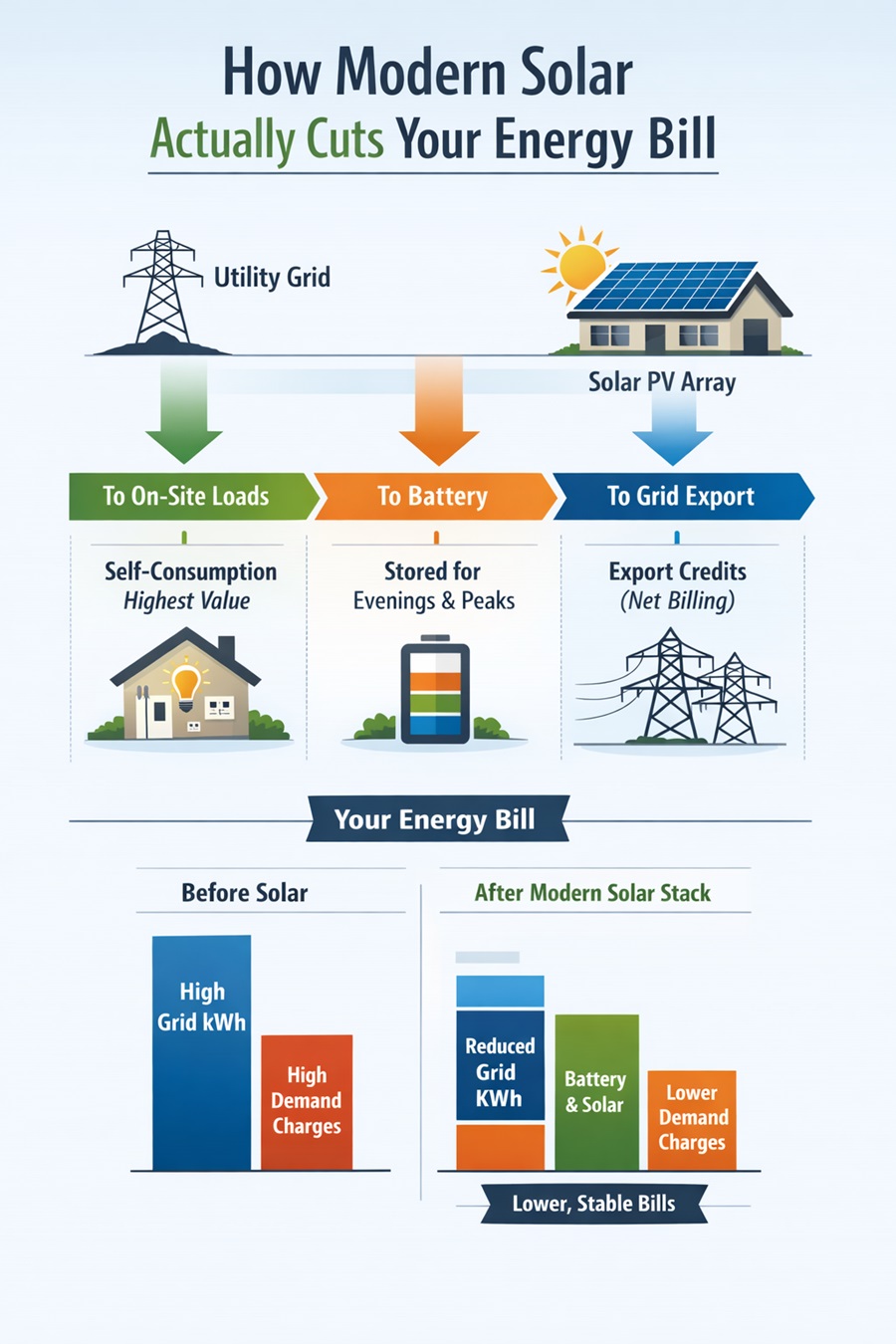
On-site generation reduces imported power (and avoids losses)
Solar PV (photovoltaics) converts sunlight into electricity right where you use it. That sounds obvious—but the efficiency implications are bigger than most people think.
Because grid electricity is generated off-site and transported through transmission and distribution networks, some percentage is lost before a kWh reaches your main panel. In many advanced economies, T&D losses average around 5%, while some regions see losses above 10–15%.
When you generate power on-site, you:
- Reduce dependence on long-distance electricity delivery
- Reduce imported kWh
- Often reduce costs during the most expensive hours
Even if panel efficiency is “only” ~20–23%, the system-level efficiency for the property can be excellent when solar output replaces high-priced grid electricity and associated losses.
Self-consumption vs export: the key efficiency driver
Two properties can install the same size solar array and get completely different efficiency and payback outcomes.
The difference is often self-consumption: the percentage of solar production used on-site instead of exported.
- High self-consumption usually means better savings per kWh produced.
- High export can still be fine under strong net metering—but many markets are moving toward net billing or lower export credits.
Modern solar solutions aim to increase self-consumption through:
- Better system sizing
- Load shifting (using energy when the sun is up)
- Batteries
- Smarter EMS-based controls
Daytime production often matches real loads
Solar production typically peaks during the day. Conveniently, many properties consume heavily during the day as well:
- HVAC and ventilation
- Refrigeration and cold rooms
- Office equipment and lighting
- Pumps and motors (water, irrigation, circulation)
- Domestic hot water (especially if electrified)
When solar aligns with those loads, the building “wastes” less generation exporting to the grid and replaces purchased electricity at the right time.
Peak shaving and demand charge reduction (commercial sites)
Commercial and industrial bills often include demand charges based on the highest kW draw during a billing period. In some tariffs, demand charges can represent 30–70% of the total bill, and many U.S. commercial customers face demand rates above $15/kW.
Solar can reduce those peaks if:
- Your peak occurs during solar hours
- The system is sized and oriented appropriately
- You combine solar with storage and controls when peaks occur in late afternoon/evening
Even a partial reduction in peak kW can produce outsized savings because it cuts a recurring monthly charge, not just energy use.
Efficiency depends on control, not just equipment
A modern solar system is also a data and controls platform:
- Smart inverters keep output stable and safe.
- Monitoring detects underperformance early (so you don’t lose months of production).
- EMS coordinates solar + battery + flexible loads to reduce grid reliance and demand spikes.
That’s why “modern solar solutions” increasingly mean solar + software, not just solar hardware.
Core technologies behind modern solar solutions
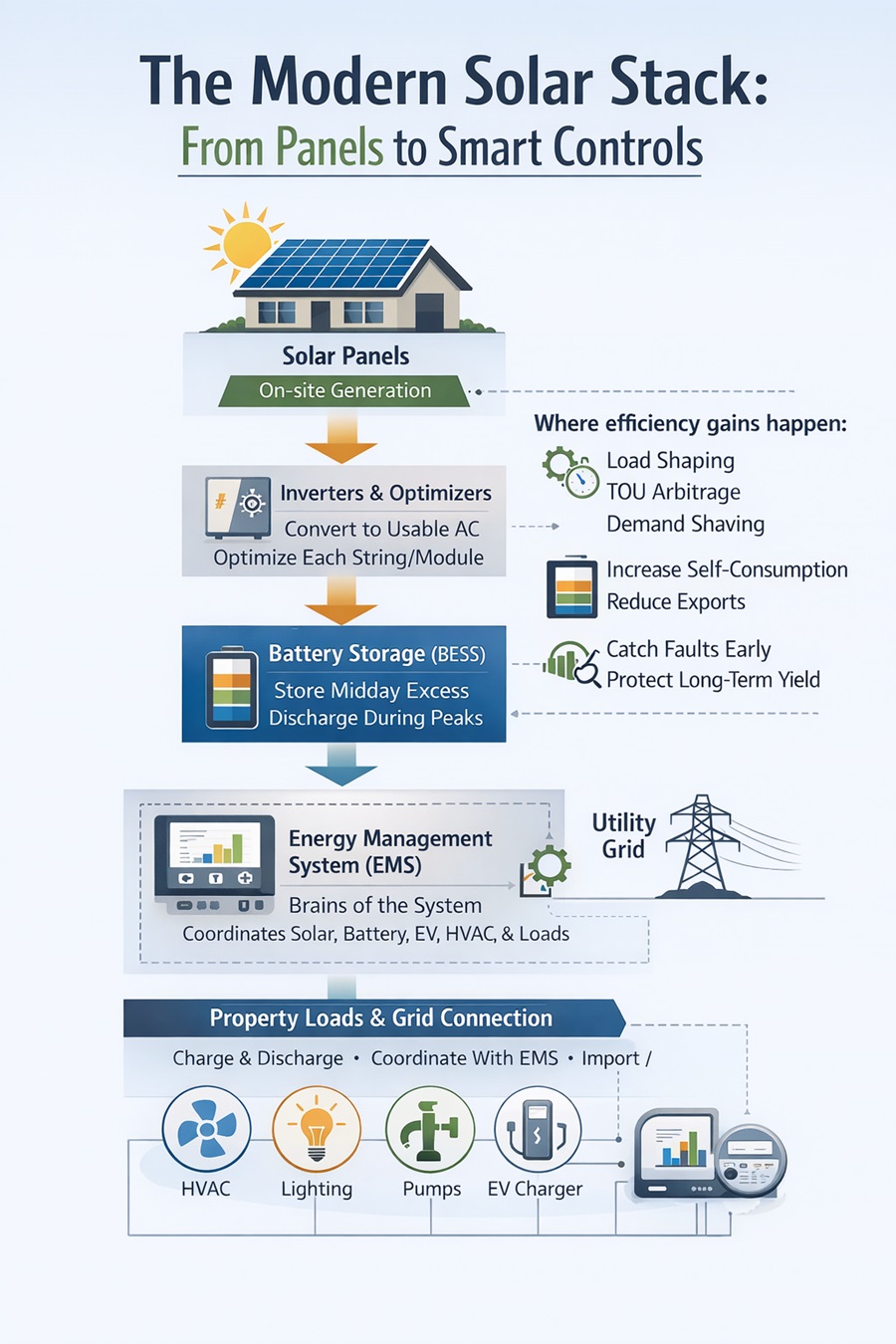
Modern solar efficiency gains come from combining the right components—and knowing what they actually do for your property.
High-efficiency solar panels (mono, PERC, TOPCon, HJT)
Most new installations use monocrystalline modules because they deliver higher efficiency and better performance per square foot than older polycrystalline panels.
Within mono modules, common cell technologies include:
- PERC (Passivated Emitter and Rear Cell): widely deployed, improved rear-side performance vs. older cells.
- TOPCon (Tunnel Oxide Passivated Contact): higher efficiency and better temperature performance; increasingly common in new builds.
- HJT (Heterojunction): very high efficiency and strong low-light performance; often premium priced.
Higher-efficiency modules help when:
- Roof space is limited
- You want more kW installed without expanding footprint
- You want better low-light or partial-shading performance (paired with good design and MLPE)
Bifacial modules (when they help and what to watch)
Bifacial panels generate from both the front and rear side, capturing reflected light. They can boost energy yield when:
- The surface below is reflective (white roofs, light gravel, snow, reflective membranes)
- Panels are elevated (common in ground-mounts and carports)
- Racking allows rear irradiance exposure
What to watch:
- If the underside is dark (black roof, dense vegetation), bifacial gains may be minimal.
- Gains depend heavily on layout, height, tilt, and shading under the array.
- Modeling bifacial gains accurately matters; aggressive assumptions can overstate production.
Battery energy storage systems (BESS)
A battery doesn’t generate energy—it stores it. But storage can dramatically improve practical efficiency outcomes by increasing self-consumption and reducing peaks.
BESS can:
- Store midday solar excess for evening/night use
- Reduce export (especially where export rates are low)
- Discharge during peak-rate windows (time-of-use arbitrage)
- Provide backup for critical loads (if configured for resilience)
- Smooth demand spikes for commercial accounts
The “right” battery depends on whether your goal is bill savings, resilience, or both.
Energy management systems (EMS)
An EMS coordinates energy assets in real time:
- Solar production
- Battery charge/discharge
- EV charging
- HVAC setpoints and scheduling (where integrated)
- Other controllable loads (pumps, water heating, refrigeration defrost cycles, etc.)
EMS is where efficiency becomes intentional. Instead of passively generating solar and hoping loads align, the property actively shapes consumption to match generation and tariffs.
Monitoring and diagnostics: the underrated efficiency tool
Monitoring protects the system’s performance ratio (PR) and long-term yield.
In practice, a good grid-connected system often targets a PR in the ~75–85% range, depending on climate, design, and maintenance.
Good monitoring can track:
- Production (kWh) and power (kW) at the inverter, string, or module level
- PR trends over months and years
- Faults, shading issues, inverter clipping, and communications issues
- Alerts for underperforming strings, failed optimizers, or inverter errors
In plain terms: monitoring prevents you from losing money quietly.
Property-by-property: where modern solar delivers the biggest efficiency wins
The same solar system design does not work equally well across all property types.
Residential homes
Biggest wins usually come from:
- Offsetting daytime loads (HVAC, appliances, home office equipment)
- Improving self-consumption with smart scheduling (dishwasher, laundry, water heating)
- Pairing with a battery if evening consumption is high or outages matter
A modern “efficient solar home” often includes:
- A right-sized PV system (not just “max the roof”)
- Smart thermostat strategies (pre-cool or pre-heat during solar hours)
- Optional battery sized to the household’s evening peak and outage needs
Multi-family buildings
Multi-family performance is heavily shaped by metering structure and regulation:
- Common-area meters (hallway lighting, elevators, central HVAC, pumps) are often easiest to offset.
- Tenant meters complicate direct allocation but may benefit from policies like virtual net metering or community solar.
Efficiency wins are strongest when the system is designed around:
- The building’s largest predictable loads (HVAC, ventilation, hot water, common-area electricity)
- Peak demand timing (especially for larger buildings with demand charges)
Retail and warehouses
These properties often have:
- Large, unobstructed roof area
- Strong midday loads (cooling, lighting, refrigeration)
- Clear operating schedules
Efficiency opportunities:
- High roof utilization with cost-effective racking
- Array orientation tuned to late-afternoon peaks where tariffs justify it
- Carport solar over parking lots (bonus: shaded parking + potential bifacial gains)
- Monitoring to quickly catch underperforming sections across large arrays
Warehouses are also great candidates for pairing solar with:
- EV fleet charging schedules
- Demand management where applicable
Industrial sites
Industrial efficiency gains can be substantial but require careful engineering:
- Process loads may be continuous or peak in specific windows.
- Power quality (harmonics, voltage fluctuations) may matter more.
- Demand charges can be significant.
Modern solar + storage can help industrial sites:
- Stabilize peak kW
- Reduce exposure to TOU pricing and demand charges
- Increase energy cost predictability
These projects benefit from deeper modeling: interval data, load segmentation, and power quality assessments.
Agricultural properties
Agriculture has unique load patterns:
- Irrigation pumps (often daytime—great solar match)
- Cold storage and refrigeration
- Remote loads where grid service is expensive or limited
Efficiency wins include:
- Solar-powered pumping with scheduling aligned to production
- Solar + storage for remote operations (reducing diesel generator reliance)
- Agrivoltaics (co-locating solar with crops/livestock) where land use is constrained
Agrivoltaics can improve land productivity and energy output simultaneously, but requires careful design and local acceptance.
Design choices that directly impact energy efficiency and long-term yield
A “good” solar system isn’t just panels and a price tag. Design decisions determine whether it stays efficient for 25+ years. The benefits extend to all property types. Homeowners gain clarity about their energy savings through detailed forecasts. Businesses reduce overhead with quicker proposal turnarounds. Solar companies close more deals because solar sales proposal softwares help them respond to leads before competitors even finish their calculations. The result is an industry that works smarter, moves faster, and delivers real value to customers.
Site assessment essentials
Before sizing anything, assess:
- Roof condition and remaining life
- Orientation (azimuth) and tilt
- Shading (trees, parapets, HVAC units, buildings)
- Structural capacity (especially older roofs or heavy ballasted systems)
- Electrical infrastructure (main panel capacity, transformer limits, interconnection constraints)
Efficiency is lost when the site is treated casually—because shading, poor layout, and electrical constraints quietly reduce yield.
System sizing for efficiency (not just maximum kW)
More panels aren’t always more efficient financially.
If export rates are low, chronic overproduction can lead to:
- Low-value exports
- Longer payback
- A system that looks great on paper but underperforms economically
A better approach is to size to offset high-value kWh first:
- Loads during peak rates
- Loads that coincide with solar hours
- Loads that drive demand charges (where relevant)
DC/AC ratio and inverter clipping
Solar arrays are rated in DC (panel capacity), while inverters are rated in AC (output capacity). A higher DC/AC ratio (more panel DC than inverter AC) can increase annual yield because the inverter operates near its optimal range more often.
But it can also cause clipping: when the array could produce more than the inverter can output during peak sun, the extra is “cut off.”
Clipping can be smart when:
- You have limited high-irradiance peak hours
- Your goal is annual kWh, not perfect peak output
- Economics favor more panels relative to inverter size
Clipping is wasteful when:
- You have strong, frequent peak irradiance
- You’re constrained by export limits or demand strategy
- Your load profile could have used that extra midday power (and you’re not storing it)
This is a design optimization problem, not a rule of thumb.
Wiring and balance-of-system losses
Small losses add up, especially on large sites:
- Long cable runs increase resistive losses
- Poor connectors create hotspots and faults
- Combiner box design and string sizing affect performance
- Voltage drop matters more than many people expect
A modern efficient system pays attention to these “boring” details—because they determine real-world yield.
Modeling expected production: using realistic performance ratios
A good proposal includes:
- Local irradiance assumptions (from credible datasets)
- A realistic performance ratio (PR) assumption that includes temperature, wiring, inverter losses, soiling, and degradation
- Shading impacts and layout constraints
- Degradation assumptions over time
Studies of grid-connected PV systems often find PR values clustered around ~75–80% on average, with outliers driven by climate and design quality.
You want yield targets that are ambitious but defensible—so you can benchmark actual production after installation.
Solar + storage + load control: the efficiency multiplier
If solar is the engine, storage and controls are the transmission. They convert generation into bill savings and operational improvements.
Why a battery increases practical efficiency
Without a battery, excess midday solar is exported. With a battery, you can:
- Capture midday excess
- Use it later (evening peak, night loads)
- Reduce grid imports when rates are highest
- Reduce demand spikes for commercial properties
In markets with low export credits, storage can be the difference between “solar is fine” and “solar is outstanding.”
Time-of-use (TOU) arbitrage
TOU arbitrage is simple:
- Charge the battery when electricity is cheap (ideally from solar)
- Discharge when electricity is expensive
Where the spread between off-peak and on-peak rates is significant (for example, $0.03/kWh or more in some U.S. TOU tariffs), arbitrage can produce meaningful savings.
Smart load shifting: “battery-lite” strategies
You don’t need to reinvent your building. Simple operational shifts can meaningfully increase self-consumption:
- Pre-cooling / pre-heating: run HVAC harder when solar is abundant, then coast later.
- Water heating: heat water midday (especially with heat pump water heaters).
- Ice storage (where used): make ice during solar hours, use it for cooling later.
- EV charging schedules: charge fleets or employee vehicles during midday solar windows.
- Pump scheduling: align irrigation or circulation pumps with solar output.
Load shifting often provides a “battery-lite” benefit without battery cost—though storage still helps with evening coverage and deeper peak shaving.
Backup power vs efficiency (don’t mix goals by accident)
Resilience is not the same as bill savings.
If you want backup power, you’ll need:
- A critical loads panel
- Islanding capability (hybrid inverter or storage system that supports it)
- Battery capacity sized for outage duration, not just TOU economics
A system can do both, but the design should clearly separate:
- What’s for backup (critical loads, runtime)
- What’s for savings (TOU discharge, peak shaving, self-consumption)
Right-sizing storage: kWh vs kW
Storage has two key sizing dimensions:
- Energy capacity (kWh): how long it can run loads
- Power (kW): how much it can discharge at once
A property with short, sharp peaks may need more kW than kWh.
A property with long evening loads may need more kWh than kW.
The right size comes from interval load data and clear goals, not guesswork.
Solar’s best partners: roof, envelope, and electrification
Solar performs best when the building isn’t wasting energy.
If your property leaks heat, has inefficient HVAC, and uses outdated lighting, you’ll need a larger solar system to achieve the same net result.
Pair solar with efficiency measures for best ROI
Common high-ROI upgrades include:
- Air sealing and insulation improvements
- High-efficiency HVAC and better controls
- LED lighting with occupancy/daylight sensors
- Variable frequency drives (VFDs) for pumps and fans
- Commissioning and control tuning (often overlooked)
A tighter, more efficient building reduces the load solar needs to cover—usually improving payback.
Cool roofs and reflective surfaces
Cool roofs can:
- Reduce cooling load (especially in hot climates)
- Improve occupant comfort
- Improve bifacial gains if reflective surfaces are used beneath elevated arrays
They don’t replace solar, but they improve the overall energy outcome.
Heat pumps and electrification (why solar pairs well)
Modern electrification—especially heat pumps—often increases electricity use while reducing fossil fuel use. That can be a win if paired with solar because:
- Heat pumps are controllable and schedulable
- Solar can offset the additional kWh
- The property becomes less exposed to gas price volatility
Induction cooking, heat pump water heating, and electrified space heating can all pair well with solar when properly planned.
Solar water heating vs. solar PV
Solar thermal (water heating) still makes sense in specific cases:
- Very hot-water-heavy properties (laundromats, certain hospitality, large DHW loads)
- Limited roof area where thermal displacement is valuable
- Good maintenance capabilities (thermal systems can be more maintenance-sensitive)
In many cases, PV + heat pump water heating is simpler and increasingly cost-effective, but solar thermal still has a role in the right applications.
Upgrade priority framework (simple and effective)
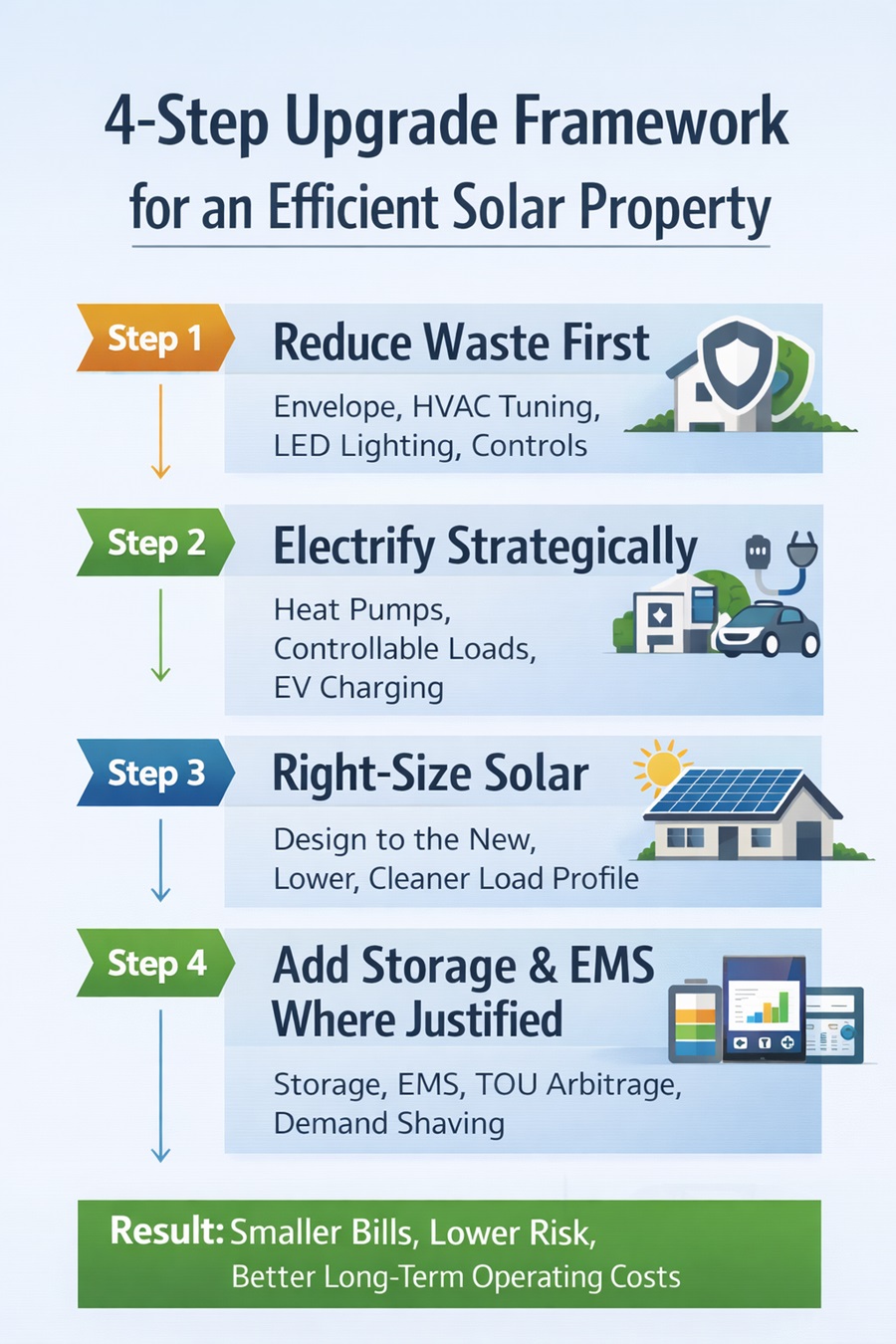
A practical sequence:
- Reduce waste first (envelope, HVAC tuning, lighting).
- Electrify strategically (heat pumps, controllable loads).
- Size solar to the new, lower, cleaner load.
- Add storage and EMS if tariffs/export rates/demand charges justify it.
Financial and policy factors that shape “efficiency” outcomes
The “most efficient” solar design is not purely technical. It’s heavily shaped by tariffs, incentives, and interconnection rules.
Tariffs: net metering, net billing, export rates
Key structures:
- Net metering: exports credited close to retail rates—often makes larger solar arrays attractive.
- Net billing / avoided-cost export: exports credited lower—this increases the value of self-consumption, storage, and careful sizing.
- TOU rates: change when solar and storage provide maximum value.
Two identical buildings in different tariff regions can require very different “optimal” designs.
Incentives (high level)
Depending on location and property type, incentives may include:
- Tax credits (e.g., investment tax credits in some markets)
- Rebates or performance-based incentives
- Accelerated depreciation for commercial properties (in applicable jurisdictions)
- Local grants or utility programs
Incentives change frequently. A good installer or energy consultant should confirm what applies locally and include it transparently in the financial model.
Payback drivers that actually matter
Common drivers of strong outcomes:
- High self-consumption percentage
- High avoided peak rates (TOU)
- Demand charge reductions (commercial/industrial)
- Low O&M surprises (good equipment + monitoring)
- Realistic modeling assumptions
If a proposal only shows “bill offset percentage” but not self-consumption and demand impacts, it’s incomplete for many properties.
Third-party ownership vs ownership (leases/PPAs vs purchasing)
Ownership structure affects optimization incentives:
- Ownership: you capture tax benefits (if eligible) and have strong incentive to invest in long-term performance and monitoring.
- Lease/PPA: can lower upfront cost and shift maintenance responsibility, but contract terms matter (escalators, buyout options, performance guarantees, data access).
Neither is inherently better. The “efficient” choice depends on capital, tax appetite, and risk tolerance.
Utility interconnection limits and approvals
Interconnection rules can cap:
- Maximum system size
- Export capability
- Required inverter functions (grid support, ride-through)
- Upgrade requirements (service panel, transformer)
These constraints often shape the best design more than expected—especially for larger commercial systems.
Installation quality and maintenance: protecting performance over 20–30 years
A modern solar system is only as efficient as its installation and O&M plan.
Installer quality checklist
Look for:
- Relevant certifications and licenses
- Strong workmanship warranty
- Transparent production modeling (not just marketing numbers)
- Clear equipment choices (modules, inverters, racking)
- References for similar property types
- Defined O&M options (especially for commercial sites)
If an installer can’t explain assumptions and tradeoffs clearly, that’s a red flag.
Commissioning basics (what should be verified)
Commissioning should include:
- Verifying string design and polarity
- Confirming inverter settings match interconnection requirements
- Ensuring monitoring is online and reporting correctly
- Testing safety shutoffs and rapid shutdown (where applicable)
- Documenting as-builts and labeling for future service
This is where many long-term efficiency problems are either prevented—or baked in.
Cleaning, O&M, and degradation
Cleaning needs vary:
- In rainy regions, cleaning may be rarely needed.
- In dusty/pollen-heavy or agricultural/industrial regions, soiling can materially reduce yield.
Monitoring-based maintenance is often best: clean or service when performance drops beyond expected variance, not just because a calendar says so.
Over the long term, PV modules generally degrade slowly. Large analyses of crystalline silicon systems often report median degradation rates around 0.4–0.8% per year, with some global surveys reporting roughly 1%/year median across technologies, climate zones, and vintages.
Plan for:
- Panel degradation over time (manufacturer-specific warranties often guarantee 80–90% of initial output at year 25)
- Inverter replacement or major service during system life (often earlier than panel replacement)
- Battery warranty terms (cycle limits, capacity retention, thermal requirements)
Long-term efficiency is a lifecycle plan, not a one-time install.
Cybersecurity and data access (yes, it matters)
Solar monitoring is connected infrastructure. Clarify:
- Who owns the monitoring account and data
- Whether you can export reports (kWh, PR, alerts history)
- How access is handled if you change service providers
- Basic cybersecurity hygiene (strong credentials, role-based access, firmware updates)
Data access is essential for benchmarking and verifying savings.
A practical planning process: choosing the right modern solar solution
Step 1: Gather 12–24 months of utility bills (and interval data if possible)
You’re looking for:
- Monthly kWh usage patterns
- Demand charges (kW) and when peaks occur
- TOU periods and seasonal rate differences
- Any penalties, riders, or special tariffs
If you can get 15-minute interval data, you can optimize solar + storage far more accurately.
Step 2: Define your goals clearly
Common goals:
- Maximum bill reduction
- Peak shaving (demand charge reduction)
- Resilience/backup for critical loads
- Meeting sustainability targets
- Preparing for electrification (heat pumps, EVs)
Your goal determines sizing, inverter choice, and whether storage/EMS is justified.
Step 3: Assess the site (roof, shade, electrical)
Before proposals, confirm:
- Roof condition and available area
- Shading constraints
- Electrical capacity and interconnection feasibility
- Future plans (roof replacement, expansions, EV charging)
Step 4: Decide what “modern” means for your project
For some properties, “modern solar” is simply high-efficiency modules + strong monitoring. For others, it’s a full stack:
- PV + BESS + EMS
- EV charger integration
- Load controls and automation
Step 5: Request proposals with the right details
Ask for proposals that include:
- Key assumptions (irradiance source, PR, soiling, degradation)
- Expected annual production (kWh) and system size (kW DC / kW AC)
- Modeled self-consumption vs export (especially where export rates are low)
- Demand charge impact estimates (for commercial/industrial)
- Financial model with sensitivity (export rate changes, rate escalation, battery cycling assumptions)
- Equipment datasheets and warranties
- Monitoring details and data access terms
If you only get panel count + total cost + “you’ll save X%,” you’re not getting an efficiency-focused design.
Step 6: Validate with simple checks
A few easy sanity checks:
- Compare modeled kWh/kW to local benchmarks.
- Make sure shading assumptions match reality.
- Confirm monitoring granularity (inverter vs string/module-level) and who has access.
- Verify warranties (panels, inverter, racking, workmanship, battery if included).
Step 7: Plan for the future
Even if you don’t add everything now, design for add-ons:
- EV chargers (especially for commercial parking and fleets)
- Heat pumps and electrified water heating
- Load growth (new tenants, equipment)
- Battery-ready architecture and space
- Electrical panel upgrades that avoid future rework
Future-proofing is a real efficiency strategy: it avoids expensive retrofits and keeps the system aligned with evolving loads.
Real-world style examples of efficiency improvements
You can adapt these archetypes to your own case.
Residential example: higher self-consumption with smart scheduling
Scenario:
- A household installs a right-sized PV system.
- They run dishwasher/laundry midday, pre-cool the home late morning/early afternoon, and heat water during solar hours.
- Optional: a small battery covers evening cooking and lighting loads.
What improves:
- Grid imports drop significantly (kWh)
- Self-consumption rate rises
- Bills become more predictable
- With a battery, evening peak imports shrink and short outages become manageable
What they measure:
- Solar production (kWh)
- Self-consumption %
- Monthly grid import reduction vs baseline
- Bill savings vs same month prior year (weather-adjusted)
Commercial example: EMS + storage reduces demand charges
Scenario:
- A small commercial building sees demand charges driven by HVAC and equipment startup spikes.
- Solar reduces daytime kWh.
- A battery discharges during peak windows and smooths short spikes.
- EMS coordinates battery dispatch to avoid discharging too early.
What improves:
- Lower peak kW (demand)
- Lower demand charges (which can be a large fraction of the bill)
- Better alignment with TOU peaks
- More predictable bills
What they measure:
- Peak demand (kW) before/after (monthly max)
- Battery dispatch profile (kW and kWh)
- Demand charge savings line item
- Solar self-consumption vs export
Warehouse example: high roof utilization + monitoring catches issues early
Scenario:
- A warehouse installs a large roof array.
- Monitoring is configured at string or module level.
- After a few months, monitoring flags underperformance on specific strings due to a connector issue.
What improves:
- Minimal lost production because faults are found early
- Higher annual yield and better PR
- Lower “silent” revenue loss over time
What they measure:
- Performance ratio trend
- Energy yield by array section
- Time-to-detection for faults
- O&M response times
Agriculture example: solar-powered irrigation with scheduling
Scenario:
- Irrigation pumps are scheduled to run during strong solar production windows.
- Where needed, storage supports early morning or evening pumping.
- Diesel use drops (if previously generator-powered), or grid imports drop sharply.
What improves:
- Reduced operating cost volatility
- Better alignment between energy availability and irrigation needs
- Potentially lower infrastructure cost for remote areas (case-dependent)
What they measure:
- Pumping kWh and runtime aligned to solar windows
- Solar production used on-site vs exported
- Reduction in diesel consumption or grid energy purchases
- Maintenance and uptime during irrigation season
What to measure after install (non-negotiables)
To verify efficiency outcomes, track:
- Solar production (kWh) monthly and annually
- Self-consumption rate (%) and export (kWh) if applicable
- Peak demand (kW) for commercial accounts
- Bill savings vs baseline (adjusted for occupancy/operations changes)
- System uptime and alerts (inverter faults, communications issues)
If you can’t measure it, you can’t manage it.
Wrap-up: the modern solar stack that maximizes efficiency
Modern solar improves property energy efficiency most when it’s designed as a system, not a standalone product.
The biggest levers are:
- Good design (site assessment, realistic modeling, right sizing)
- The right inverter architecture (and smart settings)
- Monitoring that actually gets used (alerts, PR tracking, faster fixes)
- Storage + controls where justified (self-consumption, TOU arbitrage, peak shaving)
- Load matching (scheduling and EMS-driven coordination)
- Complementary building improvements (reduce waste first, then size solar)
The core idea is simple: solar becomes “efficient” when it matches how the property truly uses energy.
If you want the best outcome, start with a basic audit of your loads and tariffs, clarify whether your priority is bill savings, peak reduction, resilience, or all three, and then request proposals that quantify:
- Expected annual kWh
- Self-consumption vs export
- Peak demand impacts (where relevant)
- Monitoring and O&M plan
Not just panel count. Not just system size.
That’s how modern solar solutions deliver real efficiency gains across homes, multi-family buildings, commercial sites, industrial facilities, and agricultural properties.
FAQs (Frequently Asked Questions)
Why do modern solar solutions matter for energy efficiency beyond just clean energy?
Modern solar solutions are crucial not only for sustainability but also for enhancing energy efficiency by reducing grid electricity consumption, cutting peak demand, and improving load matching. Through on-site generation, smart inverters, monitoring, and EMS, they help property owners save on electricity bills, improve reliability, and lower long-term operating costs.
How does solar photovoltaic (PV) technology improve energy efficiency across a property?
Solar PV converts sunlight to electricity on-site, reducing transmission and distribution losses that can average around 5% in some advanced economies and climb much higher in others.U.S. Energy Information Administration+2iea-etsap.org+2 By maximizing self-consumption and aligning daytime solar production with loads like HVAC and refrigeration, properties can shave peak demand and reduce demand charges while cutting imported kWh.
What are the core technologies behind modern solar solutions that boost energy efficiency?
Key technologies include:
- High-efficiency monocrystalline panels (often using PERC, TOPCon, or HJT cells)
- Bifacial modules that capture reflected light where conditions are right
- Advanced inverters (string, microinverters, optimizers) with robust MPPT and grid support
- Battery energy storage systems (BESS) for load shifting, TOU arbitrage, and peak shaving
- Energy management systems (EMS) to coordinate solar, storage, EV charging, and loads
- Monitoring platforms that track PR, detect faults early, and protect long-term yield
Which property types benefit most from modern solar solutions for improved energy efficiency?
- Residential homes: Offset daytime loads and integrate batteries for evening use and backup.
- Multi-family buildings: Use solar for common loads, virtual net metering, or community solar structures.
- Retail/warehouses: Leverage large roofs, consistent daytime loads, and potential carport solar.
- Industrial sites: Target process loads, demand charges, and power quality with solar + storage.
- Agriculture: Match solar with irrigation pumps, cold storage, and agrivoltaics where land is constrained.
What design choices directly impact the energy efficiency and long-term yield of a solar system?
Critical factors include thorough site assessment, realistic system sizing to avoid low-value overproduction, strategic panel placement to minimize shading, DC/AC ratio design (and acceptable clipping), minimizing wiring and BOS losses, and using credible irradiance and PR assumptions in modeling. Typical well-designed systems often achieve PR in the ~75–80% range.
How does integrating solar with storage and load control multiply energy efficiency gains?
Adding battery storage and EMS allows:
- Capturing midday excess solar for use during expensive evening peaks
- Reducing peak demand and associated charges
- Implementing smart load shifting (pre-cooling, water heating, EV charging)
- Separating backup power design from bill-savings design
Properly sized storage—based on real load profiles and tariffs—maximizes these benefits by increasing self-consumption and reducing reliance on grid electricity during costly periods.