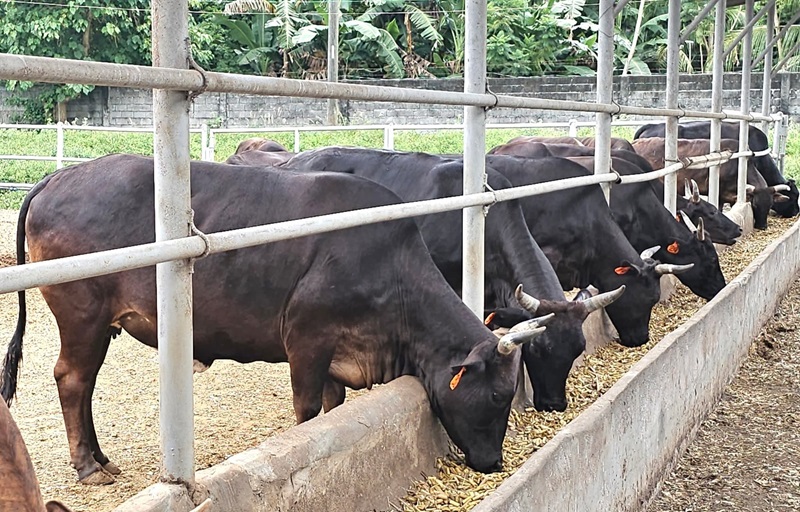

Australia’s rise as a global powerhouse in premium grain-fed beef wasn’t a stroke of luck — it was a deliberate strategy. Behind the nation’s reputation for high-value exports lies a feedlot system engineered to deliver consistency at scale, backed by scientific rigor, disciplined management, advanced nutrition, and a relentless focus on welfare and sustainability.
Today, more than one million cattle stand in accredited feedlots across Australia at any given time. Those cattle generate nearly 40% of the country’s total beef supply and dominate high-margin export channels including Japan, South Korea, the Middle East, and increasingly China.
Australia didn’t just adopt feedlotting — it industrialized excellence.
This article explains how Australia built its strong feedlot system and why it performs better than many other countries. It also shows what this means for beef supply chains over the next ten years.
You will learn how modern feedlots make money, which numbers matter most, and how new sustainability rules are shaping the future of beef.
What Exactly Is a Feedlot?
A feedlot is much more than a high-energy feeding operation. At its best, a feedlot is a controlled finishing environment designed to optimize growth, health, and meat quality — reliably, efficiently, and year-round.
Core attributes of a modern Australian feedlot:
- Controlled high-energy grain diets for rapid and predictable weight gain
- Precision nutrition formulated by professional nutritionists
- Advanced animal health and welfare systems
- Shade, clean water, drainage, and engineered yard design
- Strict welfare and environmental regulations under the National Feedlot Accreditation Scheme (NFAS)
- Data-driven management using RFID, IoT sensors, digital twins, and automated feeding systems
Feedlots exist for one clear reason. Export markets pay more for beef that is consistent, well-marbled, and reliable. Pasture-only systems cannot give the same results all year, especially with Australia’s changing weather.
Why Australia Shifted Toward Feedlots
The move toward feedlots wasn’t ideological — it was economic.
Three forces reshaped Australian beef:
- Climate volatility
Drought cycles, rainfall variability, and heat events made pasture finishing unreliable and inconsistent. - Export market demands
Japan and Korea — two of Australia’s highest-paying partners — require:- predictable carcass weights
- consistent marbling
- uniform ribeye size
- tight fat specifications
Pasture systems couldn’t deliver these metrics at scale.
Accreditation and industry discipline
The introduction of NFAS created a framework that guaranteed welfare, traceability, environmental stewardship, and measurable performance — a global benchmark unmatched by most competitors.
The result: feedlots became the backbone of Australia’s premium beef economy.
Feedlot vs Pasture Finishing
Below is a clean, business-focused comparison table.
Feedlot vs Pasture Finishing
| Category | Feedlot Finishing | Pasture Finishing |
| Daily Weight Gain (ADG) | 1.6–2.3 kg/day | 0.6–1.0 kg/day (seasonal) |
| Carcass Consistency | High, predictable | Variable; climate-dependent |
| Marbling | Strong; grain-fed advantage | Moderate; breed-dependent |
| Supply Reliability | Year-round | Seasonal |
| Market Access | High-value export grids | Grass-fed + niche markets |
| Production Time | Shorter (intensive finishing) | Longer (extensive finishing) |
| Risk Exposure | Controlled | Weather-driven |
| Profitability | Higher in export programs | Moderate; niche premiums possible |
Pasture beef has a valuable identity — but for scale, consistency, and export premiums, feedlots deliver the superior business case.
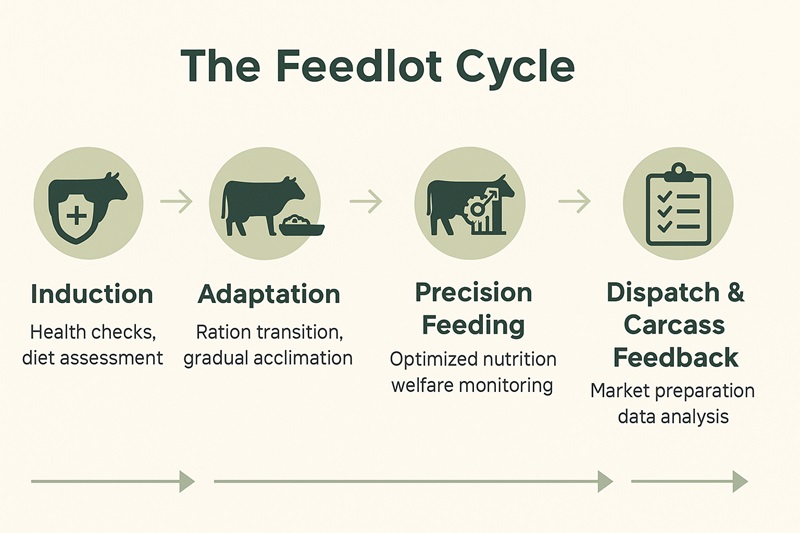
Inside the Feedlot Machine
A Step-By-Step Walkthrough of the Modern Australian Feedlot Cycle
Most people imagine “feeding cattle grain” — but the real feedlot cycle is a tightly choreographed system involving data, welfare, technology, and logistics.
Below is the complete feedlot cycle, from induction to dispatch.
-
Setting Up Animals for Success
Upon arrival, cattle undergo:
- Individual ID tagging (RFID)
- Weight recording
- Health assessment
- Vaccinations
- Parasite control
- Drafting into pens based on weight, sex, and breed
- Introduction to feed bunks and water systems
Induction is engineered to reduce stress and prepare cattle for high-performance growth.
-
Adaptation Period (Day 1–21): Rumen Training
Cattle are gradually transitioned from forage to grain-based rations via three stages:
- Starter ration (high roughage, low starch)
- Grower ration (medium starch)
- Finisher ration (high starch, low roughage)
This protects the rumen, prevents acidosis, and stabilizes intake.
-
Precision Feeding & Growth Phase
This is where Australia leads the world.
Key innovations include:
- Automated feed trucks with near-exact ration accuracy
- Steam-flaked barley, wheat, or sorghum to increase starch availability
- AI-driven bunk readers
- Probiotics, buffers, and mineral balancing
- Weather-adjusted ration formulations
- Walk-over-weigh systems to track live performance
Growth rates reach 1.6–2.3 kg/day, depending on program (short-fed, mid-fed, long-fed, Wagyu).
-
Health Monitoring & Welfare
The modern feedlot is a welfare-first environment:
- Shade structures reducing heat load
- Fresh, cool water with rapid replenishment
- Pen design encouraging natural movement
- Low-stress handling systems
- Thermal imaging for early disease detection
- Preventative respiratory management
Welfare is not an add-on — it is a performance driver.
-
Dispatch and Carcass Data Feedback
Once cattle reach target specifications, feedlots coordinate with processors and export markets.
Processors send back detailed carcass data:
- Marbling score
- Ribeye area
- Fat depth
- MSA compliance
- Color and pH metrics
This data flows back to:
- breeders (genetic refinement)
- feedlot managers (nutrition adjustments)
- nutritionists (ration optimization)
This feedback loop is one of Australia’s most valuable competitive advantages.
Genetics: The Unsung Engine of Feedlot Performance
Australia’s feedlot success begins long before cattle enter the yard — it begins in the paddock and the breeding shed.
Key genetic advantages:
- Black Angus for marbling and tenderness
- Wagyu for long-fed luxury programs
- Bos indicus composites (Droughtmaster, Santa Gertrudis) in hotter regions
- EBVs (Estimated Breeding Values) for:
- feed efficiency
- marbling
- growth
- fertility
Australia’s world-class carcass data feedback means each generation becomes more aligned with export-driven specifications.
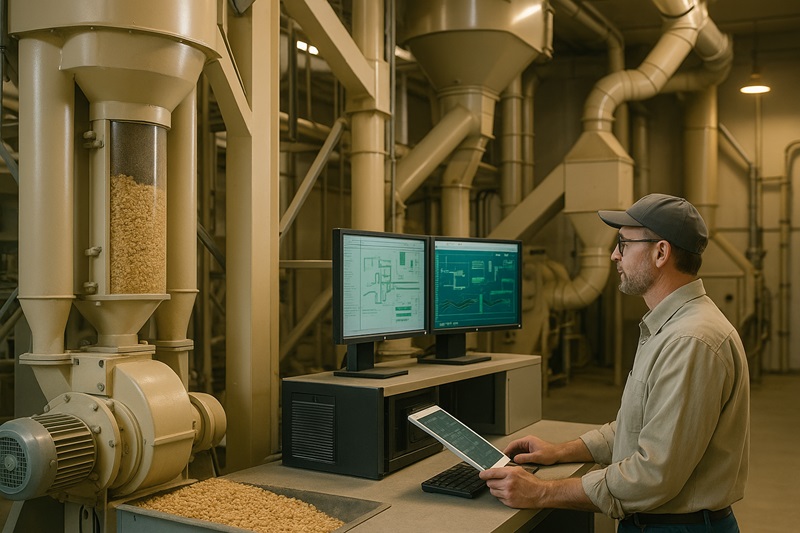
Precision Nutrition:
Nutrition is not guesswork.
Australia built a scientific ecosystem involving:
- feed chemists
- animal nutritionists
- feed-mill engineers
- AI monitoring
- ration modeling systems
Core components:
- Steam-flaked grain (barley, wheat, sorghum)
- Optimized starch availability
- Buffers for rumen stability
- Premium protein meals (cottonseed, canola)
- Trace minerals, vitamins, probiotics
The result:
Feed conversion ratios (FCR) among the best in the world.
KPI Dashboard:
The Metrics That Matter in Feedlot Profitability**
Key Feedlot Performance Indicators
| KPI | Industry Benchmark | Australia’s Performance |
| ADG (Average Daily Gain) | 1.2–1.8 kg/day | 1.6–2.3 kg/day |
| FCR (Feed Conversion Ratio) | 7:1 | 5.5–6.5:1 |
| Mortality Rate | 1.0–1.5% | 0.5–1.0% |
| Carcass Compliance | 85–90% | 92–96% |
| Marbling (Angus) | Moderate | High & consistent |
| Shade-Adjusted Intake Gains | N/A | +5–8% ADG improvement |
Australia consistently beats global benchmarks because the entire system is engineered for performance.
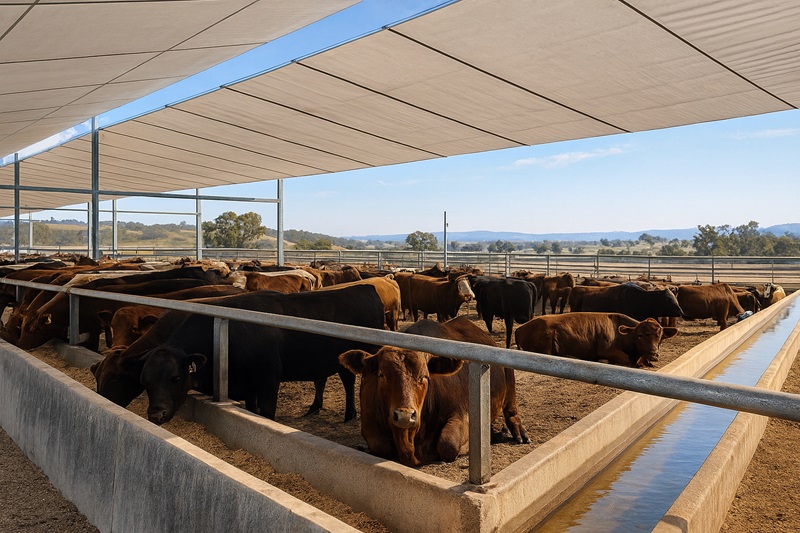
Feedlot Design Essentials:
Australian feedlots are engineered like industrial facilities.
Design fundamentals:
- Pens sloped at 2–4% for drainage
- Geofabric systems to maintain pen integrity
- Shade structures reducing heat load
- Water trough design preventing crowding
- Airflow-optimized layouts
- Handling facilities modeled on low-stress principles
- Roadways engineered for efficient feed delivery
Design is not cosmetic — it is a yield multiplier.
Waste Management as a Strategic Advantage
Australia’s environmental standards are among the strictest globally.
Sustainability Metrics (Australian Feedlot Benchmarks)
| Metric | Australia | US | Brazil |
| Manure Capture & Reuse | 95–100% | 70–80% | 50–60% |
| Effluent Reuse | High (irrigation, dust control) | Moderate | Low |
| Biogas Adoption | Emerging | Moderate | Minimal |
| Asparagopsis Methane Reduction Trials | Advanced | Early-stage | Limited |
| NFAS Environmental Compliance | Mandatory | Optional | Variable |
Manure becomes a high-value soil amendment. Effluent becomes irrigation water. Some feedlots now explore biogas and seaweed-based methane reduction.
Technology:
The Silent Revolution Behind Feedlot Efficiency**
Digital transformation is accelerating:
Systems in use:
- RFID animal tracking
- IoT water monitoring
- AI-driven bunk scoring
- Thermal imaging for health checks
- Drones for pen scanning
- Digital twins
- Machine-learning intake prediction
- Automated feeding systems
Australia treats feedlots as data enterprises, not just farms.
Global Comparison:
How Australia Stacks Up Against Major Beef Competitors**
Australia vs US vs Brazil Feedlot Comparison
| Category | Australia | United States | Brazil |
| Regulatory Rigour (Welfare) | Very High (NFAS) | High | Moderate |
| Climate Risk | High volatility | Moderate | High rainfall variability |
| Marbling Programs | Advanced (Wagyu, Angus) | Strong | Limited |
| Data Integration | Industry-leading | Strong | Developing |
| Sustainability Standards | High | Moderate | Variable |
| Export Orientation | Extremely High | Moderate | High |
| Carcass Consistency | Excellent | Excellent | Variable |
Australia’s differentiator lies in strict accreditation + export alignment + integrated data systems.
The Economics of Feedlots:
Understanding CapEx, OpEx and Profit Margins**
Capital Costs (Per Head Capacity)
- Basic systems: AUD $1,500–$3,000/head
- Advanced, AI-integrated systems: AUD $3,000–$5,000+/head
- Large commercial facilities: Several million dollars
Operating Costs
- Feed: 60–70% of total cost
- Labour
- Health treatments
- Feed additives
- Maintenance
- Utilities
Profit Margins
- Commodity market: AUD $80–$150/head
- Premium Angus: $150–$300
- Wagyu long-fed: $350–$600+
- Elite Wagyu: sometimes higher
Feedlotting offers:
- Faster turnover
- Higher carcass values
- Lower production volatility
- Strong export match
Case Study:
5:30 AM — Feed-mill starts; grain is steam-flaked.
6:30 AM — Automated trucks deliver rations.
7:30 AM — Pen riders and AI systems monitor cattle behavior.
9:00 AM — Digital twin updates intake predictions.
11:00 AM — Shade temperature differential measured.
2:00 PM — Walk-over-weigh updates growth curves.
4:00 PM — Pen checks; welfare assessments logged.
6:00 PM — Processor data imported; next-day ration adjusted.
It resembles a cross between a factory, a lab, and a logistics center—not an old-style feeding operation.
Challenges Ahead: What Could Shape Tomorrow’s Feedlots
Australia’s feedlots work well today, but they still face real pressure. Grain prices jump around, weather is getting harsher, and finding skilled workers is harder. New methane rules, demand for low-carbon beef, and competition for land also add stress. These forces make the future more complex.
But Australia is not standing still. Many feedlots already use feed additives that cut methane. Some sites run on solar power. Others turn waste into clean biogas energy. Carbon tracking is now normal, and new breeding programs help cattle grow on less feed. Australia is not waiting for change — it is preparing to stay ahead of it.
Secret Behind Australia’s Feedlot Success
Leaders in the industry say success does not come from one idea. It comes from many parts working together. Strong genetics, smart feeding plans, good animal care, and well-built yards set a solid base. Digital tools track feed, health, and daily growth.
On top of this, feedlots follow strict environmental rules. Staff are trained well. Export needs are clear. And the industry improves year after year. Australia does not rely on one edge — it builds many. This is why its feedlots are seen as some of the most efficient and consistent in the world.
Conclusion: A Simple Model for the Future of Global Protein
The world is dealing with supply problems, climate stress, and rising demand for safe protein. Australia shows how a strong system can meet these needs. Its feedlots provide steady supply, high quality, clear data, and better care for the environment.
This success comes from teamwork between science, engineering, good management, and smart market planning. This mix is what global food systems will need in the years ahead.
Australia’s feedlot sector is not just important at home. It offers a preview of how the best food systems of the future may work.